Skip to Content Facebook Feature Image

Trump accuses foreign-owned meat packers of inflating US beef prices and calls for investigation

News

Trump accuses foreign-owned meat packers of inflating US beef prices and calls for investigation
News

News

Trump accuses foreign-owned meat packers of inflating US beef prices and calls for investigation

2025-11-08 08:33 Last Updated At:08:40

WASHINGTON (AP) — President Donald Trump on Friday accused foreign-owned meat packers of driving up the price of beef in the U.S. and asked the Department of Justice to open an investigation.

The Republican president announced the move on social media days after his party suffered losses in key elections in which the winning Democratic candidates focused relentlessly on the public’s concerns about the cost of living. But experts said it's unlikely that an investigation would result in lower prices at grocery stores, and a trade group representing meat packers said they're not to blame.

Trump did not present evidence for his claims, writing on social media that “I have asked the DOJ to immediately begin an investigation into the Meat Packing Companies who are driving up the price of Beef through Illicit Collusion, Price Fixing, and Price Manipulation.”

He said he was taking the action to help ranchers, who were recently angered by his suggestion that the U.S. would buy Argentine beef to bring down stubbornly high prices for American consumers.

“We will always protect our American Ranchers, and they are being blamed for what is being done by Majority Foreign Owned Meat Packers, who artificially inflate prices, and jeopardize the security of our Nation’s food supply,” Trump said.

Beef prices have soared to record levels in part after drought and years of low prices led to the smallest U.S. herd size in decades. Trump’s tariffs on Brazil, a major beef exporter, have also curbed imports.

Meanwhile, demand for beef remains strong. Prices are high because consumers want to eat it, and they’re willing and able to pay for it, said Glynn Tonsor, who leads the Meat Demand Monitor at Kansas State University.

Tonsor said the ownership mix in the meat packing industry has not changed significantly in the past four years.

Concentration in the meat packing business has been a longtime concern for farmers and politicians on both sides of the aisle. Four major meatpacking companies dominate the beef market in the United States.

There’s no evidence to back up claims that the big packers have undue market power and use it to drive up beef prices, said Derrell Peel, an agricultural economist at Oklahoma State University.

“The packing industry in this country has been investigated and researched for 50 years, and it’s been an issue for over a hundred years, at least, for some producers,” Peel said, expressing skepticism that consumers or producers will benefit from the investigation Trump announced.

“If the outcome is to break up the big packers, the outcome will be higher beef prices for consumers, and lower cattle prices for producers,” Peel said.

Oklahoma Sen. Markwayne Mullin said Friday that he and fellow Republican senators Cindy-Hyde-Smith of Mississippi and Tim Sheehy of Montana visited the White House earlier in the day to speak with Trump about recent volatility in the beef market. Mullin said Trump agreed to have the Justice Department look at the issue.

Mullin blamed meat processors, saying that “we’re seeing the same exact game play again out” as a 2019 lawsuit against large meatpackers for violating antitrust laws.

JBS, which is based in Brazil, is the largest U.S. beef producer and its second-largest producer of poultry and pork. Half of its annual revenue comes from the U.S., where it has more than 72,000 employees.

The company has faced price-fixing charges before. In 2022, JBS agreed to a $52.5 million settlement with grocery stores and wholesalers who accused JBS, Arkansas-based Tyson Foods and other companies of working together to suppress the number of cattle being slaughtered in order to drive up beef prices.

JBS did not admit wrongdoing as part of that settlement. Messages seeking comment were left Friday with JBS USA.

Sen. Kevin Cramer, R-N.D., last week called on the administration to renew an investigation into meat packers that was opened in Trump's first term. Cramer's office said he has pushed for such a probe since March 2020.

The Meat Institute, a trade group that represents JBS and other meat producers, said its industry is being pinched by the price of cattle, despite record prices for U.S. beef.

“For more than a year, beef packers have been operating at a loss due to a tight cattle supply and strong demand,” Meat Institute President and CEO Julie Anna Potts said in a statement. “The beef industry is heavily regulated, and market transactions are transparent. The government’s own data from USDA confirms that the beef packing sector is experiencing catastrophic losses and experts predict this will continue into 2026.”

Trump’s accusations have renewed a bipartisan presidential fight against rising food prices.

Then-President Joe Biden talked with independent farmers and ranchers about initiatives to reduce food prices by increasing competition within the meat industry. And then-Vice President Kamala Harris, who Trump defeated in winning reelection last year, used her campaign to vow to crack down on food producers and major supermarkets’ “ price gouging.”

Karnowski reported from Minneapolis. Associated Press writers Dee-Ann Durbin in Detroit, Josh Funk in Omaha, Nebraska, and Stephen Groves in Washington contributed to this report.
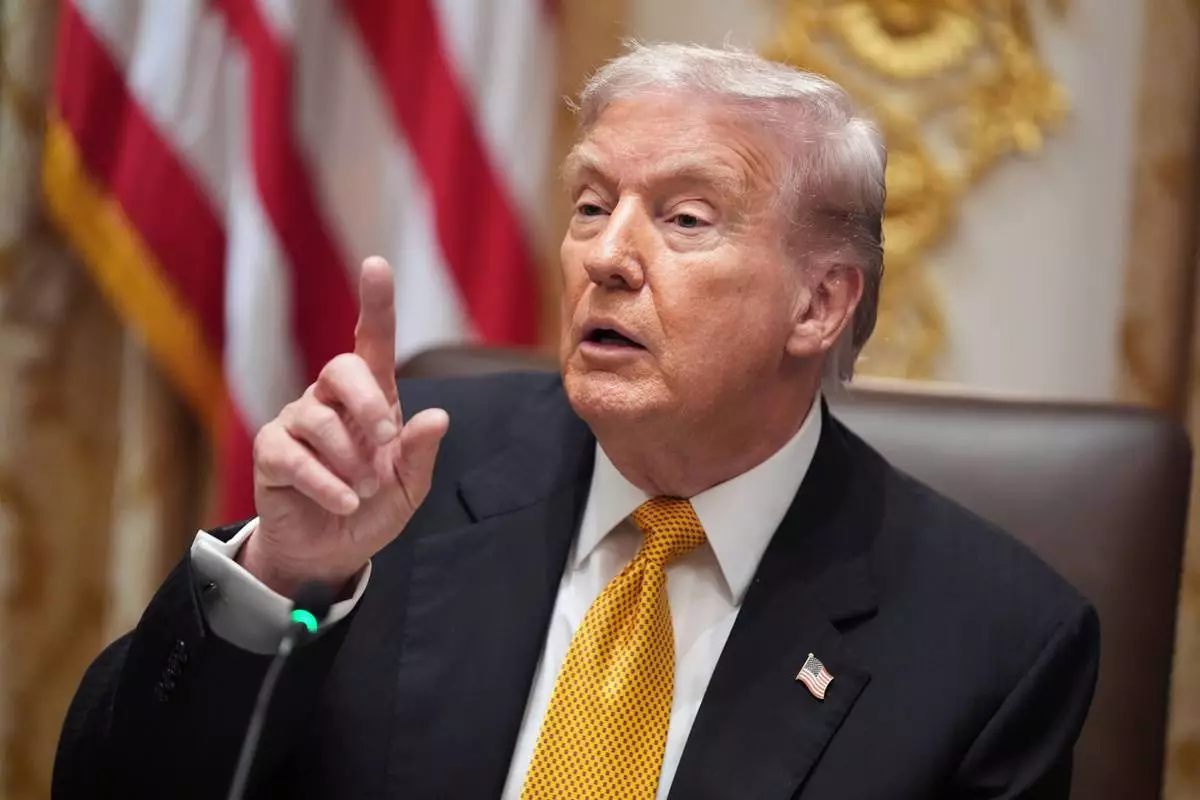
President Donald Trump speaks with reporters during a meeting with Hungary's Prime Minister Viktor Orban in the Cabinet Room of the White House, Friday, Nov. 7, 2025, in Washington. (AP Photo/Evan Vucci)
President Donald Trump speaks with reporters during a meeting with Hungary's Prime Minister Viktor Orban in the Cabinet Room of the White House, Friday, Nov. 7, 2025, in Washington. (AP Photo/Evan Vucci)
CHARLOTTE, N.C. (AP) — An economist testified in Michael Jordan's federal federal antitrust trial against NASCAR that the racing series owes a combined $364.7 million in damages to the two teams suing it over a revenue-sharing dispute.

Edward Snyder, a professor of economics who worked in the antitrust division of the Department of Justice and has testified in more than 30 cases, including “Deflategate” involving the NFL's New England Patriots, testified on Monday. He gave three specific reasons NASCAR is a monopoly participating in anticompetitive business practices.

Using a complex formula applied to profits, a reduction in market revenue, and lost revenue to 23XI Racing and Front Row Motorsports from 2021-24, Snyder came up with his amount of damages owed. Snyder applied a 45% of revenue sharing he alleged Formula 1 gives to its teams in his calculations; Snyder found that NASCAR's revenue-sharing model when its charter system began in 2016 gave only 25% to the teams.

The suit is about the 2025 charter agreement, which was presented to teams on a Friday in September 2024 with a same-day deadline to sign the 112-page document. The charter offer came after more than two years of bitter negotiations between NASCAR and its teams, who have called the agreement “a take-it-or-leave-it” ultimatum that they signed with “a gun to their head.”

A charter is similar to the franchise model in other sports, but in NASCAR it guarantees 36 teams spots in the 40-car field, as well as specific revenue.

Jordan and three-time Daytona 500 winner Denny Hamlin for 23XI, along with Front Row Motorsports and owner Bob Jenkins, were the only two teams out of 15 to refuse the new charter agreements.

Snyder's evaluations found NASCAR was in fact violating antitrust laws because the privately owned racing series controls all bargaining because “teams don't have anywhere else to sell their services." Snyder said NASCAR controls “the tracks, the teams and the cars.”

Snyder repeatedly cited exclusivity agreements NASCAR entered into with racetracks after the charter system began. The agreements prevent tracks that host NASCAR from holding events with rival racing series. Prior to the long-term agreements, NASCAR operated on one-year contracts with its host racetracks.

The Florida-based France family founded NASCAR in 1948 and, along with Speedway Motorsports, owns almost all the tracks on the top Cup Series schedule. Snyder's belief is that NASCAR entered into exclusivity agreements with tracks to stave off any threats of a breakaway startup series. In doing so, it eliminated teams' ability to race stock cars anywhere else, forced them to accept revenue-sharing agreements that are below market value, and damaged their overall evaluations.

Snyder did his calculations for both teams based on each having two charters — each purchased a third charter in late 2024 — and found 23XI is owed $215.8 million while Front Row is owed $148.9 million. Based on his calculations, Snyder determined NASCAR shorted 36 chartered teams $1.06 billion from 2021-24.

Snyder noted NASCAR had $2.2 billion in assets, an equity value of $5 billion and an investment-grade credit rating — which Snyder believed positions the France family to be able to pivot and adjust to any threats of a rival series the way the PGA did in response to the LIV Golf league. The PGA, Snyder testified, “got creative” in bringing in new revenue to pay to its golfers to prevent their defections.

Snyder also testified NASCAR had $250 million in annual earnings from 2021-24 and the France family took $400 million in distributions during that period.

NASCAR contends Snyder's estimations are wrong, that the 45% F1 model he used is not correct, and its own two experts “take serious issue” with Snyder's findings. Defense attorney Lawrence Buterman asked Snyder his opinion on NASCAR's upcoming expert witnesses and Snyder said they were two of the best economists in the world.

Snyder testified for almost the entirety of Monday's session — the sixth day of the trial — and will continue on Tuesday. The snail's pace of the trial has agitated U.S. District Judge Kenneth Bell, who heard arguments 30 minutes early Monday morning because he was annoyed that objections had been submitted at 2:55 a.m. and then 6:50 a.m.

He needed an hour to get through the rulings, and testimony resumed 30 minutes behind schedule. When the day concluded, he asked the nine-person jury if they were willing to serve an hour longer each day the rest of the week in an effort to avoid a third full week of trial.

Bell wants plaintiff attorney Jeffrey Kessler to conclude his case by the end of Tuesday, but Kessler told him he still plans to call NASCAR chairman Jim France, NASCAR commissioner Steve Phelps and Hall of Fame team owner Richard Childress, who was the subject of derogatory text messages amongst NASCAR leadership and has said he's considering legal action.

NASCAR has a list of 16 potential witnesses and Bell said he wanted the first one on the stand before Tuesday's session concludes.

AP auto racing: https://apnews.com/hub/auto-racing

FILE - Front Row Motorsports owner Bob Jenkins, left, and 23XI co-owner Denny Hamlin arrive in the Western District of North Carolina on Monday Dec 1, 2025 in Charlotte, N.C. (AP Photo/Jenna Fryer, File)

FILE - Front Row Motorsports owner Bob Jenkins, left, and 23XI co-owner Denny Hamlin arrive in the Western District of North Carolina on Monday Dec 1, 2025 in Charlotte, N.C. (AP Photo/Jenna Fryer, File)

NASCAR vice chair Lesa France Kennedy enters federal court in Charlotte, N.C., on Wednesday Dec 3, 2025. (AP Photo/Jenna Fryer)

NASCAR vice chair Lesa France Kennedy enters federal court in Charlotte, N.C., on Wednesday Dec 3, 2025. (AP Photo/Jenna Fryer)

NASCAR chairman Jim France enters federal court in Charlotte, N.C., on Wednesday Dec 3, 2025. (AP Photo/Jenna Fryer)

NASCAR chairman Jim France enters federal court in Charlotte, N.C., on Wednesday Dec 3, 2025. (AP Photo/Jenna Fryer)

Michael Jordan arrives in the Western District of North Carolina on Monday Dec 1, 2025 for the start of the antitrust trial between 23XI Racing and Front Row Motorsports against NASCAR, in Charlotte, N.C. (AP Photo/Jenna Fryer)

Michael Jordan arrives in the Western District of North Carolina on Monday Dec 1, 2025 for the start of the antitrust trial between 23XI Racing and Front Row Motorsports against NASCAR, in Charlotte, N.C. (AP Photo/Jenna Fryer)

Recommended Articles