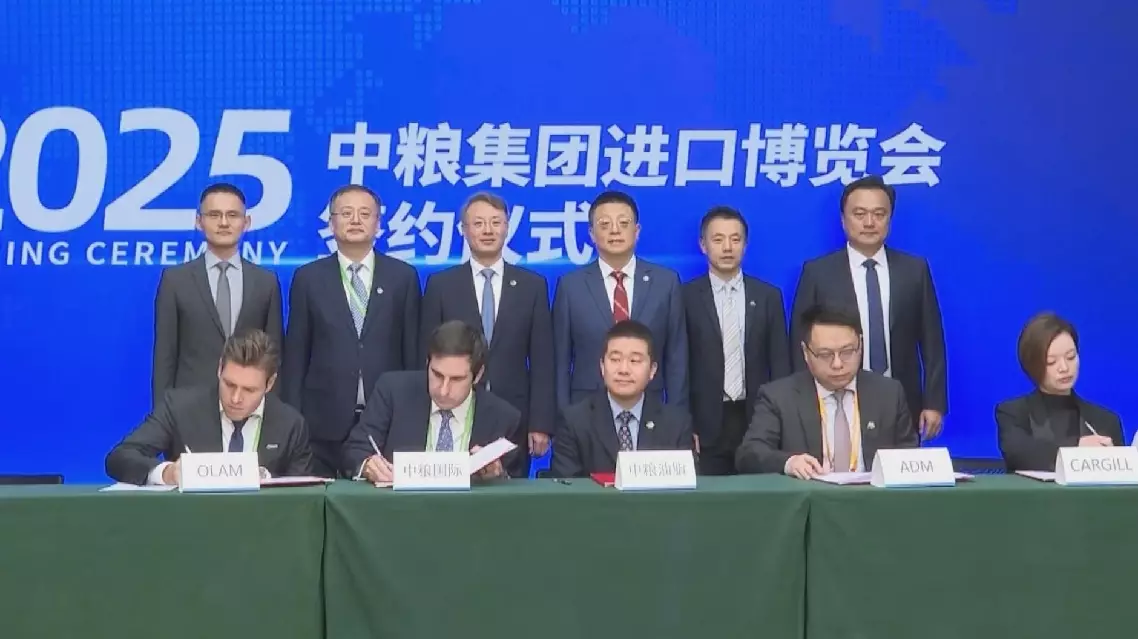
The 8th China International Import Expo (CIIE) entered its fourth day on Saturday, with momentum building in the signing hall as global exhibitors sealed a cascade of large purchase agreements from Chinese buyers, underscoring China's growing appeal as a powerhouse of consumption and innovation.
At the technology and equipment exhibition area, Danish pump giant Grundfos announced a major expansion of its China footprint.
"We will have 13 signings with different Chinese partners, including China State Construction [Engineering Corporation]. Most recently, we've invested 100 million U.S. dollars in a green factory in Jiangsu Province," said Astrid Norgaard Friis, vice president of Grundfos.
Across the exhibition floor, buyers and exhibitors signed the deals at a rapid pace. Within just one hour, their cumulative intended transaction value surpassed 10 billion yuan (about 1.4 billion U.S. dollars).
High-quality consumer goods drew particular attention, with major agreements announced for Thailand's Innococo coconut water, New Zealand's cheddar cheese, and premium wines, reflecting the rising appetite among Chinese consumers for authentic, premium international products.
"My product, Innococo coconut water, being from Thailand, to sell mainly in China. COFCO (China National Cereals, Oils and Foodstuffs Corporation) is one of the largest state-owned distributors. [It] imported very, very nice products globally. So I think working with them will help us to cooperate with more than 1 million [sales points across China]," said Pongsakorn Pongsak, CEO of IFBH Limited, a beverage and food company.
Regional trade delegations are also driving the momentum. Enterprises from east China's Zhejiang Province on Saturday signed 24 agreements with suppliers from the U.S., Brazil, Switzerland, and beyond, totaling 14.5 billion yuan (about 2 billion U.S. dollars). Purchases spanned advanced machinery, energy resources, and agricultural products.
"A total of 24 deals have been signed, with a combined value of 14.5 billion yuan, covering goods from soybeans to beef, machinery, and other equipment. Moreover, a forthcoming signing event for international medical supplies will involve over 40 companies. Many of them are Fortune 500 enterprises, with projected deal values reaching 9 billion yuan (about 1.26 billion U.S. dollars)," said Chen Zhicheng, deputy director of the commerce department of Zhejiang Provincial Government.
State-owned enterprises from Shanghai have already secured 113 purchase agreements worth 2.78 billion U.S. dollars at the expo, continuing its year-on-year growth trend.
Themed "New Era, Shared Future", this year's CIIE runs from Nov. 5 to 10. It features the largest exhibition area in its history and a record 4,108 overseas exhibitors from 155 countries, regions, and international organizations.
Global exhibitors seal cascade of large purchase deals at 8th CIIE