China's Miao ethnic group has begun celebrating their most important festival of the year -- the Miao New Year -- in Leishan County, Guizhou Province in the southwest.
The annual event, recognized as a national intangible cultural heritage, marks the end of the harvest season and falls in the tenth and eleventh month of the lunar calendar.
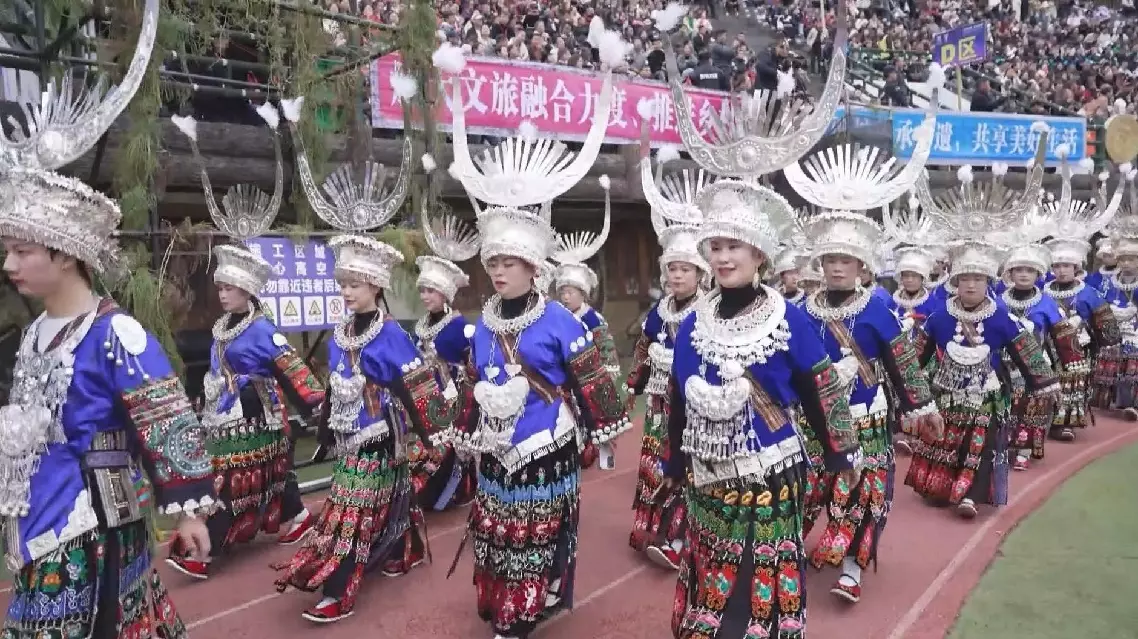
On Wednesday, Leishan celebrated the Miao New Year with a grand parade featuring intangible cultural heritage, drawing crowds of tourists with its vibrant performances and traditional attire.
"Their costumes are absolutely gorgeous. I'm simply overwhelmed," said Xu Lili, a tourist from Hebei Province in north China.
The grand parade involved 56 performing groups and more than 5,200 participants. Apart from local residents, teams from Hunan and Zhejiang provinces in central and east China, and neighboring counties including Congjiang, Rongjiang and Liping also took part in the festivities.
"I've come to the Miao New Year in Leishan for several years, and this year it's grander than ever. The intangible heritage section is especially richer," said Zheng Yade, an actor of the Lusheng (a reed-pipe wind instrument) team from Rongshui County, Guangxi Zhuang Autonomous Region in south China.
"Life is better now, and the festival gets ever livelier. Our hometown is more and more beautiful, and we welcome visitors from across the country to Guizhou, celebrate the Miao New Year, and experience our happy life and vibrant folk culture," said Li Lanhua, a villager performer from Leishan County.
This year, Leishan's Miao New Year celebrations will continue through mid-December. Leishan has introduced 11 themed travel routes linking local villages based on their cultural features and geographic locations, inviting visitors to explore the region and immerse themselves in the joyous atmosphere of Miao life.
Miao New Year celebrated in Guizhou
The restricted navigation through the Strait of Hormuz has triggered significant disruptions across the international shipping sector, driving up shipping costs and legal pressures related to shipping.
Iran has restricted navigation through the Strait of Hormuz, a vital strategic waterway linking the Persian Gulf to the Indian Ocean, as part of its response to U.S. and Israeli military attacks that started on Feb 28.
The partial blockade of this vital global energy route has not only impacted global energy supplies but also caused a ripple effect on energy trading, shipping operations, and the insurance market.
Wai Yue Loh, partner of DAC Beachcroft, and a specialist in shipping, trade, commodities and insurance law said he has been dealing with questions from shipping clients after the conflict in Iran broke out.
He said the commodities traders bear the brunt of Strait of Hormuz crisis and explained the interconnected vulnerabilities across the three industries most affected.
"It's easy to forget that the first industry directly affected would be the commodities traders who are buying and reselling crude oil coming out from the Middle East. Crude oil cargoes from this region account for about 25 percent or more of the world's crude oil supplies. The second industry affected would be the shipowners or the ship operators whose ships are chartered by these commodities traders, in simple terms hired by these commodity traders, to carry these cargoes from the Persian Gulf to refineries around the world for refining. These refined products are then on-sold to other buyers worldwide. The third would be the insurance industry that provides, amongst other things, war risk cover for ships that are trading globally," he said.
With the rising risks of war, shipping companies face not only security challenges but also complex legal issues such as rising insurance costs, increased uncertainty in contract performance, and the apportionment of liability, he added.

Hormuz Strait crisis delivers severe blow to global shipping industry