Chinese President Xi Jinping's visit to a pomelo growing base in Meizhou City of south China's Guangdong Province on Friday has encouraged local people to develop the industry as a model of rural revitalization.
During his visit, Xi, also general secretary of the Communist Party of China (CPC) Central Committee and chairman of the Central Military Commission, inspected the base in a local village of Meizhou's Meixian District and learned about local efforts to advance rural revitalization.
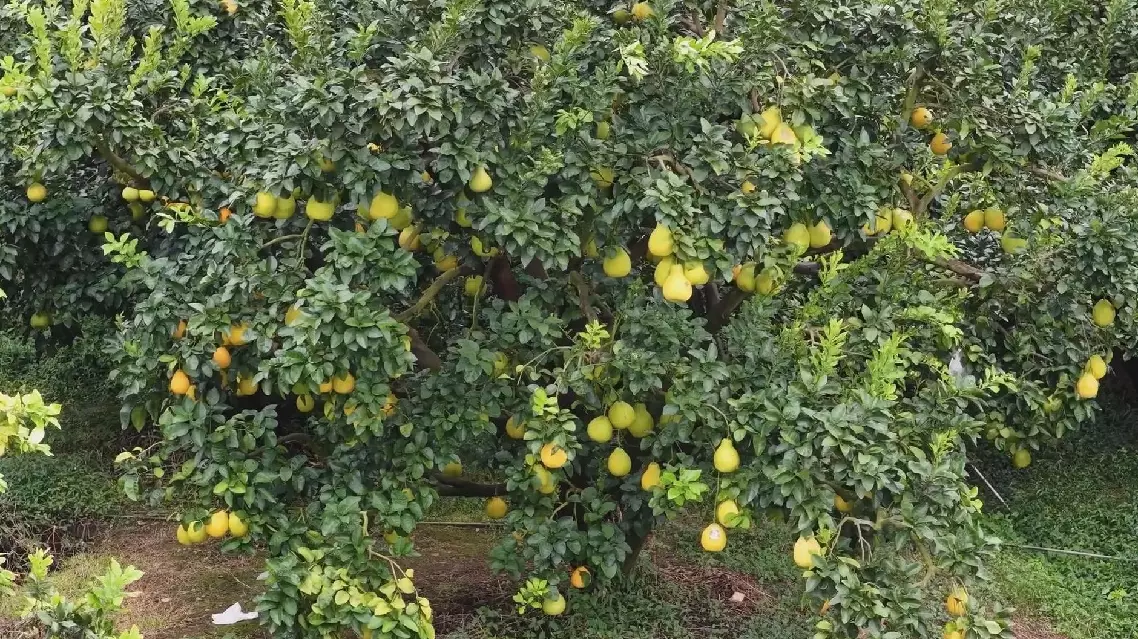
That day happened to be "Lidong" or Beginning of Winter, the 19th of the 24 solar terms on the Chinese lunar calendar, which means the winter is coming. "It's the Lidong term today, which is the harvest season for pomelos. We were very excited when the general secretary arrived. Seeing our fruit farmers' smiling faces and the hills covered with gold-like pomelos, he and we were all very happy," said Zhong Yonghui, an agricultural technician with the agro-science research institute in Meixian District.
"The general secretary visited our exhibition stand and observed the different varieties of pomelos grown in Meizhou. He also asked about the planting of pomelos, including harvesting. And he was particularly concerned about the price of the pomelos," said Ling Yun, secretary of the CPC Meixian District Committee, and member of the CPC Meizhou Standing Committee.
That concern was felt directly by the farmers.
"We happened to be here harvesting pomelos, when the general secretary came over. Seeing the fruit-filled trees, he asked us about the purchase price this year. And it's over 6 yuan per kilo. As one pomelo weighs 1 to 1.5 kilograms, it could sell for nearly 10 yuan," said Chen Zengli, a fruit farmer.
"The general secretary was very amiable and kind when he chatted with us. He encouraged us to grow pomelos well and live a better life," said Huang Hong, another fruit farmer.
The success of growing pomelos in Meixian is underpinned by technology and robust support. Farmers credited technical guidance for their improvements. "Now, it's all mechanized. In the past we had no technical guidance and we had to grope our way slowly. Then there came agricultural technicians to our orchard and gave us on-site guidance, and our skills improved," said Huang Yuliang, a fruit farmer.
"Aside from scientific measurement, monitoring, and mechanized transportation, we also have agricultural technicians in our district to go down into the fields to serve the farmers at critical moments, like periods of pollination, fruit thinning, and pruning," said Ling.
"Last year, my family produced more than 200,000 kilograms. And this year, it could be up to more than 300,000 kilograms. That's an increase of approximately 50 percent," said Huang Hong, the farmer.
At the base's smart technology showroom, pomelo-derived products from skincare and beverages to cultural and creative items have shown the local efforts to standardize cultivation, integrate the industrial chain and diversify sales to lift quality and build stronger brands.
"Meizhou's pomelo planting has a history of more than 100 years. We use not only the pulp, but also the pomelo flower, the young fruit, the peel, the pith, and the seeds to develop new products," said Ling.
"The general secretary has encouraged our industry. We agricultural technicians now feel even more confident in doing a good job in our service in the future," said Xie Qingfeng, a senior agronomist at the Party service center in Meixian's Yanyang Town.
Known for its century-long pomelo growing history, Meixian is home to China's largest pomelo commercial base, which also acts as an agricultural demonstration zone integrating production and eco-tourism.
The base enables pomelo growers to directly connect with merchants, helping to facilitate sales and improve efficiency. A smart digital platform allows the farmers to conduct real-time monitoring through a mobile application to analyze the changing soil and climatic conditions that may affect the growth of their pomelo trees.
Last year, pomelo plantations at the base exceeded 330 hectares, with the output totaling around 12.5 million kilos and the output value reaching 57.5 million yuan (over 8 million U.S. dollars).
Xi's Meizhou visit encourages locals to develop pomelo industry