China's Fujian aircraft carrier has a larger flight deck and simultaneous launch-recovery system, and advanced aircraft, enabling it strong combat capabilities, according to Wei Dongxu, a military commentator.
The aircraft carrier, China's first indigenously designed and built aircraft carrier equipped with electromagnetic catapults, entered into service on Wednesday, marking a new chapter in the development of the Chinese People's Liberation Army Navy.
It has a relatively smaller island structure, providing more space on the flight deck for efficient aircraft deployment, according to Wei.
"The island structure on the Fujian has been designed to be compact and integrated with stealth features. Reducing its size while preserving full functionality maximizes the operational space on the flight deck, allowing more room for deploying and coordinating carrier-based aircraft," said Wei.
The onboard air wing includes J-15T fighters, the J-35 stealth fighters, the KJ-600 early warning aircraft. One of the carrier's standout features is its ability to launch and recover aircraft simultaneously, said Wei.
"When there is a carrier-based aircraft in catapult-assisted take-off stage and and one in landing stage, they do not interfere with each other, as they follow different paths. The aircraft carrier can launch and recovery aircraft simultaneously, which ensures a continuous operation of aircraft," said Wei.
The J-15T is a catapult-capable variant of the J-15 fighter, dubbed the "flying shark." First unveiled at the 2024 Airshow China and later displayed aboard the Shandong carrier in Hong Kong in July 2025, the J-15T has a launch bar and a reinforced landing gear to withstand the stress of a catapult launch.
The KJ-600 is China's first carrier-based fixed-wing early warning aircraft. Debuting at a military parade on Sept 3 this year, the KJ-600 features foldable wings for carrier storage and a smaller size, compared to the KJ-500 early-warning aircraft.
The KJ-600's multi-band radar gives it powerful detection capabilities, making it the "eyes" of the fleet by extending the early warning range and also the "brain in the sky" to guide other fighter jets in combat. Its deployment marks a significant leap in the carrier strike group's ability to conduct offensive and defensive operations in distant seas.
"We call it a ra-dome. Inside, two radars are positioned back-to-back, each operating on a different frequency band. This setup enables simultaneous use of multiple radar bands, and the radar dome can rotate, giving it powerful detection capabilities," Wei explained the radar system atop the aircraft.
The Fujian also supports the J-35, a carrier-based version of China's domestically-developed stealth multi-role fighter J-35A. With a maximum takeoff weight nearing 30 tons and powered by twin medium-thrust engines, the J-35 boasts low radar visibility thanks to its unique airframe and proprietary metamaterials.
The fighter carries a wide range of weapons, allowing it to strike unexpectedly, according to Wei.
"The J-35 can carry air-to-air missiles, precision-guided munitions, and even small anti-ship missiles within its internal weapons bay. Thanks to its excellent stealth capabilities, it can evade detection by enemy warships, fighter jets, and ground-based air defense systems, allowing it to launch surprise strike and catch enemies completely off guard," said Wei.
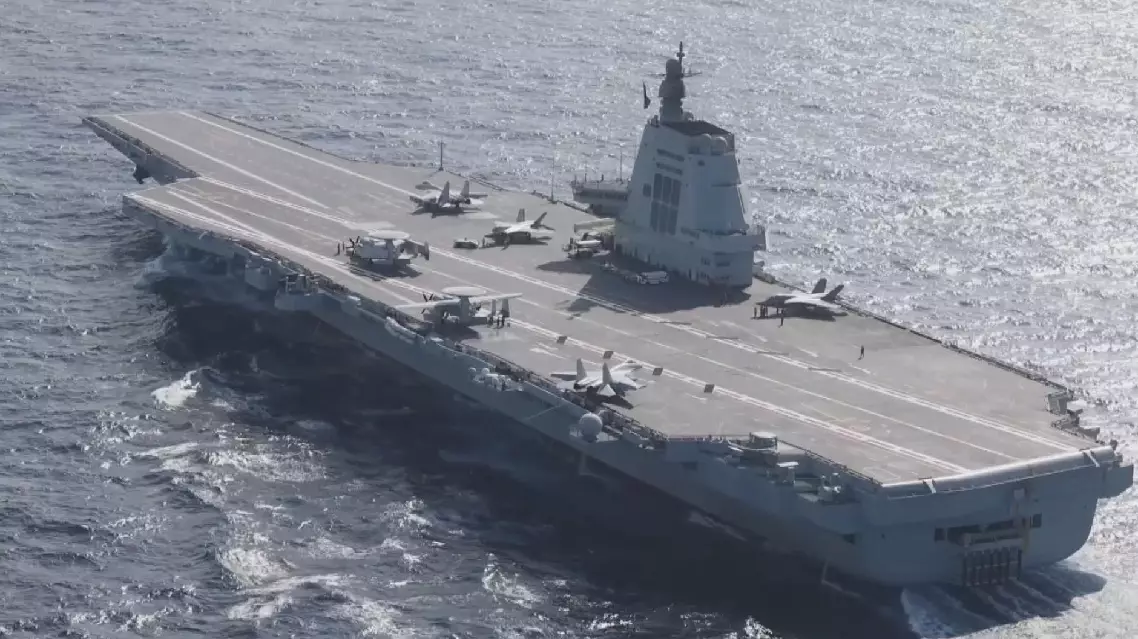
Special designs enhance combat capabilities of China's Fujian aircraft carrier: expert
Special designs enhance combat capabilities of China's Fujian aircraft carrier: expert