The Professional Women’s Hockey League is growing its schedule of Takeover Tour neutral site games to 16 for its third season.
With the eight-team league already planning further expansion in Year 4, several major Canadian and U.S. markets — including Chicago, Denver and Detroit — will be hosting two stops, the PWHL announced on Monday. The league will also play two games in Halifax, Nova Scotia, and Edmonton, Alberta, over its 120-game schedule, opening on Nov. 21.
The league will be showcasing its talent in 11 cities across the continent, including first-time stops in Halifax; Dallas; Washington, D.C.; Calgary, Alberta; Hamilton, Ontario and Winnipeg, Manitoba. Chicago is also a newcomer, with two games being played at Allstate Arena, home to the American Hockey League Chicago Wolves.
The scheduling is up from nine Takeover Tour games last year. Detroit is hosting a neutral-site game for the third year and the league returns for a second year to Denver, Quebec City and Edmonton.
“The passion and support of fans, and the enthusiasm from cities eager to engage with our league, have fueled our ambition to grow the tour,” PWHL senior vice president of business operations Amy Scheer said.
Last year’s tour proved highly popular in drawing a combined attendance of 123,601 fans, including the league setting a U.S. attendance record of 14,288 in Detroit. The game in Vancouver drew a sold-out crowd of 19,038, which ranks fourth on the league’s attendance list.
The PWHL uses the Takeover Tour to gauge potential expansion markets, which led to the league adding Seattle and Vancouver for this season. More expansion is already on the horizon, with plans already in the works to add between two and four franchises for next year.
The league is also considering the possibility of having to relocate the Ottawa Charge due to a planned reduction in seating capacity at their home rink. The city last week approved a plan to renovate TD Place in a move that would cut capacity from 8,500 to 6,600.
In an opinion piece published in the Ottawa Citizen last week, Scheer and senior vice president of hockey operations Jayna Hefford pushed back on the plan by noting how the reduction will cut into the team’s revenue.
“It’s not a matter of optimism or ambition. It’s math,” the two wrote. “Shrinking our future home by thousands of seats would make it harder for families to get in, harder for the team to grow, and harder for Ottawa to remain a flagship market for women’s hockey.”
A majority of this year’s Takeover Tour games will be played at NHL teams’ home venues, with the exception of Chicago, and markets without NHL franchises in Halifax, Hamilton and Quebec City.
Each of the PWHL’s teams will participate in at least three neutral site games. Montreal plays Toronto to open the Takeover Tour series in Halifax on Dec. 17. And the tour closes with Boston playing Vancouver in Edmonton on April 7.
AP women’s hockey: https://apnews.com/hub/womens-hockey

FILE - Fans gather to watch the Montreal Victoire and the Toronto Sceptres warm up before a PWHL hockey game in Vancouver, Wednesday, Jan. 8, 2025. (Ethan Cairns/The Canadian Press via AP, File)
WESTMINSTER, Colo.--(BUSINESS WIRE)--Apr 1, 2026--
Vantor, the leading provider of unified spatial intelligence from space to ground, has been awarded its third National Geospatial-Intelligence Agency (NGA) Luno contract to provide NGA and other U.S. Government agencies automated, near real-time orbital intelligence of high-interest objects in space.
This press release features multimedia. View the full release here: https://www.businesswire.com/news/home/20260401774885/en/
Under the $2.3 million contract, Vantor will utilize its high-resolution imagery of space objects, also known as non-Earth Imagery (NEI), to deliver intelligence on priority objects in low Earth orbit, including providing alerts when anomalies are present. The analysis will be largely automated, marking a significant step forward in eliminating manual processing and accelerating timely and actionable insights for Space Domain Awareness.
“In a contested domain like space, awareness is everything,” said Susanne Hake, Executive Vice President & General Manager, U.S. Government at Vantor. “Still, it’s the one domain where exquisite visual intelligence is extremely hard to come by, creating literal and figurative blind spots. Our NEI capabilities are one of the few technologies that can provide high-resolution visual intelligence of objects in space, providing intelligence analysts and decisionmakers with a deeper understanding of the behavior and intent of high-interest space objects—a decisive edge in an increasingly complex environment.”
Vantor’s orbital intelligence capabilities can provide insights into a space object’s features, health, velocity, and movements, including whether an object is changing orbit—a situation that could endanger the safety of U.S. assets in space. Vantor satellites can capture images of other spacecraft at an industry-leading resolution of less than 10 cm from hundreds of kilometers away, making it possible to quickly characterize those space objects and determine their health and status.
This award marks the third win for Vantor under NGA’s Luno program. Vantor previously announced a Luno contract to automatically detect land use land cover change at global scale, enabling NGA to anticipate where maps and their features may require updates. And in June, Vantor was awarded a Luno contract to deliver AI/ML-generated object detection services to identify assets across air, maritime, land, and rail domains; determine counts at specified locations; detect trends and anomalies; and perform advanced spatial and temporal geospatial intelligence analysis.
“These awards reflect the core of Vantor’s mission—to deliver real-time intelligence faster than the speed of threat, from space to ground,” said Hake. “By integrating our persistent monitoring, change detection, and space-domain awareness capabilities, we’re empowering our partners to understand and act on threats across every domain, before they emerge.”
The Luno program—made up of Luno A and Luno B—is part of NGA’s ongoing efforts to execute an agile acquisition strategy that unlocks the capacity and innovation of the commercial geospatial industry.
About Vantor
Vantor is forging the new frontier of spatial intelligence to unlock a more autonomous, interoperable world. We give decision makers and operators the power to build a unified intelligence picture, delivering the clarity they need to navigate what’s happening now and shape what’s coming next. We fuse data from the world’s most capable imaging satellites with real-time sensor feeds from space, air, and ground to create an AI-ready digital twin of Earth. Our spatial intelligence platform automates every part of the cycle—from tasking to collection to production—to update and analyze this foundation at the pace of change. Our products drive deeper mission-critical insights and connect the next generation of autonomous systems across the defense, intelligence, and commercial landscape.
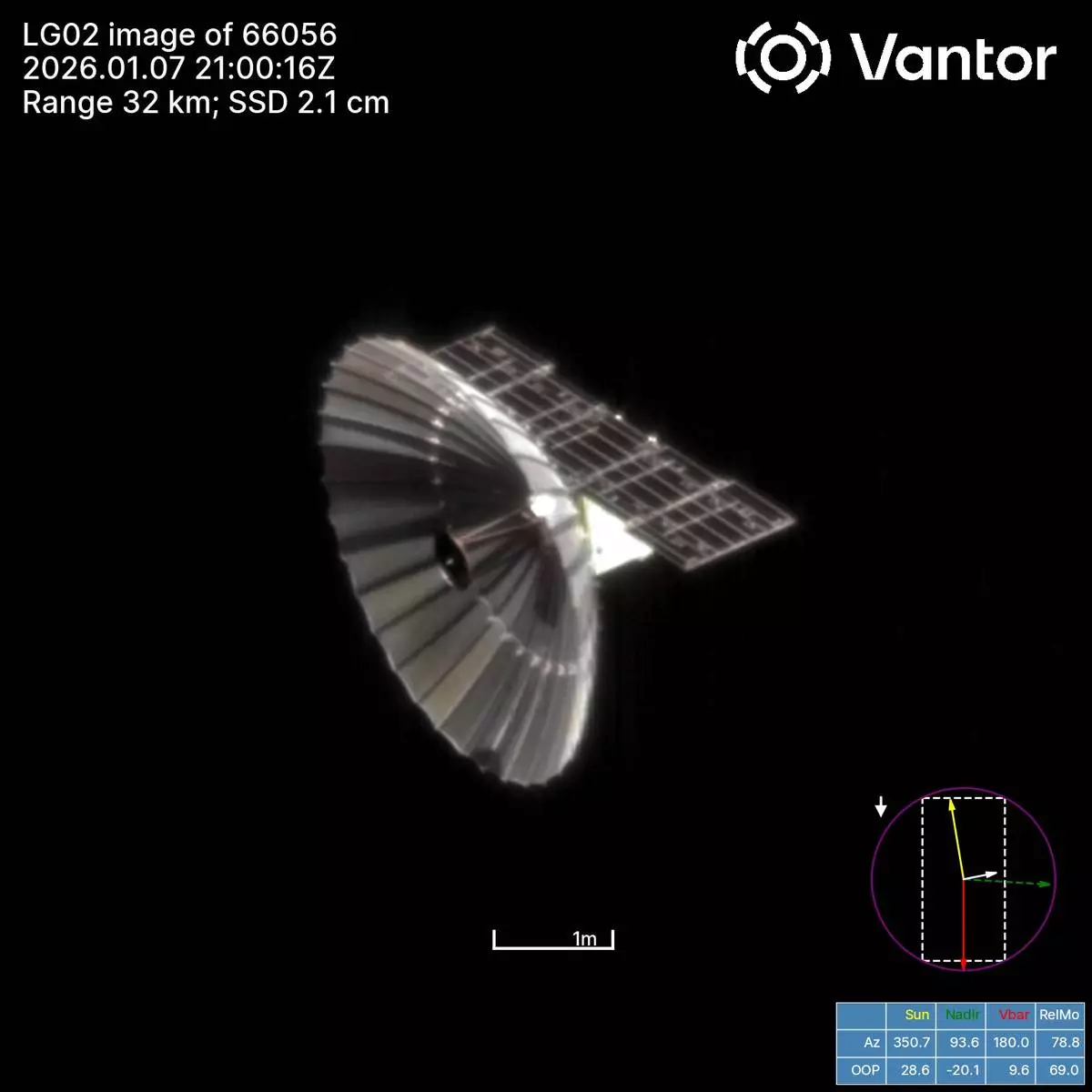
Vantor non-Earth image of a Chinese imaging satellite, collected under the NGA Luno B contract. The synthetic aperture radar (SAR) satellite features a large deployable antenna that enables high-resolution radar imaging from orbit.