Skip to Content Facebook Feature Image

Everyday volunteers are providing stopgap services during the shutdown in a show of community power

News

Everyday volunteers are providing stopgap services during the shutdown in a show of community power
News

News

Everyday volunteers are providing stopgap services during the shutdown in a show of community power

2025-11-12 01:39 Last Updated At:13:27

NEW YORK (AP) — It started with a late October meeting between a lifestyle entrepreneur, a marketing professional, a restaurant owner and a social worker at a brewery in the Florida panhandle. Within hours, Pensacola Grocery Buddies was born.

The four women wanted to pair people facing uncertainty over Supplemental Nutritional Assistance Program food benefits with charitably inclined folks offering to cover grocery costs and deliveries. In just two weeks, co-organizer Hale Morrissette said they've made over 300 matches and raised more than $10,000 for those they cannot connect.

“Everybody’s stepping up," said Morrissette, 35, the operations director at a local health nonprofit called ROOTS. "They know that this is not something that’s like a partisan type of issue. It’s about service and it’s about taking care of each other.”

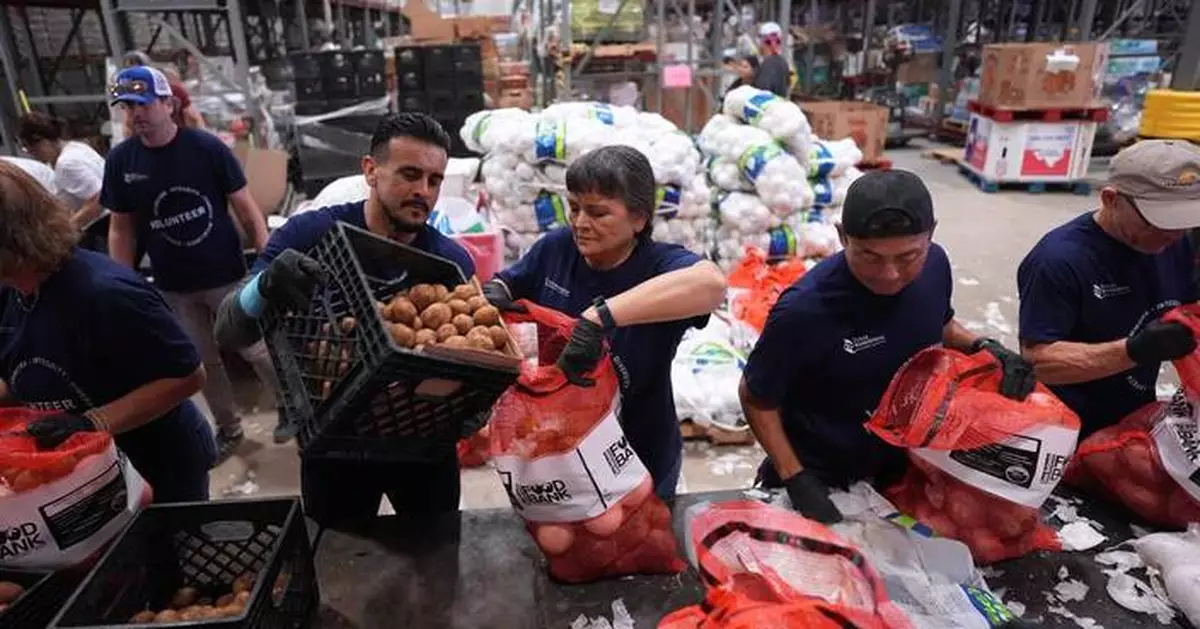
Everyday people have improvised such stopgap efforts to support their communities through a historically long government shutdown that has deepened disruptions to federal services. Whether feeding hungry families or maintaining local museum tours, volunteers nationwide are strengthening social ties that they hope will continue making their neighbors whole in the face of persistent precarity.

At the Oklahoma City National Memorial, volunteers have filled in giving the grounds tours typically led by now-furloughed National Park Service rangers. The site honors the 168 people killed 30 years ago when a truck bomb detonated outside a federal building, the deadliest homegrown attack on U.S. soil.

Pat Hall, a 74-year-old state lobbyist and memorial trustee whose wife was there the day of the explosion, said he was “honored to step up” and “keep the flame alive.” His first tour group was a senior class that had traveled three hours by bus from their rural high school.

Hall said he wanted to ensure that the government shutdown didn’t stop visitors from learning “the Oklahoma standard," a term borne from the 1995 attack to promote a culture of caring throughout the state.

“The rest of our life was to give, not take,” Hall said he realized in the attack's aftermath. “My wife survived a bombing. I have to give back.”

“We have to lift each other up,” said fellow trustee Sara Sweet. “There’s many, many, many opportunities. Because the need is so great. No matter what sector or what aspect of our communities we’re looking at.”

Many have taken up that ethos — that the vast amount of need demands greater levels of service — after a yearslong backslide in the number of people who donate their time to nonprofits.

These benevolent individuals aren't out to replace the robust charitable food networks that have become increasingly utilized in periods of hardship over the last half-century. But they've identified new roles that they themselves can play — sometimes outside of traditional philanthropic outlets.

A recent college graduate in Charlotte, North Carolina, started her own local “Grocery Buddies” chapter, similar to the one in Florida, after reading an article about the trend. While Molly Kerrigan, 23, acknowledged that food pantries are a great option for pitching in, she noted the need is so great that they're currently “overrun.”

She also welcomed the opportunity to build lasting connections between community members who would've otherwise remained strangers.

“With all of the uncertainty during the government shutdown and everything, it's easy to feel like you don't have a sense of agency," she said, adding that this program “has represented something that you can do that's right in front of you.”

Anna Culbertson was compelled earlier this year by her own job loss. The former National Institute of Allergy and Infection Diseases program specialist was among the thousands laid off this spring at the nation's top health agencies. She then co-founded 27 UNIHTED, a National Institutes of Health alumni network providing peer support and career resources.

When the shutdown began, the network put together food drives for federal employees going without pay and created a spreadsheet with available assistance for furloughed workers. They’ve placed collection boxes outside of Panera Bread and Starbucks locations, as well as the well-attended “ No Kings” protest in Washington, D.C.

This sort of organizing is new for Culbertson. As a career civil servant, she said she'd always cared about helping others. But it wasn't until recent challenges — the mass layoffs and government shutdown — that she began educating herself on effective organizing.

While it's felt good to recognize the collective power of “regular people," she said it’s sad that “we’re at this place where this is needed.”

“We’re not professional organizers," Culbertson said. “For me and the NIH cohort, we’re scientists. We’re people who care and help a lot.”

That same reciprocal care has surfaced at Norte Vista High School in Riverside, California. The school is recognized for its culture of civic engagement. Students regularly prepare ready-to-eat meals for families in need. But the Trump administration’s push to withhold food assistance funding has kicked that service into overdrive.

Norte Vista High School Principal Jason Marquez said they are partnering with local businesses and grocery stores this Thanksgiving season on a door-to-door meal delivery service called “Thanksgiving Hands.”

Jaymee O'Rafferty, Norte Vista’s community schools site coordinator, said many of their families struggle with food insecurity and have been asking her for additional support. She's rallied the mothers' group to deliver meals and gift cards. Campus clubs are collecting canned foods. It was a student who came to her with the idea for “Thanksgiving Hands.”

As she sees it, her job right now is to put one question to as many people as possible: Can you come help us?

“Our students are the ones where if they have 10 cans in their pantry, they're gonna bring five to donate," O'Rafferty said. "They already know the need and they're willing to do what it takes to help.”

“We have resources and we have power in sharing those resources," she added. "If everybody is able to come together and share a little, it makes a huge difference.”

The community engagement isn't slowing down even as lawmakers approach a deal to reopen the government. In Pensacola, Morrissette still sees a gap that needs to be bridged.

Families had to stretch their grocery budgets well before the pause on SNAP benefits, she said, and the uncertainty created by those delayed payments has brought “new faces” to her nonprofit.

Pensacola Grocery Buddies continued to see its public Facebook page fill up this past weekend with gracious posts from beneficiaries sharing photos of their delivered goods — and direct messages from potential recipients asking when they will reopen applications for new support.

The group is hammering out the final details on a Nov. 15 “Neighbors' Night Out” fundraiser so they can meet more of the demand. As a DJ, Morrissette in charge of the music.

“We're gonna dance and we're gonna talk and we're gonna sing,” she said. “We need joy in this world that tells us we shouldn't have hope.”

Associated Press coverage of philanthropy and nonprofits receives support through the AP’s collaboration with The Conversation US, with funding from Lilly Endowment Inc. The AP is solely responsible for this content. For all of AP’s philanthropy coverage, visit https://apnews.com/hub/philanthropy.
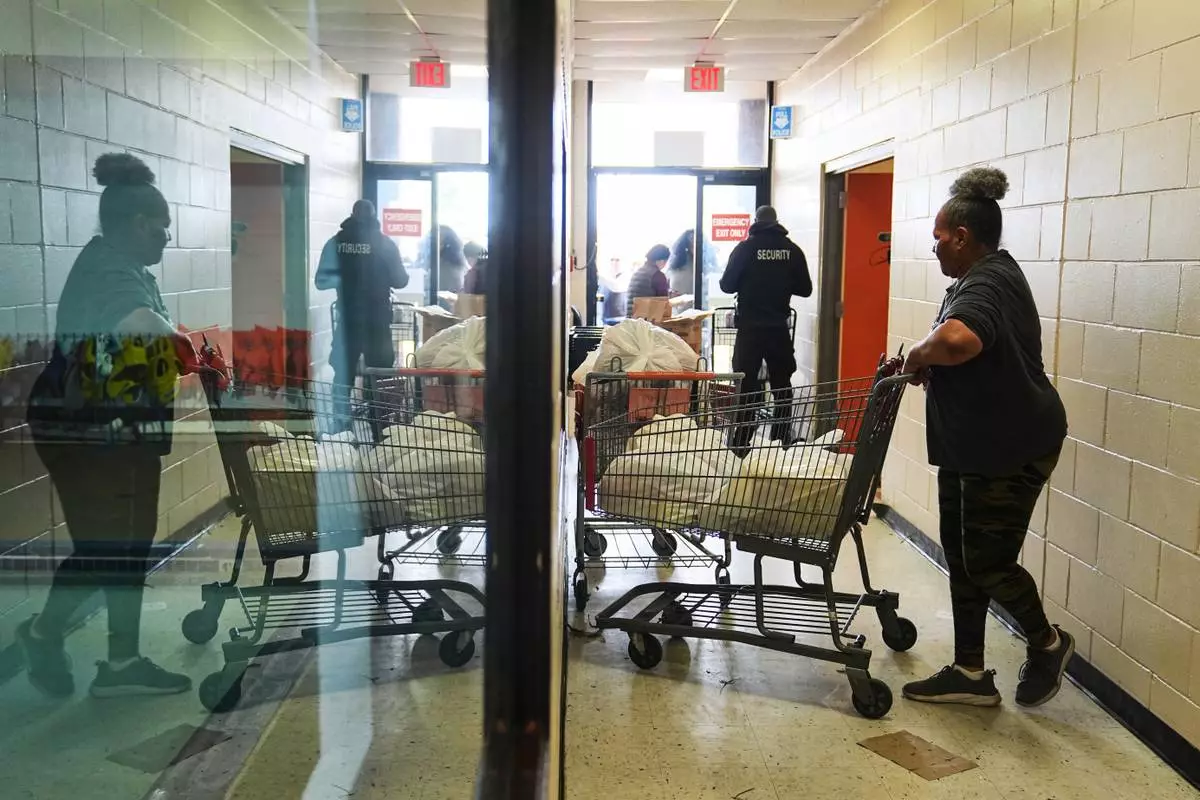
Volunteer Karen Robinson moves groceries durning an emergency food distribution at The Jewish Federation of Greater Philadelphia's Mitzvah Food Program in Philadelphia, Friday, Nov. 7, 2025. (AP Photo/Matt Rourke)

Volunteer Karen Robinson moves groceries durning an emergency food distribution at The Jewish Federation of Greater Philadelphia's Mitzvah Food Program in Philadelphia, Friday, Nov. 7, 2025. (AP Photo/Matt Rourke)

Volunteer Angus Hsigh helps a military member during a Feeding San Diego food distribution for military families affected by the federal shutdown Friday, Nov. 7, 2025, in Oceanside, Calif. (AP Photo/Gregory Bull)
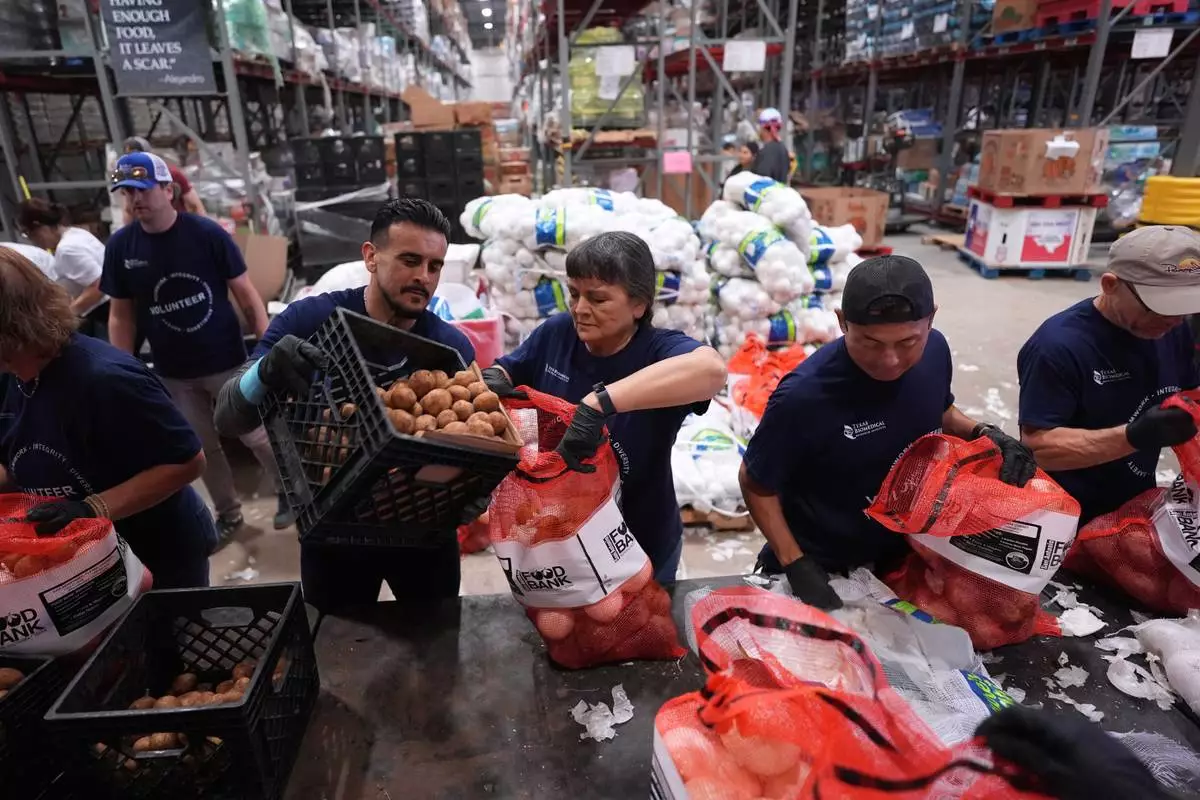
Volunteer Angus Hsigh helps a military member during a Feeding San Diego food distribution for military families affected by the federal shutdown Friday, Nov. 7, 2025, in Oceanside, Calif. (AP Photo/Gregory Bull)

Volunteers at the San Antonio Food Bank load bags of potatoes for a food distribution for SNAP recipients and other households affected by the federal shutdown, Thursday, Nov. 6, 2025, in San Antonio. (AP Photo/Eric Gay)

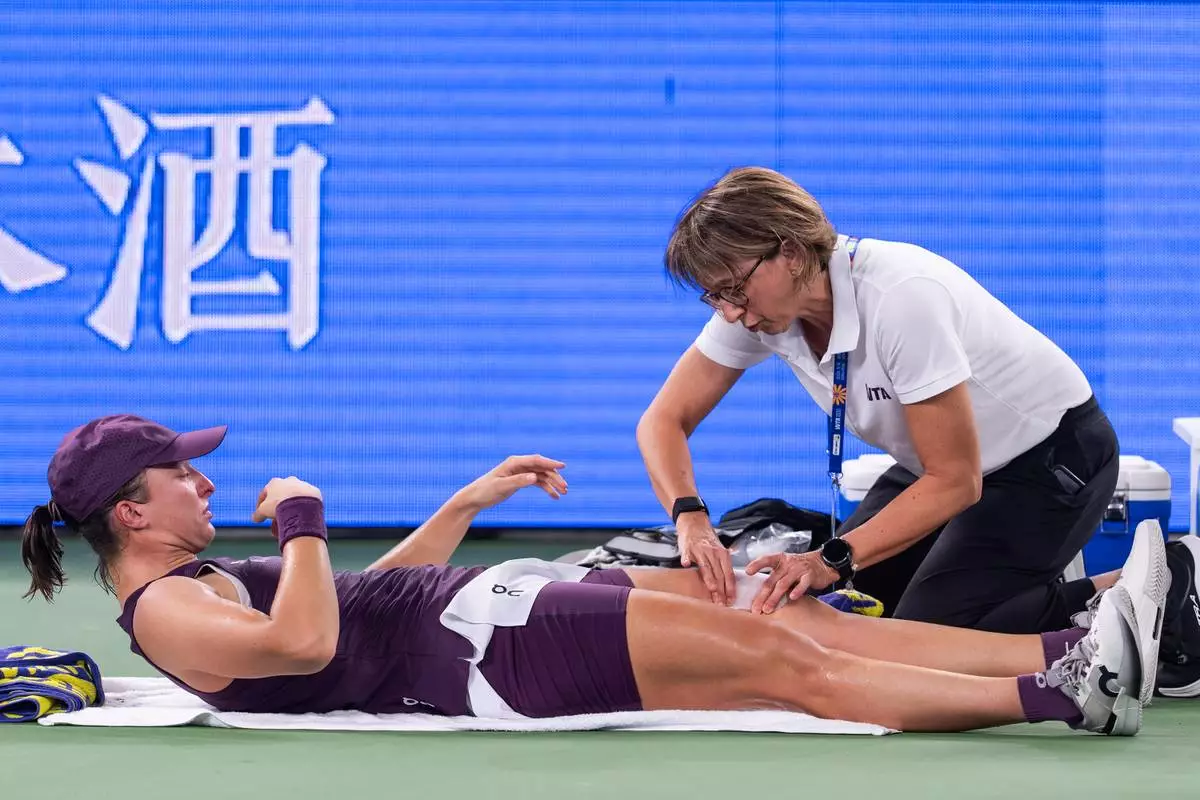
Volunteers at the San Antonio Food Bank load bags of potatoes for a food distribution for SNAP recipients and other households affected by the federal shutdown, Thursday, Nov. 6, 2025, in San Antonio. (AP Photo/Eric Gay)
WASHINGTON (AP) — Venezuelan opposition leader María Corina Machado said she presented her Nobel Peace Prize medal to President Donald Trump at the White House on Thursday even as he has questioned her credibility to take over her country after the U.S. ousted then-President Nicolás Maduro.

The Nobel Institute has said Machado could not give her prize to Trump, an honor that he has coveted. Even if it the gesture proves to be purely symbolic, it was extraordinary given that Trump has effectively sidelined Machado, who has long been the face of resistance in Venezuela. He has signaled his willingness to work with acting President Delcy Rodríguez, who had been Maduro’s second in command.

“I presented the president of the United States the medal, the Nobel Peace Prize," Machado told reporters after leaving the White House and heading to Capitol Hill. She said she had done so "as a recognition for his unique commitment with our freedom.”

Trump confirmed later on social media that Machado had left the medal for him to keep, and he said it was an honor to meet her.

“She is a wonderful woman who has been through so much. María presented me with her Nobel Peace Prize for the work I have done,” Trump said in his post. “Such a wonderful gesture of mutual respect. Thank you María!”

The White House later posted a photo of Machado standing next to Trump in the Oval Office as he holds the medal in a large frame. A text in the frame reads, "Presented as a personal symbol of gratitude on behalf of the Venezuelan people in recognition of President Trump’s principled and decisive action to secure a free Venezuela.”

Trump has raised doubts about his stated commitment to backing democratic rule in Venezuela, giving no timetable on when elections might be held. Machado indicated that he had provided few specifics on that front during their discussion.

She did not provide more information on what was said.

After the closed-door meeting, Machado greeted dozens of cheering supporters waiting for her near the White House gates, stopping to hug many.

“We can count on President Trump,” she told them without elaborating, prompting some to briefly chant, “Thank you, Trump.”

Before her visit to Washington, Machado had not been seen in public since she traveled last month to Norway, where her daughter received the peace prize on her behalf. She had spent 11 months in hiding in Venezuela before she appeared in Norway after the ceremony.

The jubilant scene after her meeting with Trump stood in contrast to political realities in Venezuela. Rodríguez remains in charge of day-to-day government operations, along with others in Maduro’s inner circle. In her first state of the union speech Thursday, the interim president promoted the resumption of diplomatic ties between the historic adversaries and advocated for opening the state-run oil industry to more foreign investment after Trump pledged to seize control of Venezuelan crude sales.

Trump has said it would be difficult for Machado to lead because she “doesn’t have the support within or the respect within the country.” Her party is widely believed to have won 2024 elections rejected by Maduro.

White House press secretary Karoline Leavitt called Machado “a remarkable and brave voice” but also said the meeting didn’t mean Trump’s opinion of her changed, calling it “a realistic assessment.”

Leavitt told reporters that Trump supported new Venezuelan elections “when the time is right” but did not say when he thought that might be.

Leavitt said Machado had sought the face-to-face meeting without setting expectations for what would occur. She spent about two and a half hours at the White House.

“I don’t think he needs to hear anything from Ms. Machado," the press secretary said while the meeting was still going on, other than to have a ”frank and positive discussion about what’s taking place in Venezuela.”

After leaving the White House, Machado went on to a closed-door meeting with a bipartisan group of senators.

Sen. Chris Murphy, D-Conn., said Machado told them that “if there’s not some progress, real progress towards a transition in power, and/or elections in the next several months, we should all be worried.”

“She reminded us that Delcy Rodríguez is, in many ways, worse than Maduro,” he added.

Asked if Machado had heard any commitment from the White House on holding elections in Venezuela, Murphy said, “No, I don’t think she got any commitment from them."

Sen. Bernie Moreno, an Ohio Republican, was exultant following the meeting, saying Machado "delivered a message that loud and clear: What President Trump did was the most important, significant event in Latin America. That getting rid of Maduro was absolutely essential.”

Machado's Washington stop coincided with U.S. forces in the Caribbean Sea seizing another sanctioned oil tanker that the Trump administration says had ties to Venezuela. It is part of a broader U.S. effort to take control of the South American country’s oil after U.S. forces captured Maduro and his wife less than two weeks ago at a heavily guarded compound in the Venezuelan capital of Caracas and brought them to New York to stand trial on drug trafficking charges.

Leavitt said Venezuela's interim authorities have been fully cooperating with the Trump administration and noted that Rodríguez's government said it planned to release more prisoners detained under Maduro. Among those released were five Americans this week.

Trump said Wednesday that he had a “great conversation” with Rodríguez, their first since Maduro was ousted.

Just hours after Maduro's capture, Trump said of Machado that “it would be very tough for her to be the leader.” Machado had steered a careful course to avoid offending Trump, notably after winning the peace prize, and had sought to cultivate relationships with him and key administration voices like Secretary of State Marco Rubio.

The industrial engineer and daughter of a steel magnate, Machado began challenging the ruling party in 2004, when the nongovernmental organization she co-founded, Súmate, promoted a referendum to recall then-President Hugo Chávez. The initiative failed, and Machado and other Súmate executives were charged with conspiracy.

A year later, she drew the anger of Chávez and his allies again for traveling to Washington to meet President George W. Bush, whom Chávez considered an adversary.

Almost two decades later, she marshaled millions of Venezuelans to reject Chávez’s successor, Maduro, for another term in the 2024 election. But ruling party-loyal electoral authorities declared him the winner despite ample credible evidence to the contrary. Ensuing anti-government protests ended in a brutal crackdown.

Garcia Cano reported from Caracas, Venezuela. Associated Press writers Lisa Mascaro, Stephen Groves, Michelle L. Price and Matthew Lee in Washington, and Megan Janetsky in Mexico City contributed to this report.

Venezuelan opposition leader Maria Corina Machado is welcomed at the Capitol before a meeting with senators, from left, Sen. John Curtis, R-Utah, Sen. Ruben Gallego, D-Ariz., Sen. Dick Durbin, D-Ill., Sen. Alex Padilla, D-Calif., and Sen. Chris Murphy, D-Conn., as the Nobel Peace Prize recipient visits American leaders two weeks after President Donald Trump toppled Venezuelan president Nicolas Maduro in a stunning military raid, at the Capitol in Washington, Thursday, Jan. 15, 2026. (AP Photo/J. Scott Applewhite)

Venezuelan opposition leader Maria Corina Machado is welcomed at the Capitol before a meeting with senators, from left, Sen. John Curtis, R-Utah, Sen. Ruben Gallego, D-Ariz., Sen. Dick Durbin, D-Ill., Sen. Alex Padilla, D-Calif., and Sen. Chris Murphy, D-Conn., as the Nobel Peace Prize recipient visits American leaders two weeks after President Donald Trump toppled Venezuelan president Nicolas Maduro in a stunning military raid, at the Capitol in Washington, Thursday, Jan. 15, 2026. (AP Photo/J. Scott Applewhite)

Venezuelan opposition leader María Corina Machado, center, leaves the Capitol, Thursday, Jan. 15, 2026, in Washington. (AP Photo/Allison Robbert)

Venezuelan opposition leader María Corina Machado, center, leaves the Capitol, Thursday, Jan. 15, 2026, in Washington. (AP Photo/Allison Robbert)

Venezuelan opposition leader Maria Corina Machado, center, is welcomed by Sen. Dick Durbin, D-Ill., left, Sen. Ruben Gallego, D-Ariz., far left, and Sen. Alex Padilla, D-Calif., right, as the Nobel Peace Prize recipient visits American leaders at the Capitol in Washington, Thursday, Jan. 15, 2026. (AP Photo/J. Scott Applewhite)

Venezuelan opposition leader Maria Corina Machado, center, is welcomed by Sen. Dick Durbin, D-Ill., left, Sen. Ruben Gallego, D-Ariz., far left, and Sen. Alex Padilla, D-Calif., right, as the Nobel Peace Prize recipient visits American leaders at the Capitol in Washington, Thursday, Jan. 15, 2026. (AP Photo/J. Scott Applewhite)

Venezuelan opposition leader María Corina Machado gestures to supporters on Pennsylvania Avenue as she leaves the White House after meeting with President Donald Trump Thursday, Jan. 15, 2026, in Washington. (AP Photo/Pablo Martinez Monsivais)

Venezuelan opposition leader María Corina Machado gestures to supporters on Pennsylvania Avenue as she leaves the White House after meeting with President Donald Trump Thursday, Jan. 15, 2026, in Washington. (AP Photo/Pablo Martinez Monsivais)

Venezuelan opposition leader María Corina Machado waves to supporters on Pennsylvania Avenue as she leaves the White House after meeting with President Donald Trump Thursday, Jan. 15, 2026, in Washington. (AP Photo/Pablo Martinez Monsivais)

Venezuelan opposition leader María Corina Machado waves to supporters on Pennsylvania Avenue as she leaves the White House after meeting with President Donald Trump Thursday, Jan. 15, 2026, in Washington. (AP Photo/Pablo Martinez Monsivais)

Venezuelan opposition leader María Corina Machado smiles on Pennsylvania Avenue as she leaves the White House after meeting with President Donald Trump Thursday, Jan. 15, 2026, in Washington. (AP Photo/Pablo Martinez Monsivais)

Venezuelan opposition leader María Corina Machado smiles on Pennsylvania Avenue as she leaves the White House after meeting with President Donald Trump Thursday, Jan. 15, 2026, in Washington. (AP Photo/Pablo Martinez Monsivais)

Venezuelan opposition leader María Corina Machado waves to supporters on Pennsylvania Avenue as she leaves the White House after meeting with President Donald Trump Thursday, Jan. 15, 2026, in Washington. (AP Photo/Pablo Martinez Monsivais)

Venezuelan opposition leader María Corina Machado waves to supporters on Pennsylvania Avenue as she leaves the White House after meeting with President Donald Trump Thursday, Jan. 15, 2026, in Washington. (AP Photo/Pablo Martinez Monsivais)

FILE - U.S. President George Bush, right, meets with Maria Corina Machado, executive director of Sumate, a non-governmental organization that defends Venezuelan citizens' political rights, in the Oval Office of the White House, Washington, May 31, 2005. (AP Photo/Charles Dharapak, File)

FILE - U.S. President George Bush, right, meets with Maria Corina Machado, executive director of Sumate, a non-governmental organization that defends Venezuelan citizens' political rights, in the Oval Office of the White House, Washington, May 31, 2005. (AP Photo/Charles Dharapak, File)

FILE - Opposition leader Maria Corina Machado gestures to supporters during a protest against President Nicolas Maduro the day before his inauguration for a third term, in Caracas, Venezuela, Thursday, Jan. 9, 2025. (AP Photo/Ariana Cubillos, file)

FILE - Opposition leader Maria Corina Machado gestures to supporters during a protest against President Nicolas Maduro the day before his inauguration for a third term, in Caracas, Venezuela, Thursday, Jan. 9, 2025. (AP Photo/Ariana Cubillos, file)

Recommended Articles