The tech industry is moving fast and breaking things again — and this time it is humanity’s shared reality and control of our likeness before and after death — thanks to artificial intelligence image-generation platforms like OpenAI’s Sora 2.
The typical Sora video, made on OpenAI’s app and spread onto TikTok, Instagram, X and Facebook, is designed to be amusing enough for you to click and share. It could be Queen Elizabeth II rapping or something more ordinary and believable. One popular Sora genre is fake doorbell camera footage capturing something slightly uncanny -- say, a boa constrictor on the porch or an alligator approaching an unfazed child -- and ends with a mild shock, like a grandma shouting as she beats the animal with a broom.
But a growing chorus of advocacy groups, academics and experts are raising alarms about the dangers of letting people create AI videos on just about anything they can type into a prompt, leading to the proliferation of nonconsensual images and realistic deepfakes in a sea of less harmful “AI slop.” OpenAI has cracked down on AI creations of public figures — among them, Michael Jackson, Martin Luther King Jr. and Mister Rogers — doing outlandish things, but only after an outcry from family estates and an actors' union.
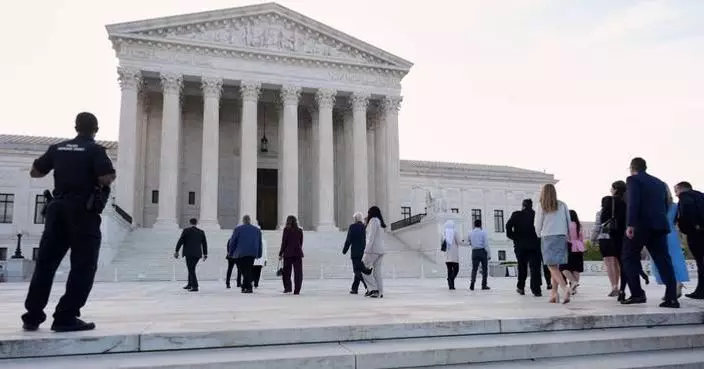
The nonprofit Public Citizen is now demanding OpenAI withdraw Sora 2 from the public, writing in a Tuesday letter to the company and CEO Sam Altman that the app’s hasty release so that it could launch ahead of competitors shows a “consistent and dangerous pattern of OpenAI rushing to market with a product that is either inherently unsafe or lacking in needed guardrails.” Sora 2, the letter says, shows a “reckless disregard” for product safety, as well as people's rights to their own likeness and the stability of democracy. The group also sent the letter to the U.S. Congress.
OpenAI didn't respond to requests for comment Tuesday.
“Our biggest concern is the potential threat to democracy,” said Public Citizen tech policy advocate J.B. Branch in an interview. “I think we’re entering a world in which people can’t really trust what they see. And we’re starting to see strategies in politics where the first image, the first video that gets released, is what people remember.”
Branch, author of Tuesday's letter, also sees broader concerns to people's privacy that disproportionately impact vulnerable populations online.
OpenAI blocks nudity but Branch said that “women are seeing themselves being harassed online” in other ways, such as with fetishized niche content that makes it through the apps' restrictions. The news outlet 404 Media on Friday reported on a flood of Sora-made videos of women being strangled.
OpenAI introduced its new Sora app on iPhones more than a month ago. It launched on Android phones last week in the U.S., Canada and several Asian countries, including Japan and South Korea.
Much of the strongest pushback has come from Hollywood and other entertainment interests, including the Japanese manga industry. OpenAI announced its first big changes just days after the release, saying “overmoderation is super frustrating” for users but that it’s important to be conservative “while the world is still adjusting to this new technology.”
That was followed by publicly announced agreements with Martin Luther King Jr.'s family on Oct. 16, preventing “disrespectful depictions” of the civil rights leader while the company worked on better safeguards, and another on Oct. 20 with “Breaking Bad” actor Bryan Cranston, the SAG-AFTRA union and talent agencies.
“That’s all well and good if you’re famous,” Branch said. “It’s sort of just a pattern that OpenAI has where they’re willing to respond to the outrage of a very small population. They’re willing to release something and apologize afterwards. But a lot of these issues are design choices that they can make before releasing."
OpenAI has faced similar complaints about its flagship product, ChatGPT. Seven new lawsuits filed last week in California courts claim the chatbot drove people to suicide and harmful delusions even when they had no prior mental health issues. Filed on behalf of six adults and one teenager by the Social Media Victims Law Center and Tech Justice Law Project, the lawsuits claim that OpenAI knowingly released GPT-4o prematurely last year, despite internal warnings that it was dangerously sycophantic and psychologically manipulative. Four of the victims died by suicide.
Public Citizen was not involved in the lawsuits, but Branch said he sees parallels in Sora's hasty release.
He said they’re “putting the pedal to the floor without regard for harms. Much of this seems foreseeable. But they’d rather get a product out there, get people downloading it, get people who are addicted to it rather than doing the right thing and stress-testing these things beforehand and worrying about the plight of everyday users.”
OpenAI spent last week responding to complaints from a Japanese trade association representing famed animators like Hayao Miyazaki's Studio Ghibli and video game makers like Bandai Namco and Square Enix. OpenAI said many anime fans want to interact with their favorite characters, but the company has also set guardrails in place to prevent well-known characters from being generated without the consent of the people who own the copyrights.
“We’re engaging directly with studios and rightsholders, listening to feedback, and learning from how people are using Sora 2, including in Japan, where cultural and creative industries are deeply valued," OpenAI said in a statement about the trade group's letter last week.

FILE - The OpenAI logo is seen displayed on a cell phone in front of an image on a computer screen generated by ChatGPT's Dall-E text-to-image model, Friday, Dec. 8, 2023, in Boston. (AP Photo/Michael Dwyer, file)
NASA's launch team has loaded more than 700,000 gallons of fuel into the 32-story Space Launch System rocket, setting the stage for the Artemis II mission crew members to board.
The mission is NASA’s planned lunar fly-around by four astronauts that will be the first moon trip in 53 years.
The Space Launch System rocket is poised to blast off Wednesday evening with a two-hour launch window beginning at 6:24 p.m. EDT at Kennedy Space Center in Florida.
Artemis astronauts Reid Wiseman, Victor Glover, Christina Koch and Jeremy Hansen will be on board. They’ll hurtle several thousand miles beyond the moon, hang a U-turn and then come straight back. No circling around the moon, no stopping for a moonwalk — just a quick out-and-back lasting less than 10 days. NASA promises more boot prints in the gray lunar dust, but not before a couple practice missions.
Unlike the Apollo missions that sent astronauts to the moonfrom 1968 through 1972, Artemis’ debut crew includes a woman, a person of color and a Canadian citizen.
Artemis II is the opening shot of NASA’s grand plans for a permanent moon base. The space program is aiming for a moon landing near the lunar south pole in 2028.
The Latest:
Wiseman, Glover, Koch and Hansen have left the Neil Armstrong Operations and Checkout Building and are on their way to launch pad 39B.
Waving to family, colleagues and news photographers, the crew boarded the so-called astrovan for the 9-mile ride to the launch pad and their awaiting SLS rocket.
Before their highly anticipated walkout, commander Reid Wiseman and his crew played a quick card game with NASA’s chief astronaut Scott Tingle. It’s a preflight tradition since the space shuttle era.
Losing is good: It means the astronaut has gotten rid of all bad luck before launching.
The four thanked the suit techs and posed for photos, keeping a safe distance from many of the bystanders to avoid germs. They then went down the elevator at the Neil Armstrong Operations & Checkout Building and walk out to a barrage of cameras and cheers.
They’ll take a custom-designed astrovan for the ride to the launch pad
House Speaker Mike Johnson posted on the social media site X ahead of the planned Artemis II launch.
“Praying for the safety and success of the Artemis II crew and @NASA as they undertake a mission that will carry humanity farther into space than we have gone in over half a century. I had the privilege of hosting these courageous pioneers at the State of the Union earlier this year. Americans are watching proudly as our Golden Age reaches new heights!” Johnson wrote.
Wiseman, 50, a retired Navy captain from Baltimore, was serving as NASA’s chief astronaut when asked three years ago to lead humanity’s first lunar trip since 1972.
His wife Carroll’s death from cancer in 2020 gave him pause.
His two teenage daughters, especially the older one, had “zero interest” in him launching again after a 2014 trip to the International Space Station.
“We talked about it and I said, ’Look, of all the people on planet Earth right now, there are four people that are in a position to go fly around the moon,” he said. “I cannot say no to that opportunity.”
The next day, homemade moon cupcakes awaited him, along with his daughters’ support.
Artemis is the twin sister of Apollo in Greek mythology. They are the children of Zeus and Leto. Artemis has long been associated with the moon.
While the Artemis name builds on the Apollo program and pays homage to it, “there is no way we could be that same mission or ever hope to even be,” said NASA astronaut Christina Koch, part of the Artemis II crew.
The Apollo program was all about beating the Russians to the moon and planting the U.S. flag. NASA sent 24 astronauts to the moon between 1968 and 1972, including 12 moonwalkers. Now China is the competition.
NASA is striving for a long-term lunar presence under Artemis, with Mars to follow.
The Artemis II astronauts are now in their orange Orion spacesuits that they will wear for launch and reentry. Testing these new suits is one of the main goals of the mission.
The four are expected to emerge for their trip to the pad sometime before 2pm.
NASA created bright orange custom spacesuits for launch and reentry. Astronauts will also use them in case of a depressurization or some other emergency.
They can survive up to six days in the suits, inserting a straw into the helmet to sip water or protein shakes and relying on undergarment bags and bladders as a built-in toilet.
Future Artemis crews to the lunar surface will wear white moonwalking suits designed by Axiom Space.
During the Apollo era, astronauts wore the same white bulky spacesuits for launch and return as well as for moonwalks because there wasn’t enough storage on board for different outfits.
“We should have done Artemis 50 years ago,” said John Tribe, a propulsion engineer during the Apollo era.
The launch team has loaded more than 700,000 gallons of fuel into the 32-story Space Launch System rocket, setting the stage for the Artemis II crew to board.
The wind is picking up at Cape Canaveral, more clouds are appearing and rain is expected in about two hours. But there is no lightning threat, NASA says, and there’s still an 80% chance the weather will be good enough to launch.
L-minus tracks the overall time to liftoff, counting down the days, hours and minutes away before the planned blastoff. It doesn’t include built-in holds, or pauses — that’s T-minus time.
The T-minus countdown in the final 10 minutes is where nerves tense up and hearts start pounding. Automated software kicks off a series of highly choreographed milestones. During this period, the clock can be stopped if a problem is spotted and restarted if it’s fixed in time.
T-0 is the moment of liftoff — zero — when the boosters ignite and the rocket begins its journey.
NASA has a narrow time frame each month to fly to the moon.
The Earth and moon must be aligned just so to achieve the proper trajectory for the mission. In any given month, there’s only about a week when Artemis II astronauts can lift off.
The Orion capsule needs to get a check of its life-support and other systems in near-Earth orbit. If that goes well, Orion will fire its main engine to hurtle toward the moon, taking advantage of the moon and Earth’s gravity to get there and back in a slingshot maneuver that requires little if any fuel.
Orion also needs sunlight for power and can’t be in darkness for more than 90 minutes at a time. Plus NASA wants to minimize heating during reentry at flight’s end.
The latest launch window runs through April 6. The next opportunity opens on April 30.
The hydrogen tank of the rocket’s core stage is 100% filled. NASA said no significant leaks have been observed so far in fueling. It was hydrogen leaks that prevented the rocket from flying in February.
The alarm clocks just went off in Kennedy Space Center’s crew quarters.
That means it’s rise and shine for the three Americans and one Canadian who are about to become the first lunar visitors in more than 53 years.
They have a long day ahead of them, whether they launch or not.
After breakfast, they’ll start suiting up. NASA’s launch window opens at 6:24 p.m. and lasts a full two hours.
Launch director Charlie Blackwell-Thompson is wearing green as are many of the controllers alongside her in the firing room.
Green represents “go” for NASA, a color symbolizing good luck.
The team is monitoring the fueling of the 322-foot moon rocket, set to blast off Wednesday evening.
A plush toy named Rise will ride with the Artemis II astronauts around the moon, carrying the names of more than 5.6 million people.
Rise is what’s known as a zero gravity indicator, which gives the astronauts a visual cue of when they reach space.
The design was inspired by the iconic “Earthrise” photo during Apollo 8, showing the planet as a shadowed blue marble from space in 1968.
Rise was selected from more than 2,600 contest submissions. It was designed by Lucas Ye of California.
Commander Reid Wiseman and his crew tucked a small memory card into Rise before the toy was loaded into the Orion capsule. The card bears the names of all those who signed up with NASA to vicariously tag along on the nearly 10-day journey.
“Zipping that little pocket on the bottom of Rise was kind of the moment that put it all together for me,” Wiseman said. “We are going for all and by all. It’s time to fly.”
NASA is fueling the new rocket that will send four astronauts to the moon.
Launch teams have begun pumping more than 700,000 gallons (2.6 million liters) of liquid hydrogen and liquid oxygen into the Space Launch System rocket at Kennedy Space Center in Florida.
It’s the latest milestone in the two-day countdown that kicked off on Monday when launch controllers reported to duty.
It will take at least four hours to fully load the rocket before astronauts climb aboard for humanity’s first flight to the moon since Apollo 17 in 1972.
The two-hour launch window opens at 6:24 p.m. EDT.
▶ Read more about Apollo vs. Artemis
The Americans who blazed the trail to the moon more than half a century ago were white men chosen for their military test pilot experience.
The Artemis II crew includes a woman, a person of color and a Canadian, products of a more diversified astronaut corps.
▶ Read more about Christina Koch, Victor Glover, Jeremy Hansen and Reid Wiseman
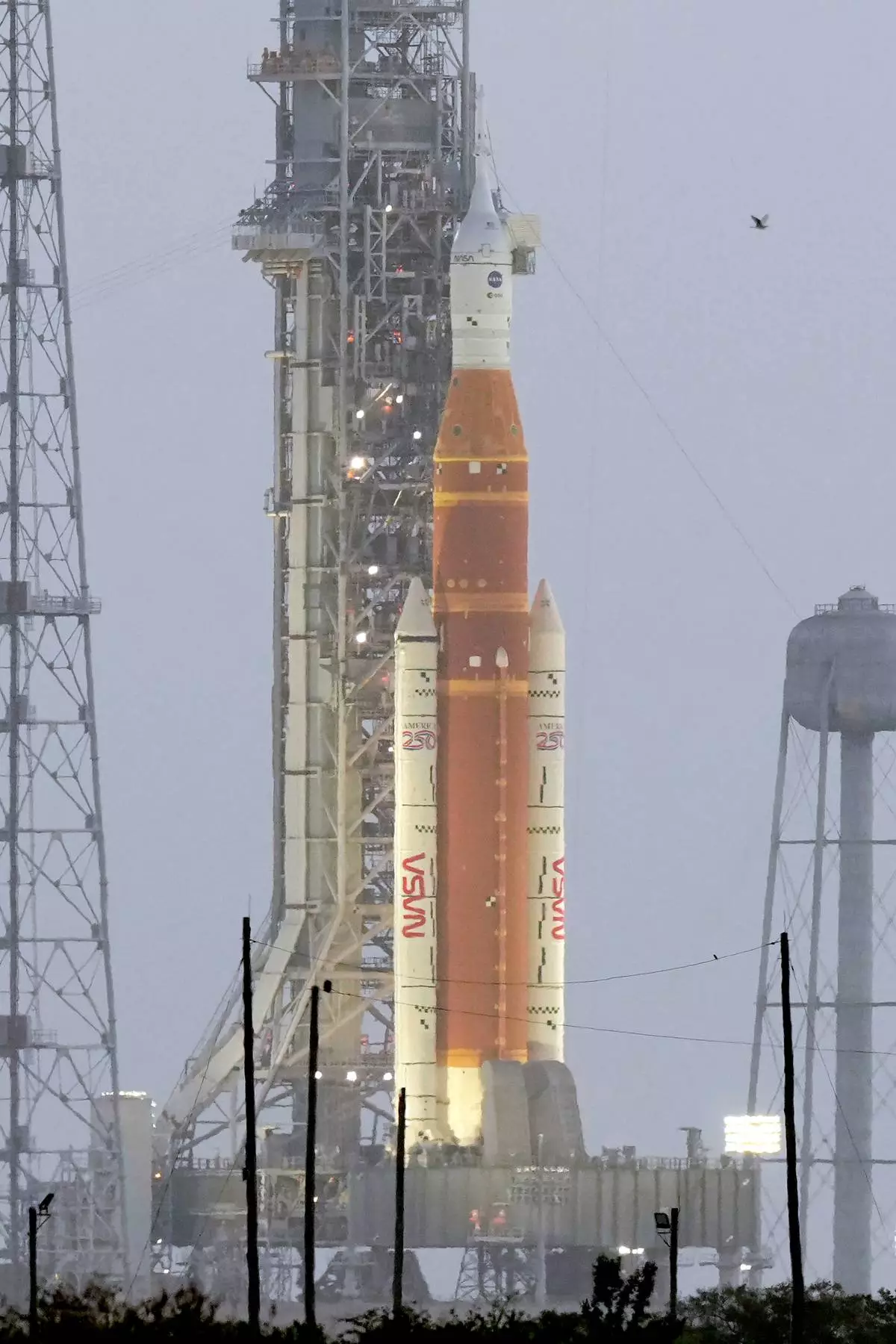
NASA's Artermis II moon rocket sits on Launch Pad 39-B at the Kennedy Space Center hours ahead of planned liftoff Wednesday, April 1, 2026, in Cape Canaveral, Fla. (AP Photo/Chris O'Meara)
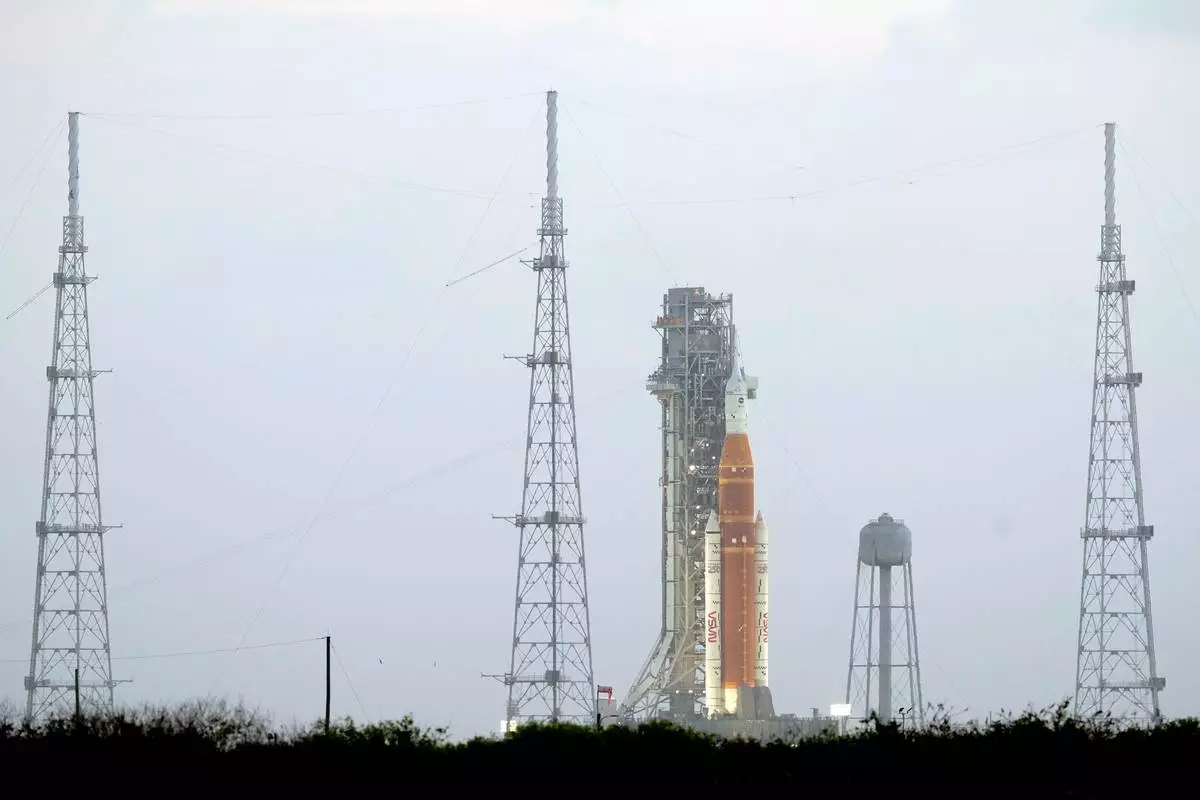
NASA's Artermis II moon rocket sits on Launch Pad 39-B at the Kennedy Space Center hours ahead of a planned launch attempt Wednesday, April 1, 2026, in Cape Canaveral, Fla. (AP Photo/Chris O'Meara)
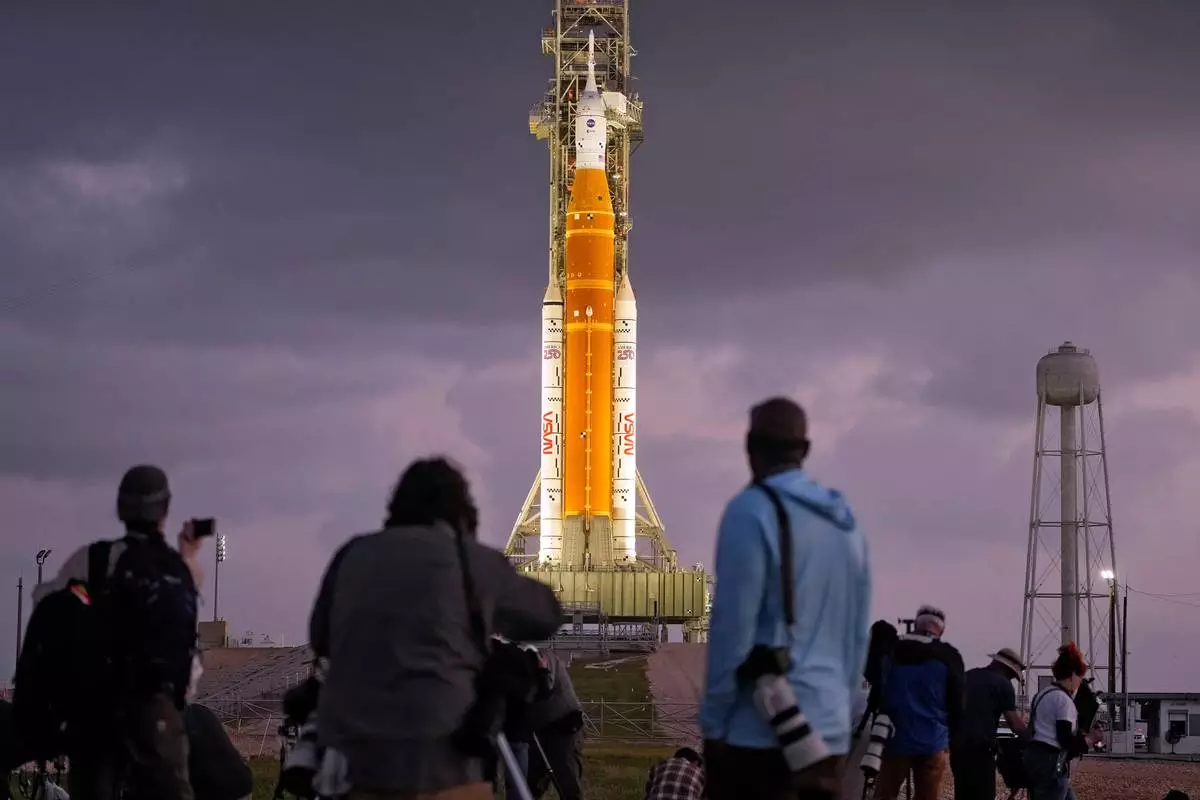
Photographers set up remote cameras near NASA's Artermis II moon rocket on Launch Pad 39-B just before sunrise at the Kennedy Space Center Tuesday, March 31, 2026, in Cape Canaveral, Fla. (AP Photo/Chris O'Meara)