Skip to Content Facebook Feature Image

Anthropic, Microsoft announce new AI data center projects as industry's construction push continues

News

Anthropic, Microsoft announce new AI data center projects as industry's construction push continues
News

News

Anthropic, Microsoft announce new AI data center projects as industry's construction push continues

2025-11-13 06:32 Last Updated At:06:40

Artificial intelligence company Anthropic announced a $50 billion investment in computing infrastructure on Wednesday that will include new data centers in Texas and New York.

Microsoft also on Wednesday announced a new data center under construction in Atlanta, Georgia, describing it as connected to another in Wisconsin to form a “massive supercomputer” running on hundreds of thousands of Nvidia chips to power AI technology.

The latest deals show that the tech industry is moving forward on huge spending to build energy-hungry AI infrastructure, despite lingering financial concerns about a bubble, environmental considerations and the political effects of fast-rising electricity bills in the communities where the massive buildings are constructed.

Anthropic, maker of the chatbot Claude, said it is working with London-based Fluidstack to build the new computing facilities to power its AI systems. It didn't disclose their exact locations or what source of electricity they will need.

Another company, cryptocurrency mining data center developer TeraWulf, has previously revealed it was working with Fluidstack on Google-backed data center projects in Texas and New York, on the shore of Lake Ontario. TeraWulf declined comment Wednesday.

A report last month from TD Cowen said that the leading cloud computing providers leased a “staggering” amount of U.S. data center capacity in the third fiscal quarter of this year, amounting to more than 7.4 gigawatts of energy, more than all of last year combined.

Oracle was securing the most capacity during that time, much of it supporting AI workloads for Anthropic's chief rival OpenAI, maker of ChatGPT. Google was second and Fluidstack came in third, ahead of Meta, Amazon, CoreWeave and Microsoft.

Anthropic said its projects will create about 800 permanent jobs and 2,400 construction jobs. It said in a statement that the “scale of this investment is necessary to meet the growing demand for Claude from hundreds of thousands of businesses while keeping our research at the frontier.”

Microsoft has branded its two-story Atlanta data center as Fairwater 2 and said it will be connected across a “high-speed network” with the original Fairwater complex being built south of Milwaukee, Wisconsin. The company said the facility's densely packed Nvidia chips will help power Microsoft's own AI technology, along with OpenAI's and other AI developers.

Microsoft was, until earlier this year, OpenAI's exclusive cloud computing provider before the two companies amended their partnership. OpenAI has since announced more than $1 trillion in infrastructure obligations, much of it tied to its Stargate project with partners Oracle and SoftBank. Microsoft, in turn, spent nearly $35 billion in the July-September quarter on capital expenditures to support its AI and cloud demand, nearly half of that on computer chips.

Anthropic has made its own computing partnerships with Amazon and, more recently, Google.

The tech industry's big spending on computing infrastructure for AI startups that aren't yet profitable has fueled concerns about an AI investment bubble.

Investors have closely watched a series of circular deals over recent months between AI developers and the companies building the costly chips and data centers needed to power their AI products. Anthropic said it will continue to “prioritize cost-effective, capital-efficient approaches” to scaling up its business.

OpenAI had to backtrack last week after its chief financial officer, Sarah Friar, made comments at a tech conference suggesting the U.S. government could help in financing chips needed for data centers. The White House's top AI official, David Sacks, responded on social media platform X that there “will be no federal bailout for AI” and if one of the leading companies fails, “others will take its place,” though he also added he didn't think “anyone was actually asking for a bailout.”

OpenAI CEO Sam Altman later confirmed in a lengthy statement that “we do not have or want government guarantees” for the company's data centers and also sought to address concerns about whether it will be able to pay for all the infrastructure it has signed up for.

“We are looking at commitments of about $1.4 trillion over the next 8 years,” Altman wrote. “Obviously this requires continued revenue growth, and each doubling is a lot of work! But we are feeling good about our prospects there.”

FILE - Dario Amodei, CEO and co-founder of Anthropic, attends the annual meeting of the World Economic Forum in Davos, Switzerland, Jan. 23, 2025. (AP Photo/Markus Schreiber, File)

FILE - Dario Amodei, CEO and co-founder of Anthropic, attends the annual meeting of the World Economic Forum in Davos, Switzerland, Jan. 23, 2025. (AP Photo/Markus Schreiber, File)

WASHINGTON (AP) — Homeland Security Secretary Markwayne Mullin on Wednesday rescinded a rule that DHS expenditures over $100,000 be personally approved by his office, ending a widely criticized policy implemented by his predecessor Kristi Noem that critics said put a particular burden on the Federal Emergency Management Agency ’s work aiding disaster response and recovery.

The decision marks the first major action by the new Homeland Security leader, sworn in last week, to change a policy implemented by Noem, whom President Donald Trump fired in March.

Mullin's move is expected to ease a spending bottleneck that lawmakers and states said delayed disaster response and recovery funds, though those impacts are unlikely to be widely felt until after the end of the DHS shutdown, now in its 46th day.

A DHS spokesperson confirmed that Mullin rescinded the rule Wednesday, telling The Associated Press the secretary “re-evaluated the contract processes to make sure DHS is serving the American taxpayer efficiently.” CBS News first reported Mullin's decision.

The spokesperson said Mullin’s action will streamline the contracting process and allocate aid more efficiently.

The International Association of Emergency Managers praised Mullin’s decision. “We appreciate Secretary Mullin’s common-sense approach to this matter, and we look forward to working with him,” said Josh Morton, president of IAEM-USA.

Noem issued a directive last June requiring that she personally approve any Department of Homeland Security expenditure over $100,000. Critics said the rule undermined FEMA in particular, an agency that routinely issues contracts and reimbursements well over that amount in its work preparing for and responding to natural and manmade disasters across the U.S.

The policy created “an untenable situation for emergency managers,” Morton said, and a bottleneck that also hindered mitigation and preparedness programs, “putting Americans at increased risk from disasters.”

A recently released report by Democratic members of the Senate Homeland Security and Governmental Affairs Committee found the approval rule had delayed at least 1,000 FEMA contracts, grants or disaster reimbursements by September.

The policy came under scrutiny after news reports linked it to unstaffed call centers and delays deploying FEMA Urban Search and Rescue teams to Texas during deadly floods last July, and brought sharp rebuke from some state officials and lawmakers, especially Republican Sen. Thom Tillis of North Carolina, whose state is still recovering from devastation wrought by Hurricane Helene in 2024.

“You’ve failed at FEMA,” Tillis told Noem at a Senate hearing the day before she was fired.

About $2.2 billion in recovery and mitigation dollars were in the DHS approval queue Wednesday, according to FEMA data seen by the AP.

“It’s got a great mission, and I think people at FEMA want to do their job,” Mullin told lawmakers at his March confirmation hearing, sparking cautious hope that he would ease the tumult experienced at the agency under Noem.

Mullin said he would keep the agency ”adequately staffed” after it lost over 2,400 employees last year, and said he was already considering nominees for a permanent FEMA administrator, which the agency still lacks.

Trump has repeatedly floated the idea of eliminating FEMA, saying as recently as Tuesday that the agency is “very expensive and it really doesn’t get the job done.”

Michael Coen, FEMA chief of staff during the Obama and Biden administrations, said, “Hopefully this a step toward transparency and stability between FEMA and states."

DHS is reviewing other policies across the agency, pausing the purchase of new warehouses for immigration detention this week as it reviews contracts signed under Noem.

Lifting the spending approval rule will not necessarily mean a rapid flow of FEMA reimbursements to states, tribes and territories, as the agency is still impacted by the DHS fund impasse, now the longest government shutdown in U.S. history.

While FEMA disaster response and recovery activities are paid out of a non-lapsing Disaster Relief Fund, that money is running low, a FEMA official warned lawmakers in a House hearing last week, with about $3.6 billion remaining. The DHS appropriations bill would add just over $26 billion to the fund.

Republican lawmakers on Wednesday signaled an agreement to end the shutdown could be reached in the coming days.

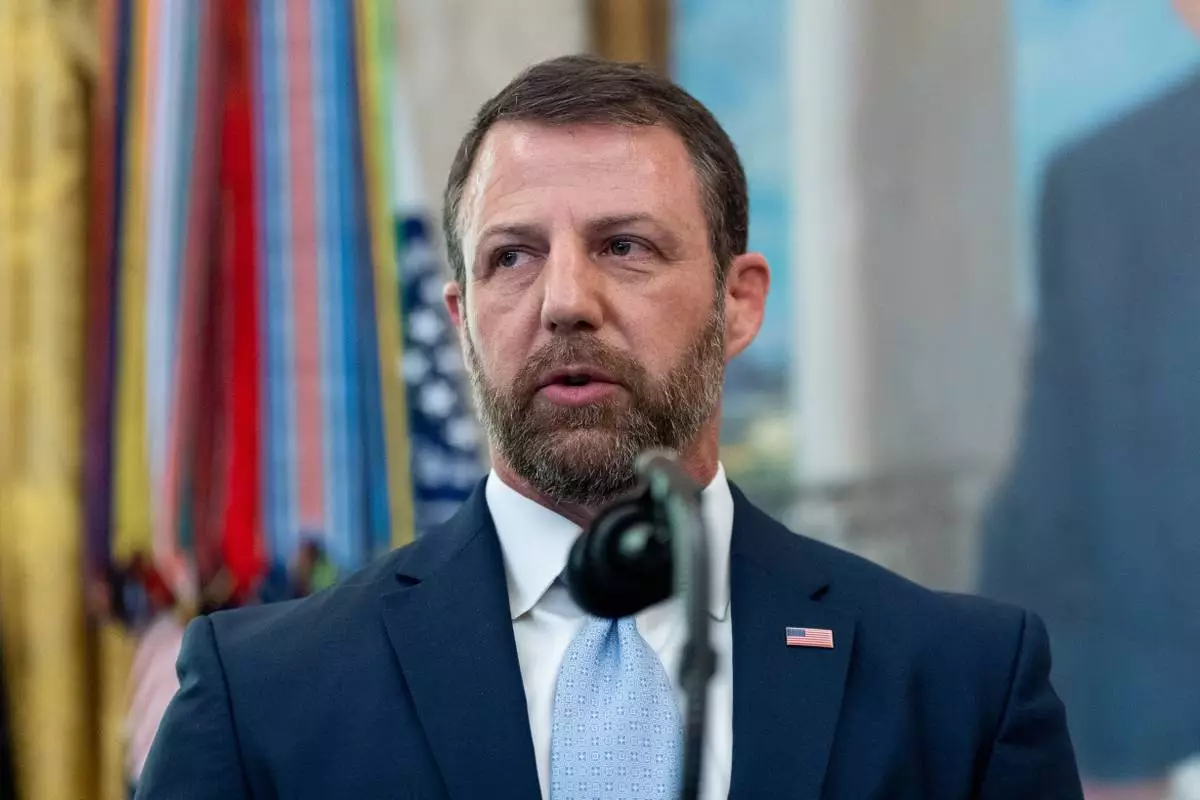
Homeland Security Secretary Markwayne Mullin speaks in the Oval Office of the White House, Tuesday, March 24, 2026, in Washington. (AP Photo/Alex Brandon)

Homeland Security Secretary Markwayne Mullin speaks in the Oval Office of the White House, Tuesday, March 24, 2026, in Washington. (AP Photo/Alex Brandon)

Recommended Articles