TOKYO--(BUSINESS WIRE)--Apr 1, 2026--
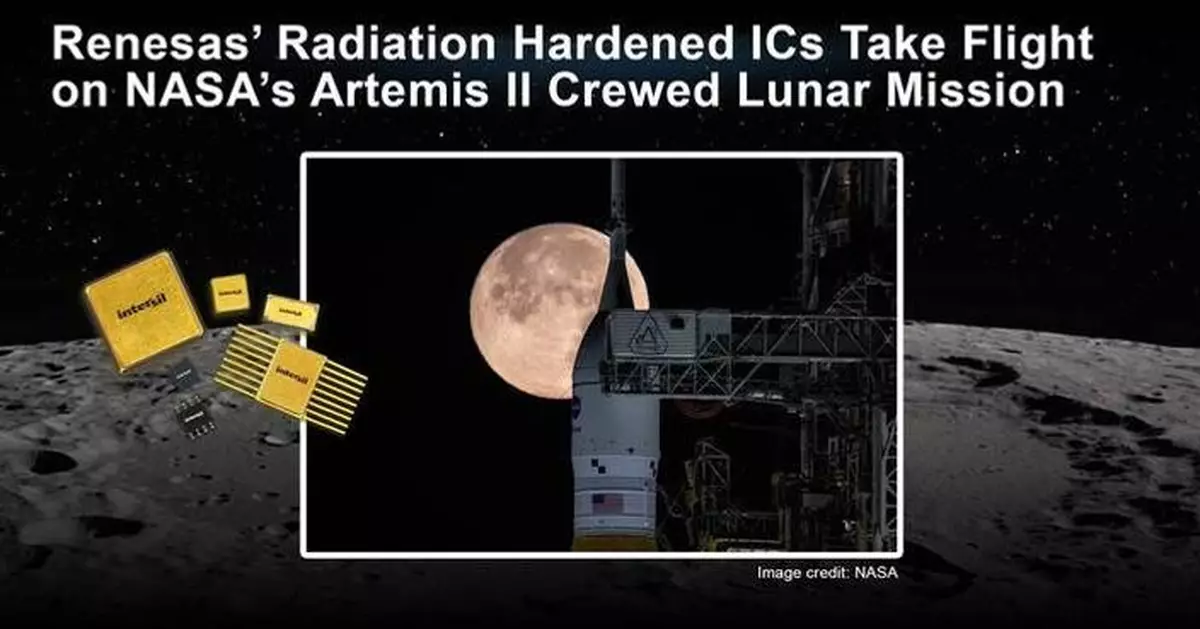
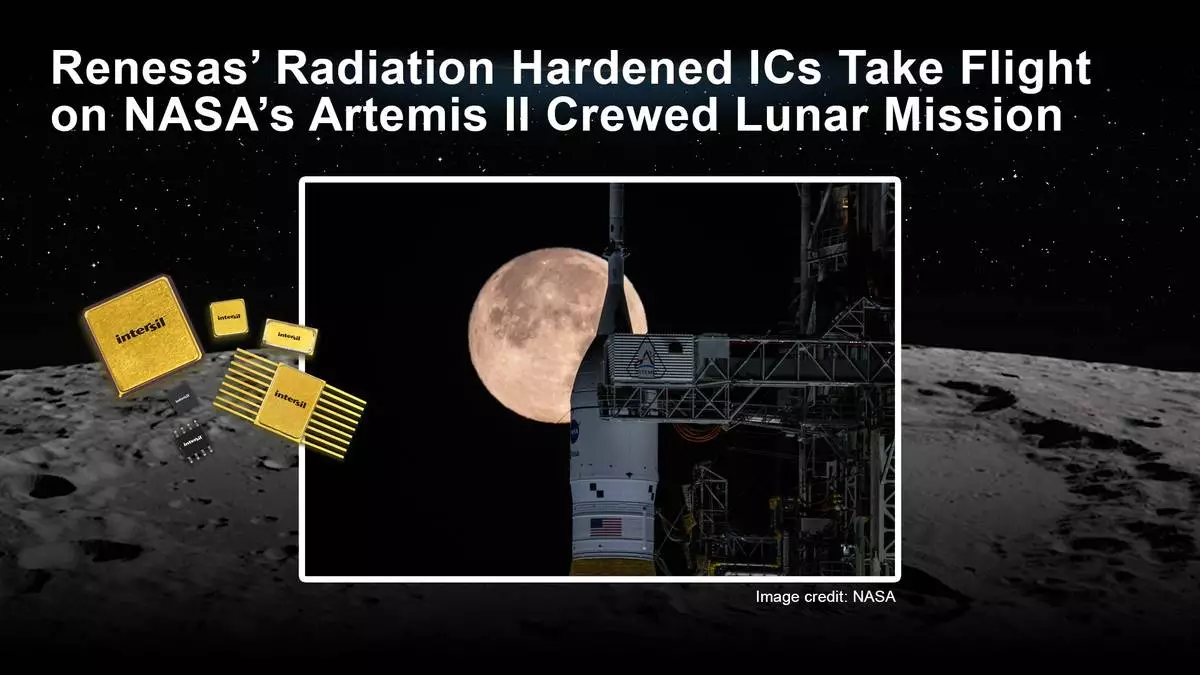
Renesas Electronics Corporation (TSE:6723), a premier supplier of advanced semiconductor solutions, today announced its radiation-hardened (rad-hard) ICs are being used in NASA’s Artemis II mission, which successfully launched from the Kennedy Space Center in Florida on April 1. The first crewed mission around the moon in decades, Artemis II represents a major milestone in NASA’s plans to return humans to the moon and establish a long-term presence on the lunar surface.
This press release features multimedia. View the full release here: https://www.businesswire.com/news/home/20260331236884/en/
Four astronauts are now en route to orbit the moon aboard NASA’s Orion spacecraft as part of NASA’s Artemis II mission, taking humans farther from Earth than they have traveled in over fifty years. During the flight, the crew will test spacecraft systems and crew performance in this deep-space environment before returning safely home. The mission will validate key spacecraft capabilities and position Orion for future crewed journeys and lunar landings.
Within the Artemis II core systems, including the Orion capsule and Space Launch System (SLS) rocket, Renesas rad-hard ICs are used across multiple subsystems. These Intersil-branded devices are embedded in the space vehicle’s avionics and safety launch system, helping to regulate and distribute power, maintain signal integrity and support onboard computing. These specialized ICs are built to operate reliably when exposed to the elevated levels of radiation and extreme temperatures that are typical of human space missions.
“Human space flight missions leave no margin for failure, and we’re proud to be one of the select few semiconductor companies entrusted to provide space-qualified technology for this historic crewed Artemis mission,” said Chris Stephens, Vice President of the HiRel Business Division at Renesas. “Our rad-hard devices help keep spacecraft systems connected, protected and precisely controlled, as crews venture into deep space. We look forward to supporting future landmark missions and ushering in the next era of solar system exploration with our space-grade semiconductor solutions.”
The Renesas Intersil brand has a long history in the space industry spanning more than six decades, beginning with the founding of Radiation Inc. in 1950. Since then, virtually every satellite, shuttle launch and deep-space exploration mission has included Intersil-branded products. Renesas leverages this experience to deliver efficient, thermally-optimized and highly-reliable SMD, MIL-STD-883 and MIL-PRF 38535 Class-V/Q Intersil-branded products for the defense, high-reliability (Hi-Rel), and rad-hard space markets. Renesas Intersil-brand rad-hard ICs support subsystems for mission critical applications in data communications transfer, power supplies and power conditioning, general protection circuitry, and telemetry, tracking and control (TT&C).
For more information on Renesas’ Intersil-brand space and hi-reliability solutions, visit: www.renesas.com/space.
About Renesas Electronics Corporation
Renesas Electronics Corporation ( TSE: 6723 ) empowers a safer, smarter and more sustainable future where technology helps make our lives easier. A leading global provider of microcontrollers, Renesas combines our expertise in embedded processing, analog, power and connectivity to deliver complete semiconductor solutions. These Winning Combinations accelerate time to market for automotive, industrial, infrastructure and IoT applications, enabling billions of connected, intelligent devices that enhance the way people work and live. Learn more at renesas.com. Follow us on LinkedIn, Facebook, X, YouTube, and Instagram.
(Remarks) All names of products or services mentioned in this press release are trademarks or registered trademarks of their respective owners.
Renesas’ Radiation-Hardened ICs Take Flight on NASA’s Artemis II Crewed Lunar Mission
CAIRO (AP) — Iranians began to regain internet access on Wednesday after authorities ended a monthslong shutdown. But users said service was slow and spotty in some areas, with apps like YouTube and Instagram heavily restricted, as they were before the cutoff began during nationwide protests in January.
Authorities justified the outage as a military imperative after the United States and Israel attacked Iran on Feb. 28. Their decision to lift some restrictions this week came as negotiators appeared to be closing in on a more permanent truce. But many Iranians feared access could be cut off again at a moment's notice.
Internet tracking company Netblocks said Iran’s connectivity, which measures the ability of devices to connect to the internet, is at around 86% of capacity from before the cutoff. Internet analysis firm Kentik said internet traffic, which measures the amount of data transferred and is a good illustration of usage, was at around 40%.
Amir Rashidi, an Iranian cybersecurity analyst, said there were still widespread disruptions. “It's too early to say the shutdown is over,” he wrote on X.
Iran’s roughly 90 million people have been cut off from the internet for most of 2026, one of the world’s longest and strictest national shutdowns. Young people with online careers saw their incomes evaporate. Job losses and the closure of online businesses added to the war's steep economic costs.
The cutoff made it difficult for Iranian families to communicate through months of unrest and war. At some points, phone lines were also cut off, though they were later restored.
A woman living in Tehran said that for months she was barely able to speak to her sons living abroad. She couldn't believe authorities had restored access, saying she had assumed they would find some justification to prolong the outage.
A taxi driver said service was restored but weak. He expressed hope it would improve so he could use messaging apps with family and friends. Both spoke on condition of anonymity for security reasons.
Prices spiked during the shutdown, with residents in Tehran at times paying around $7.50 per gigabyte. Prices are back down to around $2.25 for 30 gigabytes, roughly where they were before the protests.
Even then, Iran tightly controlled access to popular social media sites, leading many to rely on virtual private networks, or VPNs. The cost of those workarounds soared during the shutdown, making them unaffordable for many as the economy was battered.
Businesses have started reappearing online, announcing their return with posts on sites like Instagram and Telegram.
A gamer and tech influencer in the central city of Isfahan said the shutdown had caused him to lose a lot of his audience on YouTube and Instagram, where he had spent years building up a large following.
“All my views and interactions are way down. I’ve been erased from the algorithm,” he said in a voice note sent by WhatsApp, adding that his internet connection was still slower than before the shutdown.
“The situation is such that many content producers have had their income reduced to zero, have moved on to other jobs, or have been forced to sell their equipment to survive,” he said. He spoke on condition of anonymity for fear of reprisal.
Iranian authorities first shut down the internet in January during mass anti-government protests that were eventually stamped out in a violent crackdown. Thousands of people were killed and tens of thousands detained.
That cutoff was just starting to ease when the government imposed a complete internet blackout after the start of the war, when U.S. and Israeli strikes killed Iran's supreme leader and other top officials.
The government faced criticism for the prolonged shutdown, which caused even more harm to an economy devastated by inflation, strikes on key industries and a U.S. blockade on Iranian ports.
The internet cutoff cost an estimated $30-40 million daily, with indirect losses likely twice that much, a member of Iran’s Chamber of Commerce, Afshin Kolahi, told a local newspaper last month. About 10 million people have jobs that depend on internet connectivity, according to Communications Minister Sattar Hashemi.
Iranians still had access to a national net, but that has a far narrower reach, and users complained of poor service and heavy censorship. Senior government officials are given SIM cards granting them access to the global internet. Under pressure, the government expanded access to the SIM cards to some professions during the shutdown.

A woman checks her smartphone while sitting on a bench along a sidewalk in northern Tehran, Iran, Tuesday, May 26, 2026. (AP Photo/Vahid Salemi)