Skip to Content Facebook Feature Image

Pathward Research Reveals Gen Z’s Extended Path to Financial Independence and Their Increasing Reliance on Digital Financial Tools

Business

Pathward Research Reveals Gen Z’s Extended Path to Financial Independence and Their Increasing Reliance on Digital Financial Tools
Business

Business

Pathward Research Reveals Gen Z’s Extended Path to Financial Independence and Their Increasing Reliance on Digital Financial Tools

2025-11-13 21:08 Last Updated At:11-14 15:57

SIOUX FALLS, S.D.--(BUSINESS WIRE)--Nov 13, 2025--

Pathward®, N.A., a national bank focused on financial access, today announced the results of research it conducted in partnership with Mastercard on financial attitudes and behaviors of Gen Z. The report, “ From Safety Net to Solo: A Data-Driven Look at Gen Z’s Financial Journey,” illustrates the steps in their migration to financial independence. This generation faces high costs as they navigate their early financial lives but are largely optimistic about their financial future.

This press release features multimedia. View the full release here: https://www.businesswire.com/news/home/20251113498646/en/

According to the survey, only 37% of Gen Z reports being mostly or completely independent from their parents with 63% of 23 and 24 year olds relying on their parents for some portion of their expenses. Many rely on their parents to cover monthly expenses, which is likely a result of many Gen Zers transitioning to full-time employment and navigating today’s high cost of essentials like groceries, rent and gas. Even as they transition away from the financial support of their parents, many respondents indicated that they take a conservative or moderate approach to risk tolerance with their finances.

Despite the somewhat slow transition to financial independence and a generally cautious approach to risk, Gen Z has an optimistic outlook on their long-term financial prospects. Regardless of whether they are in high school, college, post-college or pursuing an alternative to college, more than half (55%) indicated the belief that they are extremely or very likely to reach their financial goals. Conversely, 9% believe they are not likely to achieve their financial goals.

“Gen Z knows where they want to go financially, and many members of this generation are optimistic that they can get there,” said Pathward President Anthony Sharett. “Understanding Gen Z’s outlook on the future and their financial priorities is essential for financial institutions looking to create solutions that align with their needs today and tomorrow.”

Gen Z Takes a Diversified Approach to Financial Tools

Even as a plethora of payment tools have been introduced to consumers, Gen Z primarily uses more traditional payment methods like debit cards (34%) and cash and checks (25%). Looking a bit closer at different cohorts within Gen Z, however, there is a clear migration to credit and digital payments (digital wallets, payment apps) that correlates with increases in age and education. While the older, more educated cohorts are not abandoning traditional payment tools, they are capitalizing on all the benefits that today’s payment options offer.

Convenience is the clear driver of digital wallet and mobile app usage, with mobile apps viewed as the most flexible payment vehicle cohort. Usage patterns across these digital payment tools vary across Gen Z age groups. While digital payment options are important to Gen Z, when asked which payment vehicle they would choose if they could only have one, 40% of respondents—including 46% of college-aged Gen Zers and 42% of Gen Zers pursuing college alternatives—selected the traditional debit card.

“Gen Z is the next generation of financial decision-makers, and their behaviors today are shaping the future of how money moves,” said Will Sowell, Pathward Divisional President of Partner Solutions. “As they transition through life stages, their expectations for easy, secure transactions set the tone for product design, education and delivery.”

Our electronic book, “From Safety Net to Solo: A Data-Driven Look at Gen Z’s Financial Journey”, provides results from an online survey of 750 participants. The study focused on Gen Z respondents (ages 18-24), segmented into four life stages: Late High School, College, College Alternative, and Post College. It explores consumer profiles and self-perceptions, key influencers, top financial products owned and used, employment status, financial independence, income levels, risk tolerance, and sources of financial advice. Understanding these patterns can help payment providers and merchants drive better targeting, reach the right audience and accept digital wallets in top tier spend categories. Read “From Safety Net to Solo: A Data-Driven Look at Gen Z’s Financial Journey” on Pathward.com to learn more.

About Pathward ®

Pathward ®, N.A., a national bank, is a subsidiary of Pathward Financial, Inc. (Nasdaq: CASH). Pathward is focused on financial access and strives to increase financial availability, choice and opportunity across our Partner Solutions and Commercial Finance business lines. The strategic business lines provide support to individuals and businesses. Learn more at Pathward.com.

Pathward published the results of research it conducted in partnership with Mastercard on financial attitudes and behaviors of Gen Z.

Pathward published the results of research it conducted in partnership with Mastercard on financial attitudes and behaviors of Gen Z.

WESTMINSTER, Colo.--(BUSINESS WIRE)--Apr 1, 2026--

Vantor, the leading provider of unified spatial intelligence from space to ground, has been awarded its third National Geospatial-Intelligence Agency (NGA) Luno contract to provide NGA and other U.S. Government agencies automated, near real-time orbital intelligence of high-interest objects in space.

This press release features multimedia. View the full release here: https://www.businesswire.com/news/home/20260401774885/en/

Under the $2.3 million contract, Vantor will utilize its high-resolution imagery of space objects, also known as non-Earth Imagery (NEI), to deliver intelligence on priority objects in low Earth orbit, including providing alerts when anomalies are present. The analysis will be largely automated, marking a significant step forward in eliminating manual processing and accelerating timely and actionable insights for Space Domain Awareness.

“In a contested domain like space, awareness is everything,” said Susanne Hake, Executive Vice President & General Manager, U.S. Government at Vantor. “Still, it’s the one domain where exquisite visual intelligence is extremely hard to come by, creating literal and figurative blind spots. Our NEI capabilities are one of the few technologies that can provide high-resolution visual intelligence of objects in space, providing intelligence analysts and decisionmakers with a deeper understanding of the behavior and intent of high-interest space objects—a decisive edge in an increasingly complex environment.”

Vantor’s orbital intelligence capabilities can provide insights into a space object’s features, health, velocity, and movements, including whether an object is changing orbit—a situation that could endanger the safety of U.S. assets in space. Vantor satellites can capture images of other spacecraft at an industry-leading resolution of less than 10 cm from hundreds of kilometers away, making it possible to quickly characterize those space objects and determine their health and status.

This award marks the third win for Vantor under NGA’s Luno program. Vantor previously announced a Luno contract to automatically detect land use land cover change at global scale, enabling NGA to anticipate where maps and their features may require updates. And in June, Vantor was awarded a Luno contract to deliver AI/ML-generated object detection services to identify assets across air, maritime, land, and rail domains; determine counts at specified locations; detect trends and anomalies; and perform advanced spatial and temporal geospatial intelligence analysis.

“These awards reflect the core of Vantor’s mission—to deliver real-time intelligence faster than the speed of threat, from space to ground,” said Hake. “By integrating our persistent monitoring, change detection, and space-domain awareness capabilities, we’re empowering our partners to understand and act on threats across every domain, before they emerge.”

The Luno program—made up of Luno A and Luno B—is part of NGA’s ongoing efforts to execute an agile acquisition strategy that unlocks the capacity and innovation of the commercial geospatial industry.

About Vantor

Vantor is forging the new frontier of spatial intelligence to unlock a more autonomous, interoperable world. We give decision makers and operators the power to build a unified intelligence picture, delivering the clarity they need to navigate what’s happening now and shape what’s coming next. We fuse data from the world’s most capable imaging satellites with real-time sensor feeds from space, air, and ground to create an AI-ready digital twin of Earth. Our spatial intelligence platform automates every part of the cycle—from tasking to collection to production—to update and analyze this foundation at the pace of change. Our products drive deeper mission-critical insights and connect the next generation of autonomous systems across the defense, intelligence, and commercial landscape.

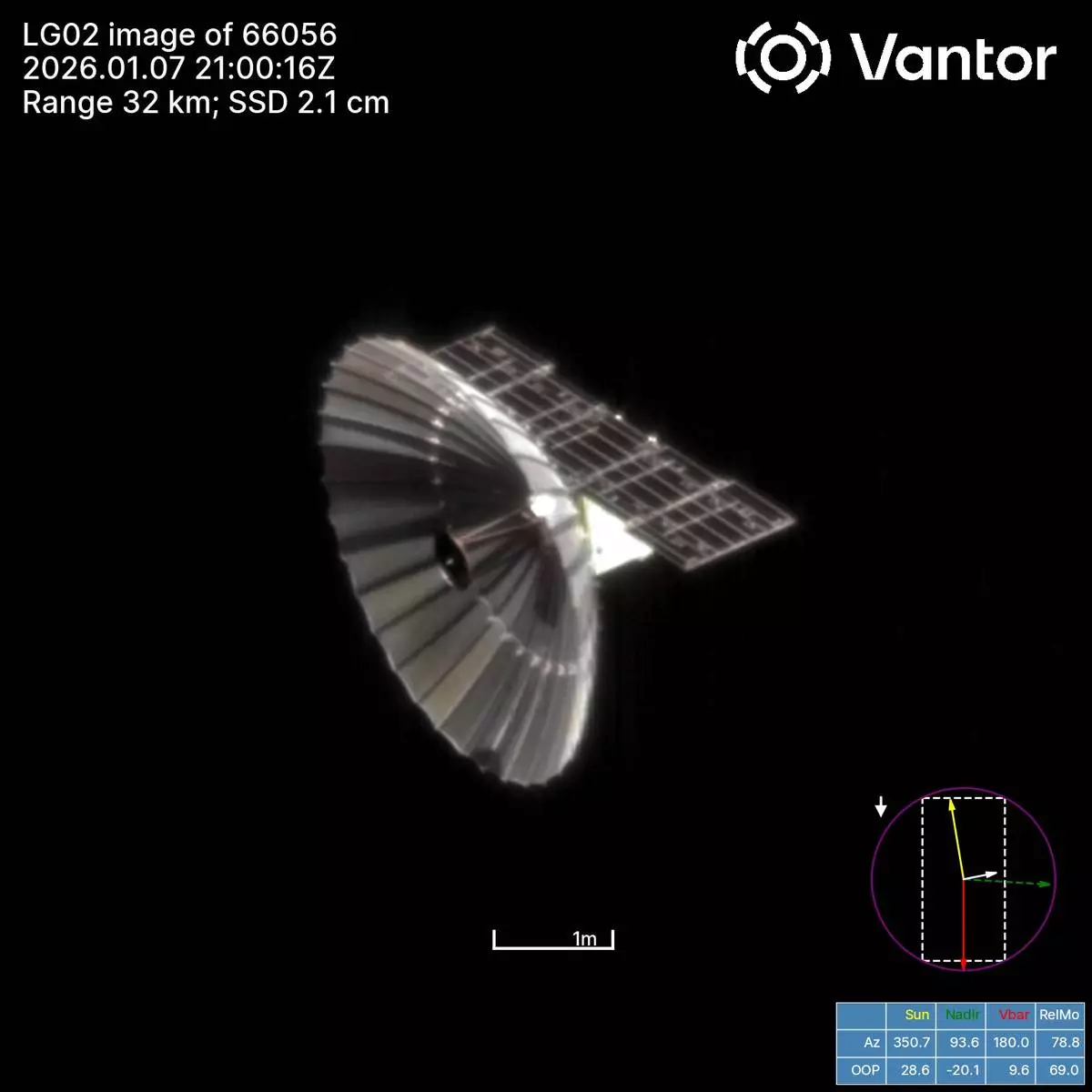
Vantor non-Earth image of a Chinese imaging satellite, collected under the NGA Luno B contract. The synthetic aperture radar (SAR) satellite features a large deployable antenna that enables high-resolution radar imaging from orbit.

Vantor non-Earth image of a Chinese imaging satellite, collected under the NGA Luno B contract. The synthetic aperture radar (SAR) satellite features a large deployable antenna that enables high-resolution radar imaging from orbit.

Recommended Articles