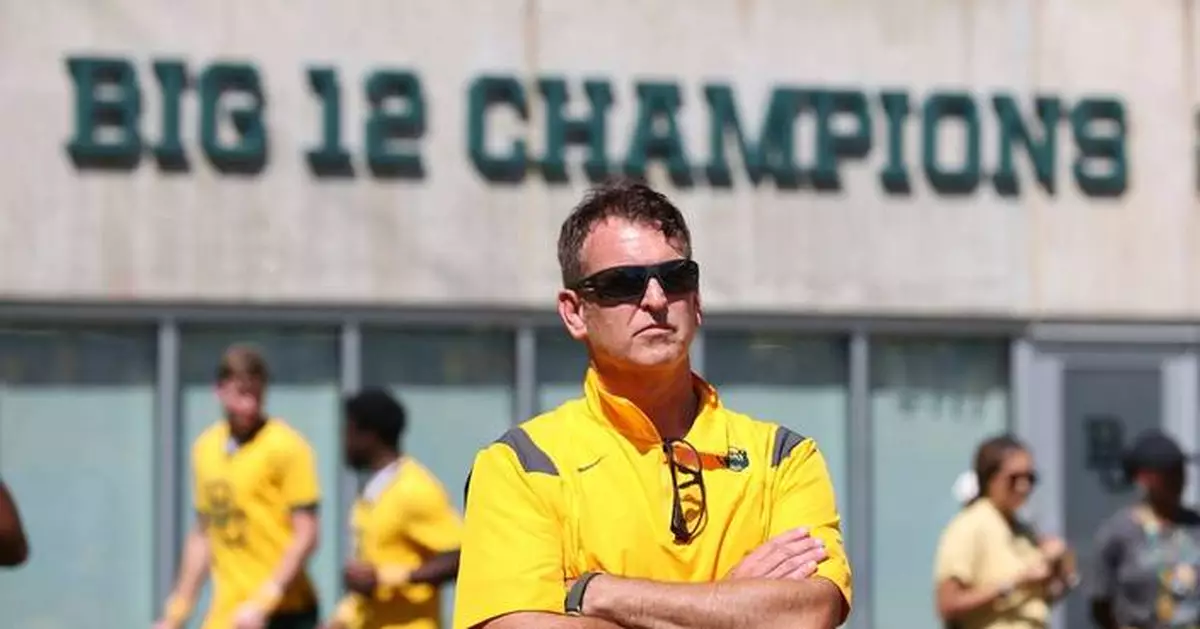
CFP selection committee chairman Mack Rhoades has been replaced by Arkansas athletic director Hunter Yurachek following an announcement Thursday that Rhoades had stepped down from the role and taken a leave of absence as the athletic director at Baylor while the school investigates unspecified allegations against him.
While not going into additional details, Baylor vice president Jason Cook said Thursday the allegations against Rhoades do not involve Title IX, student-athlete welfare or NCAA rules violations, and do not involve the football program. Cook said the university takes the allegations seriously and is in the process of conducting a thorough investigation.
The school earlier in the day released a statement that said Rhoades began his leave for “personal reasons” on Wednesday.
Rhoades didn’t respond to a message from The Associated Press. He told ESPN that he initiated his leave from Baylor, but declined to explain why.
The new allegations received this week are not related to a report earlier this month of an alleged verbal and physical altercation involving Rhoades, a football player and an assistant coach. The school had previously said it reviewed and investigated that matter, and that it was closed after appropriate actions were taken.
Rhoades was in the second year of a three-year College Football Playoff selection committee appointment, and his first season as chairman.
Yurachek, in his second year on the committee, now becomes the primary spokesperson for the CFP decision making process. The chairman regularly appears on weekly prime-time ESPN reveals of the committee's rankings.
Utah AD Mark Harlan will fill Rhoades' vacancy on the committee as the Big 12 representative. Harlan previously served a one-year term in 2023.
The selection committee, which has done two weekly rankings this season, was already down from its standard 13 members to 12 after Randall McDaniel stepped away from his role on the committee for personal reasons last month. The past All-America guard for Arizona State is expected to return next year.
Rhoades has been Baylor’s athletic director since July 2016, when he took over in the wake of the revelation of a sprawling sexual assault scandal that cost two-time Big 12 champion football coach Art Briles his job. That NCAA case against the Bears wasn’t resolved until 2021, when the school was placed on four years of probation.
Before Baylor, Rhoades was the AD at Missouri (2015-16), Houston (2009-15) and Akron (2006-09).
Outkick had reported earlier this month that Rhoades approached tight end Michael Trigg before a home game Sept. 20 against Arizona State and put his hands on the player, while using an expletive in asking why he was wearing a long-sleeved yellow shirt under his uniform. Then after the game, according to the report, Rhoades was behind Trigg and some coaches when the AD allegedly grabbed one of the assistants and verbally accosted him.
Get poll alerts and updates on the AP Top 25 throughout the season. Sign up here and here (AP News mobile app). AP college football: https://apnews.com/hub/ap-top-25-college-football-poll and https://apnews.com/hub/college-football
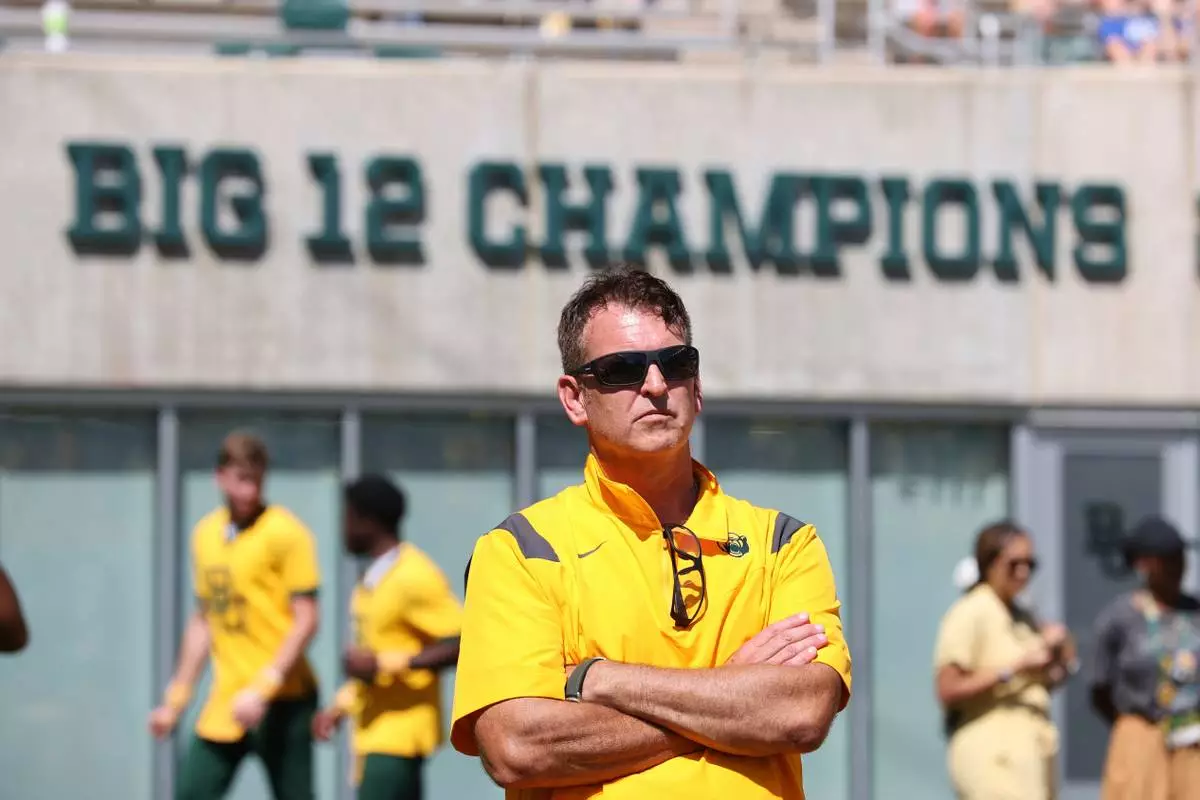
FILE - Baylor athletic director Mack Rhoades looks on from the sideline during an NCAA college football game against BYU, Saturday, Sept. 28, 2024, in Waco, Texas. (AP Photo/Jerry Larson, File)
WESTMINSTER, Colo.--(BUSINESS WIRE)--Apr 1, 2026--
Vantor, the leading provider of unified spatial intelligence from space to ground, has been awarded its third National Geospatial-Intelligence Agency (NGA) Luno contract to provide NGA and other U.S. Government agencies automated, near real-time orbital intelligence of high-interest objects in space.
This press release features multimedia. View the full release here: https://www.businesswire.com/news/home/20260401774885/en/
Under the $2.3 million contract, Vantor will utilize its high-resolution imagery of space objects, also known as non-Earth Imagery (NEI), to deliver intelligence on priority objects in low Earth orbit, including providing alerts when anomalies are present. The analysis will be largely automated, marking a significant step forward in eliminating manual processing and accelerating timely and actionable insights for Space Domain Awareness.
“In a contested domain like space, awareness is everything,” said Susanne Hake, Executive Vice President & General Manager, U.S. Government at Vantor. “Still, it’s the one domain where exquisite visual intelligence is extremely hard to come by, creating literal and figurative blind spots. Our NEI capabilities are one of the few technologies that can provide high-resolution visual intelligence of objects in space, providing intelligence analysts and decisionmakers with a deeper understanding of the behavior and intent of high-interest space objects—a decisive edge in an increasingly complex environment.”
Vantor’s orbital intelligence capabilities can provide insights into a space object’s features, health, velocity, and movements, including whether an object is changing orbit—a situation that could endanger the safety of U.S. assets in space. Vantor satellites can capture images of other spacecraft at an industry-leading resolution of less than 10 cm from hundreds of kilometers away, making it possible to quickly characterize those space objects and determine their health and status.
This award marks the third win for Vantor under NGA’s Luno program. Vantor previously announced a Luno contract to automatically detect land use land cover change at global scale, enabling NGA to anticipate where maps and their features may require updates. And in June, Vantor was awarded a Luno contract to deliver AI/ML-generated object detection services to identify assets across air, maritime, land, and rail domains; determine counts at specified locations; detect trends and anomalies; and perform advanced spatial and temporal geospatial intelligence analysis.
“These awards reflect the core of Vantor’s mission—to deliver real-time intelligence faster than the speed of threat, from space to ground,” said Hake. “By integrating our persistent monitoring, change detection, and space-domain awareness capabilities, we’re empowering our partners to understand and act on threats across every domain, before they emerge.”
The Luno program—made up of Luno A and Luno B—is part of NGA’s ongoing efforts to execute an agile acquisition strategy that unlocks the capacity and innovation of the commercial geospatial industry.
About Vantor
Vantor is forging the new frontier of spatial intelligence to unlock a more autonomous, interoperable world. We give decision makers and operators the power to build a unified intelligence picture, delivering the clarity they need to navigate what’s happening now and shape what’s coming next. We fuse data from the world’s most capable imaging satellites with real-time sensor feeds from space, air, and ground to create an AI-ready digital twin of Earth. Our spatial intelligence platform automates every part of the cycle—from tasking to collection to production—to update and analyze this foundation at the pace of change. Our products drive deeper mission-critical insights and connect the next generation of autonomous systems across the defense, intelligence, and commercial landscape.
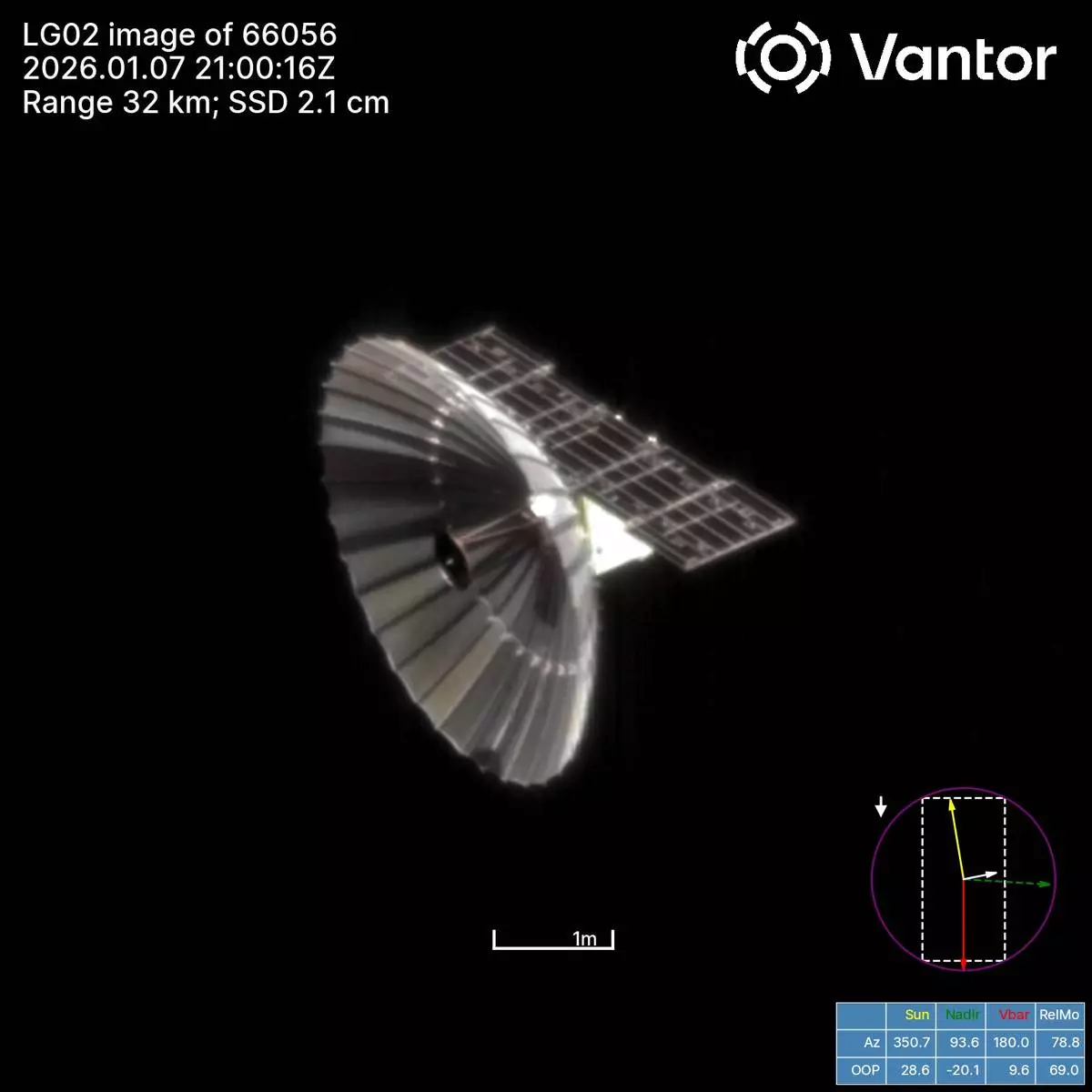
Vantor non-Earth image of a Chinese imaging satellite, collected under the NGA Luno B contract. The synthetic aperture radar (SAR) satellite features a large deployable antenna that enables high-resolution radar imaging from orbit.