MONTGOMERY, Ala. (AP) — Each day, PBS programming fills the airwaves of Alabama Public Television with shows such as “Sesame Street,” “Daniel Tiger’s Neighborhood,” “Antiques Roadshow” and “PBS Newshour.” Alabamians could lose access to those programs on state airwaves if the Alabama Educational Television Commission opts to become the first state network to sever ties with PBS.
The Alabama commission last month discussed the possibility of dropping PBS and is expected to discuss the matter again its Nov. 18 meeting.
The possibility comes after President Donald Trump and Congress in July withdrew funding for the nonprofit The Corporation for Public Broadcasting, which provides grants to public radio and television, and as some state commissioners accused PBS of being an unneeded expense or politically biased.
“We have to figure out what our options are,” said Ferris W. Stephens, the chairman of the commission. “Before we decide those things, I just think we need a lot more information.” Stephens said he does not expect a vote at the November meeting.
Alabama Public Television Executive Director Wayne Reid said some commissioners asked him to research the possibility and ramifications of ending the contract with PBS. Ending the affiliation would cause APT to lose access to popular programs such as “Sesame Street” and “PBS NewsHour”, as well as its ability to distribute content on streaming platforms. Reid said the state network would have to buy other programming to replace it.
“If we cut ties, all of that would be gone. Right now, we’re doing a ton of research. Everybody here is working on what it would take to replace the things that are affected by PBS,” Reid said.
Reid said he was also asked to research if they could keep PBS but drop the news programs “PBS NewsHour” and “Washington Week.” Reid said the decision ultimately belongs to the commission.
No other statewide network has cut ties with PBS to date, a spokesperson for PBS confirmed.
The possibility prompted a backlash from Alabama public television viewers and donors.
Jennifer Greer, a retired writer and educator, is one of the volunteers helping to mount a postcard campaign to urge the state to keep the PBS affiliation. Preschoolers, students and adults across the state benefit each day from PBS programs, she said.
“When you take one of the most effective tools in the public education toolkit, and you defund it and you make it so only the wealthy can afford it, that’s just irresponsible. That’s a step backward,” Greer said.
Petitions and posts were shared across social media urging people to “Save PBS for Alabama Children” urging people to attend the upcoming meeting.
The Corporation for Public Broadcasting provided about $2.8 million for Alabama Public Television although the money is not directly used to purchase PBS programming. Alabama Public Television pays about $2.2 million to purchase PBS programming. The amount was discounted after the federal funding cut.
Greer and others said they are concerned that dropping PBS would put Alabama Public Television in a downward financial spiral. Public media gets a substantial part of its funding from memberships and donations. “If we separate from PBS, our contributions are going to plummet, and that could jeopardize the stability of the whole operation,” she said.
Commissioners were divided at an Oct. 28 meeting, according to the Alabama Reflector and al.com.
“I just, I don’t want to fund it, PBS has made themselves the enemy of what I stand with, and so I do not like them, and I don’t follow the philosophy of feeding the beast,” commission member Les Barnett said during the meeting according to the Alabama Reflector. Barnett did not return an email from The Associated Press.
J. Holland, another commission member, said he is interested in exploring if the state can begin buying PBS programming on an a la carte basis, picking some shows but not others. The current PBS contract does not allow that.
Pete Conroy, another commission member, said they should keep PBS. He said he is concerned that some commissioners are “acting politically.”
“I know how much PBS programming is used in our public schools, private schools and churches. It’s always about the kids. These children need to be lifted up with this kind of programming,” Conroy said.

FILE - Arthur the Aardvark waves on Capitol Hill in Washington, Feb. 16, 2011, during a news conference to discuss the future of public broadcasting. (AP Photo/Harry Hamburg, File)
TOKYO (AP) — Polls opened Sunday in parliamentary elections that Japan's popular Prime Minister Sanae Takaichi hopes will give her struggling party a big enough win to push through an ambitious conservative political agenda.
Takaichi is hugely popular, but the ruling Liberal Democratic Party, which has governed Japan for most of the last seven decades, has struggled from funding and religious scandals. She called Sunday’s snap elections only after three months in office, hoping to turn that around before her popularity fades.
She wants to make progress on a right-wing agenda that aims to boost Japan’s economy and military capabilities as tensions grow with China. She also wants to nurture ties with her crucial U.S. ally, and a sometimes unpredictable President Donald Trump.
The ultraconservative Takaichi, who took office as Japan’s first female leader in October, pledged to “work, work, work,” and her style, which is seen as both playful and tough, has resonated with younger fans.
The latest surveys indicated a landslide win in the lower house for the LDP. The opposition, despite the formation of a new centrist alliance and a rising far-right, is seen as too splintered to be a real challenger.
Takaichi is betting that her LDP party, together with its new partner, the Japan Innovation Party, will secure a majority in the 465-seat lower house, the more powerful of Japan’s two-chamber parliament.
Recent surveys by major Japanese newspapers show a possibility that Takaichi’s party could win a simple majority on its own while her coalition could win as many as 300 seats, a big jump from a thin majority it held since a 2024 election loss.
If the LDP fails to win a majority, “I will step down,” she said.
A big win by Takaichi’s coalition could mean a significant shift to the right in Japan’s security, immigration and other policies, with its right-wing partner JIP's leader Hirofumi Yoshimura saying his party will serve as an “accelerator.”
Japan has recently seen far-right populists gain ground, such as the anti-globalist and surging nationalist party Sanseito.
Takaichi has pledged to revise security and defense policies by December to bolster Japan’s offensive military capabilities, lifting a ban on weapons exports and moving further away from the country’s postwar pacifist principles.
She has been pushing for tougher policies on foreigners, anti-espionage and other measures that resonate with a far-right audience but ones that experts say could undermine civil rights.
Takaichi also wants to increase defense spending in response to Trump’s pressure on Japan to loosen its purse strings.
Though Takaichi said she is seeking the public's mandate for her “nation splitting policies,” she avoided contentious issues such as ways to fund soaring military spending, how to fix diplomatic tension with China and other controversial issues.
In her campaign speeches, Takaichi enthusiastically talked about the need for “proactive” government spending to fund “crisis management investment and growth,” such as measures to strengthen economic security, technology and other industries. Takaichi also seeks to push tougher measures on immigration and foreigners, including stricter requirements for foreign property owners and a cap on foreign residents.
The snap election after only three months in office “underscores a problematic trend in Japanese politics in which political survival takes priority over substantive policy outcomes,” said Masato Kamikubo, a Ritsumeikan University politics professor. “Whenever the government attempts necessary but unpopular reforms ... the next election looms.”
There are some uncertainties. The hastily called election that gave little time for people to prepare has already invited complaints.
Sunday’s vote also began under fresh snowfall across the country, including in Tokyo. Record snowfall in northern Japan over the past few weeks, which blocked roads and was blamed for dozens of deaths nationwide, could hinder voting or delay vote counting in hard-hit areas. How her popularity will translate into votes among younger voters, notorious for their low turnout, during bad weather is unpredictable.
Kazuki Ishihara, 54, said she voted for the LDP for stability and in hopes for something new under Takaichi. “I have some hope that she could do something” her predecessors could not.
A 50-year-old office worker Yoshinori Tamada said his interest is wages. “I think a lot when I look at my pay slip, and I cast my vote for a party that I believe I can trust in that regard.”
Associated Press video journalist Mayuko Ono in Tokyo contributed to this report.
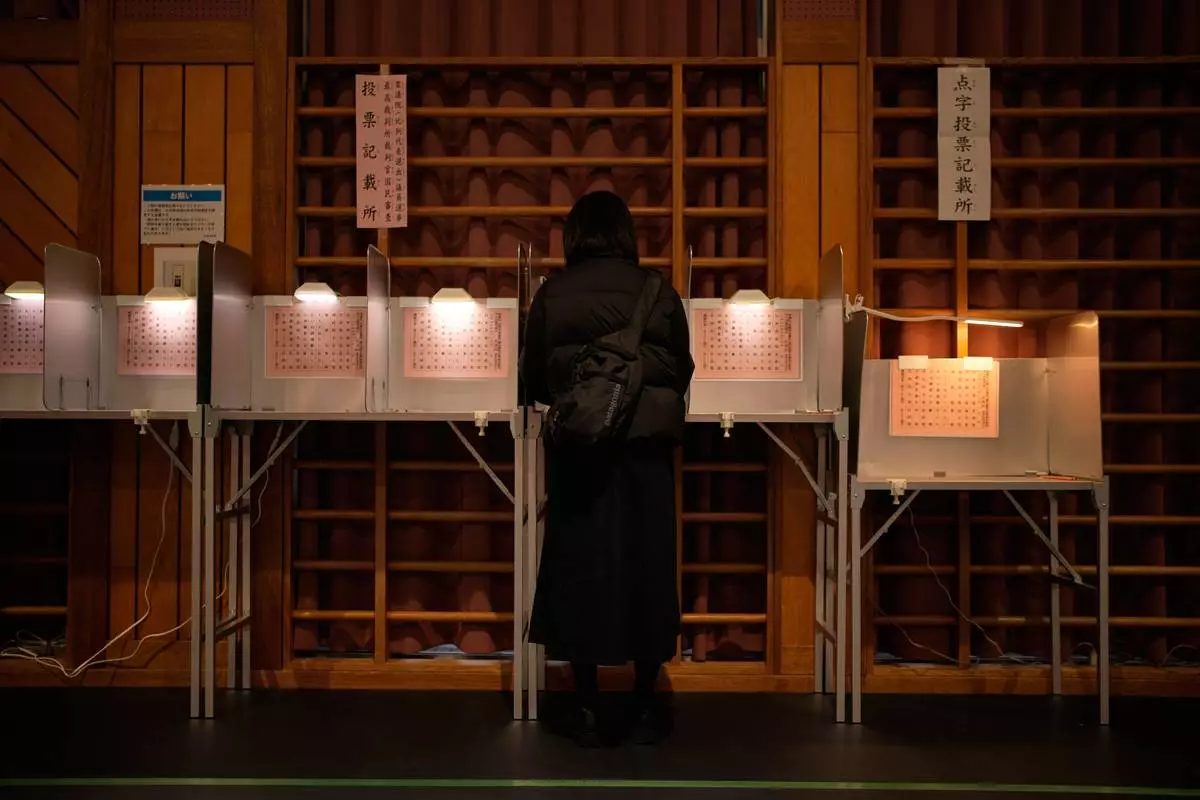
A voter fills in a ballot in the lower house election at a polling station Sunday, Feb. 8, 2026, in Tokyo. (AP Photo/Louise Delmotte)

A voter fills in a ballot in the lower house election at a polling station Sunday, Feb. 8, 2026, in Tokyo. (AP Photo/Louise Delmotte)

A voter fills in a ballot in the upper house election at a polling station Sunday, Feb. 8, 2026, in Tokyo. (AP Photo/Louise Delmotte)
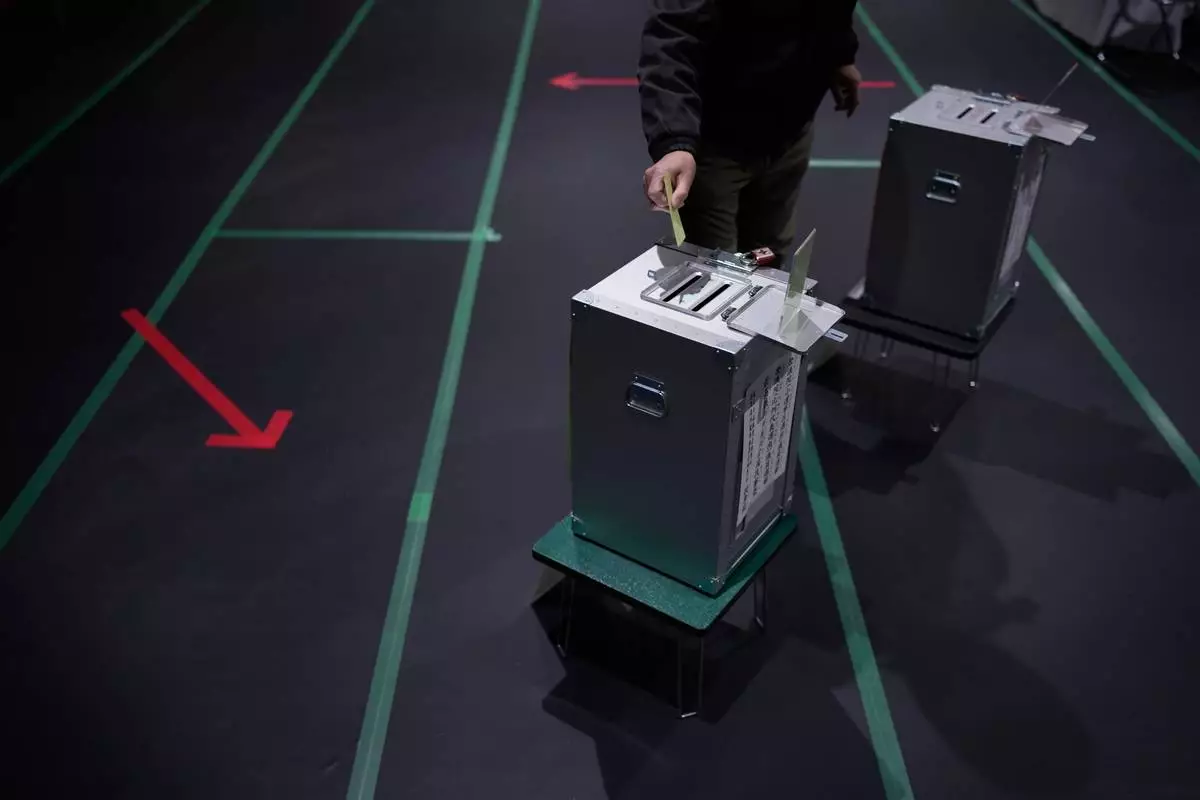
A voter casts a ballot in the upper house election at a polling station Sunday, Feb. 8, 2026, in Tokyo. (AP Photo/Louise Delmotte)
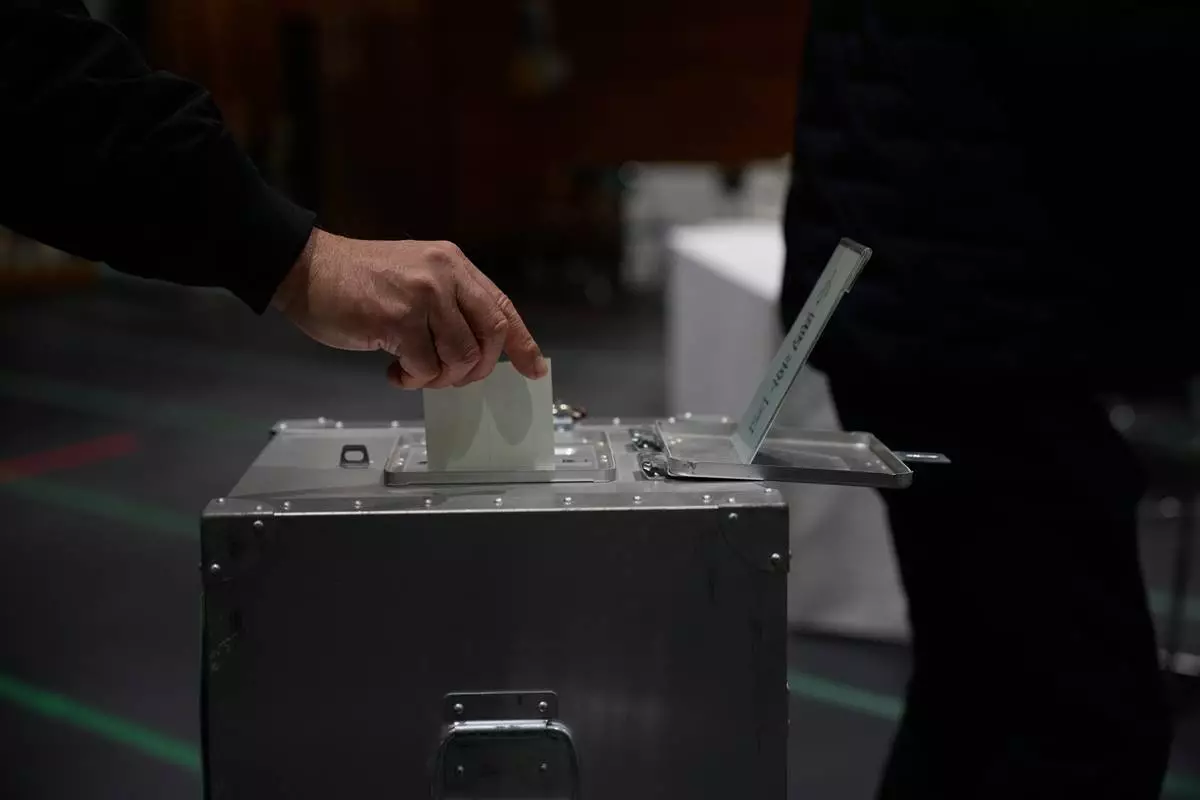
A voter casts a ballot in the upper house election at a polling station Sunday, Feb. 8, 2026, in Tokyo. (AP Photo/Louise Delmotte)