JUNEAU, Alaska (AP) — The Trump administration said Thursday it is rescinding federal rules that were aimed at protecting from future oil and gas leasing vast swaths of a petroleum reserve in Alaska that provide key habitat for migrating birds, caribou and other wildlife.
The U.S. Interior Department said the final rule would be published next week but announced it is repealing rules put in place last year. Those rules restricted future leasing and industrial development in areas within the National Petroleum Reserve-Alaska designated as special for wildlife, subsistence or other values.
Thursday's announcement is in line with an Alaska-specific executive order President Donald Trump signed upon his return to office. The order sought to unravel policies put in place by his predecessor, Democrat Joe Biden, that state political leaders complained had limited Alaska’s ability to develop its vast energy resources, including oil and gas.
The Biden-era rules also had called for the Interior Department to evaluate regularly whether to designate new special areas or to boost protections in those areas. They cited rapidly changing conditions in the Arctic — such as melting permafrost and changes in plant life and wildlife corridors — due to climate change. The agency under Biden said the rules would not affect existing leases or operations, including the large Willow oil project, but would “raise the bar” for future development.
Interior Secretary Doug Burgum in June said the Biden-era rules were at odds with a leasing program mandate for the petroleum reserve and prioritized “obstruction over production.”
There has been longstanding debate over where oil and gas should be developed within the reserve. Supporters cite the petroleum reserve’s name to underscore their point that it’s a place for drilling. But opponents say federal law requires a balancing act for managing the reserve that includes environmental considerations and protections.
The reserve, roughly the size of Indiana, was set aside more than a century ago as an emergency oil supply for the U.S. Navy. It’s been overseen by the Interior Department since the 1970s.
Biden had angered many environmentalists when his administration approved Willow in the northeast portion of the reserve in 2023. Development of that project has being ongoing.
The most recent lease sale for the reserve was in 2019. A law passed earlier this year by Congress calls for at least five sales within the reserve over a 10-year period.
Voice of the Arctic Iñupiat, an advocacy group that includes leaders from Alaska's petroleum-rich North Slope, has seen responsible development as important for the economic wellbeing of communities in the region. Members expressed concerns during the Biden administration that their views weren't being heard, and lauded Thursday's announcement.
Josiah Patkotak, North Slope Borough mayor, in a statement called repealing the rules “a meaningful step toward restoring a federal process that respects local knowledge and leadership.”
But environmentalists criticized the administration's decision as short-sighted. Erik Grafe, an attorney with Earthjustice, in a statement called it “another example of how the Trump administration is trying to take us back in time with its reckless fossil fuels agenda.”
“This would sweep aside common-sense regulations aimed at more responsibly managing the Western Arctic’s irreplaceable lands and wildlife for future generations,” he said.
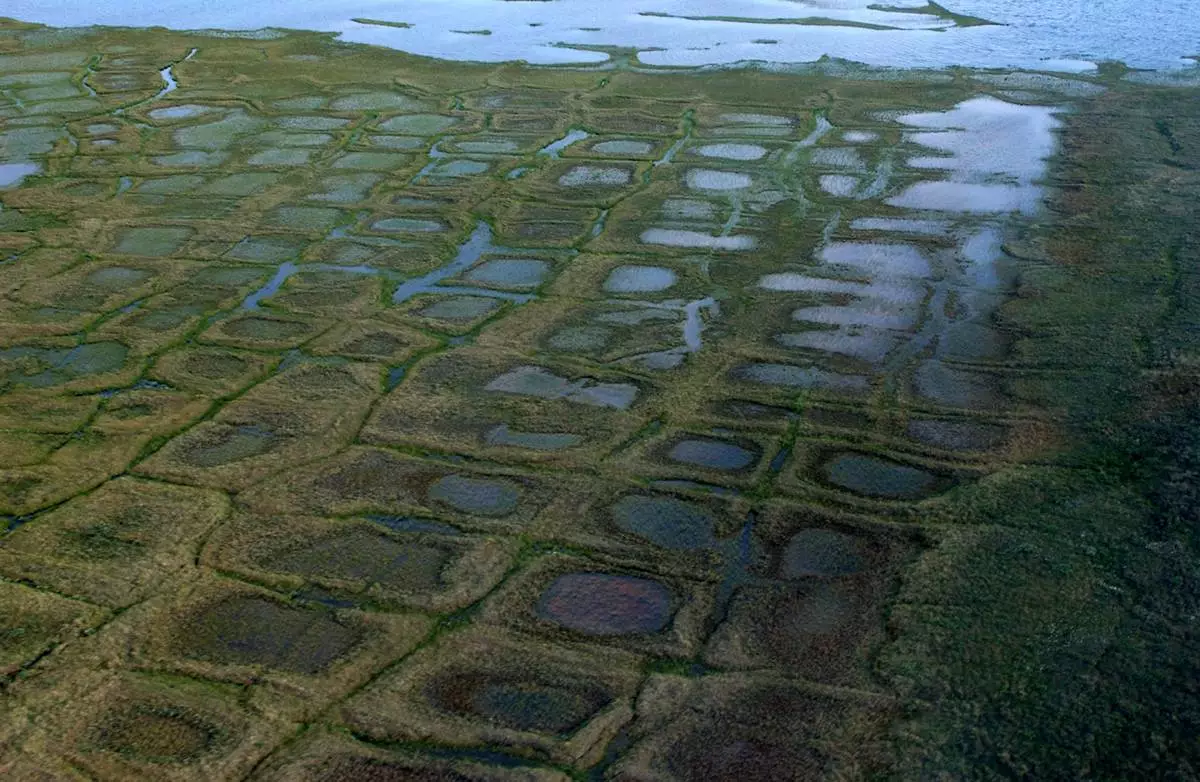
FILE - In this undated photo provided by the United States Geological Survey, permafrost forms a grid-like pattern in the National Petroleum Reserve-Alaska, managed by the Bureau of Land Management on Alaska's North Slope. (David W. Houseknecht/United States Geological Survey via AP, File)

FILE - Interior Secretary Doug Burgum speaks during the annual Alaska Sustainable Energy Conference on June 3, 2025, in Anchorage, Alaska. (AP Photo/Jenny Kane)
WESTMINSTER, Colo.--(BUSINESS WIRE)--Apr 1, 2026--
Vantor, the leading provider of unified spatial intelligence from space to ground, has been awarded its third National Geospatial-Intelligence Agency (NGA) Luno contract to provide NGA and other U.S. Government agencies automated, near real-time orbital intelligence of high-interest objects in space.
This press release features multimedia. View the full release here: https://www.businesswire.com/news/home/20260401774885/en/
Under the $2.3 million contract, Vantor will utilize its high-resolution imagery of space objects, also known as non-Earth Imagery (NEI), to deliver intelligence on priority objects in low Earth orbit, including providing alerts when anomalies are present. The analysis will be largely automated, marking a significant step forward in eliminating manual processing and accelerating timely and actionable insights for Space Domain Awareness.
“In a contested domain like space, awareness is everything,” said Susanne Hake, Executive Vice President & General Manager, U.S. Government at Vantor. “Still, it’s the one domain where exquisite visual intelligence is extremely hard to come by, creating literal and figurative blind spots. Our NEI capabilities are one of the few technologies that can provide high-resolution visual intelligence of objects in space, providing intelligence analysts and decisionmakers with a deeper understanding of the behavior and intent of high-interest space objects—a decisive edge in an increasingly complex environment.”
Vantor’s orbital intelligence capabilities can provide insights into a space object’s features, health, velocity, and movements, including whether an object is changing orbit—a situation that could endanger the safety of U.S. assets in space. Vantor satellites can capture images of other spacecraft at an industry-leading resolution of less than 10 cm from hundreds of kilometers away, making it possible to quickly characterize those space objects and determine their health and status.
This award marks the third win for Vantor under NGA’s Luno program. Vantor previously announced a Luno contract to automatically detect land use land cover change at global scale, enabling NGA to anticipate where maps and their features may require updates. And in June, Vantor was awarded a Luno contract to deliver AI/ML-generated object detection services to identify assets across air, maritime, land, and rail domains; determine counts at specified locations; detect trends and anomalies; and perform advanced spatial and temporal geospatial intelligence analysis.
“These awards reflect the core of Vantor’s mission—to deliver real-time intelligence faster than the speed of threat, from space to ground,” said Hake. “By integrating our persistent monitoring, change detection, and space-domain awareness capabilities, we’re empowering our partners to understand and act on threats across every domain, before they emerge.”
The Luno program—made up of Luno A and Luno B—is part of NGA’s ongoing efforts to execute an agile acquisition strategy that unlocks the capacity and innovation of the commercial geospatial industry.
About Vantor
Vantor is forging the new frontier of spatial intelligence to unlock a more autonomous, interoperable world. We give decision makers and operators the power to build a unified intelligence picture, delivering the clarity they need to navigate what’s happening now and shape what’s coming next. We fuse data from the world’s most capable imaging satellites with real-time sensor feeds from space, air, and ground to create an AI-ready digital twin of Earth. Our spatial intelligence platform automates every part of the cycle—from tasking to collection to production—to update and analyze this foundation at the pace of change. Our products drive deeper mission-critical insights and connect the next generation of autonomous systems across the defense, intelligence, and commercial landscape.

Vantor non-Earth image of a Chinese imaging satellite, collected under the NGA Luno B contract. The synthetic aperture radar (SAR) satellite features a large deployable antenna that enables high-resolution radar imaging from orbit.