ATLANTA (AP) — As an education reporter, I’ve heard teachers worry that the most pernicious challenges their students face, like poverty or housing insecurity, are beyond the realm of what schools can fix.
I wanted to understand better how the rising cost of housing and the prevalence of eviction could undermine a young person’s ability to thrive in school and in life.
Research shows schoolchildren threatened with eviction are more likely to transfer to another school, often one with less funding, more poverty and lower test scores. They’re more likely to miss school, and those who end up transferring are suspended more often.
I've seen this firsthand through my own reporting. A few years ago, when I was writing about students who missed school for months or longer, many of them shared a housing disruption had first kept them out of class. They lost their home, ended up staying with a relative, and didn't get back in school for weeks or longer.
So I called up a parent organizer in Atlanta who had introduced me to other families struggling with that city’s rapid gentrification.
She told me about Sechita McNair, a talkative mother of three trying to move back to Atlanta after an eviction so her kids could stay in their schools.
McNair was one of the easiest people I’ve ever written about because she was a film-industry veteran. She understood my desire to document or understand every step in the process of getting evicted or advocating for her children. I never had to explain why I was asking a question, why I wanted so much detail about where she was when she received a certain phone call, or why I wanted her to send me emails or documents. She’s an open book and sincerely thought others might benefit from reading about her perseverance and resourcefulness.
She also was challenging to write about because her life was extremely complicated. McNair has immense family responsibilities, without support from other relatives, yet she holds a deep belief that things will work out if she just keeps moving. Her situation and plans would change rapidly. Sometimes I struggled to keep up.
I traveled to Atlanta three times over several months to visit McNair, and in between we were in constant touch. I often spoke to her while she drove the kids to and from school or while she picked up orders for Uber Eats. The result is a close-up portrait of life as a single mother trying to swim upstream while carrying three boys on her back.
This is the hardest part: Everything McNair was working toward — getting her kids back into Atlanta — is exactly what researchers would say she should do. She should keep her kids in the same school so they can be in a stable environment.
But so far, it hasn't been enough.
Bianca Vázquez Toness covers the intersection of education and children’s well-being. She led the nation in showing how many students were missing school after the pandemic, and her work was honored as a finalist for the Pulitzer Prize.
The Associated Press’ education coverage receives financial support from multiple private foundations. AP is solely responsible for all content. Find AP’s standards for working with philanthropies, a list of supporters and funded coverage areas at AP.org.

Sechita McNair, center, and sons Derrick McNair-White, right, and Malachi McNair-Nesbitt, left, have breakfast on the steps of Midtown High School on June 11, 2025, in Atlanta. (AP Photo/Brynn Anderson)
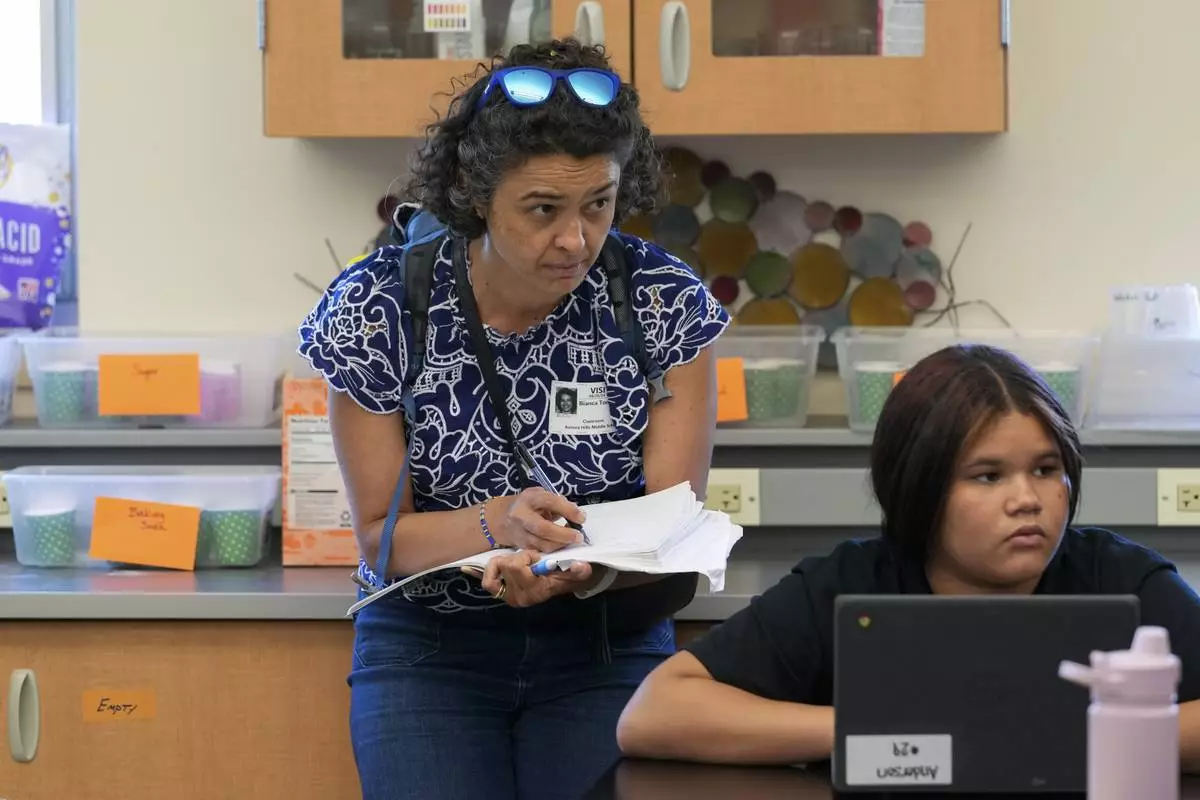
Bianca Vázquez Toness, an AP education writer, takes notes while reporting in a classroom in Aurora, Colo., Aug. 28, 2024. (AP Photo/Godofredo A. Vásquez)
WASHINGTON (AP) — A bipartisan U.S. congressional delegation is headed to Copenhagen later this week in an attempt to show unity between the United States and Denmark as President Donald Trump continues to threaten to seize Greenland, a semiautonomous territory of the NATO ally.
Sen. Chris Coons, D-Del., is leading the trip of at least nine members of Congress, including Republican Sen. Thom Tillis of North Carolina. The group will be in Copenhagen on Friday and Saturday, according to a congressional aide familiar with the trip's planning. The lawmakers will meet with high-level Danish government officials and business leaders, according to the aide, granted anonymity ahead of a formal announcement.
The trip comes as China said Monday that the United States shouldn't use other countries as a “pretext” to pursue its interests in Greenland and said that its activities in the Arctic comply with international law.
The comment by a Chinese Foreign Ministry spokesperson came in response to a question at a regular daily briefing. U.S. President Donald Trump has said that he would like to make a deal to acquire Greenland, a semiautonomous region of NATO ally Denmark, to prevent Russia or China from taking it over.
Tensions have grown between Washington, Denmark and Greenland this month as Trump and his administration push the issue and the White House considers a range of options, including military force, to acquire the vast Arctic island.
Danish Prime Minister Mette Frederiksen has warned that an American takeover of Greenland would mark the end of NATO. On Friday, Greenland Prime Minister Jens-Frederik Nielsen and the leaders of the four other parties in the territory's parliament issued a joint statement reiterating that Greenland's future must be decided by its people and emphasizing their “wish that the United States’ contempt for our country ends.”
Trump reiterated his argument that the U.S. needs to “take Greenland,” otherwise Russia or China would, in comments aboard Air Force One on Sunday. He said he’d rather “make a deal” for the territory, “but one way or the other, we’re going to have Greenland.”
China in 2018 declared itself a “near-Arctic state” in an effort to gain more influence in the region. Beijing has also announced plans to build a “Polar Silk Road” as part of its global Belt and Road Initiative, which has created economic links with countries around the world.
Asked in Beijing Monday about U.S. statements that it is necessary for Washington to take over Greenland to prevent China and Russia from taking control, Chinese Foreign Ministry spokesperson Mao Ning replied that “China’s activities in the Arctic are aimed at promoting peace, stability, and sustainable development in the region and are in accordance with international law.” She didn't elaborate on those activities.
“The rights and freedoms of all countries to conduct activities in the Arctic in accordance with the law should be fully respected,” Mao said, without mentioning Greenland directly. “The U.S. should not pursue its own interests by using other countries as a pretext.”
She said that “the Arctic concerns the overall interests of the international community.”
Danish and Greenlandic envoys are expected in Washington this week for talks, and plans are also being put together for U.S. senators to visit Denmark.
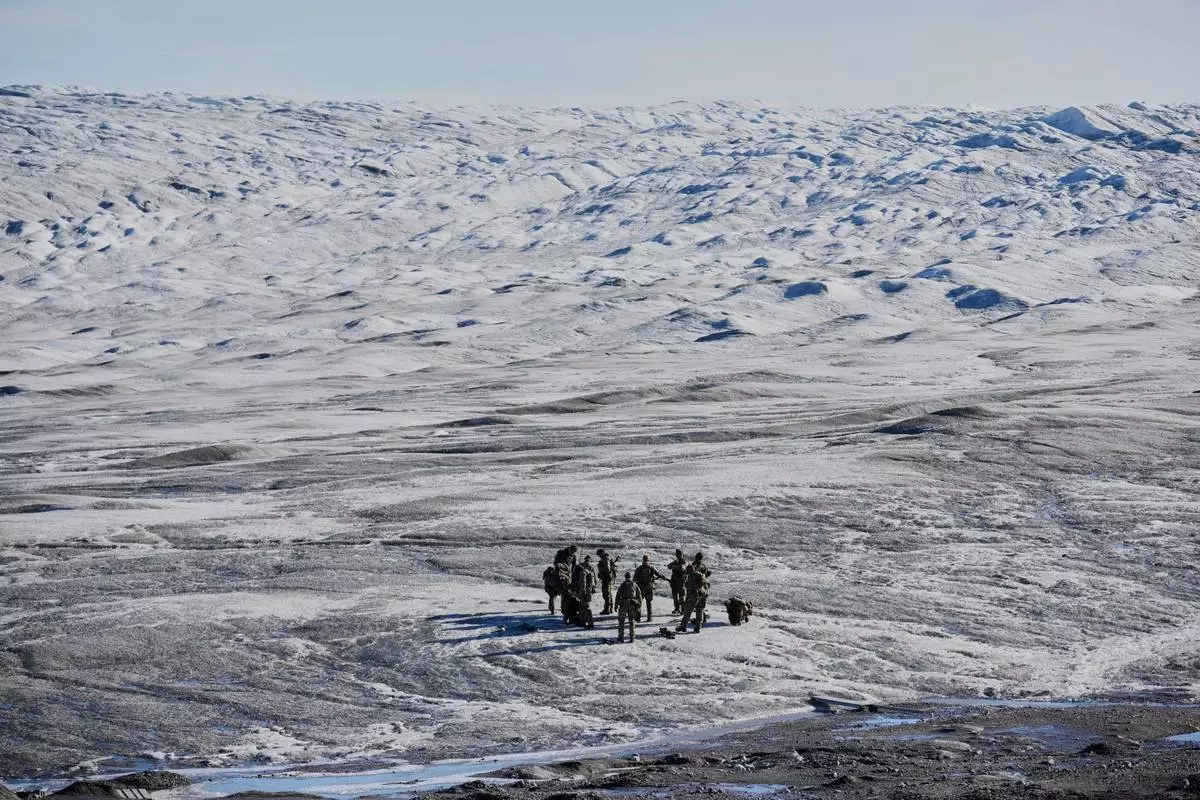
FILE - Danish military forces participate in an exercise with hundreds of troops from several European NATO members in Kangerlussuaq, Greenland, Sept. 17, 2025. (AP Photo/Ebrahim Noroozi, File)
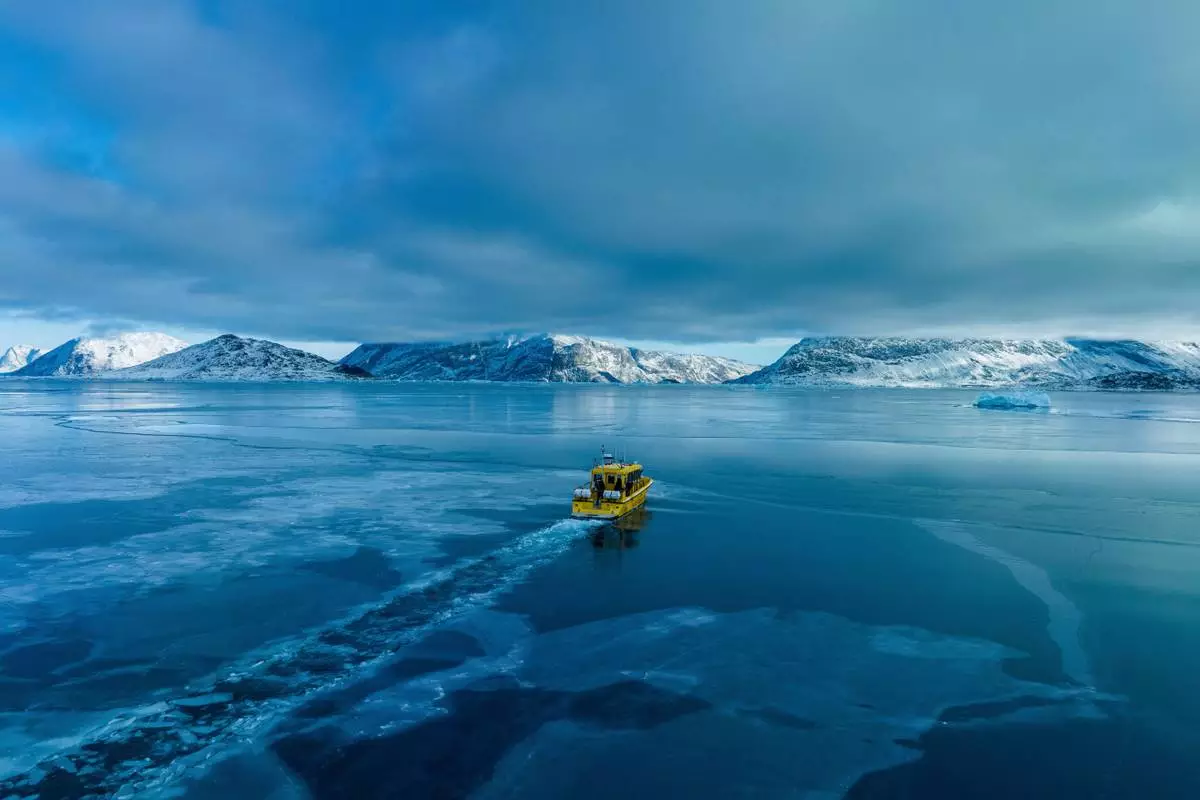
FILE - A boat rides though a frozen sea inlet outside of Nuuk, Greenland, on March 6, 2025. (AP Photo/Evgeniy Maloletka, File)