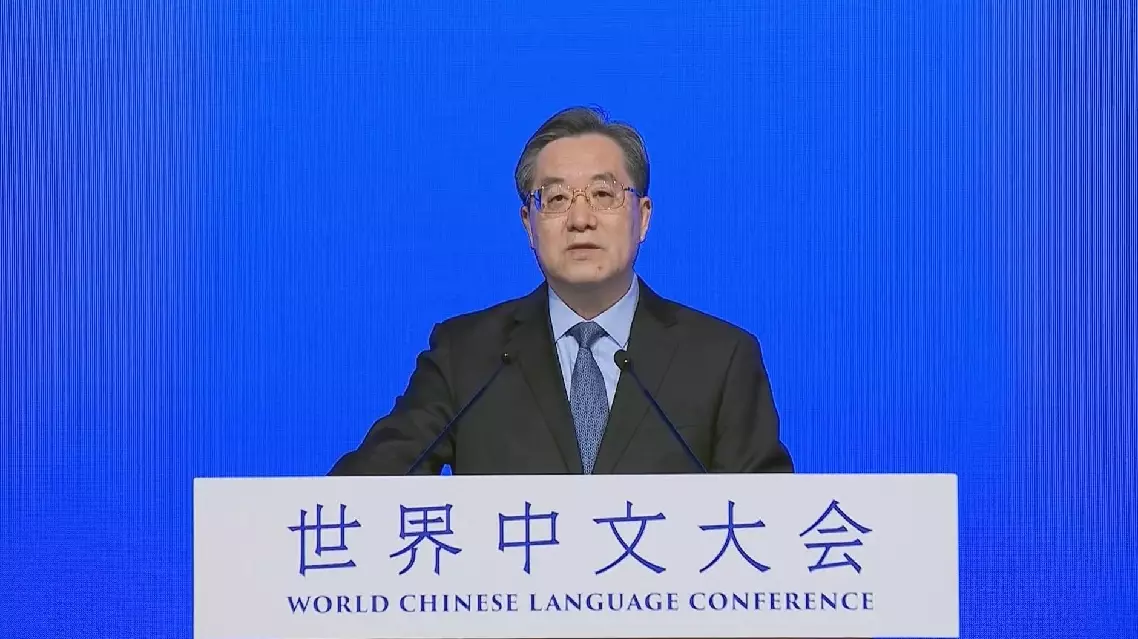
Chinese Vice Premier Ding Xuexiang called for greater innovation and openness in international Chinese language education while delivering a keynote speech at the opening ceremony of the 2025 World Chinese Language Conference in Beijing on Friday.
Highlighting President Xi Jinping's strong emphasis on international Chinese language education, Ding, also a member of the Standing Committee of the Political Bureau of the Communist Party of China (CPC) Central Committee, recalled that Xi has stressed upholding tradition while fostering innovation, strengthening connectivity and integration, building broad consensus, and creating bridges for communication among languages, for mutual understanding, and for cultural exchanges.
Thanks to joint efforts over the years, international Chinese education has achieved fruitful outcomes, and Chinese language learning has been widely welcomed around the world, he said.
Looking ahead to the coming five years, the vice premier said that China's development will bring more opportunities to the rest of the world, and global demand for learning Chinese and understanding China will accordingly keep rising.
China, as the country where the Chinese language originates, will steadfastly support and facilitate Chinese language education worldwide, he added.
Ding put forward a four-point proposal to advance international Chinese language education.
First, innovation should be adhered to as a primary driving force for joint development and sharing of digital Chinese language resources to make learning more convenient and efficient.
Second, provision of services for development should be adhered to in keeping promoting integration of international Chinese education with vocational and professional education, thereby improving learners' practical language skills and proficiency.
Third, friendly exchanges should be advocated to provide more support for Chinese language learners to study in China, thus strengthening bonds between the Chinese people and other people around the world.
And fourth, openness and inclusiveness should be stuck to in efforts to enhance two-way exchanges between Chinese and other world languages, so as to advance co-existence and mutual learning among civilizations.
Prior to the opening ceremony, Ding toured a theme exhibition of the conference.
Themed "Innovation Leads, AI Empowers: Learning Chinese Without Borders," the three-day conference brings together around 2,000 participants, including government officials, experts, university leaders, and representatives of international organizations.
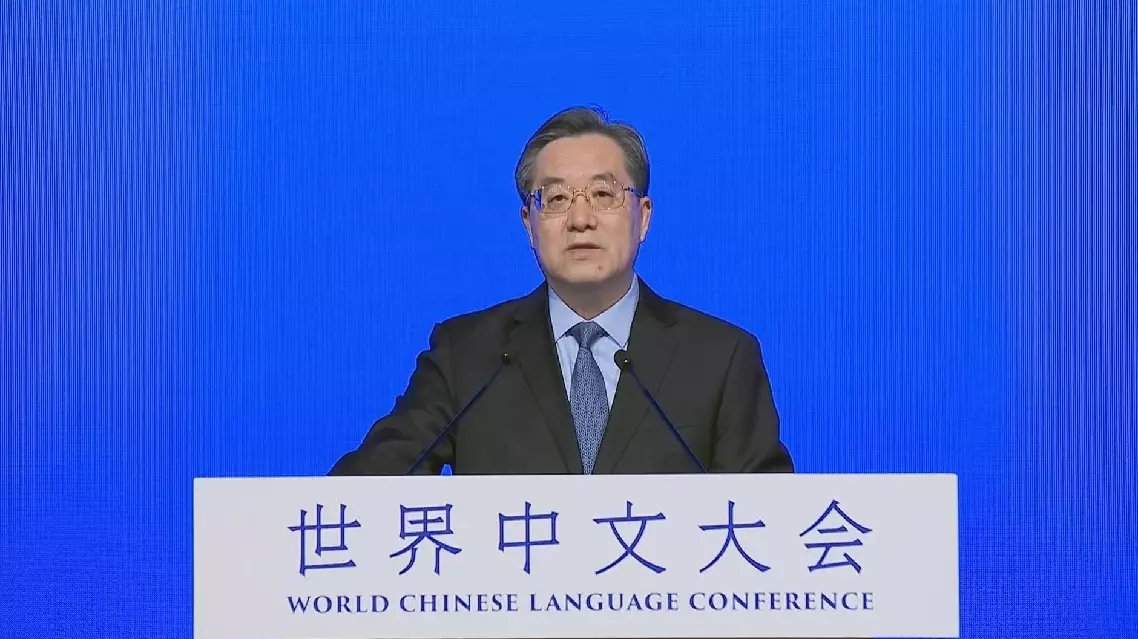
Chinese vice premier calls for greater innovation, openness in int'l Chinese language education
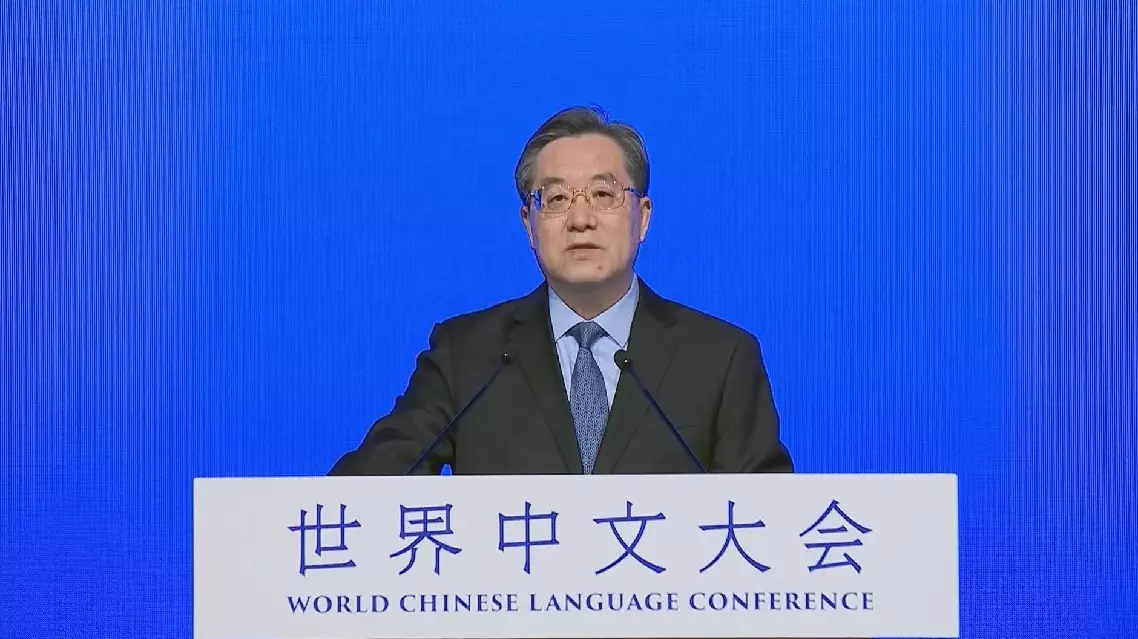
Chinese vice premier calls for greater innovation, openness in int'l Chinese language education
Chinese vice premier calls for greater innovation, openness in int'l Chinese language education
Shifting from the "world factory" to a tech innovation hub, China is accelerating the development of new quality productive forces to forge a new growth path amid an increasingly complex global landscape.
The world's second-largest economy has unveiled a pivotal document outlining priorities for its 15th Five-Year Plan (2026-2030), which emphasizes "achieving greater self-reliance and strength in science and technology" and "steering the development of new quality productive forces" as key objectives for the coming five years.
As a pillar of China's high-quality development, the cultivation of new quality productive forces tailored to local conditions has made notable strides in recent years and is expected to play an even more pivotal role in driving growth in the near future.
Since the beginning of this year, China's major sci-tech breakthroughs have shown a vigorous upward trend month by month, with cutting-edge technologies rapidly moving from labs to production lines, and more and more innovations transformed into tangible productivity.
Chinese artificial intelligence startup DeepSeek rocketed into global prominence earlier this year, taking its large-scale models from obscurity to adoption in thousands of industries.
China's new high-speed train model, CR450, is currently undergoing extensive testing and evaluation on its prototypes, a step that paves the way for the commercial launch of the new bullet train. Known as the world's fastest high-speed train, the CR450 has achieved test speeds of 450 km/h, and is expected to operate at 400 km/h in commercial service.
China's Tianwen-2, the nation's first space probe tasked with retrieving samples from an asteroid, was launched in May to shed light on the formation and evolution of asteroids and the early solar system.
The Deep Sea No. 1 Phase II project has entered full operation, marking a crucial step for China toward large-scale development of deep-sea oil and gas resources.
China's Experimental Advanced Superconducting Tokamak (EAST), dubbed the artificial sun, maintained a steady-state high-confinement plasma operation lasting 1,066 seconds at 100 million degrees Celsius in January, setting a new world record and marking a breakthrough in the quest for fusion power generation. In September, China launched the world's largest centrifuge by capacity, which can generate 300 times Earth's gravity and accommodate loads of up to 20 tonnes.
Chinese scientists have achieved a major breakthrough in integrated photonic quantum chips by demonstrating the first "continuous-variable" quantum multipartite entanglement and cluster states on a chip. The breakthrough addresses a critical gap in the development of photonic quantum chips and lays a foundation for scalable quantum entanglement, with potential applications in quantum computing and quantum networks.
Chinese automaker Guangzhou Automobile Group (GAC) has completed building the country's first large-capacity all-solid-state battery production line, boosting the driving range of new energy vehicles from 500 kilometers to 1,000 kilometers.
"It can be said that 2025 is a crucial year for cultivating and developing new quality productive forces. Major achievements have shifted from breakthroughs at individual points to system-wide breakthroughs, marking an accelerated leap for the country from catching up to keeping pace and leading in cutting-edge science and technology. Innovation is rapidly transforming into an economic driving force, injecting strong momentum into the development of new quality productive forces," said Qu Wan, a researcher at the Innovation-Driven Development Center of the National Development and Reform Commission.
Additionally, efforts have been made to deepen industry-academia-research integration in talent cultivation to build a competitive human-capital advantage, while accelerating the transformation and application of major scientific and technological achievements.
"We have close to 50 percent of the best ways to deploy AI for people and planet being based in China as well. So yes, China is at the forefront of many of these areas," said Neo Gim Huay, managing director and member of the managing board at the World Economic Forum
On a broader national scale, China has fostered more than 500,000 high-tech enterprises over the past five years and now claims the largest global share of sci-tech innovation clusters.
The China Innovation Index, a barometer of the country's innovation capability, rose 5.3 percent from the 2023 level to 174.2 last year, according to the National Bureau of Statistics (NBS). The innovation environment has continued to improve, with higher investment, faster growth in outputs and stronger drivers of economic activity, the bureau said.
The country's sci-tech innovation efforts are delivering an effective boost to growth, with the innovation effectiveness index reaching 132.4 last year, up 1.9 percent from a year earlier, according to the NBS. Specifically, the sub-index measuring the proportion of added value from new technologies, new industries and new business models in total GDP increased by 4.3 percent year on year.
Across China, traditional industries are undergoing a technology-driven transformation to raise productivity and open new paths for growth.
In northeast China's Liaoning Province, a traditional heavy-industry base, intelligent and green upgrades are transforming legacy sectors, offering a clear path to shed its rust-belt image.
For example, Ansteel, a major provincial steelmaker, has deployed an intelligent system to optimize molten steel handling, reducing production costs by 15 percent and cutting wastewater discharge by 21 percent.
Numerous companies across the country are accelerating their digital transformation efforts. According to the China Internet Development Report 2024, the country now has nearly 10,000 digitalized workshops and intelligent factories. Of these, more than 400 have been recognized as national-level benchmark factories in smart manufacturing, utilizing technologies such as AI and digital twins.
First introduced in 2023, the term "new quality productive forces" describes advanced productivity driven by innovation rather than traditional growth factors. It is marked by high technology, high efficiency, and high quality, in line with the new development philosophy.
China's new quality productive forces gather steam to turbocharge future growth