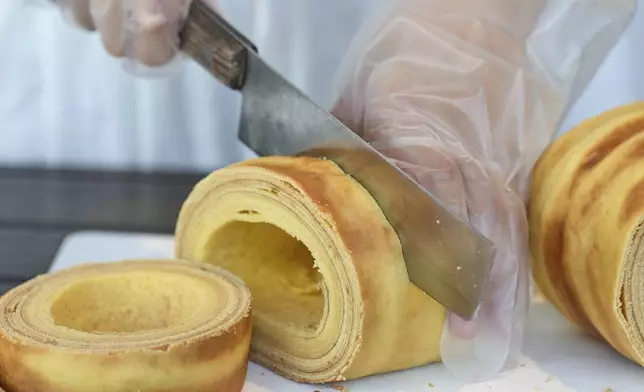
NINOSHIMA, Japan (AP) — Baumkuchen originated in Germany but has become a wildly popular sweet in Japan, where a prisoner of war on a small western island started making the treat that has thrived in its new homeland.
Today, the confectionery known as “tree cake” because of the resemblance to a trunk with rings is considered a symbol of longevity and prosperity in Japan, where Baumkuchen festivals are regularly held.
Click to Gallery
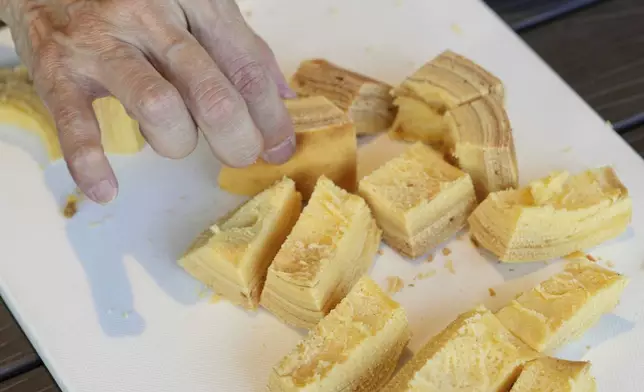
Staff and participants try out baked Baumkuchen, a German layered cake, during a workshop of Juchheim Ninoshima Welcome Center and Outdoor Activity Camp Monday, July 7, 2025, at Ninoshima island in Hiroshima, western Japan. (AP Photo/Eugene Hoshiko)
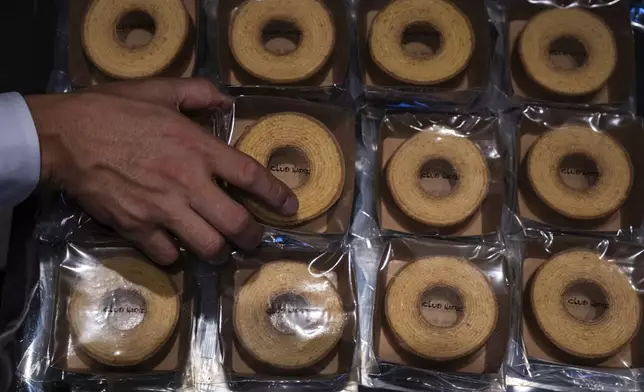
A vendor sorts articles at a baumkuchen store on its opening day in Tokyo, Friday, July 18, 2025. (AP Photo/Louise Delmotte)
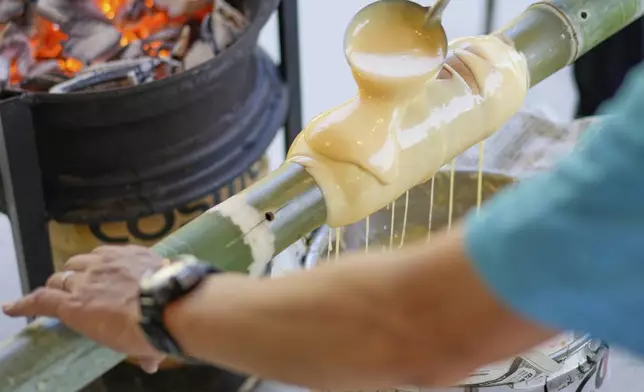
Staff make Baumkuchen, a German layered cake, during a workshop of Juchheim Ninoshima Welcome Center and Outdoor Activity Camp Monday, July 7, 2025, at Ninoshima island in Hiroshima, western Japan. (AP Photo/Eugene Hoshiko)
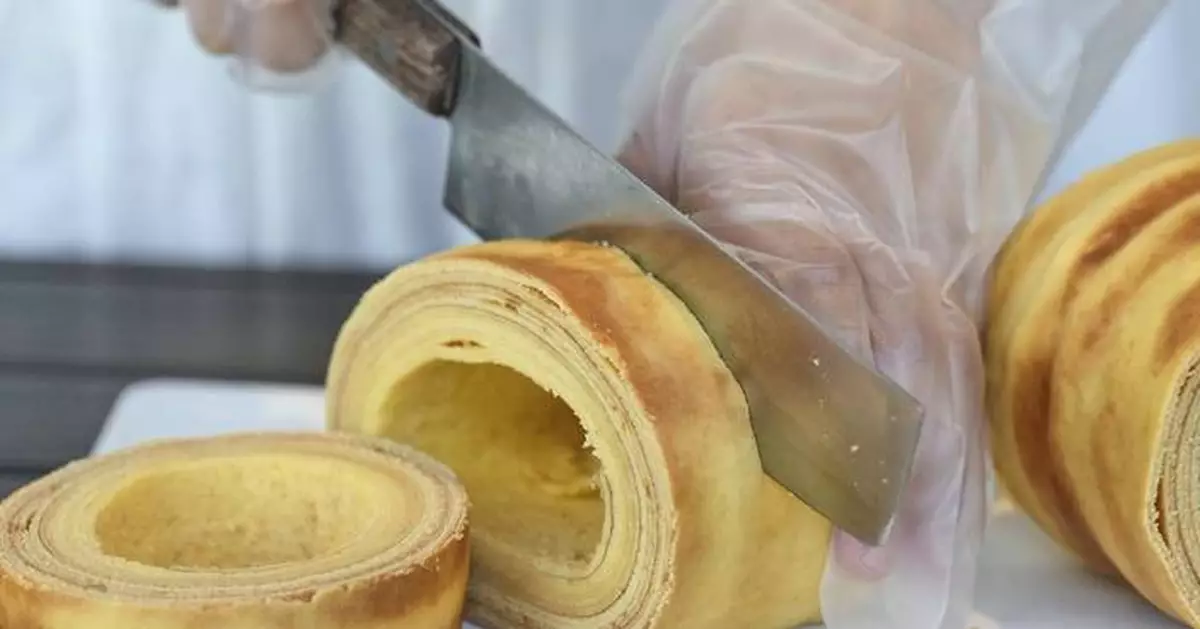
Staff and participants cut Baumkuchen, a German layered cake, during a workshop of Juchheim Ninoshima Welcome Center and Outdoor Activity Camp Monday, July 7, 2025, at Ninoshima island in Hiroshima, western Japan. (AP Photo/Eugene Hoshiko)
Japanese adaptations, including those using maccha and sweet potatoes, are popular gifts at weddings and birthdays. Baumkuchen is sold in gift boxes at luxury department stores and individually wrapped, smaller versions can be found at convenience stores.
The sweet's early years, however, are associated with a catastrophic earthquake and two world wars.
Making Baumkuchen is one of most popular activities on Ninoshima, just a 20-minute ferry ride from Hiroshima. But visitors also must learn the sleepy island’s role in Japan’s wartime history, according to Kazuaki Otani, head of the Juccheim Ninoshima Welcome Center.
At the outdoor center built over the site of a prisoner of war camp, amateur bakers pour batter on a bamboo pole and roast the mixture over a charcoal fire. As the surface turns light brown, a new layer is poured, creating brown rings as the cake grows thicker and the sweet smell wafts through the picnic area.
This is how a German confectioner named Karl Juchheim baked Baumkuchen while he was imprisoned on the island more than 100 years ago.
During Japan’s militarist expansion period beginning in the late 1890s, Ninoshima served as a military quarantine station as nearby Hiroshima developed into a major military hub. About 4,700 mostly German civilians and servicemembers were kept at 16 camps across Japan during World War I. The German prisoners at Ninoshima were given “a certain degree of freedom” and allowed to cook, Otani said.
Juchheim was running a bakery in Qingdao, China, then a German territory, when he was captured by the Japanese in 1915. He arrived on Ninoshima in 1917 with some 500 German POWs and is believed to have tested his Baumkuchen recipe there, Otani said.
When the war ended in 1918, Juchheim and about 200 fellow POWs stayed in Japan. In March 1919, Juchheim’s Baumkuchen commercially debuted in Japan at the Hiroshima Prefectural Products Exhibition. His handmade cake was hugely popular and attracted a big crowd of Japanese visitors, historical documents show.
The confectioner opened a pastry shop in Yokohama, near Tokyo, in 1922. The 1923 Great Kanto quake destroyed the business and forced Juchheim to move his family to the western port city of Kobe, where he opened a coffee shop serving Baumkuchen. That store was leveled by U.S. firebombings on Kobe two months before the end of World War II.
Yet he remained and grew the business in Kobe, where Juchheim Co., Ltd., still operates as one of Japan’s top confectioners with the help of his wife Elise and devoted Japanese staff.
The atomic bomb dropped by the U.S. on Hiroshima on Aug. 6, 1945, and another on Nagasaki three days later killed more than 210,000 by the end of that year. In the aftermath, about 10,000 severely injured victims were shipped from Hiroshima to Ninoshima for treatment and temporary shelter. Most died there and many of their remains have yet to be found, experts say.
Juchheim died of illness at a Kobe hotel on Aug. 14, 1945, the day before Japan announced its surrender.
“His baking was an expression of his wish for peace,” Otani said. “By sharing with visitors what things were like back then, I hope it gives people an opportunity to reflect on peace.”
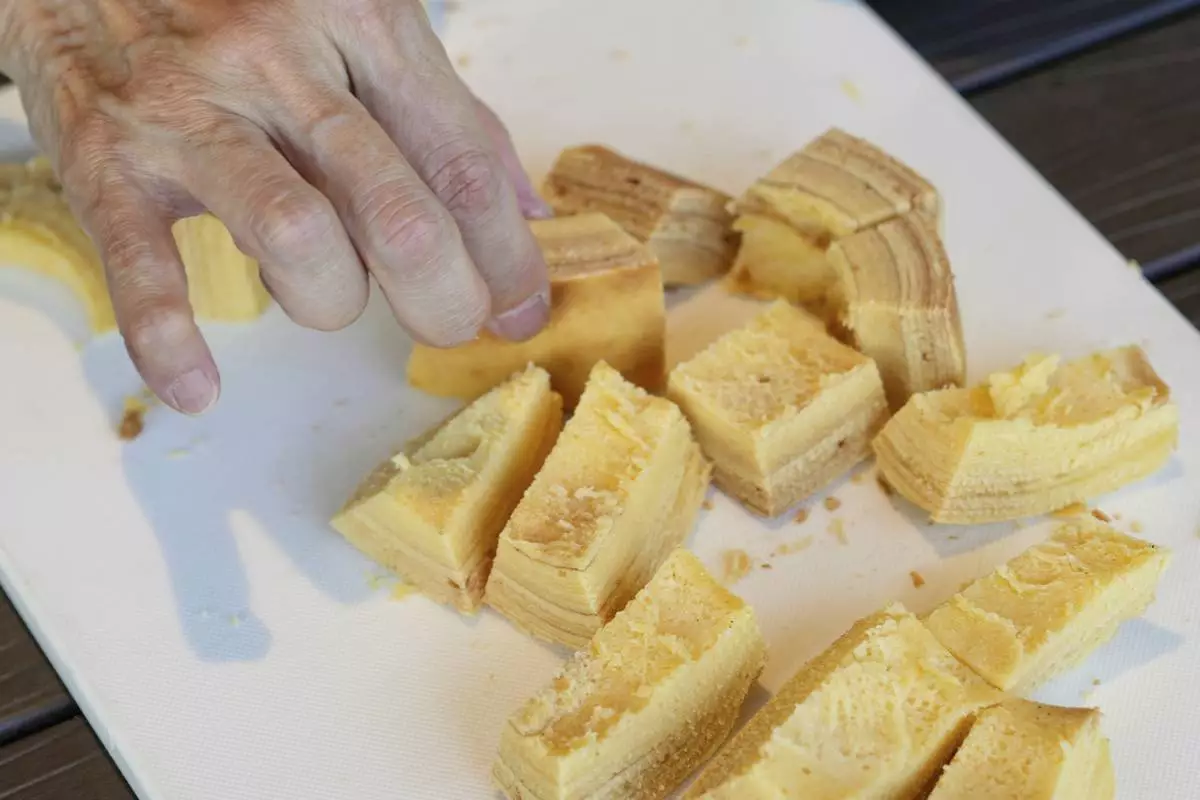
Staff and participants try out baked Baumkuchen, a German layered cake, during a workshop of Juchheim Ninoshima Welcome Center and Outdoor Activity Camp Monday, July 7, 2025, at Ninoshima island in Hiroshima, western Japan. (AP Photo/Eugene Hoshiko)

A vendor sorts articles at a baumkuchen store on its opening day in Tokyo, Friday, July 18, 2025. (AP Photo/Louise Delmotte)
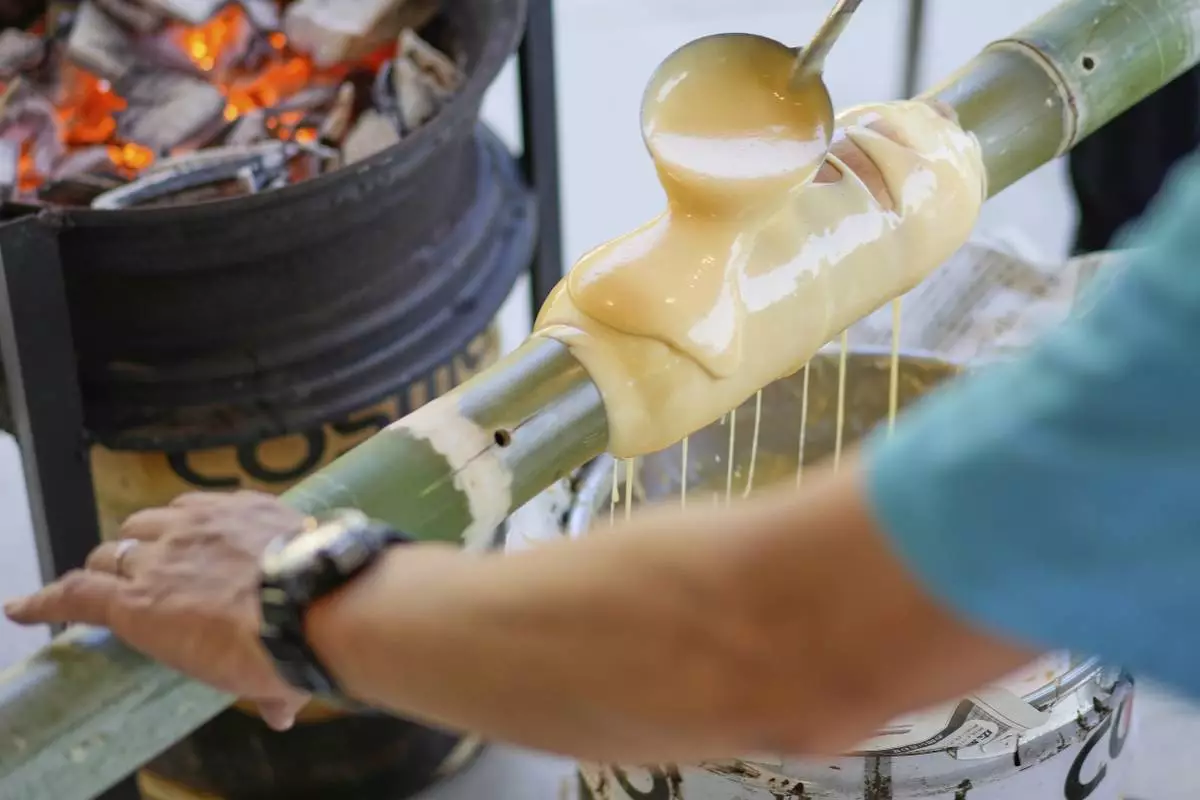
Staff make Baumkuchen, a German layered cake, during a workshop of Juchheim Ninoshima Welcome Center and Outdoor Activity Camp Monday, July 7, 2025, at Ninoshima island in Hiroshima, western Japan. (AP Photo/Eugene Hoshiko)
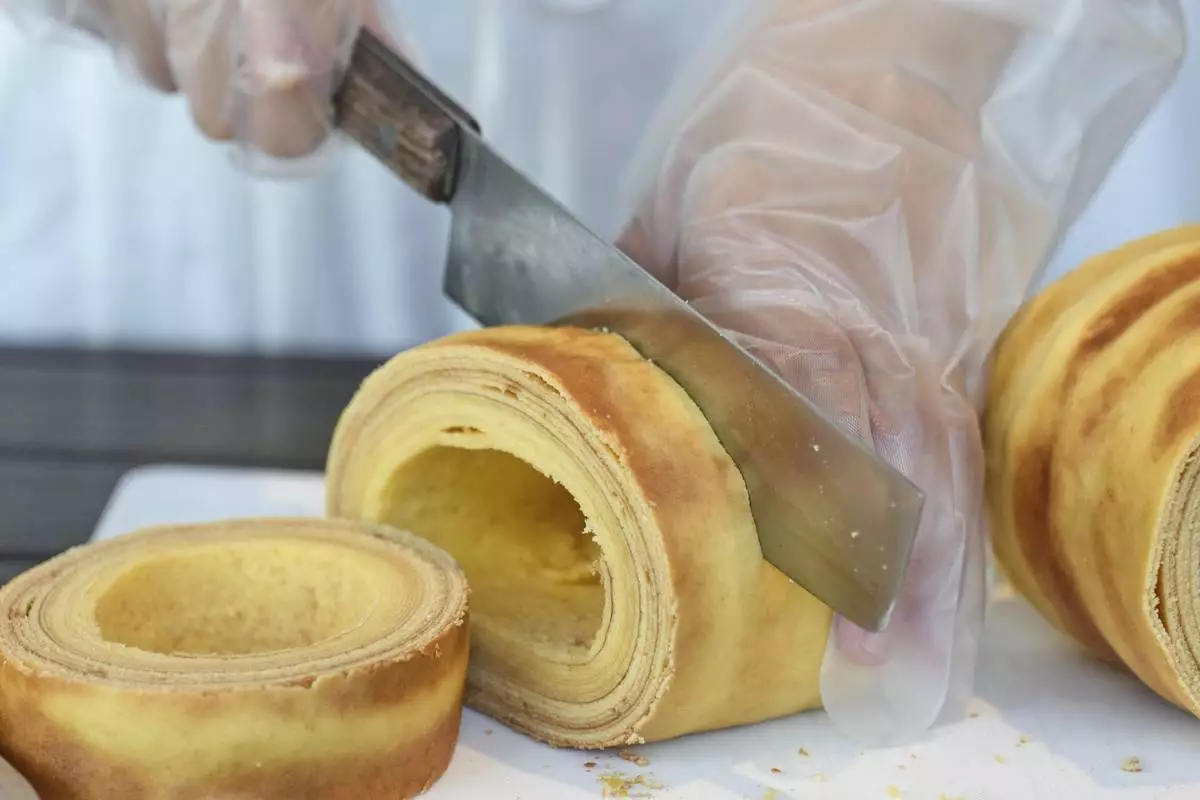
Staff and participants cut Baumkuchen, a German layered cake, during a workshop of Juchheim Ninoshima Welcome Center and Outdoor Activity Camp Monday, July 7, 2025, at Ninoshima island in Hiroshima, western Japan. (AP Photo/Eugene Hoshiko)
PROVO, Utah (AP) — The man accused of killing Charlie Kirk on a Utah college campus was back in court Friday as a state judge denied some efforts by his attorneys to limit public access to certain documents while not ruling out the possibility of closing portions of an upcoming hearing.
The outcome sets the stage for an April hearing in which attorneys for Tyler Robinson will make their case to exclude TV cameras, microphones and photographers from the courtroom.
Judge Tony Graf has been weighing the public’s right to know details about the case against concerns by defense attorneys that the media attention could undermine Robinson’s right to a fair trial. Prosecutors, Kirk’s widow and attorneys for news organizations have urged Graf to keep the proceedings open.
Prosecutors intend to seek the death penalty for Robinson, 22, who is charged with aggravated murder in the Sept. 10 shooting of the conservative activist on the Utah Valley University campus in Orem. They have said DNA evidence connects Robinson to the killing.
Robinson has not yet entered a plea.
Attorneys on Friday debated whether the defense's written request to exclude cameras, which was classified by the court as private, should be made public.
Graf said the defense failed to make its case to keep the motion private but that he will continue “balancing all the factors” when deciding which portions of the upcoming hearing may be closed.
Staci Visser, an attorney for Robinson, told the judge that the defense is not arguing in the court of public opinion.
“There seems to be an idea that flooding the public sphere with information from this courtroom will somehow dispel conspiracy theories or shift public narratives. That, in and of itself, is concerning to the defense,” Visser said. “All we should be worried about is protecting what happens in this courtroom.”
Robinson’s defense team went on to say that the April hearing will involve discussions about prejudicial pretrial publicity — for example, evidence that has yet to be admitted, confessions, personal opinions about guilt or public statements that would otherwise be inadmissible in court.
“We don’t want to be in that position of bringing in front of the court all of this prejudicial information and having the press regurgitate it yet one more time, and reinflicting a wound that we’re seeking to avoid,” defense attorney Michael Burt said.
Christopher Ballard, a prosecutor with the Utah County Attorney’s Office, dismissed those arguments. He said careful questioning during jury selection and tools like expanding the jury pool can ensure a defendant gets a fair trial.
“So just saying that this a content tornado or there's been a barrage of media coverage doesn't necessarily mean that there is going to be prejudice to the defendant,” Ballard said.
Ballard noted that most of the evidence that will be discussed at the April 17 hearing is already public, so most of it should be open.
Coalitions of national and local news organizations, including The Associated Press, are fighting to preserve media access in the case.
Media access has been a focal point of several recent hearings, with the judge placing temporary restrictions on local TV stations for showing Robinson's shackles in violation of a court order and filming close-up shots that might allow viewers to interpret what he was discussing with his attorneys.
The judge also has prevented full video recordings of Kirk’s shooting from being shown in court after defense attorneys argued the graphic footage would interfere with a fair trial. An estimated 3,000 people attended the outdoor rally to hear Kirk, a co-founder of Turning Point USA who helped mobilize young people to vote for President Donald Trump.
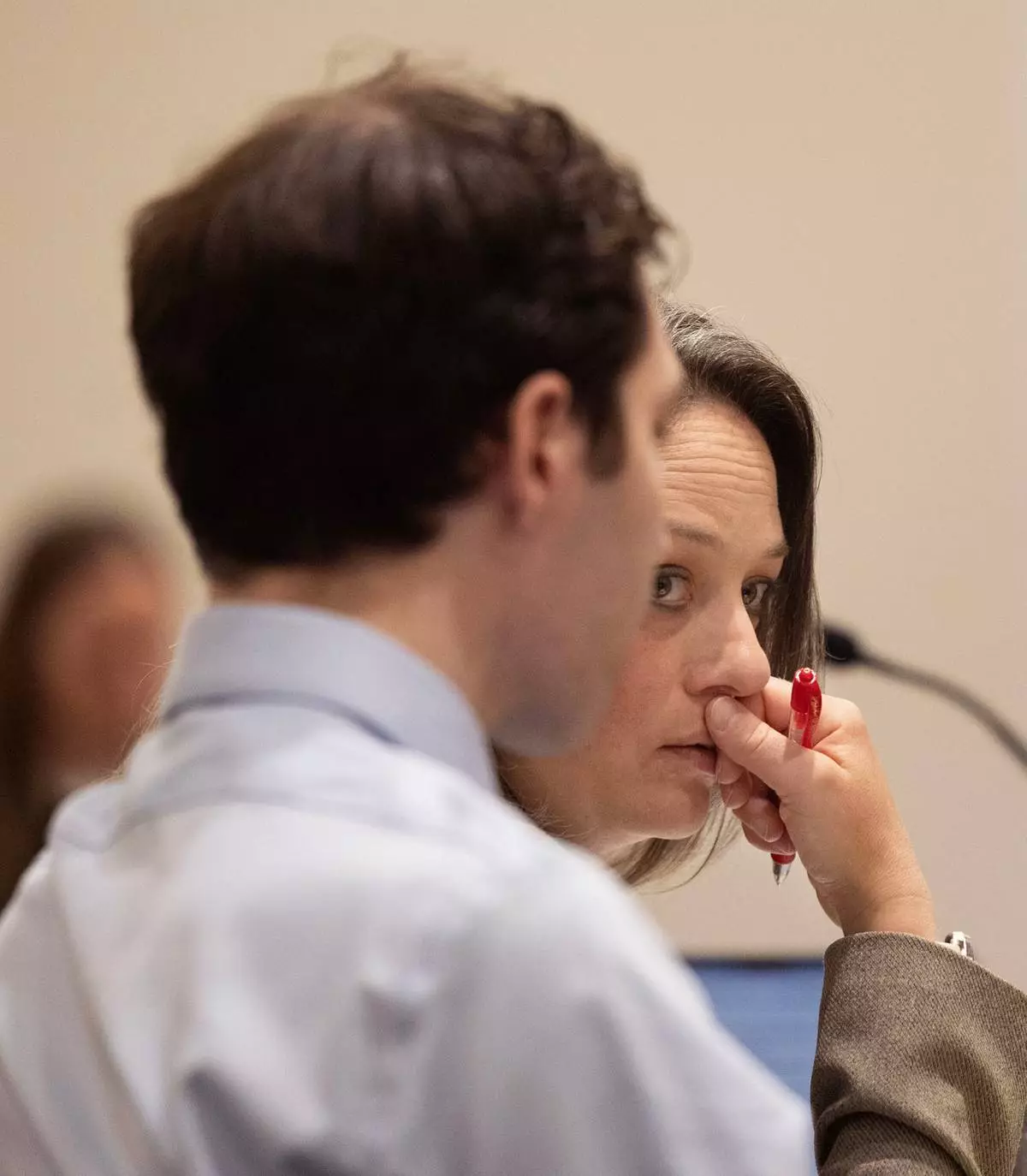
Defense attorney Staci Visser, left, and defendant Tyler Robinson, accused in the fatal shooting of conservative activist Charlie Kirk, attend a hearing in 4th District Court, Friday, March. 13, 2026, in Provo, Utah. (Laura Seitz/The Deseret News via AP, Pool)

Prosecuting and defense attorneys and defendant Tyler Robinson, right, accused in the fatal shooting of conservative activist Charlie Kirk, attend a hearing in 4th District Court, Friday, March. 13, 2026, in Provo, Utah. (Laura Seitz/The Deseret News via AP, Pool)

Prosecutor Chad Grunander, center, listens, Friday, March. 13, 2026, in 4th District Court in Provo, Utah, during a hearing for Tyler Robinson, who is accused in the fatal shooting of conservative activist Charlie Kirk. (Laura Seitz/The Deseret News via AP, Pool)

Attorney Richard Novak, left, and defendant Tyler Robinson, accused in the fatal shooting of conservative activist Charlie Kirk, attend a hearing, in 4th District Court, Friday, March. 13, 2026, in Provo, Utah. (Laura Seitz/The Deseret News via AP, Pool
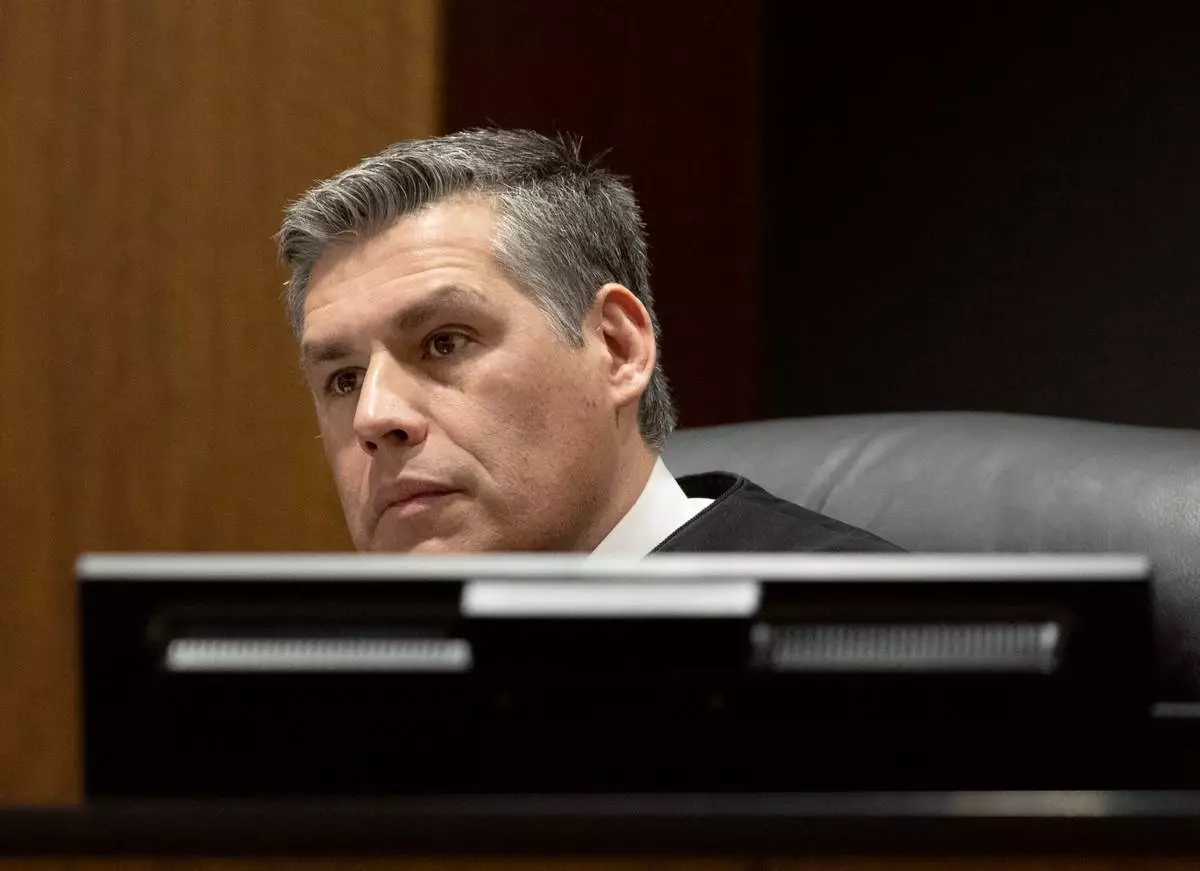
Fourth District Court Judge Tony Graf presides, Friday, March. 13, 2026, in 4th District Court in Provo, Utah, during a hearing for Tyler Robinson, who is accused in the fatal shooting of conservative activist Charlie Kirk. (Laura Seitz/The Deseret News via AP, Pool)

FILE - Tyler Robinson, who is accused of fatally shooting Charlie Kirk, appears during a hearing in Fourth District Court, in Provo, Utah, Dec. 11, 2025. (Rick Egan/The Salt Lake Tribune via AP, Pool, File)

FILE - Fourth District Court Judge Tony Graf presides over a hearing for Tyler Robinson, accused in the fatal shooting of conservative activist Charlie Kirk, in 4th District Court, Feb. 3, 2026, in Provo, Utah. (Trent Nelson/The Salt Lake Tribune via AP, Pool, File)