ANCHORAGE, Alaska (AP) — Rayann Martin sat in a classroom hundreds of miles from her devastated Alaska Native village and held up 10 fingers when the teacher asked the pupils how old they were.
“Ten — how do you say 10 in Yup'ik?” the teacher asked.
Click to Gallery
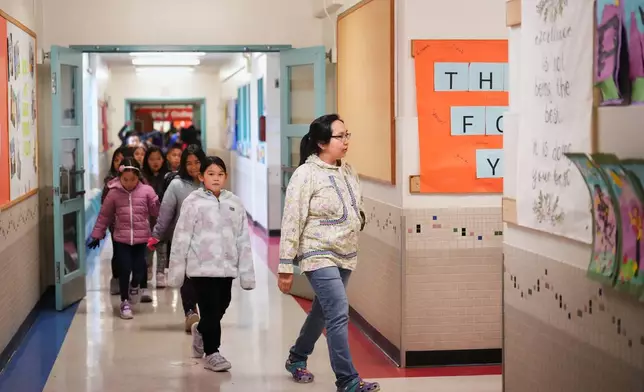
Teacher Stephanie Wooten walks by Ellyne Aliralria, center and Rayann Martin, right, both 10-year-olds displaced from their village of Kipnuk by ex-Typhoon Halong in early October, at College Gate Elementary, where students spend half their time learning in Yup'ik language immersion, Thursday, Oct. 30, 2025, in Anchorage, Alaska. (AP Photo/Lindsey Wasson)
Renee Avugiak, originally from Chefornak, Alaska, near the villages of Kipnuk and Kwigillingok that were heavily damaged by ex-Typhoon Halong, leads her class through the hallways at College Gate Elementary, where students spend half their time learning in Yup'ik language immersion, Thursday, Oct. 30, 2025, in Anchorage, Alaska. (AP Photo/Lindsey Wasson)
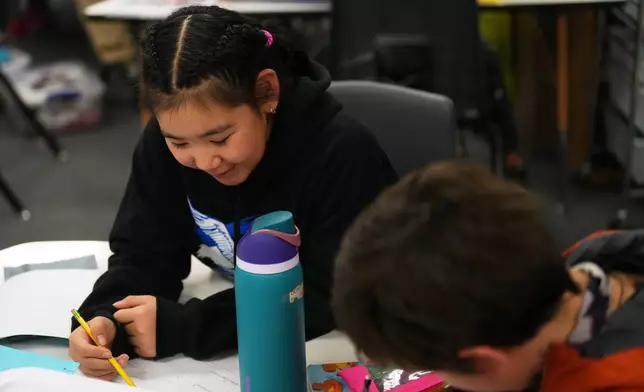
Rayann Martin, a 10-year-old displaced from the village of Kipnuk by ex-Typhoon Halong, left, talks with new classmate Lilly Loewen, 10, right, as they work in the Yup'ik language at College Gate Elementary, Thursday, Oct. 30, 2025, in Anchorage, Alaska. (AP Photo/Lindsey Wasson)
Students work in Yup'ik as part of a language immersion program at College Gate Elementary, Thursday, Oct. 30, 2025, in Anchorage, Alaska. (AP Photo/Lindsey Wasson)
Ellyne Aliralria, a 10-year-old student displaced from her village of Kipnuk by ex-Typhoon Halong, fills out a worksheet in Yup'ik at College Gate Elementary, where students spend half their time learning in a Yup'ik language immersion program, Thursday, Oct. 30, 2025, in Anchorage, Alaska. (AP Photo/Lindsey Wasson)
Teacher Stephanie Wooten walks by Ellyne Aliralria, center and Rayann Martin, right, both 10-year-olds displaced from their village of Kipnuk by ex-Typhoon Halong in early October, at College Gate Elementary, where students spend half their time learning in Yup'ik language immersion, Thursday, Oct. 30, 2025, in Anchorage, Alaska. (AP Photo/Lindsey Wasson)
Renee Avugiak, originally from Chefornak, Alaska, near the villages of Kipnuk and Kwigillingok that were heavily damaged by ex-Typhoon Halong, leads her class through the hallways at College Gate Elementary, where students spend half their time learning in Yup'ik language immersion, Thursday, Oct. 30, 2025, in Anchorage, Alaska. (AP Photo/Lindsey Wasson)
Rayann Martin, a 10-year-old displaced from the village of Kipnuk by ex-Typhoon Halong, left, talks with new classmate Lilly Loewen, 10, right, as they work in the Yup'ik language at College Gate Elementary, Thursday, Oct. 30, 2025, in Anchorage, Alaska. (AP Photo/Lindsey Wasson)
“Qula!” the students answered in unison.
Martin and her family were among hundreds of people airlifted to Anchorage, the state's largest city, after the remnants of Typhoon Halong inundated their small coastal villages along the Bering Sea last month, dislodging dozens of homes and floating them away — many with people inside. The floods left nearly 700 homes destroyed or heavily damaged. One person died, two remain missing.
As the residents grapple with uprooted lives very different from the traditional ones they left, some of the children are finding a measure of familiarity in a school-based immersion program that focuses on their Yup’ik language and culture — one of two such programs in the state.
“I’m learning more Yup’ik,” said Martin, who added that she's using the language to communicate with her mother, teachers and classmates. “I usually speak more Yup’ik in villages, but mostly more English in cities.”
There are more than 100 languages spoken in the homes of Anchorage School District students. Yup’ik, which is spoken by about 10,000 people in the state, is the fifth most common. The district adopted its first language immersion program — Japanese — in 1989, and subsequently added Spanish, Mandarin Chinese, German, French and Russian.
After many requests from parents, the district obtained a federal grant and added a K-12 Yup'ik immersion program about nine years ago. The students in the first class are now eighth-graders. The program is based at College Gate Elementary and Wendler Middle School.
The principal at College Gate Elementary, Darrell Berntsen, is himself Alaska Native — Sugpiaq, from Kodiak Island, south of Anchorage. His mother was 12 years old in 1964 when the magnitude-9.2 Great Alaska Earthquake and an ensuing tsunami devastated her village of Old Harbor. He recalls her stories of joining other villagers at high ground and watching as the surge of water carried homes out to sea.
His mother and her family evacuated to a shelter in Anchorage, but returned to Kodiak Island when Old Harbor was rebuilt. Berntsen grew up living a subsistence life — “the greatest time of my life was being able to go out duck hunting, go out deer hunting," he said — and he understands what the evacuees from Kipnuk, Kwigillingok and other damaged villages have left behind.
He has also long had an interest in preserving Alaska Native culture and languages. His ex-wife’s grandmother, Marie Smith Jones, was the last fluent speaker of Eyak, an indigenous language from south-central Alaska, when she died in 2008. His uncles had their hands slapped when they spoke their indigenous Alutiiq language at school.
As the evacuees arrived in Anchorage in the days after last month's flooding, Berntsen greeted them at an arena where the Red Cross had set up a shelter. He invited families to enroll their children in the Yup'ik immersion program. Many of the parents showed him photos of the duck, goose, moose, seal or other traditional foods they had saved for the winter — stockpiles that washed away or spoiled in the flood.
“Listening is a big part of our culture — hearing their stories, letting them know that, ‘Hey, I live here in Anchorage, I’m running one of my schools, the Yup’ik immersion program, you guys are welcome at our school,’” Berntsen said. "Do everything we can to make them feel comfortable in the most uncomfortable situation that they’ve ever been through.”
Some 170 evacuated children have enrolled in the Anchorage School District — 71 of them in the Yup'ik immersion program. Once the smallest immersion program in the district, it's now “booming,” said Brandon Locke, the district's world language director.
At College Gate, pupils receive instruction in Yup’ik for half the day, including Yup’ik literacy and language as well as science and social studies. The other half is in English, which includes language arts and math classes.
Among the program's new students is Ellyne Aliralria, a 10-year-old from Kipnuk. During the surge of floodwater the weekend of Oct. 11, she and her family were in a home that floated upriver. The high water also washed away her sister's grave, she said.
Aliralria likes the immersion program and learning more phrases, even though the Yup’ik dialect being spoken is a bit different from the one she knows.
“I like to do all of them, but some of them are hard,” the fifth-grader said.
Also difficult is adjusting to living in a motel room in a city nearly 500 miles (800 km) from their village on the southwest coast.
“We’re homesick,” she said.
Lilly Loewen, 10, is one of many non-Yup'iks in the program. She said her parents wanted her to participate because "they thought it was really cool.”
“It is just really amazing to get to talk to people in another language other than just what I speak mostly at home,” Loewen said.
Berntsen is planning to help the new students acclimate by holding activities such as gym nights or Olympic-style events, featuring activities that mimic Alaska Native hunting and fishing techniques. One example: the seal hop, in which participants assume a plank position and shuffle across the floor to emulate how hunters sneak up on seals napping on the ice.
The Yup'ik immersion program is helping undo some of the damage Western culture did to Alaska Native language and traditions, he said. It's also bridging the gap of two lost generations: In some cases, the children's parents or grandparents never learned Yup'ik, but the students can now speak with their great-grandparents, Locke said.
“I took this as a great opportunity for us to give back some of what the trauma had taken from our Indigenous people,” Berntsen said.

Students work in Yup'ik as part of a language immersion program at College Gate Elementary, Thursday, Oct. 30, 2025, in Anchorage, Alaska. (AP Photo/Lindsey Wasson)
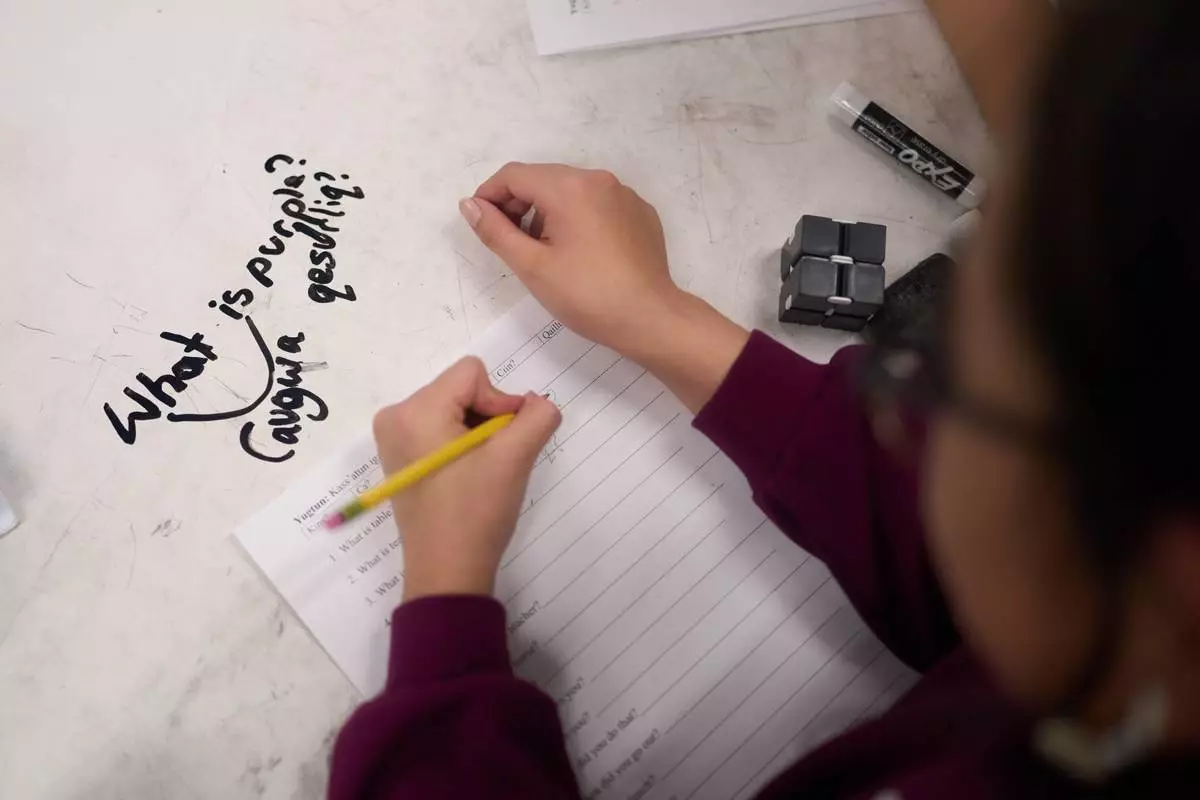
Ellyne Aliralria, a 10-year-old student displaced from her village of Kipnuk by ex-Typhoon Halong, fills out a worksheet in Yup'ik at College Gate Elementary, where students spend half their time learning in a Yup'ik language immersion program, Thursday, Oct. 30, 2025, in Anchorage, Alaska. (AP Photo/Lindsey Wasson)

Teacher Stephanie Wooten walks by Ellyne Aliralria, center and Rayann Martin, right, both 10-year-olds displaced from their village of Kipnuk by ex-Typhoon Halong in early October, at College Gate Elementary, where students spend half their time learning in Yup'ik language immersion, Thursday, Oct. 30, 2025, in Anchorage, Alaska. (AP Photo/Lindsey Wasson)

Renee Avugiak, originally from Chefornak, Alaska, near the villages of Kipnuk and Kwigillingok that were heavily damaged by ex-Typhoon Halong, leads her class through the hallways at College Gate Elementary, where students spend half their time learning in Yup'ik language immersion, Thursday, Oct. 30, 2025, in Anchorage, Alaska. (AP Photo/Lindsey Wasson)

Rayann Martin, a 10-year-old displaced from the village of Kipnuk by ex-Typhoon Halong, left, talks with new classmate Lilly Loewen, 10, right, as they work in the Yup'ik language at College Gate Elementary, Thursday, Oct. 30, 2025, in Anchorage, Alaska. (AP Photo/Lindsey Wasson)
WASHINGTON (AP) — Outdated intelligence likely led to the United States carrying out a deadly missile strike on an elementary school in Iran that killed over 165 people, many of them children, in the opening hours of the conflict, according to a U.S. official and a second person briefed on findings of a preliminary U.S military investigation into the incident.
The bombing of the school and its casualties involving children has become a focal point of the war, and if ultimately confirmed to be at the hands of the U.S., would also stand among the highest civilian casualty events caused by the American military operations in the last two decades.
President Donald Trump initially blamed Iran for the attack, later said he wasn’t certain who was to blame, and then said he would accept the results of the Pentagon’s investigation. The issue took on added urgency on Wednesday after the New York Times first reported that a preliminary investigation found that the U.S. was responsible.
U.S. Central Command relied on target coordinates for the strike using outdated data provided by the Defense Intelligence Agency, according to the person familiar with the preliminary finding.
The agency did not respond to a request for comment.
The preliminary finding prompted immediate calls for more information from the Pentagon. White House press secretary Karoline Leavitt said that “the investigation is still ongoing.”
Both the U.S. official and the person familiar with the matter spoke to The Associated Press on the condition of anonymity to discuss the sensitive matter.
Dozens of Democratic senators demanded answers from the Trump administration on Wednesday as a growing body of evidence suggested that the U.S. was likely responsible for a strike at an elementary school in Iran that killed over 165 people, many of them children.
The letter from more than 45 senators pressed Defense Secretary Pete Hegseth on whether the U.S. was culpable for the strike and what previous analysis of the building had been done. The senators also raised concerns about the Pentagon hollowing-out a congressionally mandated office set up specifically to reduce civilian casualties.
“Under this administration, budgetary and personnel cuts at the Department have robbed military commands of crucial resources to prevent and respond to civilian casualties,” the senators wrote. Those include cuts at U.S. Central Command, whose forces are leading the military campaign against Iran, and the Civilian Protection Center of Excellence, which was signed into law in 2022 as part of a Pentagon ambition to reduce death tolls from strikes.
The revelation could threaten to erode public support in the U.S. effort against Iran at a time when Trump, who as a candidate railed against American involvement in “stupid” overseas wars, faces persistent questions about the purpose and of the conflict and what would bring it to an end.
One former Pentagon official said the Feb. 28 strike that hit Shajareh Tayyebeh Elementary School, which is located near a neighboring base for the Iranian Revolutionary Guard, came as a natural result of changes made by the Trump administration to reduce staff to mitigate civilian harm and Hegseth’s emphasis on lethality over legality.
There are several indications that the strike on the school may have been avoidable.
It happened Saturday morning, the start of the Iranian school week, when the building was full of young children. Satellite analysis by the AP shows that the school, as well as other targets struck the same day, had characteristics visible from the air that could have identified them as civilian sites before they were struck.
The AP reported last week that satellite images, expert analysis, a U.S. official and public information released by the U.S. military all suggested it was likely a U.S. strike. That evidence grew stronger on Monday, as new footage emerged showing what experts identified as a U.S.-made Tomahawk cruise missile slamming into the military compound as smoke was already rising from the area where the school was located.
Publicly available satellite imagery shows the school building was part of the military compound until about 2017, when a new wall was added to separate the two. A watchtower on the property was also removed. Around the same time, the imagery shows the walls surrounding the building were painted with murals in vibrant colors, primarily blue and pink, so bright they're visible from space
The school was clearly labeled as such in online maps and has an easily-accessible website full of information about students, teachers and administrators.
International law governing warfare bars strikes on structures, vehicles and people that are not military objectives and combatants. Civilian homes, schools, medical facilities and cultural sites are generally off limits for military strikes. The proximity of a school to a valid military target does not change its status as a civilian site, said Elise Baker, a senior staff lawyer at the Atlantic Council, a Washington-based nonprofit think tank.
If the U.S. is found responsible, said Sen. Tim Kaine during a briefing with journalists on Wednesday: “It’s either we’ve changed our traditional targeting rules or we made a mistake.”
“If we’ve changed our traditional targeting rules and we no longer provide the same level of protection for civilians, that would be tragic,” Kaine said.
Some Republicans, too, are sounding alarms.
Sen. Kevin Cramer of North Dakota told reporters that an investigation needs to “get to the bottom of it,” and then “admit if you know whose fault it is.”
If the U.S. was behind it, Cramer said, the military must “do everything you can to eliminate those mistakes going forward.”
He added: “But you also can’t undo it.”
Congress directed the Pentagon to create the Civilian Protection Center of Excellence in late 2022 as part of the wide-ranging annual defense authorization bill, which passed both chambers with broad bipartisan support. The bill said the center was to “institutionalize and advance knowledge, practices, and tools for preventing, mitigating, and responding to civilian harm.”
The measure put into law an initiative that had already been started by Defense Secretary Lloyd Austin earlier that year. The 36-step action plan was “ambitious and necessary,” Austin said at the time.
In April 2023, that office had a full-time director hired by the Army and an initial core staff of 30 civilians, according to a 2024 Pentagon report that said that the workforce was expected to grow.
Wes Bryant began working there in 2024 as the Branch Chief of Civil Harm Assessments. One of the things the office was discussing was updating the “no strike list,” he said, a series of civilian targets in other countries that the Pentagon keeps. When he was working at the Pentagon, it was well known that the list was out-of-date, he said. But under Hegseth, the office's size was slashed and the work on updating the no-strike lists stopped, he said.
“They have no budget. They're just sitting there trying to maintain any semblance of the mission,” he said.
Capt. Tim Hawkins, the spokesman for U.S. Central Command, denied reports that the military command only had a single person assigned to the mission but would not offer any further details, citing the ongoing investigation.
Frankel reported from Jerusalem. Associated Press writers Mary Clare Jalonick, Konstantin Toropin and Joey Cappelletti in Washington contributed to this report.

The arm of a deceased person is seen protruding from the rubble as rescue workers and residents search in the aftermath a strike on a girls' elementary school in Minab, Iran, Saturday, Feb. 28, 2026. (Abbas Zakeri/Mehr News Agency via AP)
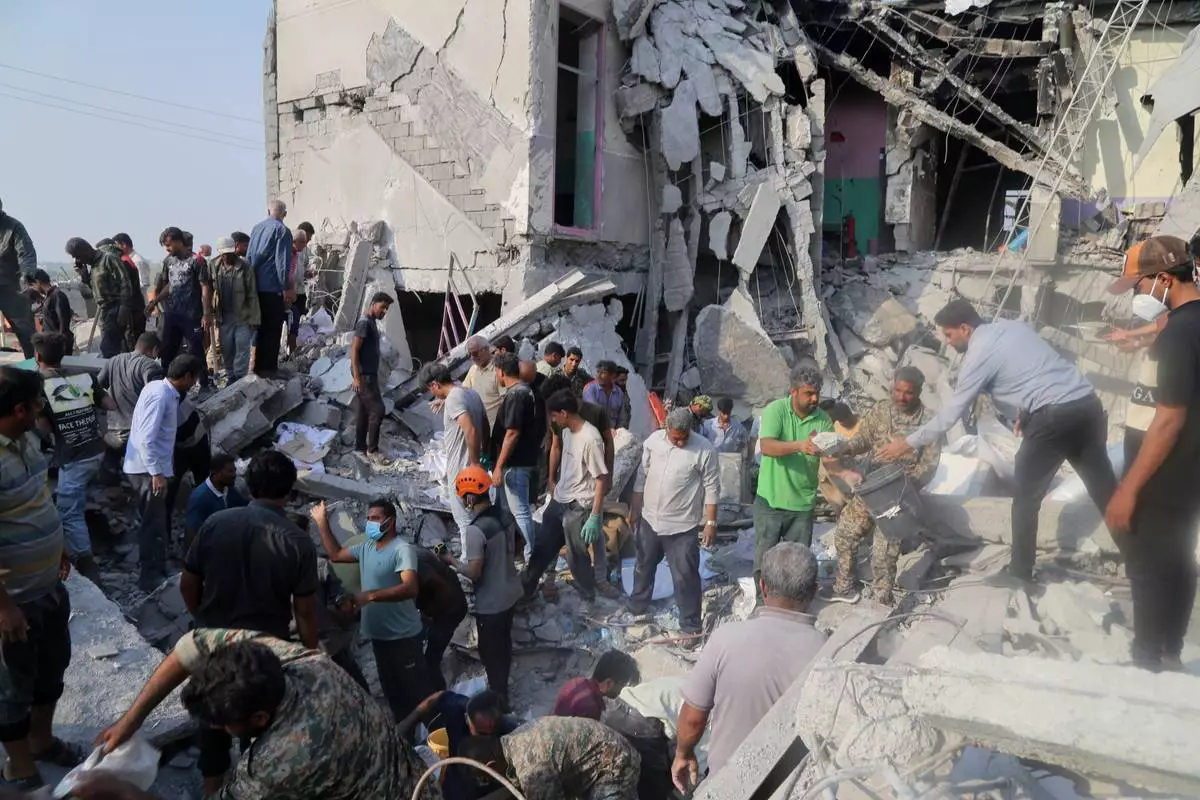
Rescue workers and residents search through the rubble in the aftermath of a strike on a girls' elementary school in Minab, Iran, Saturday, Feb. 28, 2026. (Abbas Zakeri/Mehr News Agency via AP)
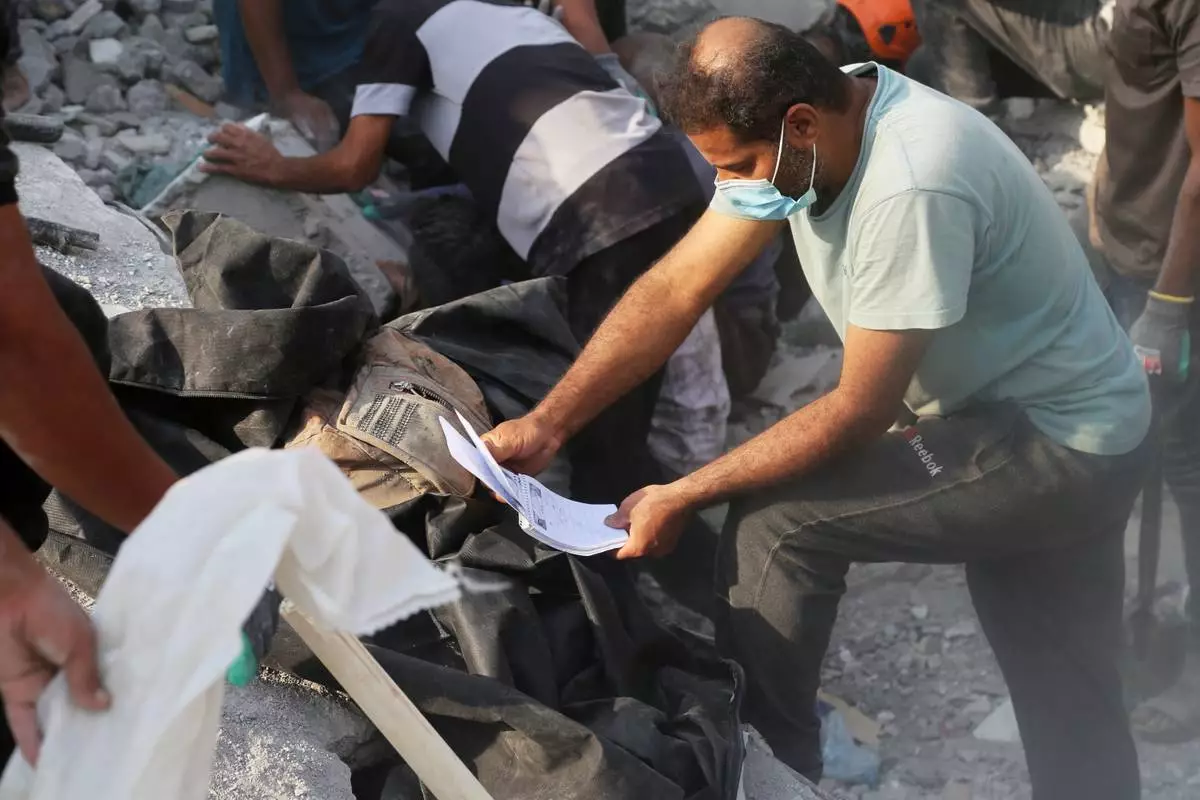
Rescue workers and residents search through the rubble in the aftermath of a strike on a girls' elementary school in Minab, Iran, Saturday, Feb. 28, 2026. (Abbas Zakeri/Mehr News Agency via AP)
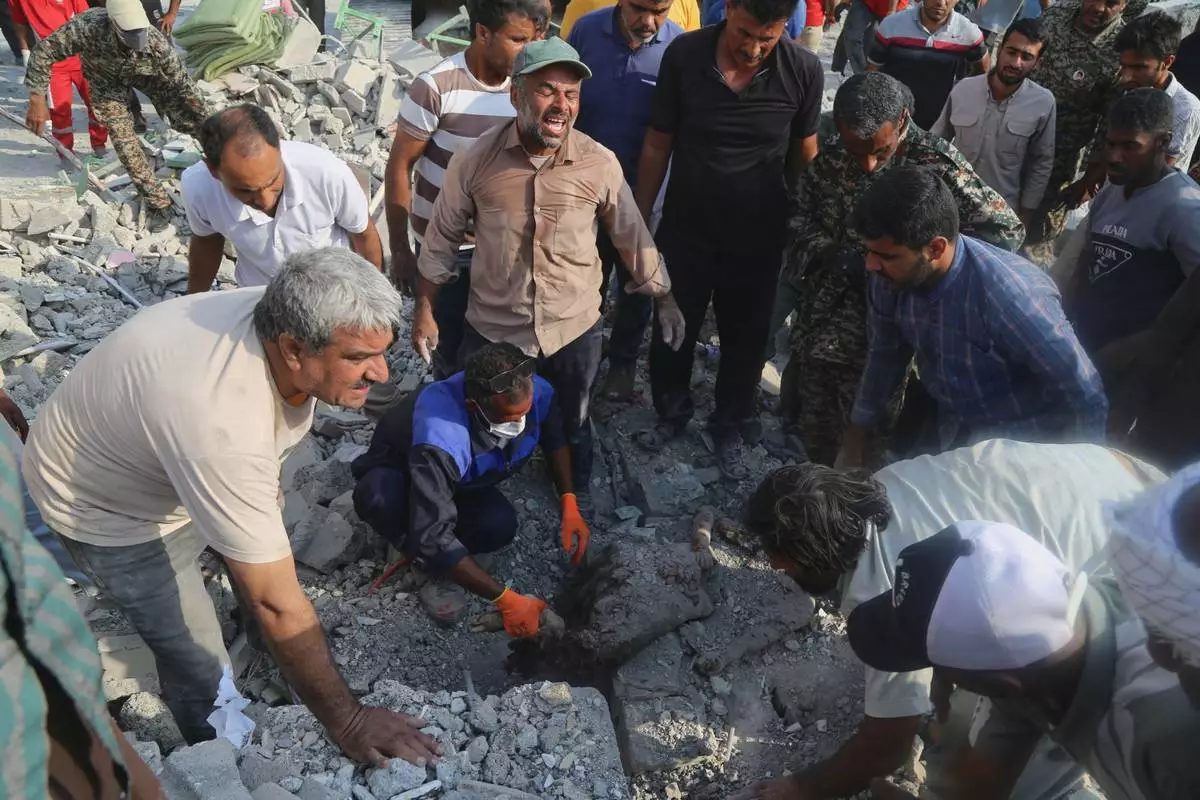
Rescue workers and residents search through the rubble in the aftermath of a strike on a girls' elementary school in Minab, Iran, Saturday, Feb. 28, 2026. (Abbas Zakeri/Mehr News Agency via AP)
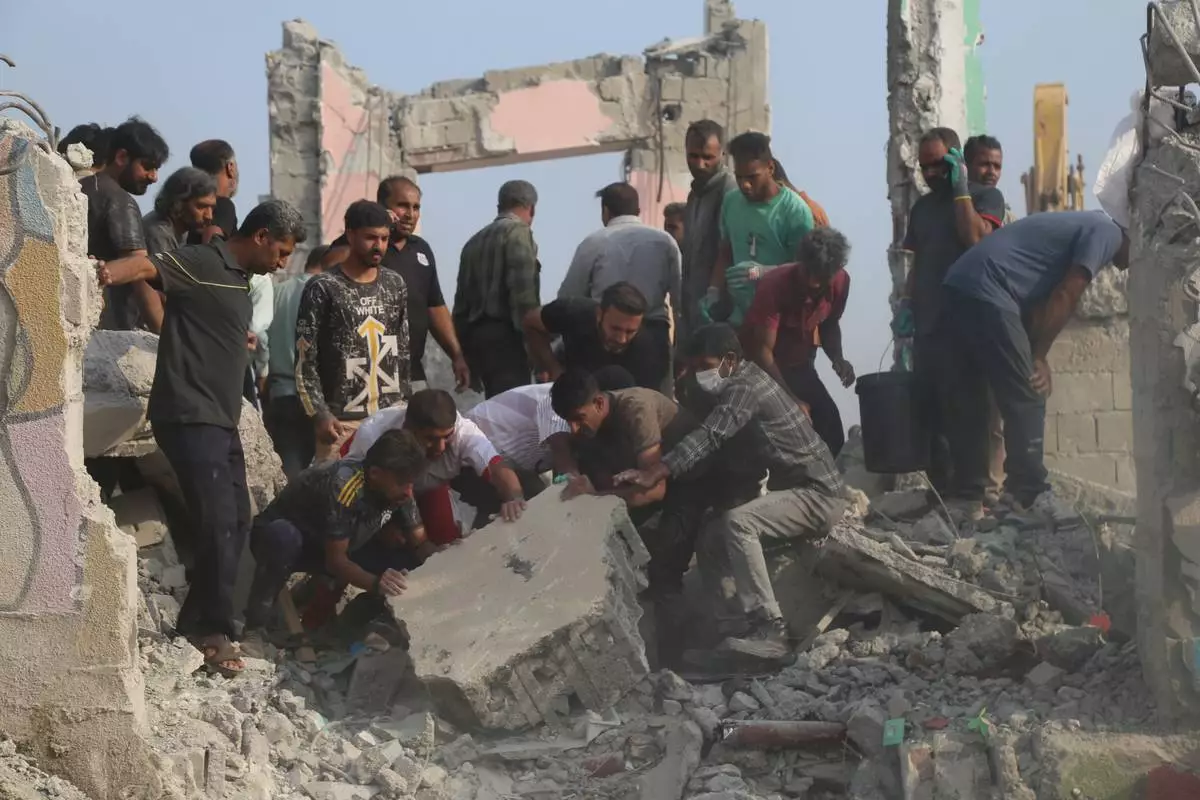
Rescue workers and residents search through the rubble in the aftermath of a strike on a girls' elementary school in Minab, Iran, Saturday, Feb. 28, 2026. (Abbas Zakeri/Mehr News Agency via AP)