Skip to Content Facebook Feature Image

Palestinian deaths in Israeli custody have surged. A prison guard describes rampant abuse

News

Palestinian deaths in Israeli custody have surged. A prison guard describes rampant abuse
News

News

Palestinian deaths in Israeli custody have surged. A prison guard describes rampant abuse

2025-11-17 23:14 Last Updated At:23:20

TEL AVIV, Israel (AP) — The number of Palestinians dying in Israeli custody surged to nearly 100 people since the start of the war in Gaza, according to a report published Monday by a human rights group that says systematic violence and denial of medical care at prisons and detention centers contributed to many of the deaths it examined.

The picture that emerges from the report by Physicians for Human Rights-Israel is consistent with findings by The Associated Press, which interviewed more than a dozen people about prison abuses, medical neglect and deaths, analyzed available data, and reviewed reports of autopsies. AP spoke with a former guard and a former nurse at one prison, an Israeli doctor who treated malnourished prisoners brought to his hospital, former detainees and their relatives, and lawyers representing them and rights groups.

The former guard at a military prison notorious for its harsh treatment of Palestinians told the AP detainees were routinely shackled with chains and kicked and hit with batons, and that the facility had been dubbed a “graveyard” because so many prisoners were dying there. He agreed to talk to AP to raise awareness of violence in Israeli prisons and spoke on condition of anonymity due to fear of reprisal.

Of the 98 prisoner deaths PHRI documented since the Oct. 7, 2023, attack that ignited the war, 27 occurred in 2023, 50 in 2024 and 21 this year, the most recent on Nov. 2. PHRI says the actual death toll over this timeframe is “likely significantly higher,” noting that Israel has refused to provide information about hundreds of Palestinians detained during the war.

Fewer than 30 Palestinians died in Israeli custody in the 10 years preceding the war, PHRI says. But since the war, the prison population more than doubled to 11,000 as people were rounded up, mainly from Gaza and the West Bank. The number of prisoners dying grew at an even faster rate over that period, PHRI data shows.

PHRI documented deaths by interviewing former detainees and prison medical staff, examining reports prepared by doctors who observed autopsies at the behest of dead prisoners’ families, and confirming dozens of fatalities through freedom of information requests.

“The alarming rate at which people are killed in Israeli custody reveals a system that has lost all moral and professional restraint,” said Naji Abbas, a director at PHRI.

Last year, the head of Israel’s prison system, National Security Minister Itamar Ben-Gvir, boasted that he had degraded prison conditions to the legal minimum. Under pressure from rights groups, conditions improved slightly.

Israel’s Prison Service said it operates in accordance with the law. It declined to comment on the death count and directed any inquiries to Israel’s army.

The army said it is aware some detainees have died, including people with preexisting illnesses or combat-related injuries. But army spokesperson Nadav Shoshani said the death count in the PHRI report is inflated, while declining to say what the army believes the real number to be.

The army also said allegations of abuse or inadequate conditions are assessed, and that those who violate the army’s code of conduct are punished and sometimes subject to criminal investigations.

Although hesitant at first, the former guard at the Sde Teiman military prison in southern Israel said he eventually participated in beatings of prisoners.

One morning, early in Israel’s war against Hamas, the guard arrived at work to see a motionless Palestinian lying on his side in the yard, yet no guards rushed to see what had happened to the man, who was dead.

“It was sort of business as usual with the dead guy,” said the guard, who didn’t know the cause of death.

Prisoners’ arms and legs were always in chains, and they were beaten if they moved or spoke, the guard said, adding that nearly all would urinate and defecate on themselves rather than ask to use the bathroom.

The former nurse at Sde Teiman said chains used to restrain many prisoners’ arms and legs caused such severe wounds that some needed their limbs to be amputated. She spoke on condition of anonymity for fear of reprisal. During the several weeks she worked there at the start of last year she didn’t see anyone die, but she said the staff at times talked about prisoner deaths. She left the job because she didn’t like the abusive treatment of the prisoners, she said.

The army said prolonged handcuffing is implemented only in exceptional cases when there are “significant security considerations.” Even then, detainees' medical condition is taken into account, it said. Only a few detainees from Gaza are currently being handled this way, it added.

Guards were told by their commanders — who also participated in the beatings -- that they needed to reduce the deaths, according to the Sde Teiman guard, who spent several months there.

Eventually cameras were installed, which helped mitigate the abuse, he said. Twenty-nine prisoners have died at Sde Teiman since the war began, according to PHRI.

Earlier this year, an Israeli soldier was convicted of abusing Palestinians in Sde Teiman and sentenced to seven months in prison, according to the army, which said this shows there is accountability.

But lawyers for prisoners say Israel rarely conducts serious investigations into alleged violence and that this fuels the problem.

In a sign of the public climate, the Israeli military’s top lawyer was recently forced to resign after acknowledging she approved the leak of a surveillance video at the center of an investigation into allegations of severe sexual abuse against a Palestinian at Sde Teiman. The leak, meant to defend the decision by her office to prosecute guards for the alleged abuses, instead triggered fierce criticism from hard-line Israeli leaders who sympathized with the guards.

Several soldiers were indicted in that case, which is still pending before the military court.

It is difficult to pinpoint with certainty the cause of death for most prisoners. Sometimes, at the behest of prisoners’ families, doctors were granted permission by Israel to attend autopsies and provided reports to the families on what they saw.

Eight reports seen by the AP showed a pattern of physical abuse and medical neglect.

In one, a 45-year-old man who died in Kishon detention center, Mohammad Husein Ali, showed multiple signs of physical assault, likely causing brain bleed, according to the report. The potential use of excessive restraints was also noted. His family said he was healthy before he was detained from his home in the West Bank. He died within a week of being imprisoned.

Husein Ali had previously served time in an Israeli prison after being convicted of association with militancy, according to his family. But they said he had no ties with militants when he was arrested last year.

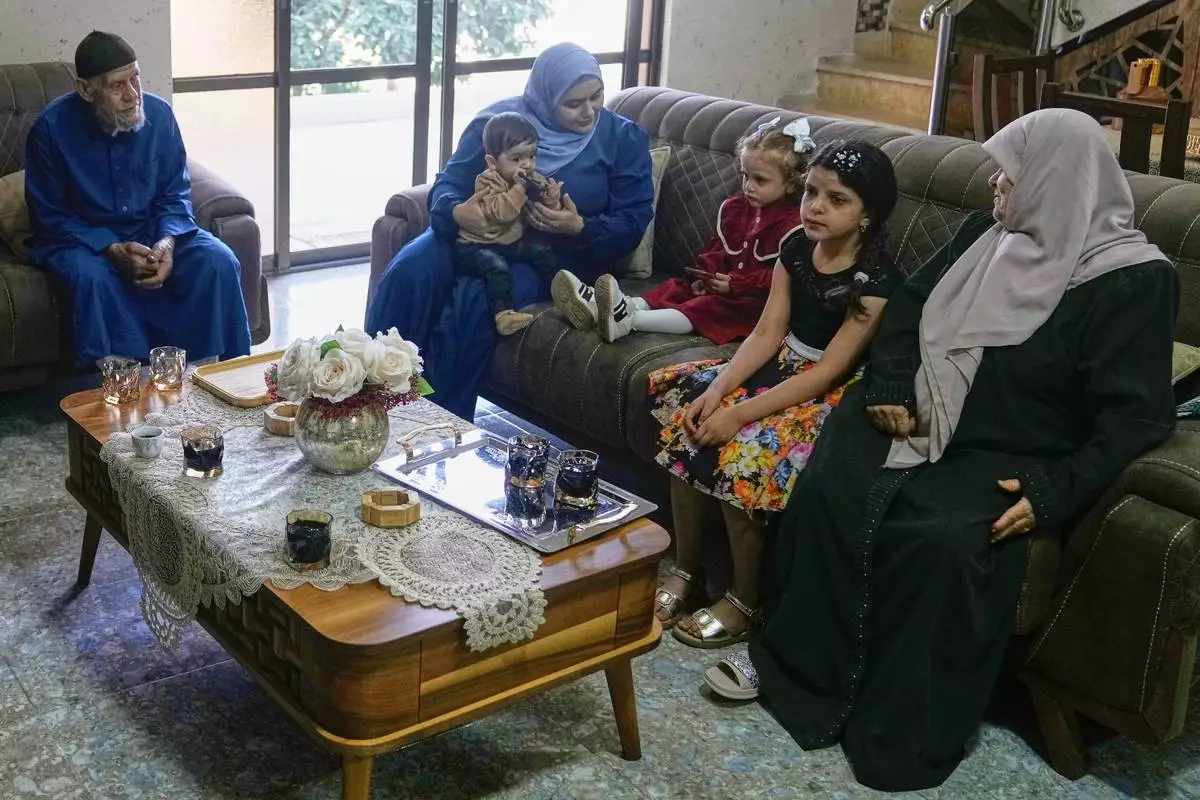
After Husein Ali was taken, his 2-year-old daughter would stare out the window calling for her father, said his wife, Hadeel. “She'd say ‘baba, where’s baba’, but after time she stopped asking,” she said, wiping tears from her eyes.

Malnutrition was a contributing factor in at least one death, according to PHRI, leading to a 17-year-old boy dying from starvation.

In September, Israel’s Supreme Court ordered that more and better food be served to Palestinian inmates. Rights groups say the situation has slightly improved.

The army said detainees receive three meals a day, approved by a dietitian. It said every detainee is examined by a doctor upon arrival and, for those who need it, monitored with regular checkups.

Sariy Khuorieh, an Israeli-Palestinian lawyer from Haifa, said he was detained at the start of the war after Israel accused him of inciting violence through his social media posts. While in Megiddo prison for 10 days, Khuorieh says he saw a man die after repeated beatings.

Khuorieh said the 33-year-old father of four from the West Bank was beaten almost daily. The man, and some of his relatives, had close ties to Hamas, according to a Palestinian security official and someone who knew the family, both of whom spoke on condition of anonymity out of concern for retaliation.

The night before the man died, he screamed in pain for hours while in solitary confinement, said Khuorieh, who choked back tears while recounting what happened. The man had repeatedly called for a doctor, but none came, Khourieh said.

A spokesperson for Israel’s Prison Service wouldn't comment on the case.

A report written about the man's autopsy seen by AP said the cause of death was inconclusive but that there were signs of old and new bruising, including broken ribs. The report said it could be assumed that violence contributed to his death.

When the guards opened the man’s cell they kicked and beat him before summoning a physician who tried to revive him and then pronounced him dead, said Khuorieh, who said he was able to see what was happening through the small window in his cell door.

Once the man was pronounced dead, Khuorieh said one of the officer’s laughed and said: there's “at least one less” to care about.
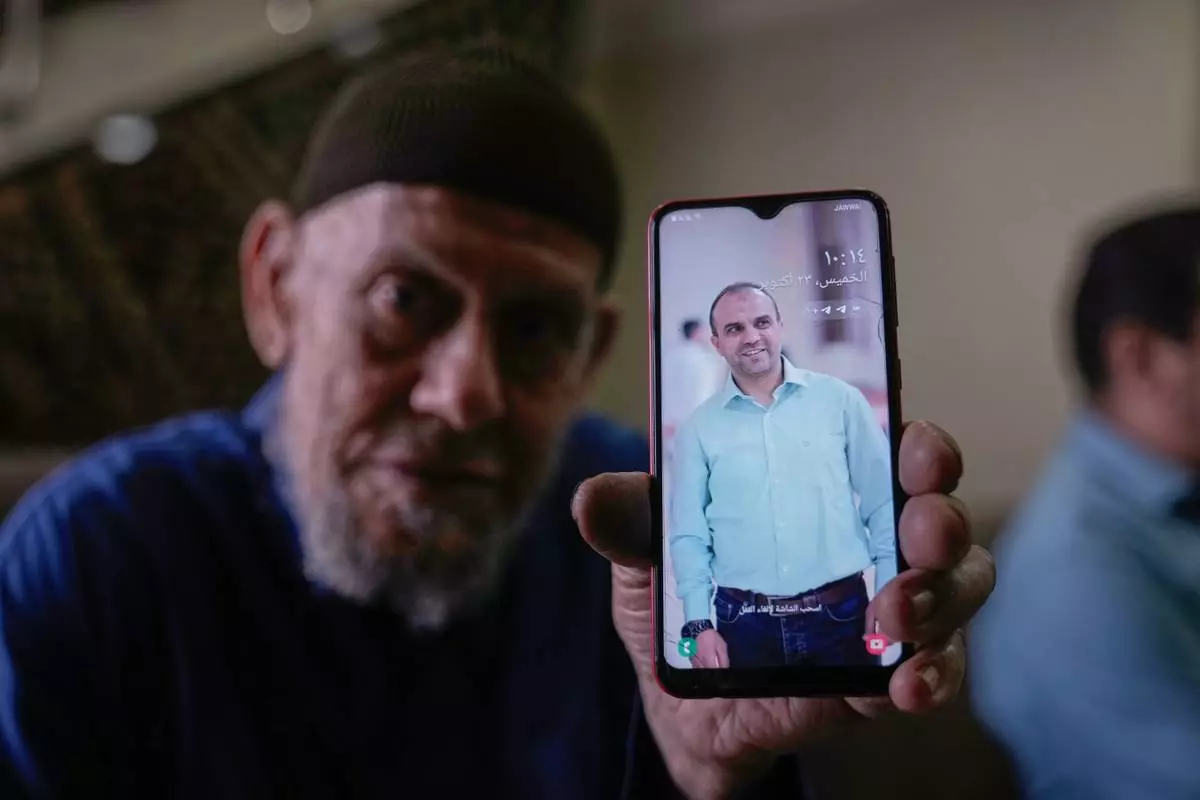
Waleed Husein Ali, shows a picture on a phone of his son, Mohammad, 45, who died in Israeli custody at the Kishon detention center, as he sits in the family's living room in the Nur Shams refugee camp near the West Bank town of Tulkarem, Thursday, Oct. 23, 2025. (AP Photo/Majdi Mohammed)
Waleed Husein Ali, shows a picture on a phone of his son, Mohammad, 45, who died in Israeli custody at the Kishon detention center, as he sits in the family's living room in the Nur Shams refugee camp near the West Bank town of Tulkarem, Thursday, Oct. 23, 2025. (AP Photo/Majdi Mohammed)

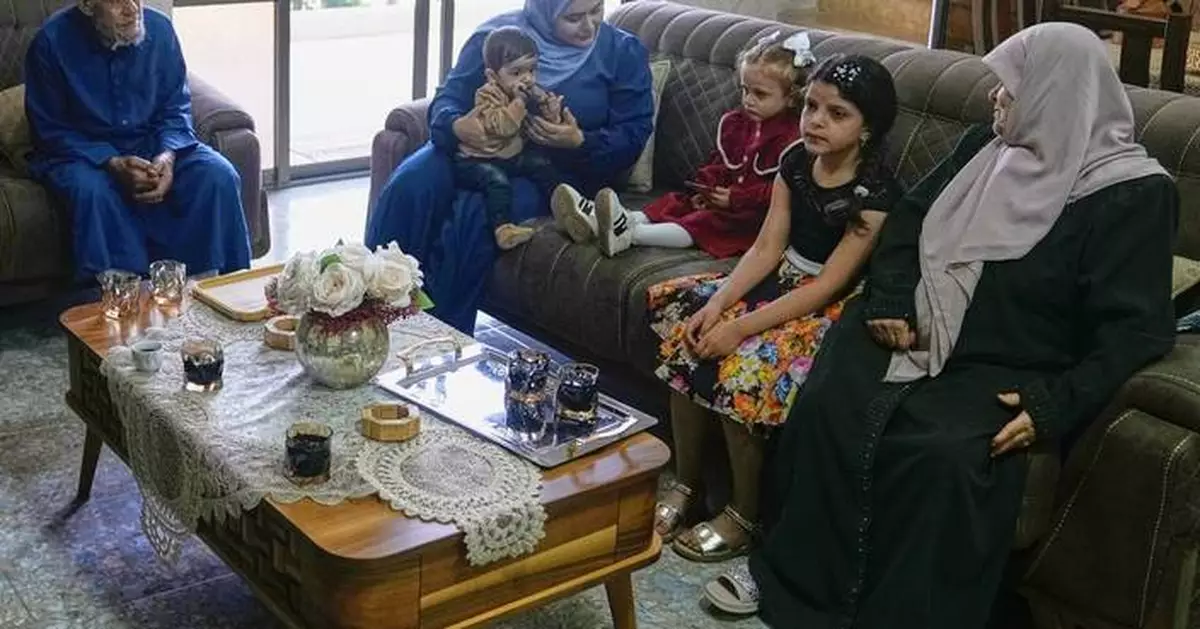
Relatives of Mohammad Husein Ali, 45, who died in the Israeli Kishon detention center, sit in their living room in the Nur Shams refugee camp near the West Bank town of Tulkarem, Thursday, Oct. 23, 2025. From left are Mohammad’s father Waleed Husein Ali, wife Hadeel, son Bara’, daughter Misk, an unidentified relative, and Mohammad’s mother Sobheya Husein Ali. (AP Photo/Majdi Mohammed)
Relatives of Mohammad Husein Ali, 45, who died in the Israeli Kishon detention center, sit in their living room in the Nur Shams refugee camp near the West Bank town of Tulkarem, Thursday, Oct. 23, 2025. From left are Mohammad’s father Waleed Husein Ali, wife Hadeel, son Bara’, daughter Misk, an unidentified relative, and Mohammad’s mother Sobheya Husein Ali. (AP Photo/Majdi Mohammed)
SYDNEY (AP) — Australian federal and state government leaders on Monday agreed to immediately overhaul already-tough national gun control laws after a mass shooting targeted a Hanukkah celebration on Sydney's Bondi Beach, leaving at least 15 people dead.

The action would include renegotiating the landmark national firearms agreement that virtually banned rapid-fire rifles after a lone gunman killed 35 people in Tasmania in 1996, galvanizing the country into action, the nine leaders' said in a statement after an emergency meeting.

The violence erupted at the end of a summer day when thousands had flocked to Bondi Beach, an icon of Australia’s cultural life. They included hundreds gathered for the “Chanukah by the Sea” event celebrating the start of the eight-day Hanukkah festival with food, face painting and a petting zoo.

At least 38 people, including two police officers, were being treated in hospitals after the massacre, when the two suspected shooters fired on the beachfront festivities. Those killed included a 10-year-old girl, a rabbi and a Holocaust survivor.

None of the dead or wounded victims have been formally named by the authorities. Identities of those killed, who ranged in age from 10 to 87, began to emerge in news reports Monday.

Among them was Rabbi Eli Schlanger, assistant rabbi at Chabad of Bondi and an organizer of the family Hanukkah event that was targeted, according to Chabad, an Orthodox Jewish movement that runs outreach worldwide and sponsors events during major Jewish holidays.

Israel’s Foreign Ministry confirmed the death of an Israeli citizen, but gave no further details. French President Emmanuel Macron said a French citizen, identified as Dan Elkayam, was among those killed.

Larisa Kleytman told reporters outside St Vincent’s Hospital in Sydney that her husband, Alexander Kleytman, was among the dead. The couple were both Holocaust survivors, according to The Australian newspaper.

Police shot the two suspected shooters, a father and son. The 50-year-old father died at the scene. His 24-year-old son remained in a coma in hospital on Monday, Prime Minister Anthony Albanese said.

Police won't reveal their names.

Albanese confirmed that Australia’s main domestic spy agency, the Australian Security Intelligence Agency, had investigated the son for six months in 2019.

Australian Broadcasting Corp. reported that ASIO had examined the son’s ties to a Sydney-based Islamic State group cell. Albanese did not describe the associates, but said ASIO was interested in them rather than the son.

“He was examined on the basis of being associated with others and the assessment was made that there was no indication of any ongoing threat or threat of him engaging in violence,” Albanese said.

Albanese had proposed new gun restrictions, including limiting the number of guns a licensed owner can obtain and reviewing existing licenses over time.

His proposals were announced after the authorities revealed that the older suspected gunman had held a gun license for a decade and amassed his six guns legally.

“The government is prepared to take whatever action is necessary. Included in that is the need for tougher gun laws,” Albanese said.

The horror at Australia’s most popular beach was the deadliest shooting in almost three decades since the 1996 Port Arthur massacre. The removal of rapid-fire rifles has markedly reduced the death tolls from such acts of violence since then.

Albanese called the Bondi massacre an act of antisemitic terrorism that struck at the heart of the nation.

Government leaders on Monday proposed restricting gun ownership to Australian citizens, a measure that would have excluded the older suspect, who came to Australia in 1998 on a student visa and became a permanent resident after marrying a local woman. Officials wouldn’t confirm what country he had migrated from.

His son, who doesn't have a gun license, is an Australian-born citizen.

The government leaders also proposed the “additional use of criminal intelligence” in deciding who was eligible for a gun license. That could mean the son’s suspicious associates could disqualify the father from owning a gun.

Chris Minns, premier of New South Wales where Sydney is the state capital, said his state's gun laws would change, but he could not yet detail how.

“It means introducing a bill to Parliament to — I mean to be really blunt — make it more difficult to get these horrifying weapons that have no practical use in our community,” Minns said.

“If you’re not a farmer, you’re not involved in agriculture, why do you need these massive weapons that put the public in danger and make life dangerous and difficult for New South Wales Police?” Minns asked.

Meanwhile, the massacre provoked questions about whether Albanese and his government had done enough to curb rising antisemitism. Jewish leaders and the massacre’s survivors expressed fear and fury as they questioned why the men hadn’t been detected before they opened fire.

“There’s been a heap of inaction,” said Lawrence Stand, a Sydney man who raced to a bar mitzvah celebration in Bondi when the violence erupted to find his 12-year-old daughter.

“I think the federal government has made a number of missteps on antisemitism,” Alex Ryvchin, spokesperson for the Australian Council of Executive Jewry, told reporters gathered on Monday near the site of the massacre. “I think when an attack such as what we saw yesterday takes place, the paramount and fundamental duty of government is the protection of its citizens, so there’s been an immense failure.”

On Monday, hundreds arrived near the scene to lay flowers at a growing pile of floral tributes. There were words of pride, too, for a man who was captured on video appearing to tackle and disarm one gunman, before pointing the man’s weapon at him, then setting the gun on the ground.

The man was identified by Home Affairs Minister Tony Burke as Ahmed al Ahmed. The 42-year-old fruit shop owner and father of two was shot in the shoulder by the other gunman and survived.

Al Ahmed, an Australian citizen who migrated from Syria in 2006, underwent surgery on Monday, his family said.

“Ahmed is a real-life hero. Last night, his incredible bravery no doubt saved countless lives when he disarmed a terrorist at enormous personal risk,” Minns posted on social media with a photo of the premier sitting at the end of al Ahmed’s hospital bed.

Al Admed's parents, who moved to Australia in recent months, said their son had a background in the Syrian security forces.

“My son has always been brave. He helps people. He’s like that,” his mother, Malakeh Hasan al Ahmed, told ABC through an interpreter.

Australia, a country of 28 million people, is home to about 117,000 Jews, according to official figures. Over the past year, the country was rocked by antisemitic attacks in Sydney and Melbourne. Synagogues and cars were torched, businesses and homes graffitied and Jews attacked in those cities, where 85% of the nation’s Jewish population lives.

The Australian government has enacted various measures to counter a surge in antisemitism since Hamas attacked Israel on Oct. 7, 2023, and Israel launched a war on Hamas in Gaza in response.

Israel’s Prime Minister Benjamin Netanyahu said Sunday that he warned Australia’s leaders months ago about the dangers of failing to take action against antisemitism. He claimed Australia’s decision, in line with scores of other countries, to recognize a Palestinian state “pours fuel on the antisemitic fire.”

Albanese in August blamed Iran for two of the previous attacks and cut diplomatic ties to Tehran. Authorities have not suggested Iran was linked to Sunday’s massacre.

Graham-McLay reported from Wellington, New Zealand and McGuirk from Melbourne, Australia.

Governor General Sam Mostyn places flowers at a tribute to shooting victims outside the Bondi Pavilion at Sydney's Bondi Beach, Monday, Dec. 15, 2025, a day after a shooting. (AP Photo/Mark Baker)

Governor General Sam Mostyn places flowers at a tribute to shooting victims outside the Bondi Pavilion at Sydney's Bondi Beach, Monday, Dec. 15, 2025, a day after a shooting. (AP Photo/Mark Baker)

Governor General Sam Mostyn, left, greets MP, Allegra Spender, at a gathering at a flower memorial to shooting victims outside the Bondi Pavilion at Sydney's Bondi Beach, Monday, Dec. 15, 2025, a day after a shooting. (AP Photo/Mark Baker)

Governor General Sam Mostyn, left, greets MP, Allegra Spender, at a gathering at a flower memorial to shooting victims outside the Bondi Pavilion at Sydney's Bondi Beach, Monday, Dec. 15, 2025, a day after a shooting. (AP Photo/Mark Baker)

A woman is escorted from a flower memorial outside the Bondi Pavilion at Sydney's Bondi Beach, Monday, Dec. 15, 2025, a day after a shooting. (AP Photo/Mark Baker)

A woman is escorted from a flower memorial outside the Bondi Pavilion at Sydney's Bondi Beach, Monday, Dec. 15, 2025, a day after a shooting. (AP Photo/Mark Baker)

A woman kneels and prays at a flower memorial to shooting victims outside the Bondi Pavilion at Sydney's Bondi Beach, Monday, Dec. 15, 2025, a day after a shooting. (AP Photo/Mark Baker)

A woman kneels and prays at a flower memorial to shooting victims outside the Bondi Pavilion at Sydney's Bondi Beach, Monday, Dec. 15, 2025, a day after a shooting. (AP Photo/Mark Baker)

A couple lay flowers at a tribute to shooting victims outside the Bondi Pavilion at Sydney's Bondi Beach, Monday, Dec. 15, 2025, a day after a shooting. (AP Photo/Mark Baker)

A couple lay flowers at a tribute to shooting victims outside the Bondi Pavilion at Sydney's Bondi Beach, Monday, Dec. 15, 2025, a day after a shooting. (AP Photo/Mark Baker)

Recommended Articles