ALBANY, N.Y.--(BUSINESS WIRE)--Nov 17, 2025--
Soluna Holdings, Inc. (“Soluna” or the “Company”) (NASDAQ: SLNH), a developer of green data centers for intensive computing applications, including Bitcoin mining and AI, announced its financial results for the third quarter ended September 30, 2025.
Click to Gallery
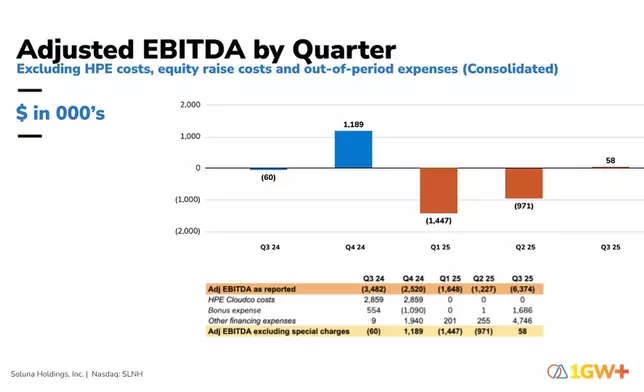
Soluna Reports Q3-2025 Adjusted EBITDA by Quarter, Excluding Special Charges
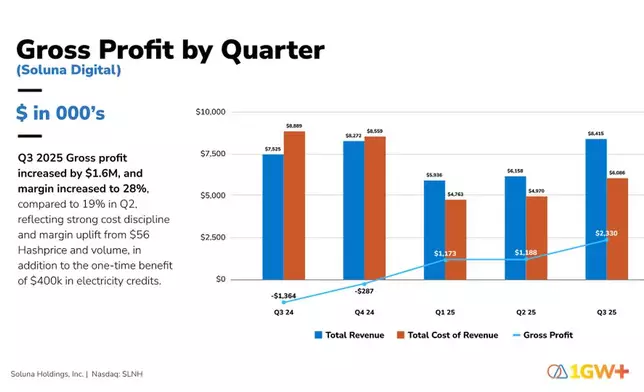
Soluna Reports Q3-2025 Gross Profit by Quarter
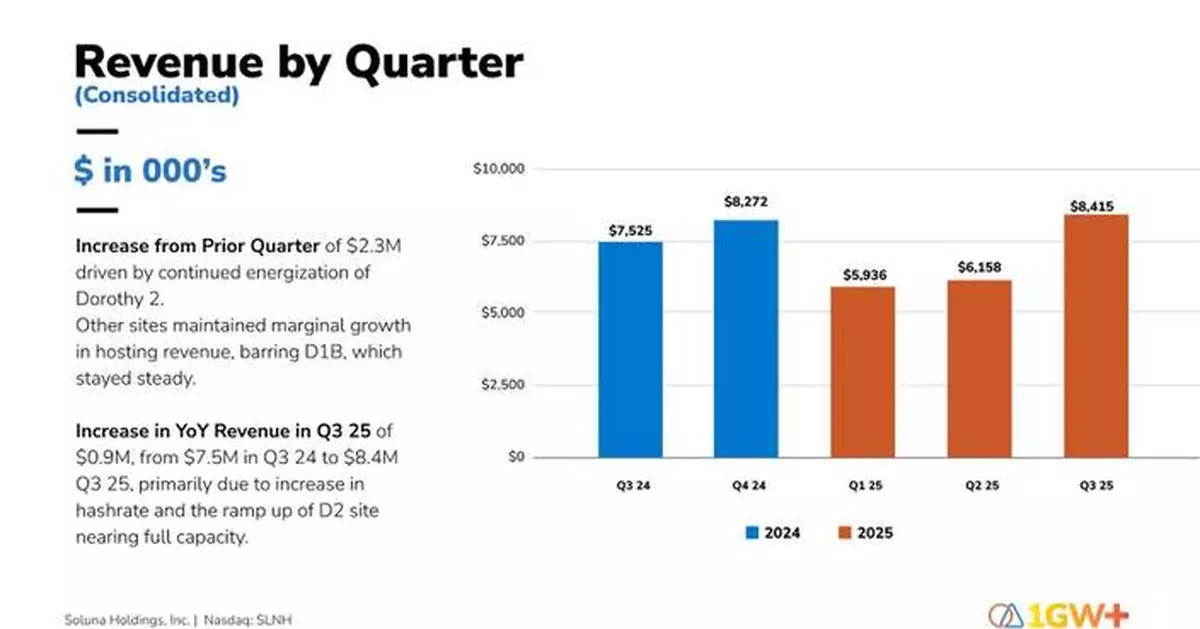
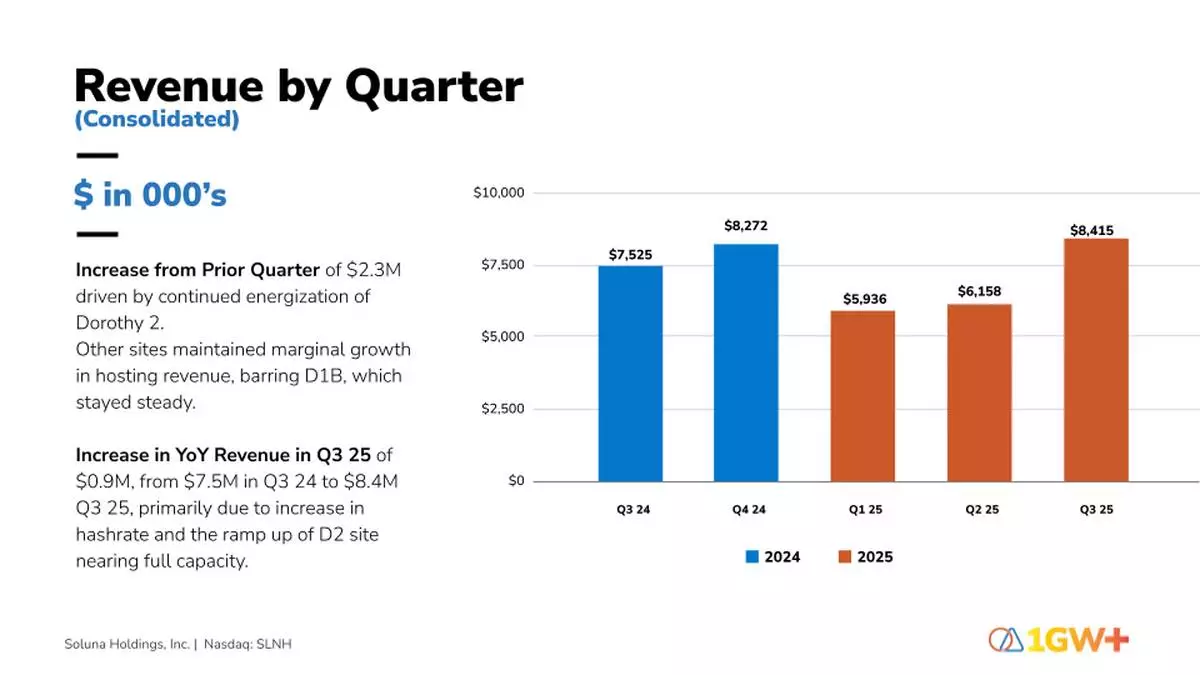
Soluna Reports Q3-2025 Revenue by Quarter
This press release features multimedia. View the full release here: https://www.businesswire.com/news/home/20251117209594/en/
“This is a new Soluna,” said John Belizaire, CEO of Soluna Holdings. “What we achieved in the third quarter reflects the exceptional execution of our small but mighty team. We’ve proven that our business model works and scales, strengthened our position as a leading Bitcoin hosting provider, and attracted new, world-class capital partners.”
Belizaire continued: “We’ve also strengthened our capital structure to be more flexible and growth-oriented. With this foundation, we now have more firepower to accelerate the growth of our existing business and expand into the fast-growing AI market.”
Q3 2025 Operational and Corporate Highlights:
Third Quarter Finance and Operations Highlights:
Q3 2025 Revenue & Cost of Revenue by Project Site
Q3 2024 Revenue & Cost of Revenue by Project Site
The audited financial statements and Annual Report on Form 10-K for the year ended December 31, 2024, filed with the U.S. Securities and Exchange Commission (“SEC”) on March 31, 2025, are available online.
Our current Investor Presentation can be found here.
Our 2025 Earnings Power Presentation can be found here.
Soluna’s glossary of terms can be found here.
Safe Harbor Statement
This announcement contains forward-looking statements. These statements are made under the "safe harbor" provisions of the U.S. Private Securities Litigation Reform Act of 1995. These forward-looking statements can be identified by terminology such as "will," "expects," "anticipates," "future," "intends," "plans," "believes," "estimates," "confident," and similar statements. Other examples of forward-looking statements may include, but are not limited to, (i) statements of Company plans and objectives, including the deployments at Project Kati 1, (ii) statements of future economic performance, and (iii) statements of assumptions underlying other statements about the Company or its business. Soluna may also make written or oral forward-looking statements in its periodic reports to the SEC, in its annual report to shareholders, in press releases and other written materials, and in oral statements made by its officers, directors, or employees to third parties. Statements that are not historical facts, including but not limited to statements about Soluna’s beliefs and expectations, are forward-looking statements. Forward-looking statements involve inherent risks and uncertainties, further information regarding which is included in the Company's filings with the SEC. All information provided in this press release is as of the date of the press release, and Soluna undertakes no duty to update such information, except as required under applicable law.
Non-GAAP Measures
In addition to figures prepared in accordance with generally accepted accounting principles (“GAAP”), Soluna from time to time may present alternative non-GAAP performance measures, e.g., EBITDA, adjusted EBITDA, adjusted net profit/loss, adjusted earnings per share, free cash flow, both on a company basis and on a project-level basis, among others. EBITDA is defined as earnings before interest, taxes, and depreciation and amortization. Adjusted EBITDA is defined as EBITDA adjusted for stock-based compensation costs, provision for credit losses, loss on sale of fixed assets and credit on equipment deposit, provision for credit losses, impairment on fixed assets, fair value adjustment loss (gain), fair value on placement agent warrants financing fee, and loss (gain) on debt extinguishment and revaluation, net. Project-level measures may not take into account a full allocation of corporate expenses. These measures should be considered in addition to, but not as a substitute for, the information prepared in accordance with GAAP. Alternative performance measures are not subject to GAAP or any other generally accepted accounting principles. Other companies may define these terms in different ways. See our annual report on Form 10-K for the year ended December 31, 2024, for an explanation of how management uses these measures in evaluating its operations. Investors should review the non-GAAP reconciliations provided above and not rely on any single financial measure to evaluate the Company’s business.
About Soluna Holdings, Inc. (Nasdaq: SLNH)
Soluna is on a mission to make renewable energy a global superpower using computing as a catalyst. The company designs, develops, and operates digital infrastructure that transforms surplus renewable energy into global computing resources. Soluna’s pioneering data centers are strategically co-located with wind, solar, or hydroelectric power plants to support high-performance computing applications, including Bitcoin Mining, Generative AI, and other compute-intensive applications. Soluna’s proprietary software MaestroOS(™) helps energize a greener grid while delivering cost-effective and sustainable computing solutions and superior returns. To learn more, visit solunacomputing.com and follow us on:
LinkedIn: https://www.linkedin.com/company/solunaholdings/
X (formerly Twitter): x.com/solunaholdings
YouTube: youtube.com/c/solunacomputing
Newsletter: bit.ly/solunasubscribe
Resource Center: solunacomputing.com/resources
Soluna regularly posts important information on its website and encourages investors and potential investors to consult the Soluna investor relations and investor resources sections of its website regularly.
Segment Information
The following table details revenue, cost of revenues, and other operating costs for the Company’s reportable segments for three months ended September 30, 2025 and 2024, and reconciles to net income (loss) on the consolidated statements of operations:
The following table presents the reconciliation of segment operating income (loss) to net income (loss) before taxes:
The following table details revenue, cost of revenues, and other operating costs for the Company’s reportable segments for nine months ended September 30, 2025 and 2024, and reconciles to net income (loss) on the consolidated statements of operations:
The following table presents the reconciliation of segment operating income (loss) to net income (loss) before taxes:
Gross Profit Breakout:
The following table summarizes the balances for the project sites for cryptocurrency mining revenue, data hosting revenue, high-performance computing service revenue, demand response revenue, cost of cryptocurrency mining revenue, exclusive of depreciation, cost of data hosting revenue, exclusive of depreciation, cost of high-performance computing services, and cost of depreciation during the three months ended September 30, 2025:
The following table summarizes the balances for the project sites for cryptocurrency mining revenue, data hosting revenue, high-performance computing service revenue, demand response revenue, cost of cryptocurrency mining revenue, exclusive of depreciation, cost of data hosting revenue, exclusive of depreciation, cost of high-performance computing services, and cost of depreciation during the three months ended September 30, 2024:
The following table summarizes the balances for the project sites for cryptocurrency mining revenue, data hosting revenue, high-performance computing service revenue, demand response revenue, cost of cryptocurrency mining revenue, exclusive of depreciation, cost of data hosting revenue, exclusive of depreciation, cost of high-performance computing services, and cost of depreciation during the nine months ended September 30, 2025:
The following table summarizes the balances for the project sites for cryptocurrency mining revenue, data hosting revenue, high-performance computing service revenue, demand response revenue, cost of cryptocurrency mining revenue, exclusive of depreciation, cost of data hosting revenue, exclusive of depreciation, cost of high-performance computing services, and cost of depreciation during the nine months ended September 30, 2024:
EBITDA and Adjusted EBITDA Tables:
Reconciliations of EBITDA and Adjusted EBITDA to net loss, the most comparable GAAP financial metric, for historical periods are presented in the table below:
The following table represents the Adjusted EBITDA activity between each three-month period from January 1, 2025 through September 30, 2025.
The following table represents the Adjusted EBITDA activity between each three-month period from January 1, 2024 through December 31, 2024.
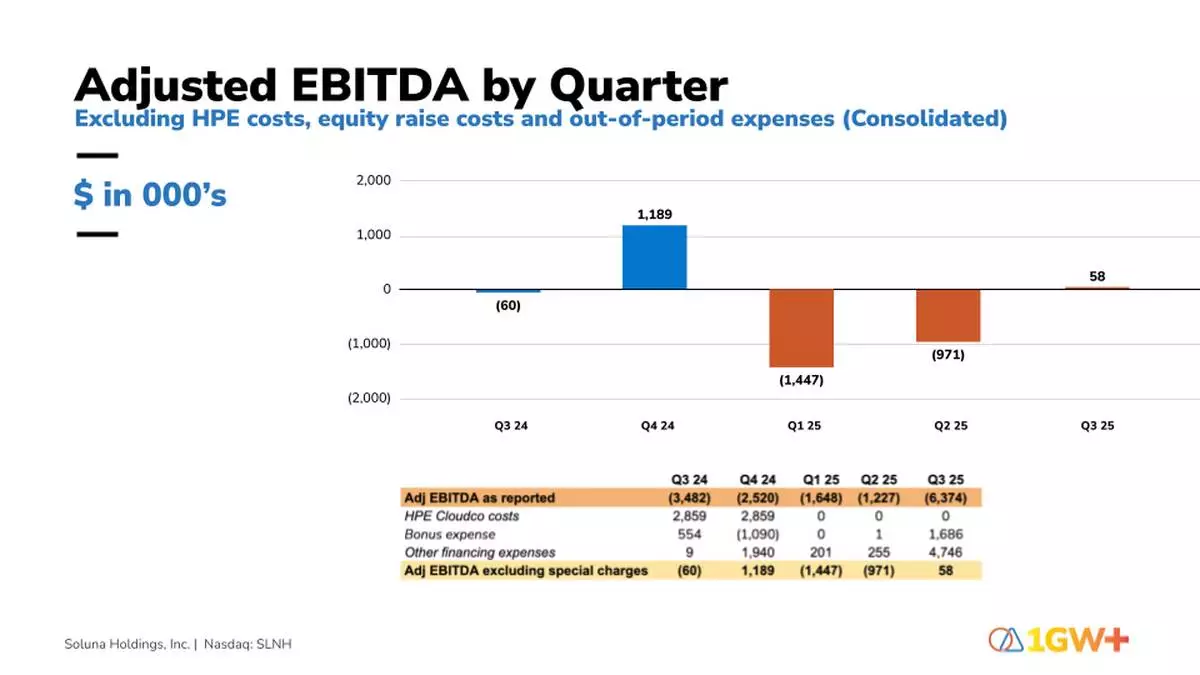
Soluna Reports Q3-2025 Adjusted EBITDA by Quarter, Excluding Special Charges
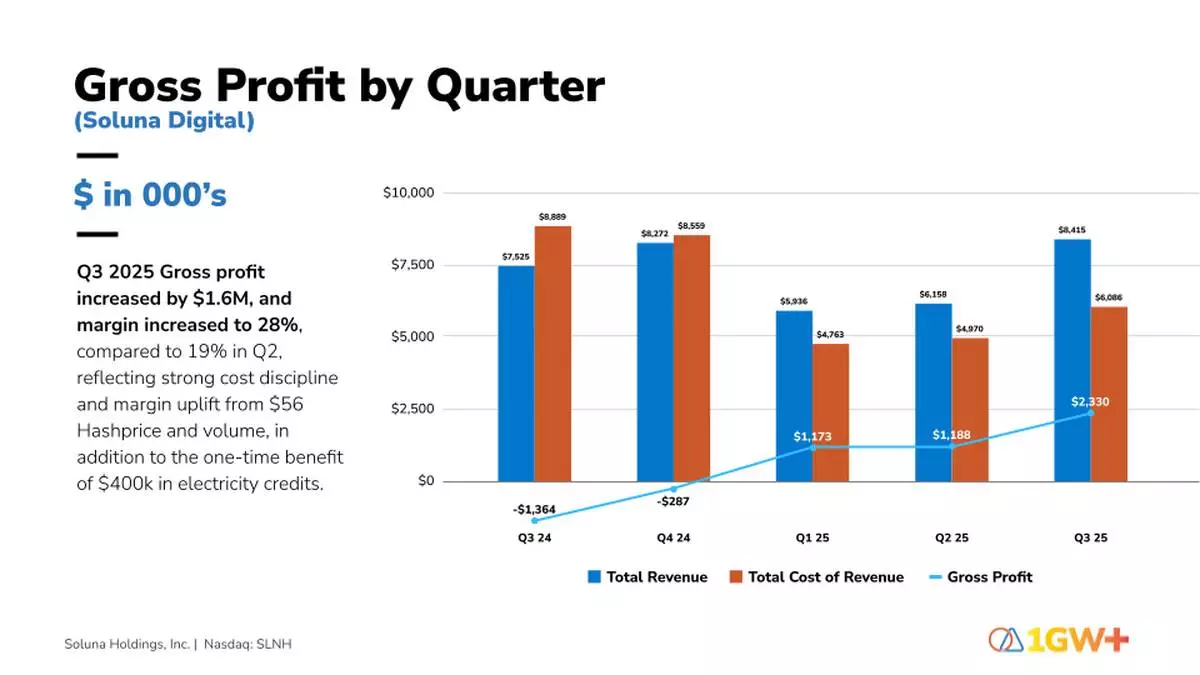
Soluna Reports Q3-2025 Gross Profit by Quarter
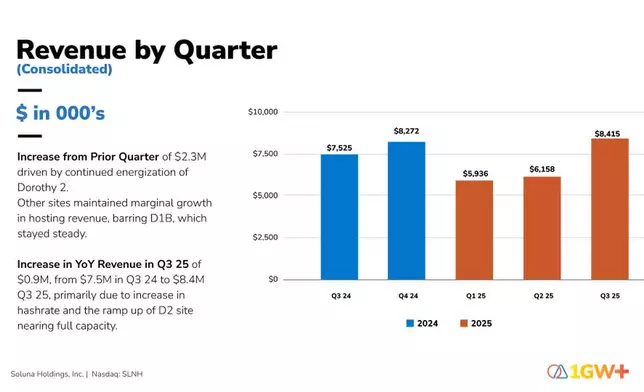
Soluna Reports Q3-2025 Revenue by Quarter