A city once known as China's unrelenting coal capital has been undergoing something of a diversification in recent years and is now drawing strength from technology, culture, and creativity, as it builds on its century-old reputation as a coal-producing powerhouse.
Datong City in north China's Shanxi Province has coal reserves which make up one-eighth of the nation's total and this single industry has shaped the destiny of the city while also fueling China's economic rise.
However, like many resource-dependent cities around the world, Datong has learned the hard truth that what builds you can also bind you. Decades of unchecked mining meant that by the early 2000s, Datong was one of China's most polluted cities, with its reliance on the industry threatening both the environment and its future.
To cope with these challenges, Datong has been making efforts to protect its pillar industry while also developing new sectors, all to benefit the people.
At a local coal research center, experts are exploring cleaner and smarter ways to use coal, making it flexible enough to work with renewable energy while improving efficiency across every stage - mining, production, transport and consumption.
"Our research focuses on three main areas. First, clean, efficient, and flexible coal combustion, enabling deep and flexible peak shaving in coal-fired power plants. Second, graded and quality-based conversion and utilization of coal. This technology makes full use of coal's properties as a raw material, converting it through chemical decomposition into everyday products such as activated carbon, paint, plastics, and medical supplies. Third, resources utilization technologies for carbon-based fuels. Through methods like heat treatment, we transform waste coal gangue into construction materials, ceramics, refractory materials and more, advancing both resource efficiency and environmental sustainability," said Tian Jilin, director of the research and development center at the Datong Research Institute for the Clean and Efficient Utilization of Coal.
The true objective extends far beyond delivering industrial upgrades, with the ultimate aim of ensuring bluer skies and a sustainable future to the people being the primary goal.
The numbers reflect the huge progress that has been made since the turn of the century. From a mere 49 days of good air in 2001, last year there were 314 days classed as having good air quality. In just over 20 years, the city has completed a remarkable turnaround, going from a national laggard in air quality to a provincial leader.
While an improved environment marks a new chapter for Datong, the city is evolving beyond its industrial roots, powered by a cultural soul honed over 1,000 years. It is now turning this time-honored heritage into a new engine for deep cultural-tourism integration, fueling broader socioeconomic progress.
The huge success of the Chinese video game "Black Myth: Wukong" last year has sparked renewed interest in Datong's cultural treasures. Beyond its captivating storyline, the game highlights ancient Chinese architecture and features 36 real-world locations, six of which are in Datong.
As a result, more visitors than ever are coming to the city to explore these historic wonders for themselves.
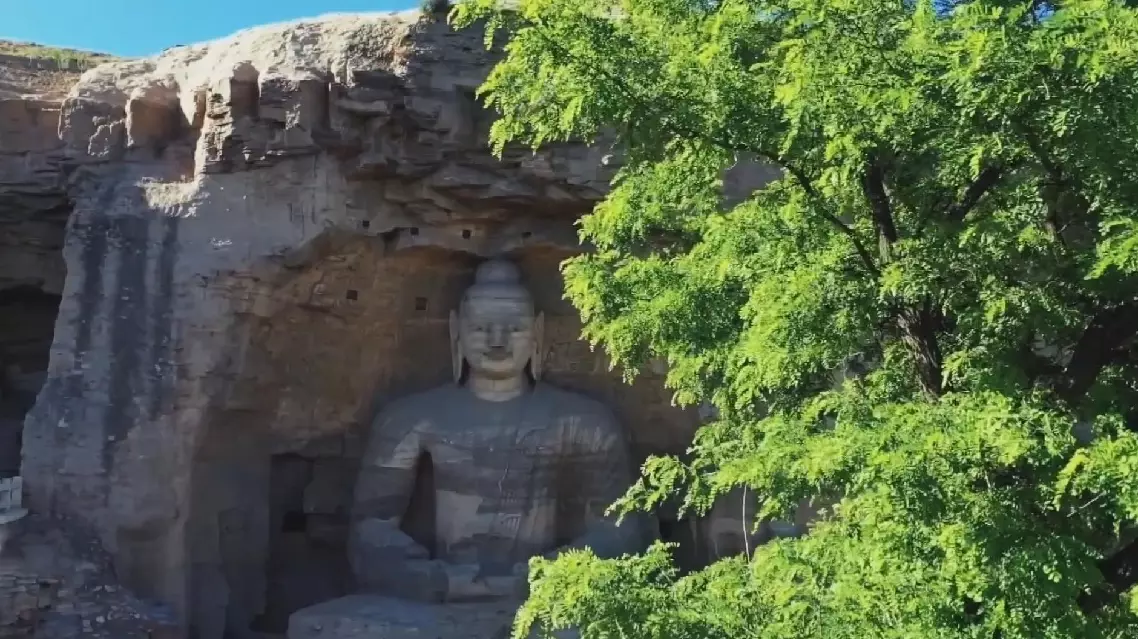
One of the most popular destinations is the ancient site of the Yungang Grottoes, which has made the most of this new wave of global fame by upgrading its services and adding fresh experiences to keep visitors engaged.
"Since last year, we've launched check-in activities themed around 'Black Myth: Wukong.' We offer exclusive Yungang Grottoes postcards featuring the game, available on-site. Visitors can also collect a special cultural seal at designated locations," said Wen Lili, head of tourist services at the Yungang Grottoes.
"We learned online that Datong has a rich cultural heritage, and we were drawn here by its stunning scenery. We wanted to experience what life was like during the Northern Wei Dynasty thousands of years ago," said one tourist.
But despite the sudden influx of visitors, efforts are being made to carefully protect the cave's important heritage with a modern approach.
Yan Hongbin, head of the Yungang Grottoes Academy Studio for Relics Preservation and Repair, said that a dense grid of sensors have been installed at the site to monitor temperature and humidity levels throughout the cave. This setup allows them to build an environmental model of the entire cave system, with the data helping develop an optimal conservation plan.
Yan said this key approach is not about protecting heritage by simply locking away it away, but rather preserving it by keeping it alive, with this advanced technology enabling an important historical site to remain open and accessible to the world.
The drive to boost the city's tourism sector has paid off. In the eight months of this year alone, Datong welcomed over 15 million visitors, an 18 percent increase, while the city's overall tourism revenue has more than quadrupled in recent years, soaring from 15 billion yuan in 2022 to over 61 billion last year.
Most importantly, this transformation is creating new pathways for ordinary people to reap the rewards.
A community craft team of more than 80 retired and unemployed women in the city's Yunzhou District has been busy making handcrafted cultural accessories inspired by Datong's famed heritage, with some carefully added modern twists.
"Starting last year, Buddha dolls became a huge hit among consumers. [So we thought,] why not make hoodies for the dolls? We never expected the orders to come in faster than we could keep up with," said Liu Chengfang, head of the Jixiangli Community who is leading the craft project.
The surge in demand for these dolls has provided the women with a decent income, close to the local average wage, while giving them a new purpose and confidence.
China's "coal capital" Datong diversifies into center of culture
Shifting from the "world factory" to a tech innovation hub, China is accelerating the development of new quality productive forces to forge a new growth path amid an increasingly complex global landscape.
The world's second-largest economy has unveiled a pivotal document outlining priorities for its 15th Five-Year Plan (2026-2030), which emphasizes "achieving greater self-reliance and strength in science and technology" and "steering the development of new quality productive forces" as key objectives for the coming five years.
As a pillar of China's high-quality development, the cultivation of new quality productive forces tailored to local conditions has made notable strides in recent years and is expected to play an even more pivotal role in driving growth in the near future.
Since the beginning of this year, China's major sci-tech breakthroughs have shown a vigorous upward trend month by month, with cutting-edge technologies rapidly moving from labs to production lines, and more and more innovations transformed into tangible productivity.
Chinese artificial intelligence startup DeepSeek rocketed into global prominence earlier this year, taking its large-scale models from obscurity to adoption in thousands of industries.
China's new high-speed train model, CR450, is currently undergoing extensive testing and evaluation on its prototypes, a step that paves the way for the commercial launch of the new bullet train. Known as the world's fastest high-speed train, the CR450 has achieved test speeds of 450 km/h, and is expected to operate at 400 km/h in commercial service.
China's Tianwen-2, the nation's first space probe tasked with retrieving samples from an asteroid, was launched in May to shed light on the formation and evolution of asteroids and the early solar system.
The Deep Sea No. 1 Phase II project has entered full operation, marking a crucial step for China toward large-scale development of deep-sea oil and gas resources.
China's Experimental Advanced Superconducting Tokamak (EAST), dubbed the artificial sun, maintained a steady-state high-confinement plasma operation lasting 1,066 seconds at 100 million degrees Celsius in January, setting a new world record and marking a breakthrough in the quest for fusion power generation. In September, China launched the world's largest centrifuge by capacity, which can generate 300 times Earth's gravity and accommodate loads of up to 20 tonnes.
Chinese scientists have achieved a major breakthrough in integrated photonic quantum chips by demonstrating the first "continuous-variable" quantum multipartite entanglement and cluster states on a chip. The breakthrough addresses a critical gap in the development of photonic quantum chips and lays a foundation for scalable quantum entanglement, with potential applications in quantum computing and quantum networks.
Chinese automaker Guangzhou Automobile Group (GAC) has completed building the country's first large-capacity all-solid-state battery production line, boosting the driving range of new energy vehicles from 500 kilometers to 1,000 kilometers.
"It can be said that 2025 is a crucial year for cultivating and developing new quality productive forces. Major achievements have shifted from breakthroughs at individual points to system-wide breakthroughs, marking an accelerated leap for the country from catching up to keeping pace and leading in cutting-edge science and technology. Innovation is rapidly transforming into an economic driving force, injecting strong momentum into the development of new quality productive forces," said Qu Wan, a researcher at the Innovation-Driven Development Center of the National Development and Reform Commission.
Additionally, efforts have been made to deepen industry-academia-research integration in talent cultivation to build a competitive human-capital advantage, while accelerating the transformation and application of major scientific and technological achievements.
"We have close to 50 percent of the best ways to deploy AI for people and planet being based in China as well. So yes, China is at the forefront of many of these areas," said Neo Gim Huay, managing director and member of the managing board at the World Economic Forum
On a broader national scale, China has fostered more than 500,000 high-tech enterprises over the past five years and now claims the largest global share of sci-tech innovation clusters.
The China Innovation Index, a barometer of the country's innovation capability, rose 5.3 percent from the 2023 level to 174.2 last year, according to the National Bureau of Statistics (NBS). The innovation environment has continued to improve, with higher investment, faster growth in outputs and stronger drivers of economic activity, the bureau said.
The country's sci-tech innovation efforts are delivering an effective boost to growth, with the innovation effectiveness index reaching 132.4 last year, up 1.9 percent from a year earlier, according to the NBS. Specifically, the sub-index measuring the proportion of added value from new technologies, new industries and new business models in total GDP increased by 4.3 percent year on year.
Across China, traditional industries are undergoing a technology-driven transformation to raise productivity and open new paths for growth.
In northeast China's Liaoning Province, a traditional heavy-industry base, intelligent and green upgrades are transforming legacy sectors, offering a clear path to shed its rust-belt image.
For example, Ansteel, a major provincial steelmaker, has deployed an intelligent system to optimize molten steel handling, reducing production costs by 15 percent and cutting wastewater discharge by 21 percent.
Numerous companies across the country are accelerating their digital transformation efforts. According to the China Internet Development Report 2024, the country now has nearly 10,000 digitalized workshops and intelligent factories. Of these, more than 400 have been recognized as national-level benchmark factories in smart manufacturing, utilizing technologies such as AI and digital twins.
First introduced in 2023, the term "new quality productive forces" describes advanced productivity driven by innovation rather than traditional growth factors. It is marked by high technology, high efficiency, and high quality, in line with the new development philosophy.
China's new quality productive forces gather steam to turbocharge future growth