Speech by CE at International Forum on China's Economy and Policy 2025 (with photos/video)
Following is the speech by the Chief Executive, Mr John Lee, at the International Forum on China's Economy and Policy 2025 today (November 18):
Honarable Doctor Zhao Zhimin (Secretary-General of Chinese Academy of Social Sciences), Nobel laureate Professor Joseph Stiglitz, (University Professor of Columbia University; Nobel Memorial Prize Laureate in Economic Sciences), distinguished speakers, ladies and gentlemen,
Good morning. Welcome to Hong Kong, and to the International Forum on China's Economy and Policy 2025.
My thanks, first of all, to the organisers affiliated with the Chinese Academy of Social Sciences: the National Academy of Economic Strategy and the Chinese Institute of Hong Kong; to the co-organisers from three universities in Hong Kong; and to all the heavyweight speakers here today.
This forum is convened by the Chief Executive's Policy Unit, which is my think tank responsible for research and engagement on long-term, strategic issues.
It works closely with academia and other think tanks, contributing rigorous analyses and innovative ideas that enhance Hong Kong's economic resilience and ongoing vibrancy. It is precisely this mission that makes this forum so valuable to us.
I understand that nearly 500 of you are here with us to discuss this year's theme: "Economic Transformations in a Multipolar World". Given today's complex global economy, it's a particularly timely topic.
The forum, and its expert speakers, will examine the challenges facing today's global economy. It will assess China's economic strategy and the sustainable development model for regional economic co-operation. To contribute to that discussion, I would like to share three main points with you today.
First, China, our country, is solidly on a path of high-quality development, creating a stable platform for global growth.
In the face of the global economy's distressing instability – the rise of protectionism and unilateralism – our country continues its focus on high-quality development, achieving groundbreaking progress.
The world's second-largest economy, our country contributes more than one-third of global economic growth. China's expanding trade and capital flows help buoy the economy of the region and the world at large. Its fundamentals remain sound, thanks to a vast domestic market and the robust policies in place to withstand external challenges.
This year marks the conclusion of our country's 14th Five-Year Plan, and preparation for the 15th Five-Year Plan is well underway.
The fourth Plenary Session of the 20th Central Committee of the Communist Party of China concluded last month, in Beijing, setting a key objective for the next five years, among other goals, to achieve significant advancements in high-quality development, with fresh policy pledges poised to reaffirm the country as a crucial anchor of stability and a source of opportunities for the global economy.
Second, as a part of this national endeavour, the Hong Kong SAR (Special Administrative Region) is proud to contribute with its own unique advantages.
Under the "one country, two systems" principle, Hong Kong enjoys the dual advantage of having both national and global opportunities. Despite the chaos in the global economy, Hong Kong's third-quarter performance was robust, thanks to a continuing surge in exports and sustained expansion in domestic demand.
Looking ahead, the Hong Kong economy should see further solid growth, supported by sustained moderate global economic growth, vibrant financial market activity, interest rate cuts in the US (United States), a continued increase in visitor arrivals, and so on.
In fact, Hong Kong has long shone as a resilient and resourceful economy, one of the world's most competitive in the many sectors we commit to. Confidence is getting stronger and stronger. And the world has recognised our achievements.
This year's World Competitiveness Yearbook ranked Hong Kong third in the world, up two places from last year. The Fraser Institute once again ranked Hong Kong as the world's freest economy, number one, and we placed third in the latest Global Financial Centres Index, just two points back of New York, one behind London – and tops in Asia.
These, and other international kudos, highlight our economic strengths, long supported by the rule of law and a common law system that dovetails with most global financial hubs. That provides the critical assurances investors demand and take confidence in.
Our determination to build on these strengths is reflected in the theme of my Policy Address this year: "Deepening Reforms for Our People, Leveraging Our Strengths for a Brighter Future". It serves as a roadmap for our economic progress, our pursuit of diversified development, and our determination to improve the livelihood of the people of Hong Kong. In doing so, I am confident we will accelerate our advancement from stability to prosperity.
This brings me to my third point. Hong Kong's unparalleled advantages are not just for our own benefit – they equip us to play a critical role in global economic transformations.
In these times of economic uncertainty, Hong Kong remains a financial harbour wide open to the world, to free and unfettered trade, thanks to our role as a "super connector" and "super value-adder", building bridges for a world of mutual opportunity.
We hold fast to the belief that free trade is the answer to boosting global output – the critical element in creating a more interconnected, productive and peaceful world economy.
This belief is put into practice through our role as the paramount destination both for Chinese companies looking to access offshore capital and for the world seeking the Chinese Mainland's deep capital market.
As of last year, more than 2 600 Chinese Mainland enterprises had established operations in Hong Kong. Our Task Force on Supporting Mainland Enterprises in Going Global, launched last month, will co-ordinate efforts to help mainland enterprises connect, more efficiently, with global markets and buyers, taking advantage of our world-class financial and professional services.
As an international financial, shipping and trade centre, Hong Kong has the infrastructure and services to support international trade at the highest levels. Our ports, airports and logistics systems boost trade flow efficiency, supporting cross-boundary e-commerce and supply chains designed for the flourishing future we are surely building.
Hong Kong, after all, is China's most internationalised city. We offer the world a market-friendly business environment, replete with business and investment advantages unmatched by any other city anywhere in the world. We are working now, proactively, to align ourselves with the 15th Five-Year Plan, fulfil Hong Kong's responsibilities and seize the plentiful opportunities there for us – for all of us.
Ladies and gentlemen, Hong Kong is ready to contribute to the "economic transformations" you will discuss. I wish you all a rewarding forum, the best of business in the coming year, and an enjoyable stay in our Asia's world city - Hong Kong. Thank you.
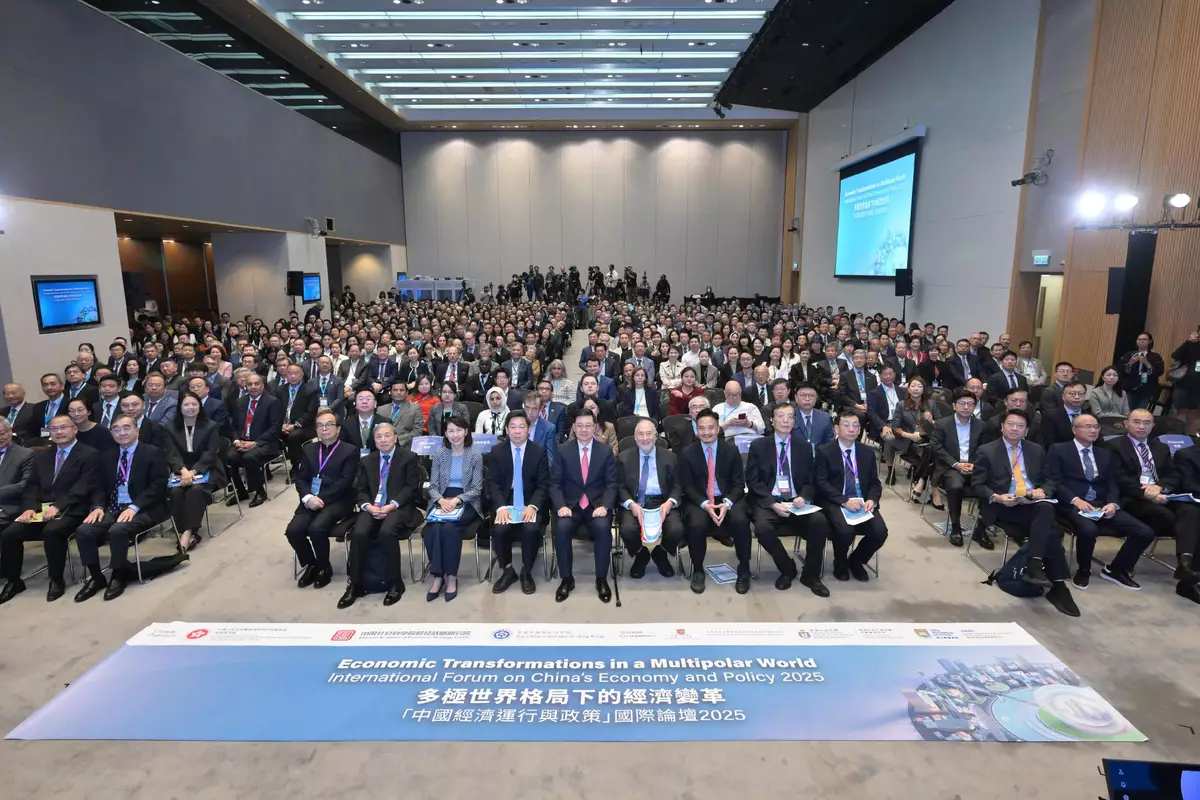
Speech by CE at International Forum on China's Economy and Policy 2025 Source: HKSAR Government Press Releases
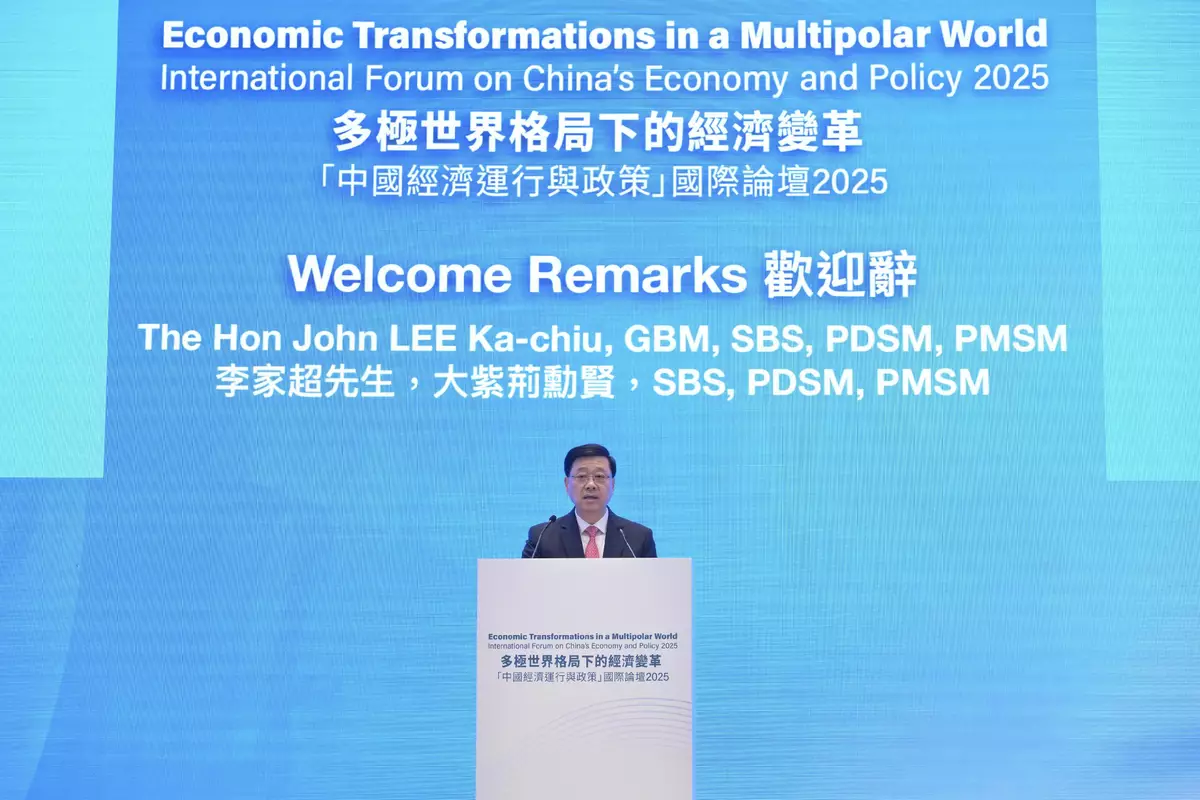
Speech by CE at International Forum on China's Economy and Policy 2025 Source: HKSAR Government Press Releases