"The Golden Age of the Sui and Tang Dynasties Depicted in Dunhuang Murals" roving exhibition starts today
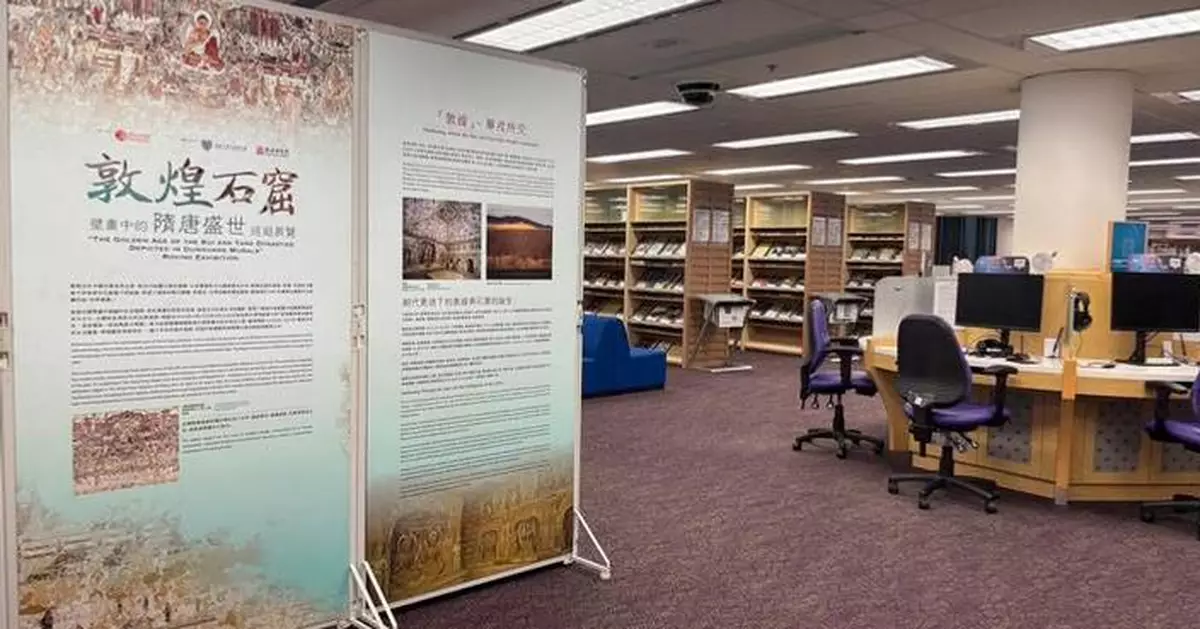
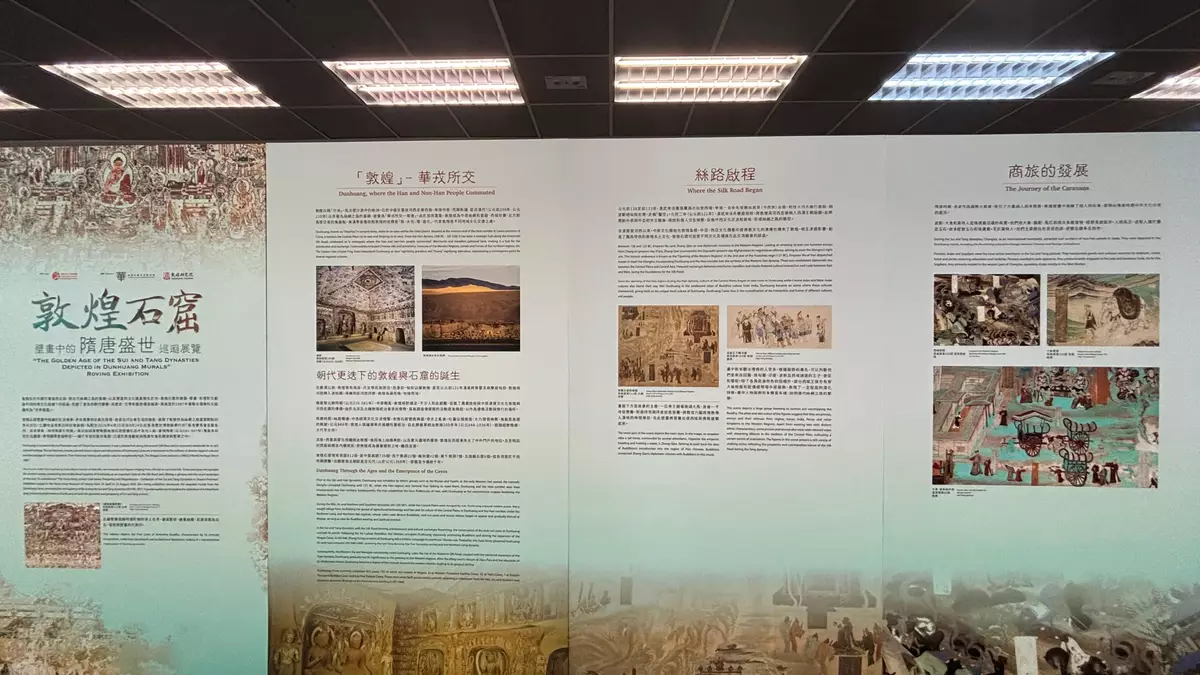
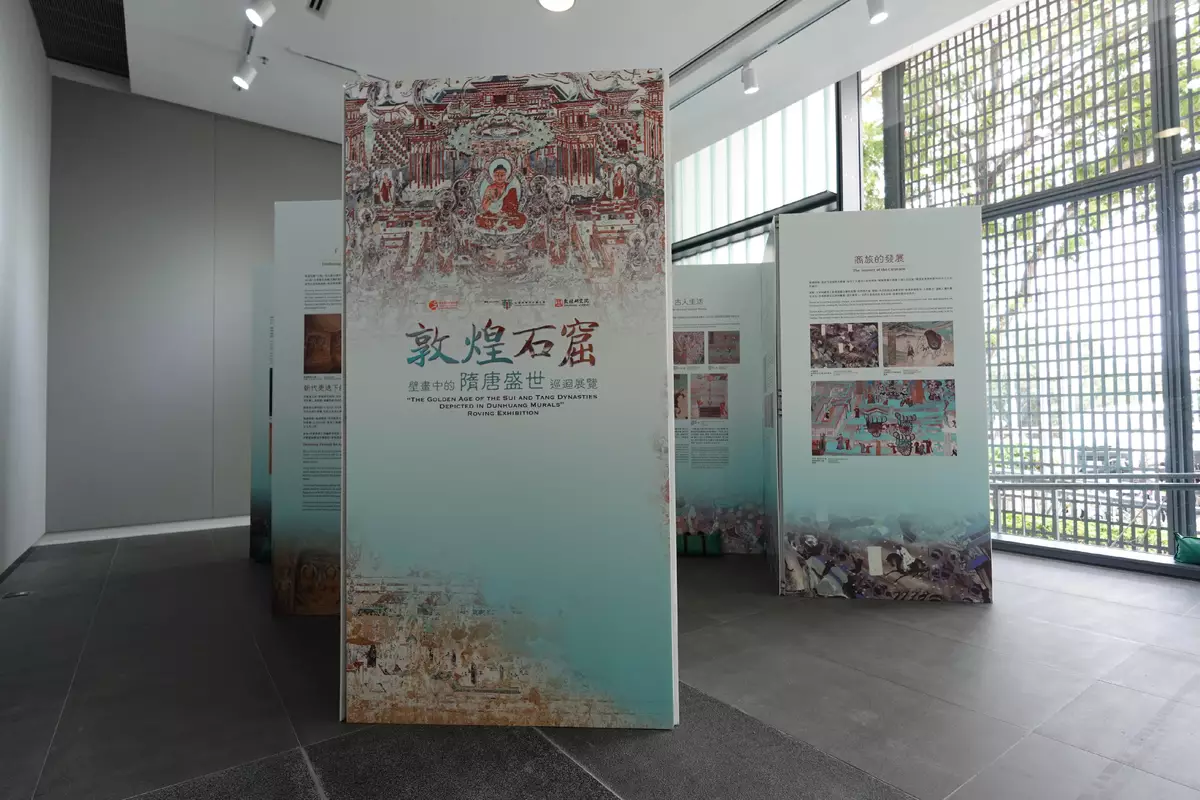
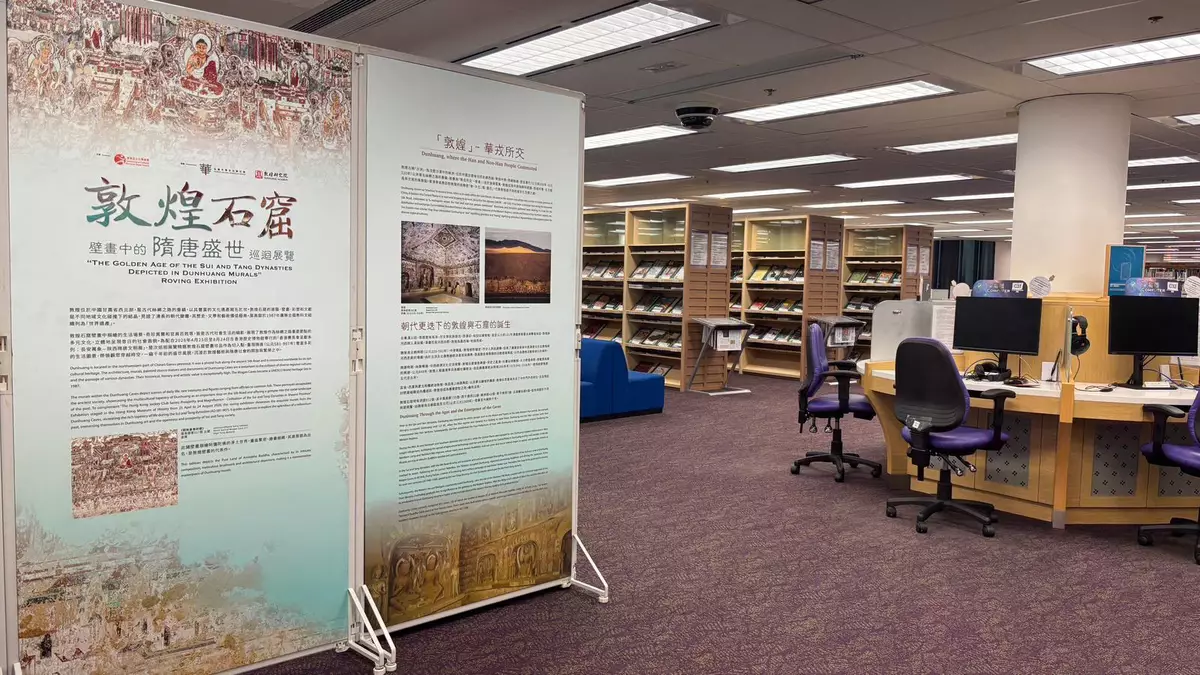
Jointly organised by the Chinese Culture Promotion Office (CCPO) of the Leisure and Cultural Services Department (LCSD) and the Dunhuang Academy, "The Golden Age of the Sui and Tang Dynasties Depicted in Dunhuang Murals" roving exhibition will be held at various LCSD public libraries and sports centres from today (April 1) to October 31. With panel text and photos, this roving exhibition showcases the exquisite murals from the Dunhuang Caves, recreating the rich tapestry of life during the Sui and Tang dynasties. It guides audiences to explore the splendour of a millennium past, immersing themselves in Dunhuang art and the openness and prosperity of Sui and Tang society. Admission is free.
Dunhuang is a pivotal hub along the ancient Silk Road, renowned worldwide for its rich cultural heritage. The murals within the Dunhuang Caves depict scenes of daily life, rare treasures and figures ranging from officials to common folk. These portrayals encapsulate the ancient society, showcasing the multicultural tapestry of Dunhuang as an important stop on the Silk Road and offering a glimpse into the social landscape at that time.
To complement this roving exhibition, the CCPO will organise a series of public and school education activities. These will include the "Unveiling History" outreach programme held in local primary and secondary schools, where interactive teaching methods will allow students to learn about the history and culture of the Sui and Tang dynasties through Dunhuang art. Additionally, experts and education officers from the Dunhuang Academy will be invited to Hong Kong to deliver a public lecture and conduct school educational workshops. Using the mural paintings of the Dunhuang Caves, these activities will showcase the multicultural diversity and prosperity of Sui and Tang society, aiming to enhance public interest in Chinese history and strengthen a sense of belonging and identity with traditional culture. For details of the exhibition and activities, please visit the website: www.ccpo.gov.hk/en/programme/the-golden-age-of-the-sui-and-tang-dynasties-depicted-in-dunhuang-murals-roving-exhibition
"The Golden Age of the Sui and Tang Dynasties Depicted in Dunhuang Murals" roving exhibition starts today Source: HKSAR Government Press Releases
"The Golden Age of the Sui and Tang Dynasties Depicted in Dunhuang Murals" roving exhibition starts today Source: HKSAR Government Press Releases
"The Golden Age of the Sui and Tang Dynasties Depicted in Dunhuang Murals" roving exhibition starts today Source: HKSAR Government Press Releases
FEHD releases sixth batch of gravidtrap indexes for Aedes albopictus in March
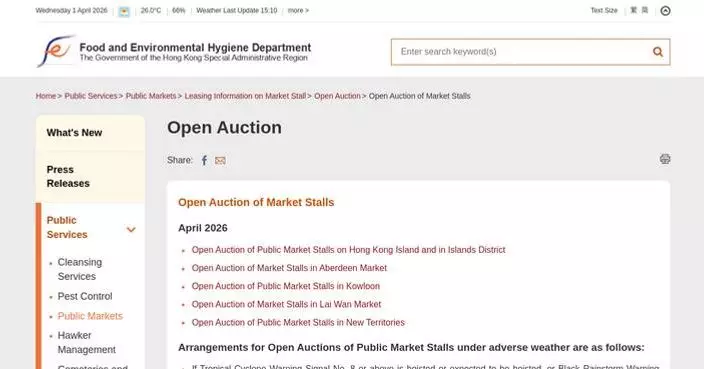
The Food and Environmental Hygiene Department (FEHD) today (April 1) released the sixth batch of gravidtrap indexes and density indexes for Aedes albopictus in March, covering 18 survey areas, as follows:
District |
Survey Area |
March 2026 |
First Phase Gravidtrap Index |
First Phase Density Index |
Islands |
Cheung Chau |
0.0% |
N/A |
Wong Tai Sin |
Wong Tai Sin West |
0.0% |
N/A |
Sai Kung |
Sai Kung Town |
0.0% |
N/A |
Kwai Tsing |
Lai King |
0.0% |
N/A |
Yuen Long |
Hung Shui Kiu and Ping Shan |
0.0% |
N/A |
District |
Survey Area |
March 2026 |
Area Gravidtrap Index |
Area Density Index |
Central and Western |
Kennedy Town and Shek Tong Tsui |
0.0% |
N/A |
Wan Chai |
Happy Valley and Tai Hang |
1.8% |
1.0 |
Islands |
Tung Chung |
0.0% |
N/A |
Kowloon City |
Ho Man Tin |
0.9% |
1.0 |
Kowloon Tong |
2.5% |
1.0 |
Sham Shui Po |
Cheung Sha Wan |
0.9% |
1.0 |
Sham Shui Po and Shek Kip Mei |
0.0% |
N/A |
Yau Tsim |
Tsim Sha Tsui and Yau Ma Tei |
0.0% |
N/A |
North |
Fanling South |
0.0% |
N/A |
Tai Po |
Tai Po East |
0.0% |
N/A |
Tsuen Wan |
Sheung Kwai Chung |
1.0% |
1.0 |
Tuen Mun |
Tuen Mun South |
0.9% |
1.0 |
Yuen Long |
Yuen Long Town |
0.0% |
N/A |
Among the sixth batch of First Phase Gravidtrap Indexes covering five survey areas and Area Gravidtrap Indexes covering 13 survey areas in March, most of the areas recorded 0 per cent, indicating that the distribution of Aedes albopictus mosquitoes was not extensive.
The FEHD has so far released six batches of gravidtrap indexes for Aedes albopictus in March 2026, covering 62 survey areas. Among these 62 survey areas, 47 recorded a decrease or remained unchanged as compared to the Area Gravidtrap Index last month (i.e. February 2026), representing that the areas' mosquito infestation improved or maintained a low level. Fifteen other areas recorded a slight increase, but the indexes were lower than 10 per cent.
The warm and humid weather of spring is favourable for mosquito breeding. Members of the public should strengthen prevention work against mosquito breeding before the rainy season, and eliminate potential mosquito breeding sites in advance, with a view to avoiding the nuisances caused by rapid mosquito breeding during the rainy season and reducing the risk of transmitting mosquito-borne diseases.
Public participation is crucial to the effective control of mosquito problems. The FEHD appeals to members of the public to continue to work together in strengthening personal mosquito control measures, including:
tidy up their premises and check for any accumulation of water inside their premises;
remove all unnecessary water collections and eliminate the sources;
check household items (those placed in outdoor and open areas in particular), such as refuse containers, vases, air conditioner drip trays, and laundry racks to prevent stagnant water;
change water in flower vases and scrub their inner surfaces thoroughly, and remove water in saucers under potted plants at least once a week;
properly cover all containers that hold water to prevent mosquitoes from accessing the water;
properly dispose of articles that can contain water, such as disposable meal boxes and empty cans; and
scrub drains and surface sewers with alkaline detergent at least once a week to remove any mosquito eggs.
Starting in August 2025, following the completion of the surveillance of individual survey areas, and once the latest gravidtrap index and the density index are available, the FEHD has been disseminating relevant information through press releases, its website and social media. It aims to allow members of the public to quickly grasp the mosquito infestation situation and strengthen mosquito control efforts, thereby reducing the risk of chikungunya fever (CF) transmission.
Following recommendations from the World Health Organization and taking into account the local situation in Hong Kong, the FEHD sets up gravidtraps in districts where mosquito-borne diseases have been recorded in the past, as well as in densely populated places such as housing estates, hospitals and schools to monitor the breeding and distribution of Aedes albopictus mosquitoes, which can transmit CF and dengue fever. At present, the FEHD has set up gravidtraps in 62 survey areas of the community, with a surveillance period of two weeks. During the surveillance period, the FEHD will collect the gravidtraps once a week. After the first week of surveillance, the FEHD will immediately examine the glue boards inside the retrieved gravidtraps for the presence of adult Aedine mosquitoes to compile the Gravidtrap Index (First Phase) and Density Index (First Phase). At the end of the second week of surveillance, the FEHD will instantly check the glue boards for the presence of adult Aedine mosquitoes. Data from the two weeks of surveillance will be combined to obtain the Area Gravidtrap Index and the Area Density Index. The gravidtrap and density indexes for Aedes albopictus in different survey areas, as well as information on mosquito prevention and control measures, are available on the department's webpage (www.fehd.gov.hk/english/pestcontrol/dengue_fever/Dengue_Fever_Gravidtrap_Index_Update.html#).
Source: AI-found images