CE meets Nobel Memorial Prize laureates in Economic Sciences
The Chief Executive, Mr John Lee, today (November 18) met with two Nobel Memorial Prize laureates in Economic Sciences in 2001, Professor Joseph E Stiglitz and Professor Michael Spence, to exchange views on issues of mutual interest including the economy, innovation and technology (I&T), and education. The Director of the Chief Executive's Office, Ms Carol Yip, and the Head of the Chief Executive's Policy Unit, Dr Stephen Wong, also attended the meeting.
Mr Lee welcomed Professor Stiglitz and Professor Spence to Hong Kong to attend the International Forum on China's Economy and Policy 2025 to share their insights on the economic development of the world, the country and Hong Kong. Mr Lee said he was pleased that the two scholars are optimistic about Hong Kong's development prospects, recognise its notable strengths in education and I&T, and support the Hong Kong Special Administrative Region (HKSAR) Government's various strategic plans of diversifying investments, exploring emerging markets, and further deepening collaborative developments in the Guangdong-Hong Kong-Macao Greater Bay Area (GBA) to seize opportunities.
Mr Lee noted that Hong Kong enjoys the dual advantage of having national and global opportunities under the "one country, two systems" principle and will continue to play the roles of a "super connector" and "super value-adder", connecting the Mainland with the world, fully integrating into the overall national development and actively dovetailing with GBA developments. As one of the core cities of the GBA, Hong Kong plays a vital role in driving regional development. The HKSAR Government will continue to collaborate with GBA cities in strengthening connectivity and enhancing the flow of people, goods, data and capital, with a view to further encouraging and supporting enterprises and talent to grasp development opportunities in the GBA.
Mr Lee highlighted that Hong Kong is the world's freest economy, which attracts global capital and top talent, and has maintained its position of third globally and first in Asia Pacific as an international financial centre according to the newly published Global Financial Centres Index. Hong Kong is the only city worldwide that hosts five universities ranked among the world's top 100, and its ranking leapt to fourth globally in the newly published World Talent Ranking 2025, marking its highest-ever ranking. The HKSAR Government is actively accelerating the development of the Northern Metropolis University Town and promoting the "Study in Hong Kong" brand to further develop Hong Kong into an international hub for post-secondary education and high-calibre talent.
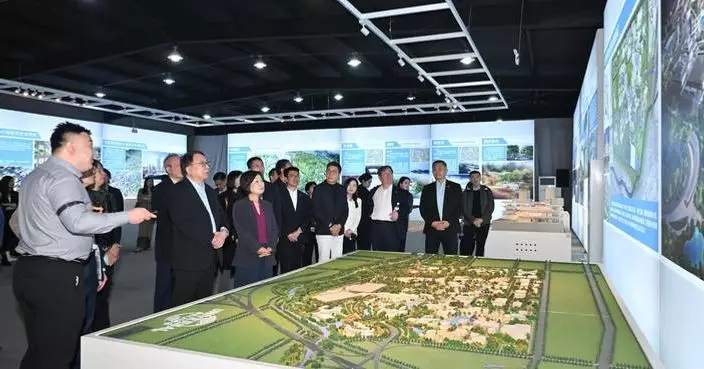
Noting that the world is undergoing unprecedented changes at an accelerating pace and facing global economic uncertainties, Mr Lee said that the HKSAR Government is continuously seeking new growth opportunities. Among these, the Northern Metropolis being developed at full steam serves as a new engine for Hong Kong's economic growth, boasting significant development potential and economic value. It is expected to create more jobs and enhance productivity for Hong Kong. At the same time, the HKSAR Government is vigorously promoting I&T, artificial intelligence, and related industries, while advancing the development of the Hong Kong Park of the Hetao Shenzhen-Hong Kong Science and Technology Innovation Co-operation Zone, and fostering the integrated development of education, technology, and talent to develop Hong Kong into an international I&T centre with a view to contributing to the country's high-quality development.

CE meets Nobel Memorial Prize laureates in Economic Sciences Source: HKSAR Government Press Releases
Re-launch of Reporting Scheme for Unauthorised Building Works in New Territories Exempted Houses
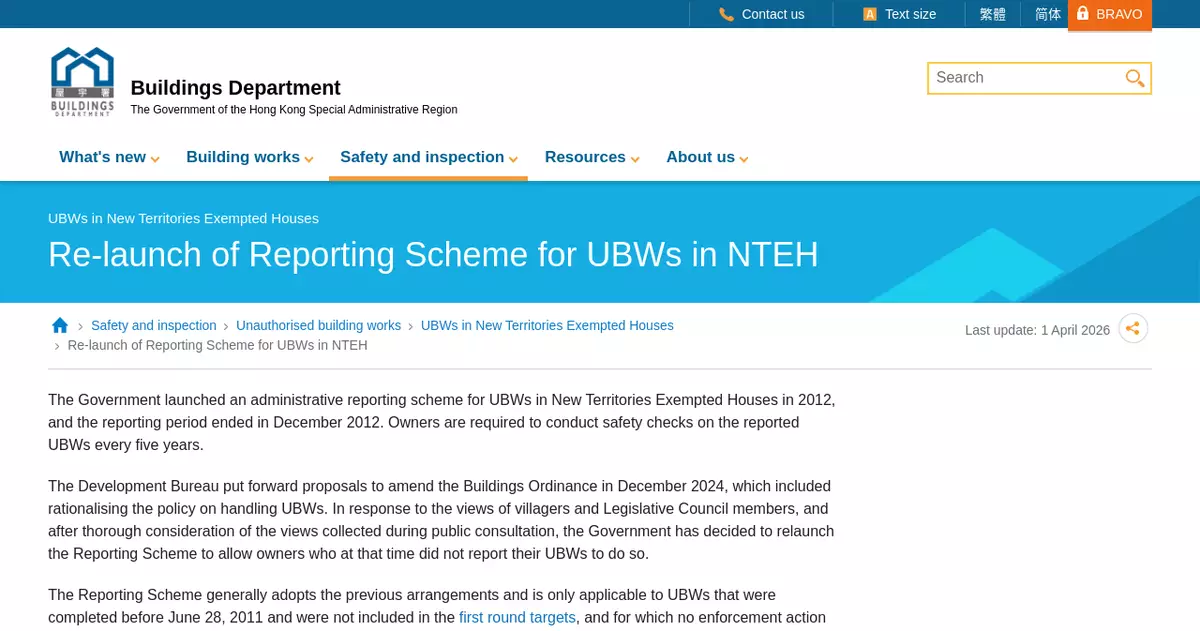
Following the direction of earlier proposals, the Buildings Department (BD) announced today (April 1) the re-launch of the Reporting Scheme for Unauthorised Building Works (UBWs) in New Territories Exempted Houses (NTEHs). The reporting period will last for one year from April 1, 2026 to March 31, 2027.
"In view of the history and unique circumstances of the NTEHs (commonly known as village houses), the Government launched a one-off administrative reporting scheme in 2012 as a special arrangement. Under the scheme, owners could report to the BD about UBWs that were erected before June 28, 2011, posed lower risks or constituted less serious contravention of the law. The reporting period ended in December 2012. The Development Bureau (DEVB) put forward proposals to amend the Buildings Ordinance in December 2024, which included rationalising the policy for handling UBWs. The DEVB also pointed out that in response to the views of villagers and Legislative Council members that the reporting period was too short, the Government prepared to re-launch the Reporting Scheme to allow owners who at that time did not report their UBWs to do so," a spokesman for the BD said.
Relevant stakeholders and Legislative Council members generally considered the above proposals practical and feasible, and they welcomed the proposals. The DEVB and the BD have also consulted Heung Yee Kuk on the relevant implementation arrangements.
The re-launched Reporting Scheme will maintain the original criteria, including:
(1) The types of UBWs that can be reported and their erection dates are the same as the original Reporting Scheme, meaning that only UBWs erected before June 28, 2011, posed lower risks or constituted less serious contravention of the law and were not the First Round Targets (Note) are eligible. Examples include signboards projecting from the external walls of village houses; enclosed rooftop structures with a coverage of not more than 50 per cent of the roofed-over area of the main building.
(2) Same as the original Reporting Scheme, owners are required to conduct safety inspections on the reported UBWs every five years.
"The BD will not require the immediate removal of the reported UBWs unless their structures become obviously dangerous. Regarding UBWs in village houses, the BD is prioritising the handling of First Round Targets. If any relevant UBWs remain not reported after the application deadline of March 31, 2027, the BD will, after dealing with the First Round Targets, take priority enforcement action against the non-reported UBWs. The BD will formulate enforcement strategy for the reported UBWs at a later stage in accordance with the risks and the actual situation," the spokesman added.
To enhance the efficiency of processing applications, reports must be submitted via the electronic platform on the BD's website by technically competent persons or registered professional engineers appointed by owners. In accordance with the user-pays principle, an administrative fee of $600 is payable for each application. Upon successful reports, owners must also pay the relevant administrative fee when conducting safety inspections of the reported UBWs every five years.
Details of the re-launched Reporting Scheme are available on the BD's website at https://www.bd.gov.hk/en/safety-inspection/ubw/UBW-in-new-territories-exempted-houses/index_relaunch_reporting_scheme.html; Villagers who wish to report can call 2626 1616 for enquiry. The BD will also use different channels such as distributing leaflets and posters to Rural Committees to enable villagers to know more about the re-launch of the Reporting Scheme.
Owners who had successfully participated in the Reporting Scheme in 2012 are not required to submit reports again. However, they must continue to comply with the requirements of the original Reporting Scheme, including conducting safety inspections of the reported UBWs every five years, submitting safety certificates and paying administrative fees to the BD.
Note: The First Round Targets refer to UBWs with higher potential risks and more serious nature, such as village houses of four storeys or more, and enclosed rooftop structures covering more than 50 per cent of the roofed-over area.
Source: AI-found images