Skip to Content Facebook Feature Image

Electricity Tariffs to Decrease for Hong Kong Residents Starting January 2026

HK

Electricity Tariffs to Decrease for Hong Kong Residents Starting January 2026
HK

HK

Electricity Tariffs to Decrease for Hong Kong Residents Starting January 2026

2025-11-18 20:05 Last Updated At:20:18

EEB and power companies announce 2026 electricity tariff adjustment (with photo/video)

​The Environment and Ecology Bureau (EEB) and the two power companies announced today (November 18) the electricity tariff adjustment for next year. After negotiation with the Government, CLP Power Hong Kong Limited and Castle Peak Power Company Limited (CLP Power) will reduce their average Net Tariff by 2.6 per cent to 140.6 cents per kWh with effect from January 1, 2026, and the Hongkong Electric Company Limited (HK Electric) will lower their average Net Tariff by 2.2 per cent to 163.3 cents per kWh.

The Secretary for the Environment and Ecology, Mr Tse Chin-wan, said at the press conference today that the Government's energy policy objectives are to ensure that the public will enjoy safe, reliable and environmentally friendly electricity supply at reasonable costs. Therefore, the Government has been diligently playing a gate-keeping role in accordance with the Scheme of Control Agreements. After rounds of negotiations, the two power companies eventually agreed to lower the average Net Tariff starting January next year. Regarding the Basic Tariff, CLP Power agreed to reduce the next year's Basic Tariff to a level lower than the projected level of Basic Tariff under its five-year Development Plan, while HK Electric's Basic Tariff remains consistent with the projected level.

Mr Tse said, "Based on the two power companies' estimates, after the tariff adjustment, a typical three-member family household with monthly consumption of 275kWh will pay around $10 less each month compared to the approved rates for 2025."

The CLP Power Managing Director, Mr Joseph Law, said, "We expect the tariff reduction to help lower living expenses of households and operating costs of small and medium-sized enterprises. We also allocate $270 million from the CLP Community Energy Saving Fund to promote energy conservation and decarbonisation, support the underprivileged, and inject momentum into Hong Kong's economy. While geopolitical tensions continue to pose uncertainties to fuel prices, we remain committed to managing fuel costs through a diversified fuel mix as well as upholding prudent financial management and enhancing operational efficiency with innovative technologies in delivering reliable, environmentally responsible, and reasonably priced electricity services."

The HK Electric Managing Director, Mr Francis Cheng, said, "HK Electric has been committed to providing Hong Kong with a safe, reliable, and clean electricity supply over the years. Through prudent planning, we continuously replace assets that have reached or exceeded their design or useful lives, in accordance with their depreciation cycles or actual condition to ensure a stable and reliable power supply while avoiding unnecessary capital investment. In light of the increasingly severe cyberattack threats, IT systems have to be enhanced also to strengthen their resilience. These capital investments inevitably put pressure on tariffs. Notwithstanding, the relatively stable fuel prices mean the fuel clause charge will be reduced, resulting in the net electricity tariff next year lower than that in January this year."

Mr Tse said, "Notwithstanding a minor reduction in average net tariff next January, we encourage the general public to cultivate a green living style and select energy efficient electrical appliances for environmental protection, which will help further reduce electricity expenditure and carbon emissions, and protect the environment. The Government's Mandatory Energy Efficiency Labelling Scheme (MEELS), which covers 11 types of appliances, has fully implemented new grading standards for refrigerating appliances, washing machines and storage type electric water heaters since September 2025. The full implementation of MEELS is expected to bring an additional energy saving of about 270 million kWh per year, which is equivalent to annual electricity consumption of 80 000 typical three-member family households. The public is encouraged to visit Energy Saving Tips in Government's webpage Energy Saving for All to get to know more about ways to save energy and practice 'smart electricity consumption' together."
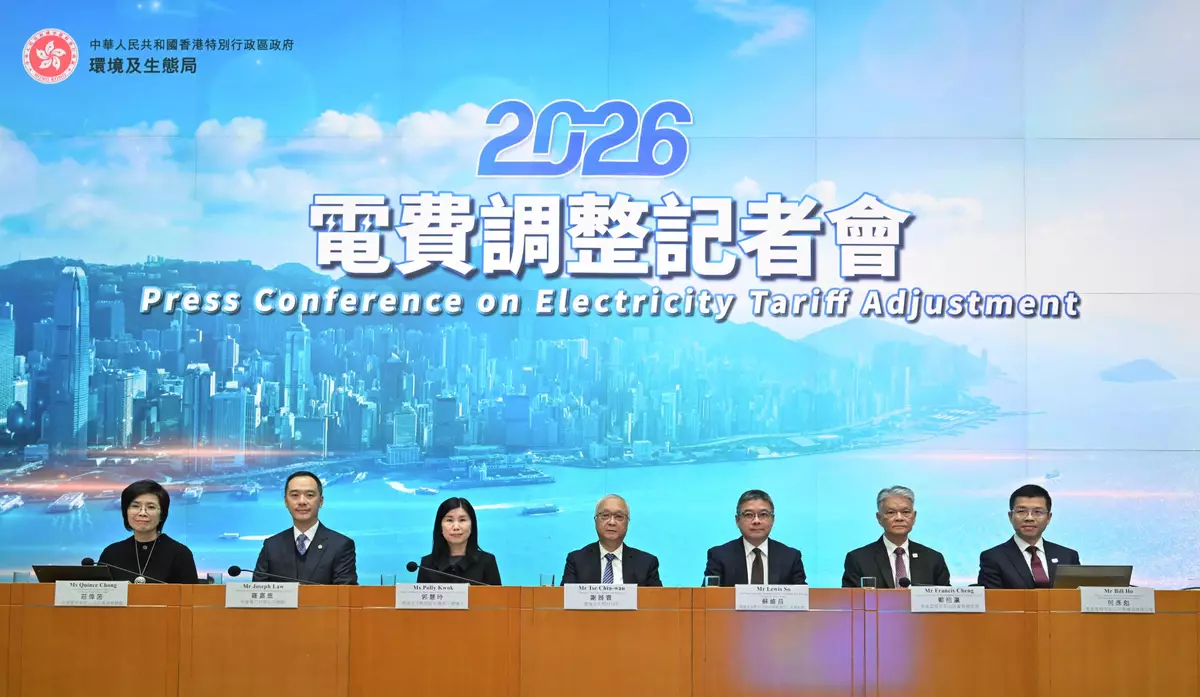
EEB and power companies announce 2026 electricity tariff adjustment (with photo/video) Source: HKSAR Government Press Releases
EEB and power companies announce 2026 electricity tariff adjustment (with photo/video) Source: HKSAR Government Press Releases
Re-launch of Reporting Scheme for Unauthorised Building Works in New Territories Exempted Houses

Following the direction of earlier proposals, the Buildings Department (BD) announced today (April 1) the re-launch of the Reporting Scheme for Unauthorised Building Works (UBWs) in New Territories Exempted Houses (NTEHs). The reporting period will last for one year from April 1, 2026 to March 31, 2027.

"In view of the history and unique circumstances of the NTEHs (commonly known as village houses), the Government launched a one-off administrative reporting scheme in 2012 as a special arrangement. Under the scheme, owners could report to the BD about UBWs that were erected before June 28, 2011, posed lower risks or constituted less serious contravention of the law. The reporting period ended in December 2012. The Development Bureau (DEVB) put forward proposals to amend the Buildings Ordinance in December 2024, which included rationalising the policy for handling UBWs. The DEVB also pointed out that in response to the views of villagers and Legislative Council members that the reporting period was too short, the Government prepared to re-launch the Reporting Scheme to allow owners who at that time did not report their UBWs to do so," a spokesman for the BD said.

Relevant stakeholders and Legislative Council members generally considered the above proposals practical and feasible, and they welcomed the proposals. The DEVB and the BD have also consulted Heung Yee Kuk on the relevant implementation arrangements.

The re-launched Reporting Scheme will maintain the original criteria, including:

(1) The types of UBWs that can be reported and their erection dates are the same as the original Reporting Scheme, meaning that only UBWs erected before June 28, 2011, posed lower risks or constituted less serious contravention of the law and were not the First Round Targets (Note) are eligible. Examples include signboards projecting from the external walls of village houses; enclosed rooftop structures with a coverage of not more than 50 per cent of the roofed-over area of the main building.

(2) Same as the original Reporting Scheme, owners are required to conduct safety inspections on the reported UBWs every five years.

"The BD will not require the immediate removal of the reported UBWs unless their structures become obviously dangerous. Regarding UBWs in village houses, the BD is prioritising the handling of First Round Targets. If any relevant UBWs remain not reported after the application deadline of March 31, 2027, the BD will, after dealing with the First Round Targets, take priority enforcement action against the non-reported UBWs. The BD will formulate enforcement strategy for the reported UBWs at a later stage in accordance with the risks and the actual situation," the spokesman added.

To enhance the efficiency of processing applications, reports must be submitted via the electronic platform on the BD's website by technically competent persons or registered professional engineers appointed by owners. In accordance with the user-pays principle, an administrative fee of $600 is payable for each application. Upon successful reports, owners must also pay the relevant administrative fee when conducting safety inspections of the reported UBWs every five years.

Details of the re-launched Reporting Scheme are available on the BD's website at https://www.bd.gov.hk/en/safety-inspection/ubw/UBW-in-new-territories-exempted-houses/index_relaunch_reporting_scheme.html; Villagers who wish to report can call 2626 1616 for enquiry. The BD will also use different channels such as distributing leaflets and posters to Rural Committees to enable villagers to know more about the re-launch of the Reporting Scheme.

Owners who had successfully participated in the Reporting Scheme in 2012 are not required to submit reports again. However, they must continue to comply with the requirements of the original Reporting Scheme, including conducting safety inspections of the reported UBWs every five years, submitting safety certificates and paying administrative fees to the BD.

Note: The First Round Targets refer to UBWs with higher potential risks and more serious nature, such as village houses of four storeys or more, and enclosed rooftop structures covering more than 50 per cent of the roofed-over area.

Source: AI-found images

Source: AI-found images

Recommended Articles