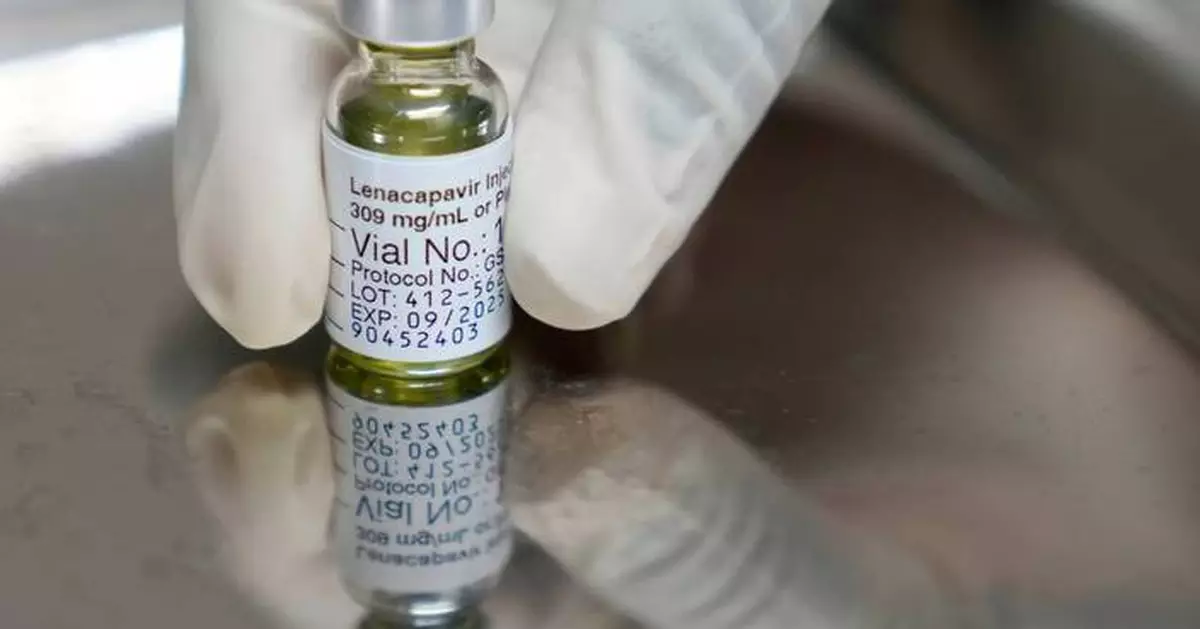
HARARE, Zimbabwe (AP) — Eswatini on Tuesday became the first African country to receive lenacapavir, the first twice-yearly HIV prevention injection hailed by global health officials as a game-changer in the fight against a virus that has killed tens of millions of people across the continent.
Developed by Gilead Sciences, lenacapavir has demonstrated near-total protection in clinical studies. Its rollout, initially planned for 10 high-risk African countries, is part of the U.S. President’s Emergency Plan for AIDS Relief, or PEPFAR, in partnership with the Global Fund. By 2027, the initiative aims to benefit at least 2 million people in those countries.
Daniel O’Day, chair and CEO of Gilead Sciences, described the Eswatini rollout as “extraordinary” because “it’s the first time in history that a new HIV medicine is reaching a country in sub-Saharan Africa in the same year as approval of the United States” and because Eswatini “is the country with the highest incidence of HIV in the world.” The U.S. approved the drug in June.
The United States, whose deep cuts to foreign aid this year under President Donald Trump have severely impacted Africa’s health programs, initially planned to distribute 250,000 doses this year to the 10 countries. Zambia also received its first shipment Tuesday, while Gilead seeks regulatory authority in Botswana, Kenya, Malawi, Namibia, Rwanda, Tanzania, Uganda and Zimbabwe.
That was increased to 325,000 due to “early demand signs,” Brad Smith, senior advisor for the Bureau of Global Health Security and Diplomacy, told journalists.
The U.S. government has noted that over 25 million people across Africa are living with HIV.
In Eswatini, a tiny kingdom in southern Africa, about 6,000 high-risk people are set to benefit from the drug's initial rollout, primarily to prevent HIV transmission from mothers to newborns. Home to roughly 1.2 million people, Eswatini currently has over 200,000 people living with HIV, with most receiving treatment funded by PEPFAR, Smith said.
Eswatini, the world’s last absolute monarchy with a documented record of human rights violations, is also among the African countries participating in Trump’s third-country deportation program, which has faced protests from rights groups.
In July, the World Health Organization approved lenacapavir as an additional HIV prevention option. UNAIDS has called long-acting injectables a “fresh option” amid concerns that foreign funding cuts could worsen infections.
South Africa’s health minister, Aaron Motsoaledi, recently called lenacapavir “groundbreaking” but raised concerns over limited supplies when South Africa begins its own rollout in April 2026.
Motsoaledi also welcomed Gilead’s steep price reduction from over $28,000 per person annually in the U.S. to approximately $40 for lower-income countries.
The rollout has fueled debate over access and manufacturing rights. Civil society groups in South Africa, sub-Saharan Africa’s most advanced economy, have criticized Gilead for excluding local manufacturers from voluntary licensing agreements despite the country’s role in clinical trials.
For more on Africa and development: https://apnews.com/hub/africa-pulse
The Associated Press receives financial support for global health and development coverage in Africa from the Gates Foundation. The AP is solely responsible for all content. Find AP’s standards for working with philanthropies, a list of supporters and funded coverage areas at AP.org.

FILE - A pharmacist holds a vial of lenacapavir, an injectable HIV prevention drug, at the Desmond Tutu Health Foundation's Masiphumelele Research Site, in Cape Town, South Africa, July 23, 2024. (AP Photo/Nardus Engelbrecht, File)
WASHINGTON (AP) — President Donald Trump is not immune from civil claims that he incited a mob of his supporters to attack the Capitol on Jan, 6, 2021, a federal judge has ruled in one of the last unresolved legal cases stemming from the riot.
U.S. District Judge Amit Mehta ruled Tuesday that Trump's remarks at his “Stop the Steal” rally, held on the Ellipse near the White House shortly before the siege began, “plausibly” were inciting words that are not protected by the First Amendment right to free speech.
The Republican president is not shielded from liability for much of his Jan. 6 conduct, including that speech and many of his social media posts that day, according to the judge. But Mehta said Trump cannot be held liable for his official acts that day, including his Rose Garden remarks during the riot and his interactions with Justice Department officials.
“President Trump has not shown that the Speech reasonably can be understood as falling within the outer perimeter of his Presidential duties,” Mehta wrote. “The content of the Ellipse Speech confirms that it is not covered by official-acts immunity."
The decision is not the court's first ruling that Trump can be held liable for the violence at the Capitol and it is unlikely to be the last given the near-certainty of an appeal. But the 79-page ruling sets the stage for a possible civil trial in the same courthouse where Trump was charged with crimes for his Jan. 6 conduct, before his 2024 election ended the prosecution.
Mehta previously refused to dismiss the claims against Trump in a February 2022 ruling that Trump was not entitled to presidential immunity from the claims brought by Democratic members of Congress and law enforcement officers who guarded the Capitol on Jan. 6. In that decision, Mehta also concluded that Trump’s words during his rally speech plausibly amounted to incitement and were not protected by the First Amendment.
The case returned to Mehta after an appeals court ruling upheld his 2022 decision. He said Tuesday's ruling on immunity falls under a more "rigorous" legal standard at this later stage in the litigation.
Mehta, who was nominated by Democratic President Barack Obama, said his latest decision is not a “final pronouncement on immunity for any particular act.”
“President Trump remains free to reassert official-acts immunity as a defense at trial. But the burden will remain his and will be subject to a higher standard of proof,” the judge wrote.
Trump spoke to a crowd of his supporters at the rally before the mob’s attack disrupted the joint session of Congress for certifying Democrat Joe Biden’s 2020 electoral victory over Trump. Trump closed out his speech by saying, “We fight. We fight like hell and if you don’t fight like hell, you’re not going to have a country anymore.”
Trump’s lawyers argued that Trump's conduct on Jan. 6 meets the threshold for presidential immunity.
The plaintiffs contended that Trump cannot prove he was acting entirely in his official capacity rather than as an office-seeking private individual. They also said the Supreme Court has held that office-seeking conduct falls outside the scope of presidential immunity.
Rep. Bennie Thompson, D-Miss., who at that time led the House Homeland Security Committee, sued Trump, Trump's personal attorney Rudolph Giuliani and members of the Proud Boys and Oath Keepers extremist groups over the Jan. 6 riot. Other Democratic members of Congress later joined the litigation, which was consolidated with the officers' claims.
The civil claims survived Trump’s sweeping act of clemency on the first day of his second term, when he pardoned, commuted prison sentences and ordered the dismissal of all 1,500-plus criminal cases stemming from the Capitol siege. More than 100 police officers were injured while defending the Capitol from rioters.
The plaintiffs' legal team includes attorneys from the Lawyers’ Committee for Civil Rights Under Law. Damon Hewitt, the group's president and executive director, praised the ruling as a “monumental victory for the rule of law, affirming that no one, including the president of the United States, is above it.”
“The court rightly recognizes that President Trump’s actions leading to the January 6 insurrection fell outside the scope of presidential duties," Hewitt said in a statement. “This ruling is an important step toward accountability for the violent attack on the Capitol and our democracy.”
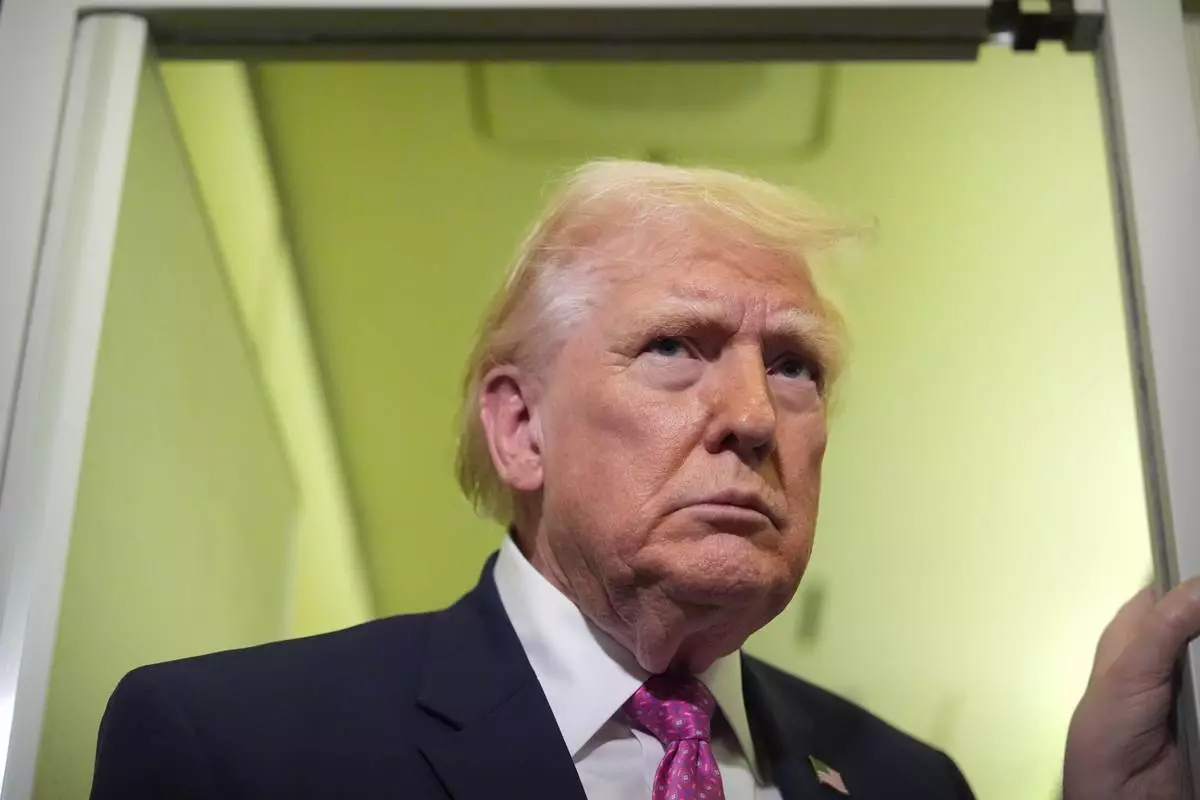
President Donald Trump speaks to reporters aboard Air Force One en route from West Palm Beach, Fla., to Joint Base Andrews, Md., Sunday, March 29, 2026. (AP Photo/Mark Schiefelbein)