Roblox is stepping up its age verification system for users who want to chat with other players and implementing age-based chats so kids, teens and adults will only be able to communicate with people around their own age.
The moves come as the popular gaming platform continues to face criticism and lawsuits over child safety and a growing number of states and countries are implementing age verification laws.
The company had previously announced the age estimation tool, which is provided by a company called Persona, in July. It requires players to take a video selfie that will be used to estimate their age. Roblox says the videos are deleted after the age check is processed. Users are not required to submit a face scan to use the platform, only if they want to chat with other users.
Roblox doesn’t allow kids under 13 to chat with other users outside of games unless they have explicit parental permission — and unlike different platforms, it does not encrypt private chat conversations, so it can monitor and moderate them.
While some experts have expressed caution about the reliability of facial age estimation tools, Matt Kaufman, chief safety officer at Roblox, said that between the ages of about 5 to 25, the system can accurately estimate a person's age within one or two years.
“But of course, there’s always people who may be well outside of a traditional bell curve. And in those cases, if you disagree with the estimate that comes back, then you can provide an ID or use parental consent in order to correct that,” he said.
After users go through the age checks, they will be assigned to age groups ranging from under 9, 9 to 12, 13 to 15, 16 to 17, 18 to 20 and over 21. Users will then be able to chat with their age group or similar age groups, depending on their age and the type of chat.
Roblox said it will start enforcing age checks in Australia, New Zealand, and the Netherlands in the first week of December and the rest of the world in early January.
A growing number of tech companies are implementing verification systems to comply with regulations or ward off criticism that they are not protecting children. This includes Google, which recently started testing a new age-verification system for YouTube that relies on AI to differentiate between adults and minors based on their watch histories. Instagram is testing an AI system to determine if kids are lying about their ages.
“While we welcome the new age ID measures as a step forward, it remains to be seen how effective it will be and whether Roblox will stay the course on a voluntary measure once public scrutiny fades," said Shelby Knox, director of online safety campaigns at the advocacy group ParentsTogether. “We have to remember this comes from a platform that has historically been slow to address systemic predatory behavior despite being marketed to and used by very young children.”

FILE - The gaming platform Roblox is displayed on a tablet, Oct. 30, 2021, in New York. (AP Photo/Leon Keith, File)
WASHINGTON (AP) — In his news conference on Monday, President Donald Trump threatened to blow up every bridge and power plant in Iran, a declaration so far-reaching that some experts in military law said it could constitute a war crime.
The issue could turn on whether the power plants were legitimate military targets, the attacks were proportional compared with what Iran has done and whether civilian casualties were minimized.
Trump's threat was so broad brush it did not seem to account for the harm to civilians, prompting Democrats in Congress, some United Nations officials and scholars in military law to say such strikes would violate international law.
The president's eventual actions often fall short of his all-encompassing rhetoric in the moment, but his warnings about the power plants and bridges were unambiguous both on Sunday and Monday as he set a deadline of Tuesday night for Iran to open the Strait of Hormuz.
A spokesman for U.N. Secretary-General Antonio Guterres on Monday warned that attacking such infrastructure is banned under international law.
“Even if specific civilian infrastructure were to qualify as a military objective,” Stephane Dujarric said, an attack would still be prohibited if it risks “excessive incidental civilian harm.”
Rachel VanLandingham, a Southwestern Law School professor who served as a judge advocate general in the U.S. Air Force, said civilians are likely to die if power is cut to hospitals and water treatment plans.
“What Trump is saying is, ‘We don’t care about precision, we don’t care about impact on civilians, we’re just going to take out all of Iranian power generating capacity,’" the retired lieutenant colonel said.
Shipping in the Strait of Hormuz, a chokepoint in the Persian Gulf through which 20% of the world's oil normally flows, has been all but halted, sending oil prices soaring and roiling the stock market.
Trump said Monday that he’s “not at all” concerned about committing war crimes as he continues to threaten destruction. He also warned that every power plant will be “burning, exploding and never to be used again.”
“I hope I don’t have to do it,” Trump added.
When asked for further comment Monday, White House spokeswoman Anna Kelly said “the Iranian people welcome the sound of bombs because it means their oppressors are losing.”
“The Iranian regime has committed egregious human rights abuses against its own citizens for 47 years, just murdered tens of thousands of protestors in January, and has indiscriminately targeted civilians across the region in order to cause as much death as possible throughout this conflict,” Kelly wrote in an email.
As the conflict has entered its second month, Trump has escalated his warnings to bomb Iran's infrastructure, including Kharg Island, central to Iran’s oil industry, and desalination plans that provide drinking water.
In a Truth Social post on March 30, Trump warned that the U.S. would obliterate "all of their Electric Generating Plants, Oil Wells and Kharg Island (and possibly all desalinization plants!), which we have purposefully not yet ‘touched.’“
On Easter Sunday, Trump threatened in an expletive-laden post that Iran will face, "Power Plant Day, and Bridge Day, all wrapped up in one,” while adding that “you’ll be living in Hell” unless the strait reopens.
“This strikes me as clearly a threat of unlawful action,” said Michael Schmitt, a professor emeritus at the U.S. Naval War College and an international law professor at the University of Reading in Britain.
A power facility can be attacked under the laws of armed conflict if it provides electricity to a military base in addition to civilians, Schmitt said. But the strike must not "cause disproportionate harm to the civilian population, and you’ve done everything to minimize that harm.”
Harm does not include inconvenience or fear, said Schmitt, who has taught military commanders. But it does mean severe mental suffering, physical injury or illness.
Schmitt said military commanders should consider alternatives, such as targeting a substation or transmission lines that feed electricity to a base, before destroying an entire power plant.
“If you look at the operation and you’ve got a valid military objective, but it’s going to cause harm to civilians and you go, ‘Whoa, that’s a lot,’ then you should stop,” Schmitt said. “If you hesitate to take the shot, don’t take the shot.”
Republican Sen. Joni Ernst of Iowa said Monday that Trump is “absolutely not” threatening a war crime when he said he might bomb civilian infrastructure.
The infrastructure is also used by the military, Ernst said, and “it’s an ongoing operation.“
“If he needs leverage, he’s using that leverage,” she said while presiding over a brief pro forma session of the Senate.
But Democratic Sen. Chris Van Hollen of Maryland, also in the Capitol for the brief session, said it would be a “textbook war crime.”
“If you target civilian infrastructure for the purposes the president was talking about, it clearly is a war crime,” Van Hollen said.
Dujarric, the U.N. spokesman, said the question of whether attacks on civilian infrastructure would be considered war crimes would have to be decided by a court.
However, Katherine Thompson, a senior fellow in defense and foreign policy studies at the CATO Institute, a libertarian think tank, said any accountability would more likely come from Congress.
She said thinking otherwise would mean believing that the U.S. would allow its president to be held accountable by foreign entities.
“This is the persnickety, inconvenient truth about international law: It only works if sovereign nations are willing to cede their sovereignty to a foreign body for accountability,” she said.
But Congress would have to say the president has gone too far. And then both houses would have to take action and with enough support to overcome a presidential veto, a highly unlikely prospect.
Trump also appears to have broad legal immunity under the Supreme Court’s ruling in the criminal case before his reelection, said VanLandingham. And the president could also grant preemptive pardons to top officials if needed.
Even if technically justified under the law of war, strikes that bring harm to civilians could backfire for the U.S. long term, VanLandingham said.
“There's a lot of violence that can still be justified as lawful, but lawful can still be awful,” VanLandingham said. “How far did that get us in Iraq? How far did that get us in Afghanistan? How far did that get us in Vietnam?”
Trump’s rhetoric risks spreading fear among regular Iranians and communicating that the U.S. isn’t worried about their well-being, VanLandingham said. The country’s leaders could use it as propaganda to create and harden opposition, contributing to a longer, tougher war.
Associated Press writers Farnoush Amiri and Edith M. Lederer in New York and Mary Clare Jalonick and Seung Min Kim in Washington contributed to this report.
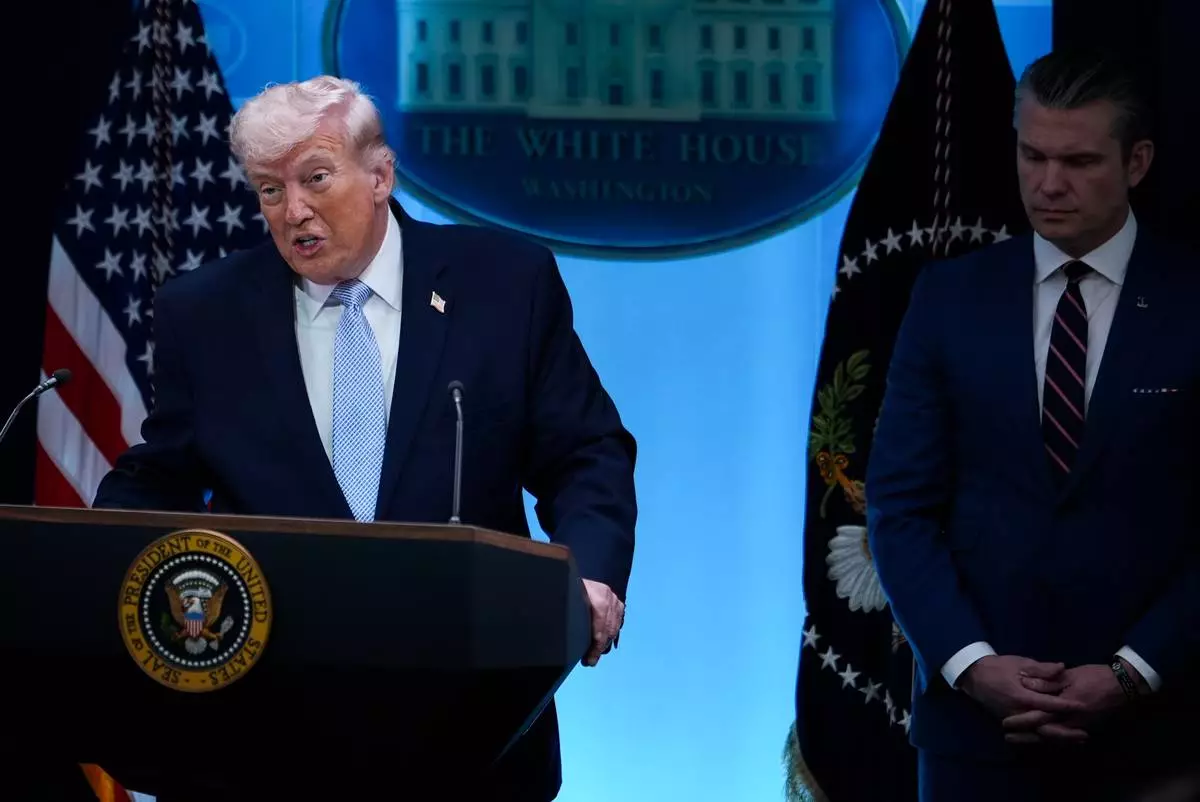
President Donald Trump, accompanied by Defense Secretary Pete Hegseth, speaks with reporters in the James Brady Press Briefing Room at the White House, Monday, April 6, 2026, in Washington. (AP Photo/Julia Demaree Nikhinson)
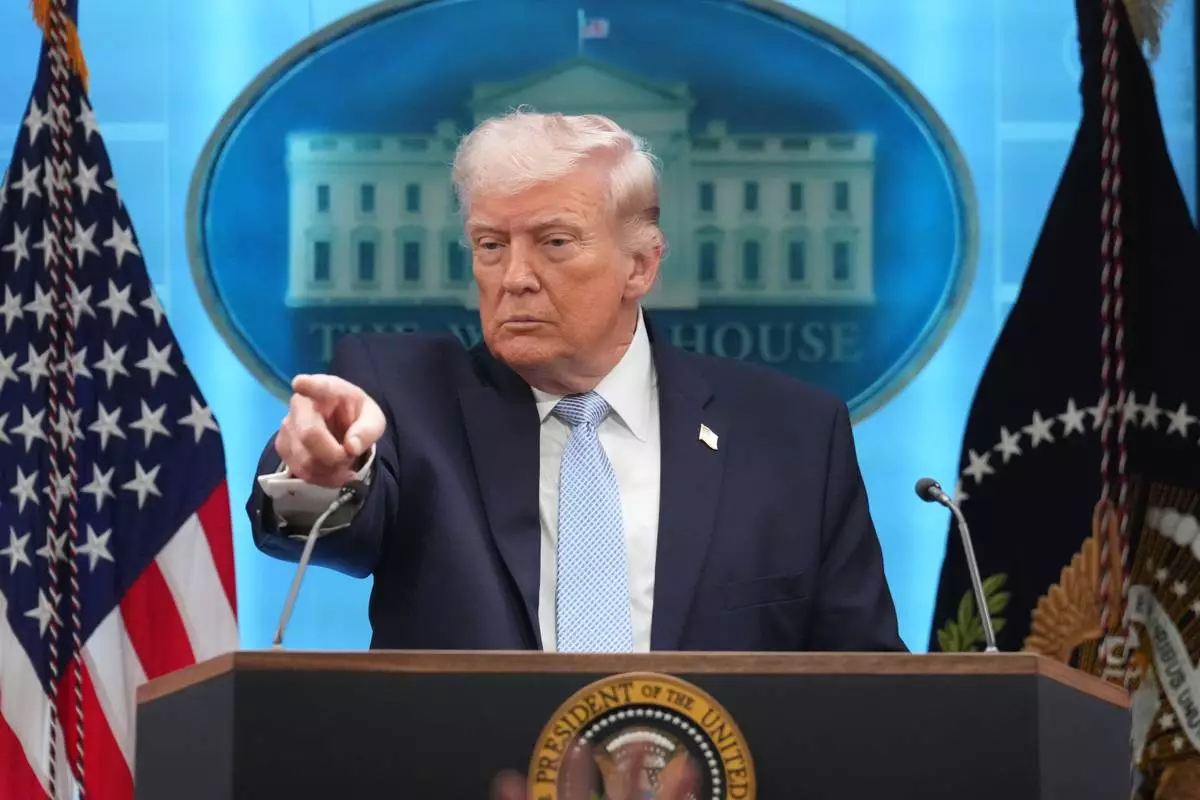
President Donald Trump speaks with reporters during a news conference in the James Brady Press Briefing Room at the White House, Monday, April 6, 2026, in Washington. (AP Photo/Mark Schiefelbein)