Entrepreneurs attending the 2025 World Internet Conference (WIC) Wuzhen Summit in east China's Zhejiang Province stated that China's industrial environment and highly skilled talents have contributed to developing new technologies.
Founders of six leading tech startups in Zhejiang's Hangzhou City, collectively known as the "Six Little Dragons", shared their views at the summit.
Han Bicheng, founder and CEO of BrainCo, said in an exclusive interview with China Central Television (CCTV) during the event that China not only boasts advanced hardware processing capabilities but also an exceptional pool of diligent and highly-skilled talents, making it the ideal place for developing brain-machine interfaces.
"Because, first of all, the brain-machine interface is a hardware device, and hardware devices require a very precise production environment. In fact, when we were in the United States, we were trying to find a place to manufacture such products. It was about 10 years ago, and we found it to be very difficult for us to attain the goal. Actually, we discovered that the best place in the world that boasts advanced hardware processing capabilities is actually in China. After returning from abroad, we realized that there is an even greater advantage in China: a large pool of exceptionally diligent and highly-skilled talents," said Han.
"We are not focused on how flashy or cutting-edge the technology appears, but on which technologies can truly address these profound and long-standing challenges," said Han.
Huang Xiaohuang, founder and chairman of Manycore Tech, said their vision extends beyond serving just the Chinese market, as they strive to create products that can transform human life and foster a better world for all. "When we were exploring problems, at least in the past, we never limited ourselves to serving only the Chinese market. We hope all of our products are designed to transform lives worldwide. This is the kind of future humanity as a whole needs. We hope this is the world we aspire to create," said Huang.

China's industrial, talent environment help promote sci-tech development: entrepreneurs
Escalating tariff clashes between the United States and Canada have deepened into a full-scale trade confrontation, piling pressure on businesses as duties spread across autos, steel, lumber and consumer goods.
The tit-for-tat measures have disrupted cross-border supply chains and eroded profits, stoking concern over jobs and industrial stability in North America.
The impact of prolonged tariff tensions is now deeply felt across Michigan's industrial and small business sectors, a core hub tightly linked to Canada's cross-border supply chains.
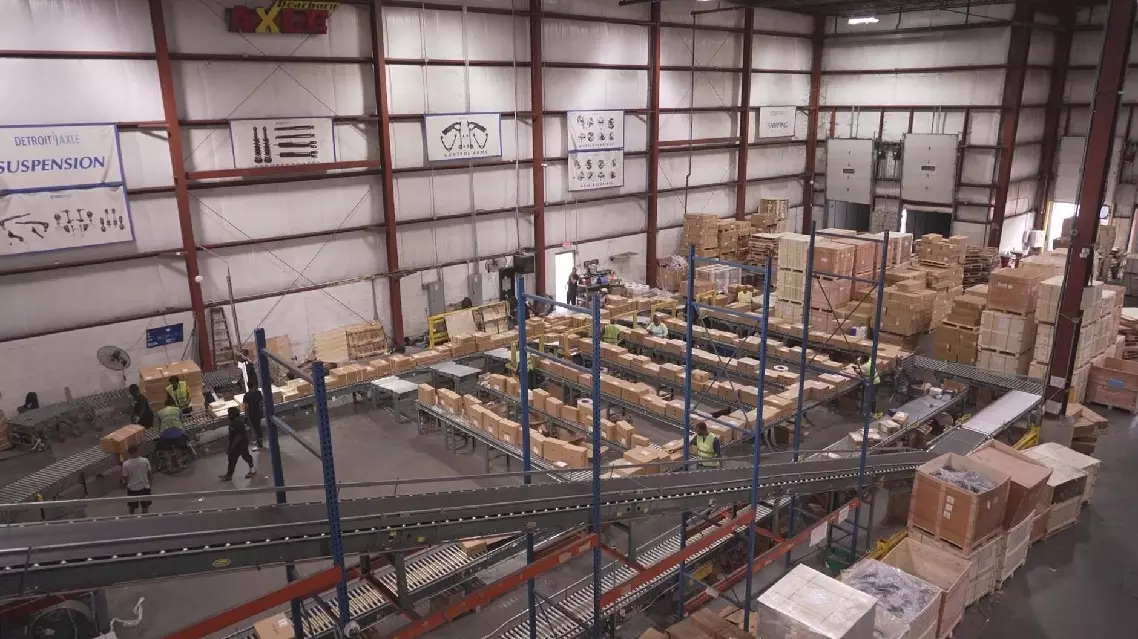
Founded as a family business and expanded into a multinational enterprise, Detroit Axle, a Michigan-based auto parts manufacturer with global operations, now employs nearly 1,000 workers, generating over 500 million U.S. dollars in annual revenue. According to its CEO Mike Musheinesh, the company has witnessed drastic cost spikes over the past 18 months amid the ongoing trade dispute.
In April last year, the US announced a 25-percent tariff on all imports of non-US made automobiles and auto parts from Canada. Added to that, there is also a 50-percent tariff on steel and aluminum products.
"If I imported a million dollars' worth of product, once upon a time we'd pay the government 25,000 U.S. dollars in tariffs. Now it went up to 725,000 U.S. dollars in tariffs overnight," said Musheinesh.
The automotive industries of Michigan and Ontario are highly interdependent, with auto parts frequently crossing the U.S.-Canada border multiple times before final assembly.
"96 of the top 100 suppliers have a facility or a headquarters in Michigan. Those are global suppliers. 13 assembly plants. It's a 348-billion-dollar economic contribution. It is our signature industry," said Glenn Stevens Jr., executive director of the trade association MichAuto.
He emphasized that the sophisticated automotive supply chain operates on thin profit margins, leaving little room to absorb extra expenditures.
"The auto industry is an extremely complex, highly developed supply chain, and the margins are not huge. They're pretty thin, right? So every step counts. Every piece of equipment, every investment, every cost, every gasoline increase, everything adds to the cost of the system and tariffs do that too," he continued.
Beyond the automotive sector, local small businesses are also bearing the brunt of tariff escalation. In nearby Warren, Michael Howard busily works on a new piece of furniture. He began a wood furniture company after moving into a home without any and has grown his business to include everything from bookcases to chopping boards.
But he has been hit by a roughly 45-percent tariff on Canadian lumber.
"There was a medical facility that we were doing the receptionist desks for, and hopefully some other cabinets inside of their facility. And they gave us a budget, and we were already at the upper limits of that budget, and when the tariffs went into place, even the threat of those, we had to reach back out and say, this incoming increase in costs on supplies is going to be applied. And they decided not to go forward. And that one project alone cost our family 3,000 U.S. dollars in sales," said Michael Howard, Owner of Howard Family Designs.
The various tariffs and retaliatory tariffs between the US and Canada have already caused economic stresses on both sides. The two economies are deeply intertwined, exchanging some 720 billion dollars' worth of goods last year. But there is a concern that the situation could get even worse.
That is because U.S. President Donald Trump is threatening a further 50-percent tariff on all Canadian automotive and steel imports beginning January 1.
"It's not tenable. That's not something the industry can absorb. That's just something that would make things cost prohibitive to make. And it would really be quite paralyzing," said Glenn Stevens Jr.
US-Canada tariff conflict casts shadow over businesses on both sides