GÖTEBORG, Sweden & LIÈGE, Belgium--(BUSINESS WIRE)--Nov 19, 2025--
Frontgrade™ Gaisler Technologies a leading provider of high-reliability electronic solutions for space and national security missions, and DELTATEC, a very high-level design house specialized in advanced technologies are pleased to celebrate their successful collaboration in delivering high-performance computing solutions for space applications, with the GR712RC dual-core microprocessor at the heart of several flight-proven systems.
This press release features multimedia. View the full release here: https://www.businesswire.com/news/home/20251119011567/en/
The GR712RC, developed by Frontgrade Gaisler and based on the fault-tolerant LEON3FT architecture, has been integrated into multiple Data Handling System (DHS) units designed by DELTATEC. These include one Payload Data Handling Unit (PDHU) and two On-Board Computers (OBCs) currently operating aboard ESA’s eSAIL mission, launched into Low Earth Orbit (LEO) in September 2020.
Moreover, DELTATEC recently delivered the Flight Model of the Mass Memory Unit for ESA’s Altius mission, demonstrating the versatility of the GR712RC microprocessor in multiple space applications. Other Frontgrade rad-hard components utilized in this platform are the 16Mb MRAM (UT8MR2M8), the 40Mb SRAM (UT8ER1M39M), the 16Mb SRAM (UT8R128K32) and the voltage supervisor (UT01VS50D).
“We are especially proud of how cost-efficient and versatile the GR712RC microprocessor is,” said Sandi Habinc, General Manager at Frontgrade Gaisler.
“Its flexibility allowed DELTATEC to deploy it across a range of computer systems, from payload data handling to mass memory units. This adaptability not only streamlines development but also supports long-term mission reliability and scalability,” adds Eric Callut, Senior Project Manager at DELTATEC.
Frontgrade Gaisler and DELTATEC continue to enable efficient and resilient satellite systems for current and future space missions worldwide, through advanced microprocessor technology and system design.
About Frontgrade Gaisler
Frontgrade Gaisler, a Frontgrade company, is a leading provider of radiation-hardened microprocessors and IP cores for critical applications, particularly in the space industry. The company’s processors are ideal for any space mission or other high-reliability application due to their reliability, fault tolerance, and radiation tolerance. Frontgrade Gaisler microprocessors can be found all over the solar system, from Mercury to Neptune.
About DELTATEC
Since its creation, DELTATEC has been committed to developing state-of-the-art electronic solutions that give its clients a decisive technological edge. As a design services company, DELTATEC adapts its role to each customer’s specific needs — from pure hardware, FPGA, or dedicated software development to the complete design and manufacturing management of integrated products. While maintaining design excellence and the highest product quality, DELTATEC accelerates development cycles and optimizes time-to-market for its clients.
Since 2005, space has become a strategic activity for DELTATEC. In the space segment, DELTATEC specializes, among others, in the design of read-out electronics for cameras used in Earth or scientific observation satellites, and in Data Handling Systems (DHSs) like mass memory units (MMUs), payload data handling units (PDHUs), and on-board computers (OBCs).
Renowned organizations such as ESA, CSL, OHB Luxspace, and Spacebel, among others, regularly entrust their projects to DELTATEC.

Frontgrade Gaisler and DELTATEC Enable Advanced Space Computing Across Multiple Missions
WASHINGTON (AP) — N’nanba (Robin Rue Simmons) has spent years trying to answer a question that has vexed the United States since the abolition of slavery: What would it actually look like to repair the damage?
In Evanston, Illinois, she helped turn that question into a $25,000 housing grant for Black residents whose families were harmed by discriminatory housing policies. Now, Rue Simmons is spreading the nation’s first municipal reparations program to more than 100 communities across the country.
But as America celebrates its 250th anniversary, there is a formidable hurdle: President Donald Trump's administration.
The administration’s campaign against diversity, equity and inclusion programs, and its broader efforts to curtail federal support for race-based initiatives and Black history, have prompted some institutions to reconsider or quietly scale back reparations work.
Those reversals come while at least part of the world community is reexamining the past. In March the U.N. General Assembly issued a resolution declaring the trafficking of millions of enslaved Africans “the gravest crime against humanity” and calling for reparations. More than 120 countries supported the resolution — only three voted against it — Argentina, Israel and the U.S. Fifty-two, including England and 27 members of the European Union, abstained.
“Under this administration, of course, there are many barriers to achieving that, but we still stand on federal redress as our collective north star,” Rue Simmons, the chairman of Evanston’s Reparations Committee and a former city councilwoman, told The Associated Press.
For more than three and half centuries, the trans-Atlantic slave trade forced an estimated 12.5 million Africans aboard ships bound for the Americas; some 1.8 million didn't survive the journey. Roughly 388,000 enslaved people were taken to what is now the U.S. and their enslavers maintained a system of chattel slavery, treating the enslaved and their children as property, until abolition in 1865.
Enslavement deprived generations of Black Americans their freedom and any meaningful share of the fruits of their labor. Jim Crow segregation, discrimination and systemic racism further depressed the Black population's ability to build wealth that is still largely concentrated among white families.
From the unfulfilled promise of 40 acres and a mule, to modern day reparations proposals, initiatives to address the legacy of slavery are entering a new era of political uncertainty.
“I don’t think that there’s been any president who’s been supportive of comprehensive Black reparations — for a long time it was just taboo to even speak the word," said William Darity, who wrote a book on reparations with A. Kirsten Mullen.
"Now, Trump will speak the word, but with hostility,” he added.
“They want to steal your money for reparations,” Trump told his supporters during a speech in September. "Our country doesn’t have that kind of money. ... The people that hate our country are asking for it, but it’s going nowhere.”
Marcus Anthony Hunter, a sociologist in African American studies at the University of California, Los Angeles, said reparations are about atoning for the past crime of chattel slavery, even if some programs come in the form of housing grants or college scholarships instead of direct cash payments.
"It's not even a lot of money that they are given. But it comes back to the recognition, the acknowledgment, responsibility and remedy,” he said.
The Trump administration disagrees and has entered the legal fight in Evanston to stop it from happening.
The Republican administration's attacks on modern-day repayment efforts include a lawsuit in Evanston, which was initially filed by Judicial Watch.
Michael Bekesha, who represents the plaintiffs, says the Evanston program distributes funds based on race without specific harm identification. He argues the city's program is unlike historical reparations programs.
“The Constitution prohibits governments from picking winners and losers based entirely on race," Beshka told the AP.
The Justice Department this month received a federal judge's permission to intervene in the case, alleging that the city’s actions violate the equal protection clause of the 14th Amendment and the Fair Housing Act.
Last year, the Justice Department sent a letter of warning to leaders in Asheville and Buncombe County, North Carolina, contemplating creating their own programs.
Kiersten Pels, a spokeswoman for the Justice Department, said in a statement to the AP that “race-based government benefit programs are both unconstitutional and often violate federal civil rights laws."
"Those implementing these programs do so in violation of federal law and the federal government has an obligation to stop them,” she said.
The White House referred questions to the Justice Department.
Georgetown University was one of the leaders, offering admission consideration for the descendants of enslaved people tied to the campus’ past, an effort that has continued despite Trump’s crackdown on campus DEI efforts.
But across higher education, new efforts have come to a standstill, said Richard Cellini, who previously led a Harvard University project to identify descendants of people enslaved by Harvard’s past leaders.
“People don’t want to talk about it, they don’t want to hear about it, they’re not hiring for it,” Cellini said.
At Harvard, Cellini's team identified nearly 500 living descendants of enslaved people tied to Harvard’s past. But just days after Trump returned to the White House in January 2025 and signed an anti-DEI order aimed at U.S. universities, Harvard fired the entire team.
Research by an outside company, American Ancestors, has continued. But Harvard has yet to provide redress to living descendants.
Harvard declined to comment for this story. The Education Department referred questions to the Justice Department.
Some Virginia universities have quietly been taking steps to provide scholarships to descendants, as required under a 2021 state law. But otherwise there has been no sign of new scholarship programs being started since Trump returned to office, said Kirt von Daacke, a University of Virginia historian who leads a consortium of colleges studying slavery.
“I don’t think there is any will to do anything that would threaten federal research dollars,” he said.
The Georgetown initiative focuses on descendants of slaves sold by Georgetown's Jesuit priests to slaveholders in Louisiana.
Juan Woolfolk, 36, one of the Georgetown descendants, is using the $10,000 scholarship he has received indirectly through a foundation set up for descendants to pursue a degree in museum studies at Southern University at New Orleans. He called it a “tremendous opportunity,” especially with the seeming attack on presenting the nation’s past accurately.
The Virginia Theological Seminary makes annual cash payments to the descendants whose family members labored on its campus during slavery and Jim Crow eras. The private institution's program is funded by an endowment started in 2019 that has grown from $1.7 million to $2.8 million. Payments to individuals vary based on the closest lineage to the family members and continue into perpetuity.
“We believe we’re the only educational institution in the United States which makes annual cash reparations payments” with no strings attached, said Nicky Burridge, the seminary’s spokeswoman.
“The moral repair, the healing aspect is as great as the monetary one,” said Ebonee Davis-Hayes, director of reparations.
In Evanston, Joe Martin, a 46-year-old reparations recipient who works as a Delta flight attendant, said he was pleasantly surprised with the program. The nation’s history has been to ignore the contributions of Black Americans helping “build America” or the terror they endured, he said.
Now, the Trump administration supports stopping the program he benefits from.
"We all know the history, 40 acres and a mule didn’t go down the way it was supposed to,” he said, and so someone establishes a program that’s legitimate and “the government’s like, naw.”
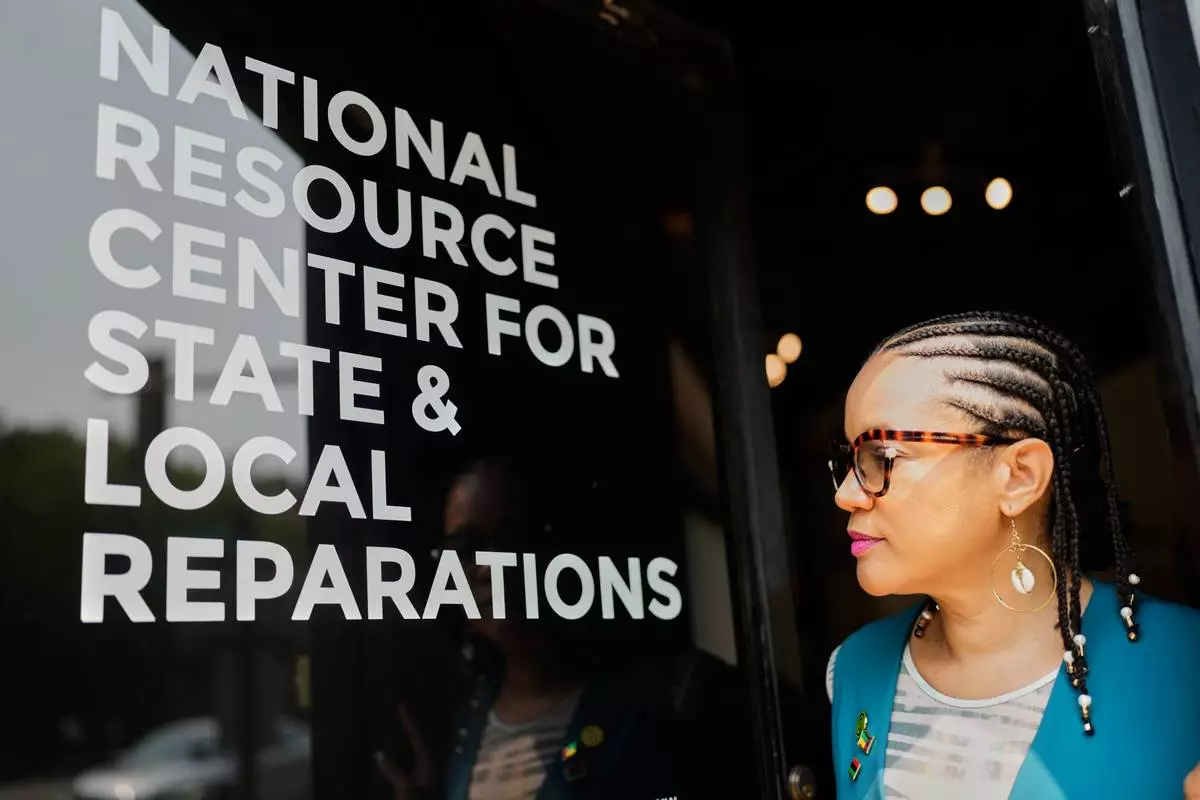
Founder and Executive director of FirstRepair, Robin Rue Simmons looks at a window at her office Monday, Aug. 10, 2026, in Evanston, Ill. (AP Photo/Nam Y. Huh)
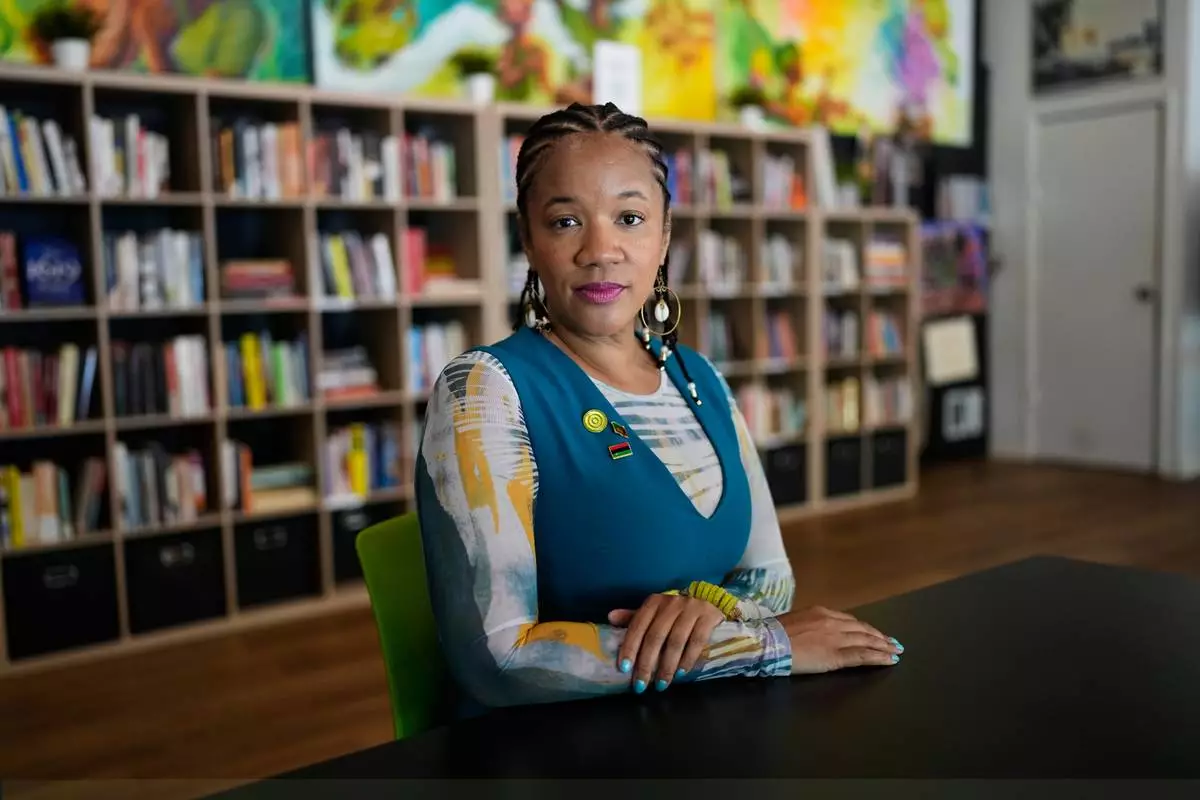
Founder and Executive director of FirstRepair, Robin Rue Simmons poses for a photo ah her office Monday, Aug. 10, 2026, in Evanston, Ill. (AP Photo/Nam Y. Huh)
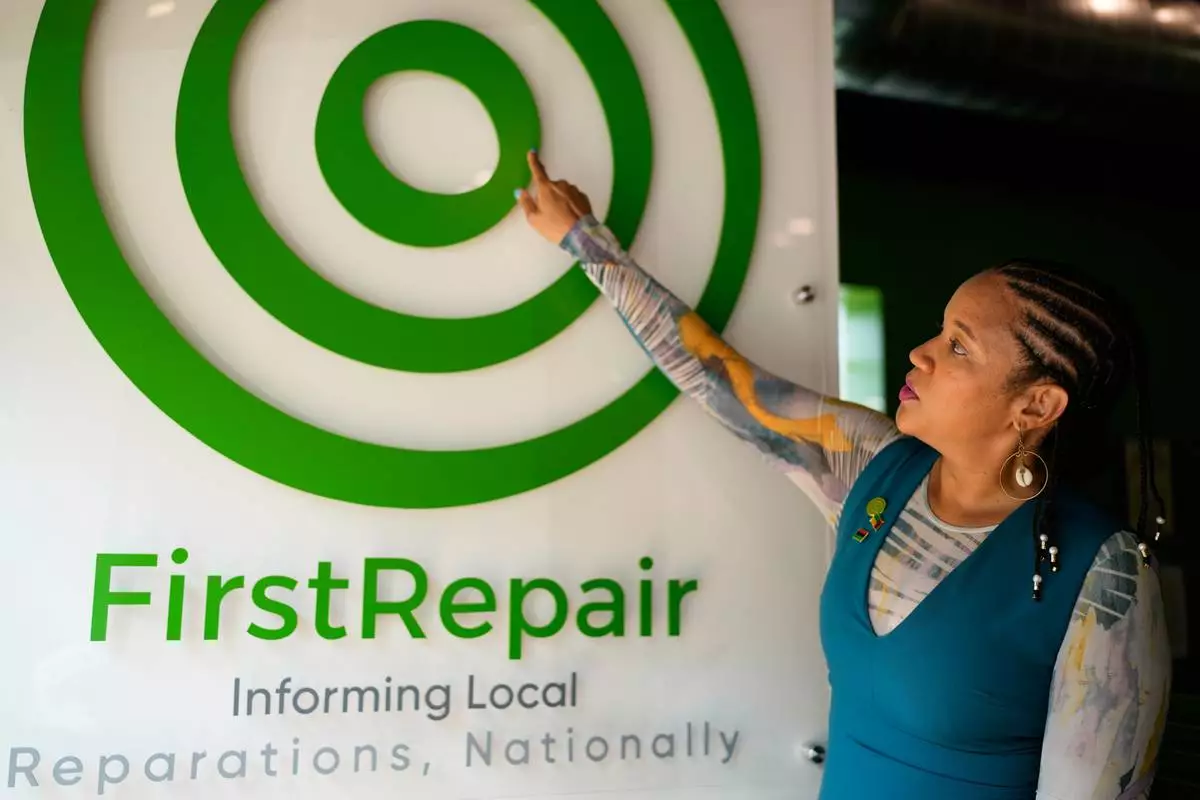
Founder and Executive director of FirstRepair, Robin Rue Simmons points FirstRepair logo as she talks at her office Monday, Aug. 10, 2026, in Evanston, Ill. (AP Photo/Nam Y. Huh)

Founder and Executive director of FirstRepair, Robin Rue Simmons poses for a photo at her office Monday, Aug. 10, 2026, in Evanston, Ill. (AP Photo/Nam Y. Huh)
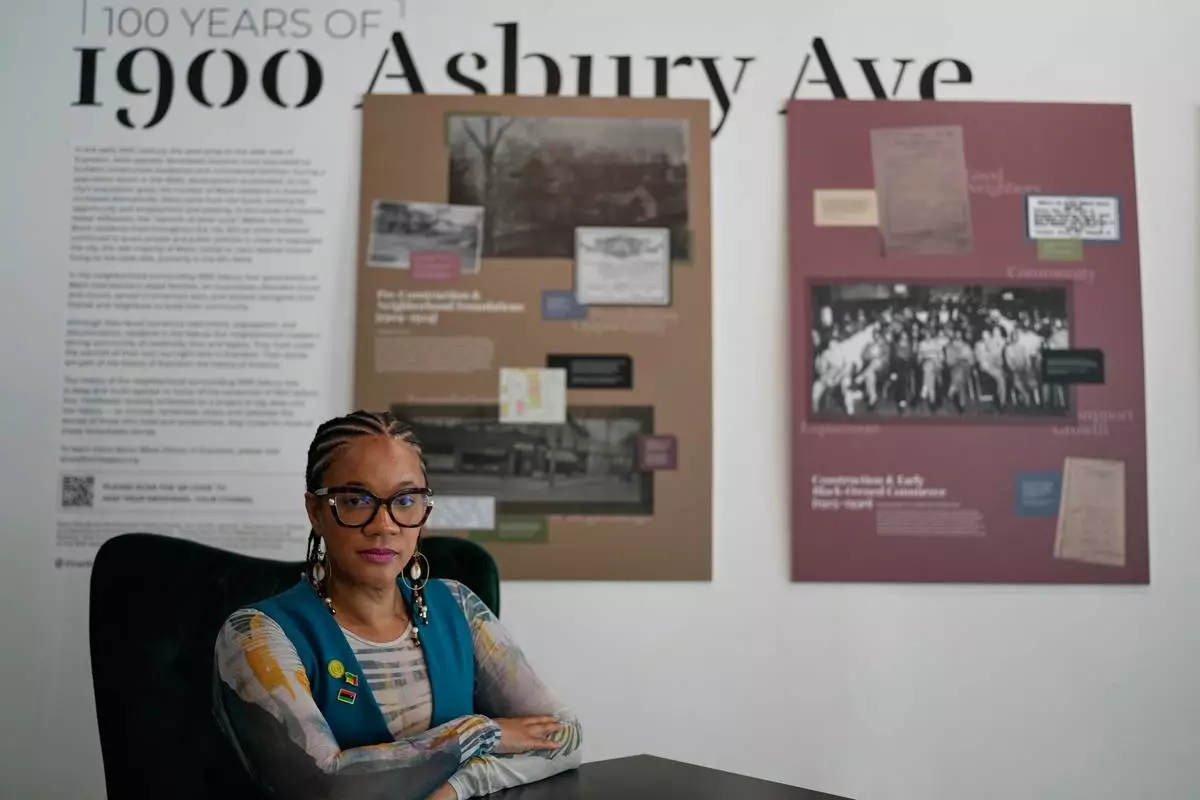
Founder and Executive director of FirstRepair, Robin Rue Simmons poses for a photo ah her office Monday, Aug. 10, 2026, in Evanston, Ill. (AP Photo/Nam Y. Huh)