SAN FRANCISCO--(BUSINESS WIRE)--Nov 19, 2025--
Synthio Labs, a clinical-grade voice AI company transforming how life sciences organisations engage clinicians and patients, today announced that it has raised $5 million in seed funding. The round was led by Elevation Capital with participation from 1984 Ventures, Peak XV Partners, Y Combinator, and several strategic angels from the global healthcare and AI ecosystem.
This press release features multimedia. View the full release here: https://www.businesswire.com/news/home/20251119509940/en/
“ We believe Synthio Labs is defining the next major Customer Engagement infrastructure for Life Sciences. Their Clinical-grade Voice AI platform unifies how pharma communicates - giving field teams a powerful voice companion, and giving physicians and patients instant, trusted, compliant answers 24/7. Pharma’s global Commercial and GTM footprint is a trillion-dollar machine ripe for reinvention, and Synthio has exactly the right team to deliver on this mission, ” said Krishna Mehra, AI Partner, Elevation Capital.
Pharma companies spend over $30 billion every year to engage doctors and patients, yet most communication is still manual, fragmented, and difficult to scale. Doctors are flooded with information, and many patients do not get regular support, leading to treatment drop-off rates of up to 50% in long-term illnesses. Synthio Labs aims to solve this problem with compliant and real-time Voice AI that helps deliver clear, accurate medical information to every doctor and patient. This technology can support pharma companies and healthcare providers globally, especially in chronic care and large patient support programs.
Synthio Labs’ AI Operating System unifies three flagship platforms: Jarvis, the clinical-grade Voice AI copilot for field teams; Ather, the multimodal AI engine that powers seamless omnichannel engagement with physicians and patients; and Simulation Studio, the advanced insight platform that generates high-fidelity digital twins of clinicians and patients for research and strategy. Together, these products help life-sciences teams automate compliant conversations, capture structured intelligence at scale, and deliver consistent, human-grade experiences to every clinician and patient.
“ Beyond breakthrough medicines, the future of healthcare will depend on how we reach and support every clinician and patient who relies on them,” said Supreet Deshpande, Co-founder and CEO of Synthio Labs .“At Synthio, we’re building the AI infrastructure that makes that possible - intelligently, compliantly, and at scale,” added Rajashekar Vasantha, Co-founder and CTO.
Sahitya Sridhar, Co-founder and Chief Product Officer, said,“We’re designing products that make every conversation between pharma and their customers smarter, faster, and more meaningful. Healthcare is moving into a world of abundance. Our view is simple: bring consumer-grade experiences to pharma and empower the people delivering care.”
Early adopters include several of the Top 10 Pharma Companies and leading D2C healthcare brands who are using Synthio’s Voice AI to transform physician and patient engagement. In one project, Synthio’s Voice AI reached more than 5,000 eczema patients in 48 hours, highlighting its ability to scale personalized support rapidly.
Rafal Pielak, Founder and CEO, Soteri Skin, said,“It’s been a pleasure working with the Synthio Labs team. They built a voice AI agent that engaged thousands of eczema patients, completing 5,000 calls in just two days. The agent supported onboarding, screening, and patient assistance end-to-end, fully automating our feedback and review collection. We’re very happy with the results and look forward to working together again.”
Synthio Labs was founded by Supreet Deshpande, Sahitya Sridhar and Rajashekar Vasantha, an India-origin team with early academic and professional roots in the country. The founders bring deep expertise across pharma strategy and advanced AI engineering, built through leadership roles at McKinsey, ZS Associates, Amazon and Audible. They have led multi-million-dollar commercial programmes for global life sciences companies and played key roles in developing foundational LLMs and multi-agent voice systems at Amazon and Audible. The company plans to use this funding to expand its engineering and product teams, scale enterprise deployments across the U.S. and Europe, and deepen its partnerships with leading life sciences clients. Synthio aims to establish AI-driven engagement as the new standard for how pharma teams support clinicians and patients globally.
For more details, please refer to this video link:Synthio Labs Funding Announcement
About Synthio Labs
Synthio Labs is a clinical-grade conversational voice AI company that helps life sciences organizations engage clinicians and patients through secure, compliant, and intelligent voice technology. Its suite of AI products Jarvis, Ather, and Simulation Studio, powers omnichannel engagement for global pharma and biotech teams. Headquartered in the San Francisco Bay Area with teams across India and the U.S., Synthio is backed by Elevation Capital, Peak XV Partners, 1984 Ventures, Y Combinator, and leading life sciences investors.
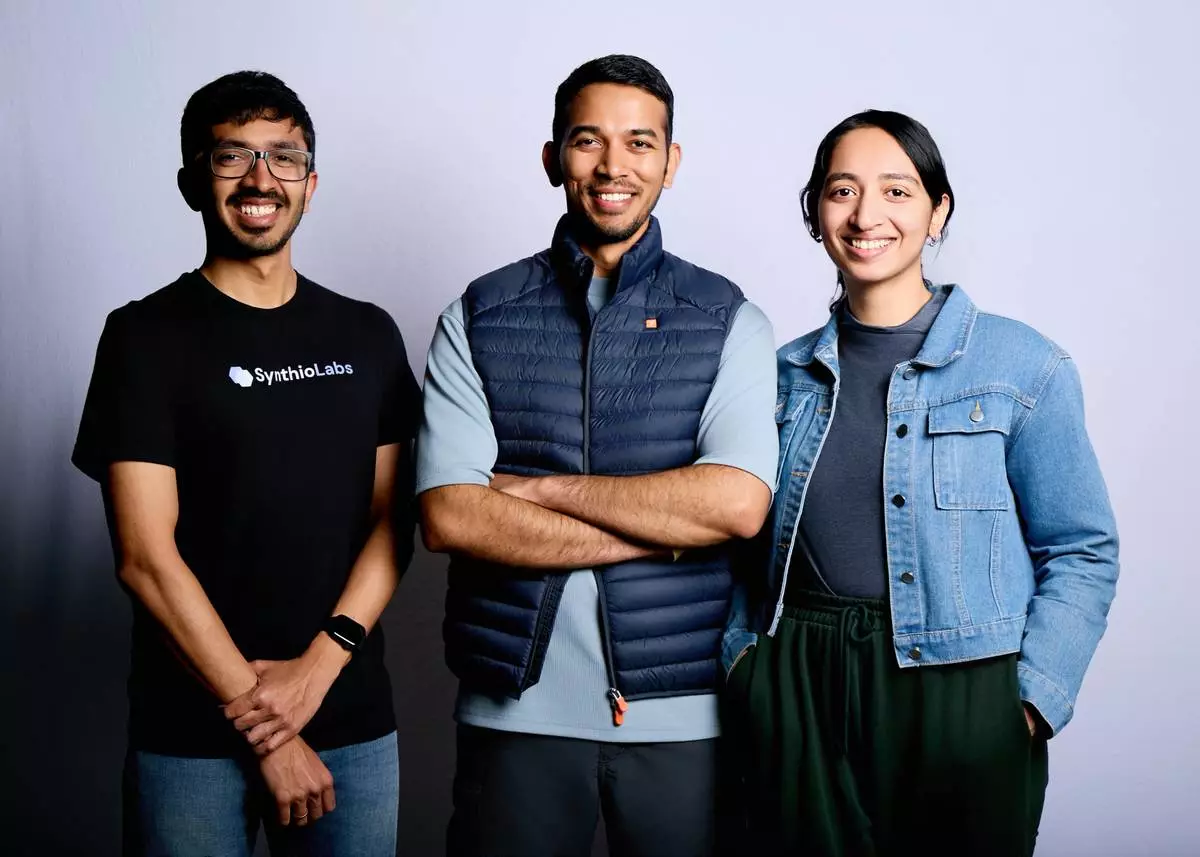
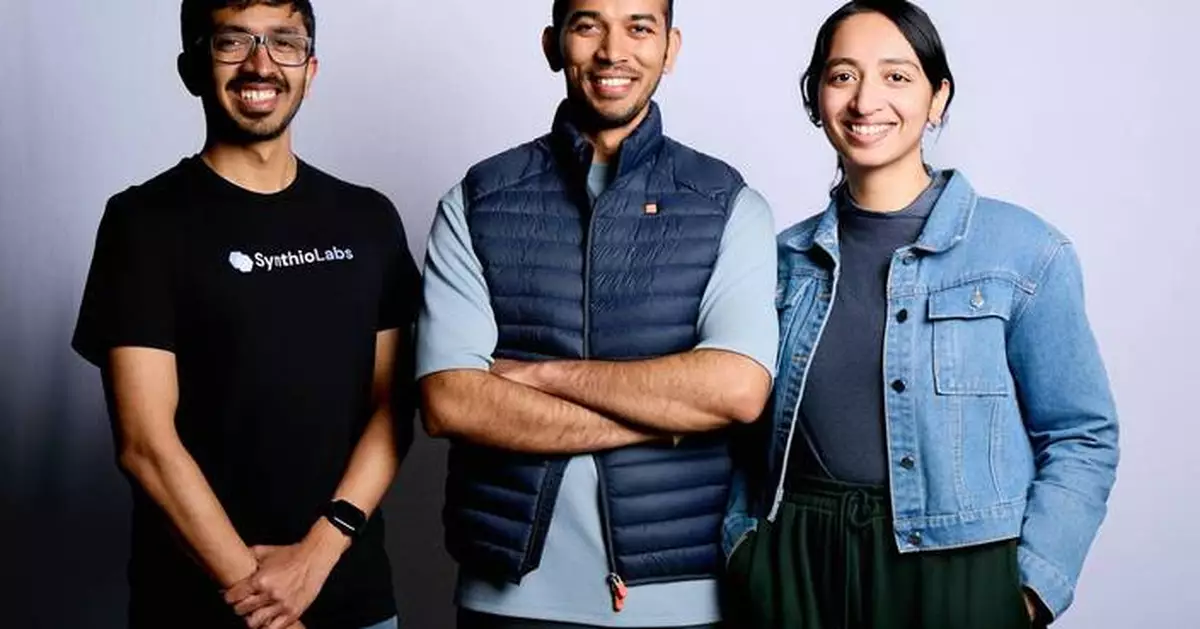
Rajashekar Vasantha (left), Supreet Deshpande (center), and Sahitya Sridhar (right), the founding team behind Synthio Labs’ voice-powered AI platform for pharma
SANTA ANA, Calif. (AP) — A crack in a damaged chemical tank in Southern California has eliminated the risk of a catastrophic explosion but it's still not safe enough for the remaining 16,000 residents living closest to the aerospace plant to go home, officials said Tuesday.
Crews were spraying water to keep cooling the tank that overheated last week, prompting the evacuation of 50,000 people in the Orange County city of Garden Grove. Most returned home after a crack formed over the Memorial Day holiday weekend, relieving pressure inside.
The evacuation zone remained the same on Tuesday morning, said Orange County Fire Capt. Brian Yau.
Crews worked overnight to ensure two other nearby tanks were neutralized and would not be affected by the compromised tank, he said, adding that material from one of these two tanks was transferred to another that has a neutralizing agent.
“They are moving material over to ensure that all threats have been eliminated,” Yau said.
Those threats include the risk of a very small explosion and potential spill, officials said.
Exposure to methyl methacrylate — a highly flammable chemical used to make plastics — can cause serious respiratory problems, neurological problems and irritation to the skin, eyes and throat, according to the federal Environmental Protection Agency. The tank at the GKN Aerospace Transparency Systems plant contains 6,000 to 7,000 gallons (22,700 to 26,500 liters) of the chemical.
The interior cooled to 93 degrees F (33.9 degrees C), the county's fire division chief Craig Covey said Monday, down from 100 degrees (37.7 degrees C) a day earlier. The company said its technical specialists and the county fire authority have removed insulation from the tank to help cool it.
Health officials sought to reassure people who are returning to homes near the plant.
“There was no contamination. There were no fumes,” Orange County Health Director Regina Chinsio-Kwong said at Monday's news conference. “There was not a leak. So it should be, you should feel comfortable going home even if you’re across the street from that new zone line.”
The South Coast Air Quality Management District will monitor the air for several months and the EPA will be checking sewer and storm drains for spills, Orange County Supervisor Janet Nguyen said.
Garden Grove Unified School District said last week it was shutting a dozen schools through what was supposed to be the last day of the school year on Wednesday but later said only three would remain closed Tuesday. It was unclear if they would reopen before the school year ends this week.
At a parking lot at a large park in Fountain Valley, just southwest of Garden Grove, people sought refuge in an ad hoc shelter there or pitched tents outside. Other people gathered in the park to enjoy Memorial Day.
Kim Yen, a retiree who was still evacuated from her home two blocks from the plant, welcomed news that the worst was not expected.
“I am happy and many of us are happy,” she said Monday.
She said she's ready to go back but wants to be sure it’s safe first. She's also been worrying about the emergency workers, who she called “our heroes.”
As the tank heated up, the chemical converted from liquid to gas, ramping up the pressure and explosion risk, said Andrew Whelton, a Purdue University engineering professor who has studied environmental contamination. Some of the methyl methacrylate may already have hardened into a stable plastic similar to plexiglass, reducing the danger, he said.
The tank could eventually cool enough for crews to safely stabilize and drain the remaining material without triggering a spark or ignition, Whelton said.
However, he said there is still a risk of an explosion while the chemical remains hot and reactive. Temperatures need to fall closer to 60 to 70 degrees Fahrenheit (15.6 to 21.1 degrees C) before conditions are considered significantly safer, he said.
GKN Aerospace Transparency Systems makes cockpit windows, canopies and windshields for military and commercial aircraft. It employs about 16,000 people across 32 manufacturing sites in 12 countries, according to the company website.
“We apologize for the ongoing disruption this incident is causing and our priority remains its safe resolution, so that residents can return to their homes as quickly as possible,” the company said.
GKN Aerospace agreed in 2025 to pay state regulators more than $900,000 to settle violations involving recordkeeping, permitting issues and nitrogen oxide emissions, according to a report on the South Coast Air Quality Management District website.
——
This story has been corrected to attribute a quote to TJ McGovern, interim fire chief of the Orange County Fire Authority, not to division chief Craig Covey.
Willingham reported from Boston. Contributing were Associated Press journalists Jamie Stengle in Dallas; Ethan Swope in Garden Grove, California; and Christopher Weber in Los Angeles.
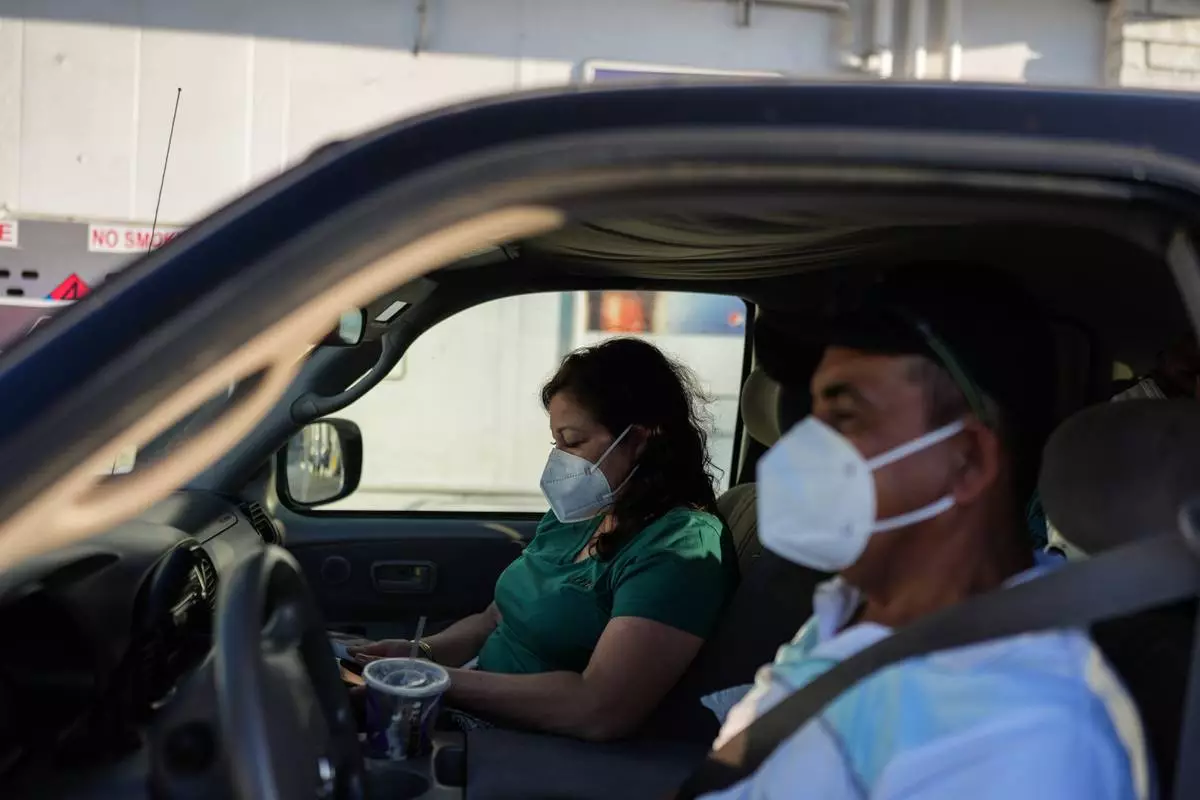
Two evacuees sit in their pickup truck at a gas station within the evacuation zone in Stanton, Calif., Monday, May 25, 2026. (AP Photo/Jae C. Hong)

An aerial view shows a police checkpoint enforcing a road closure at the evacuation zone boundary in Anaheim, Calif., Monday, May 25, 2026. (AP Photo/Jae C. Hong)
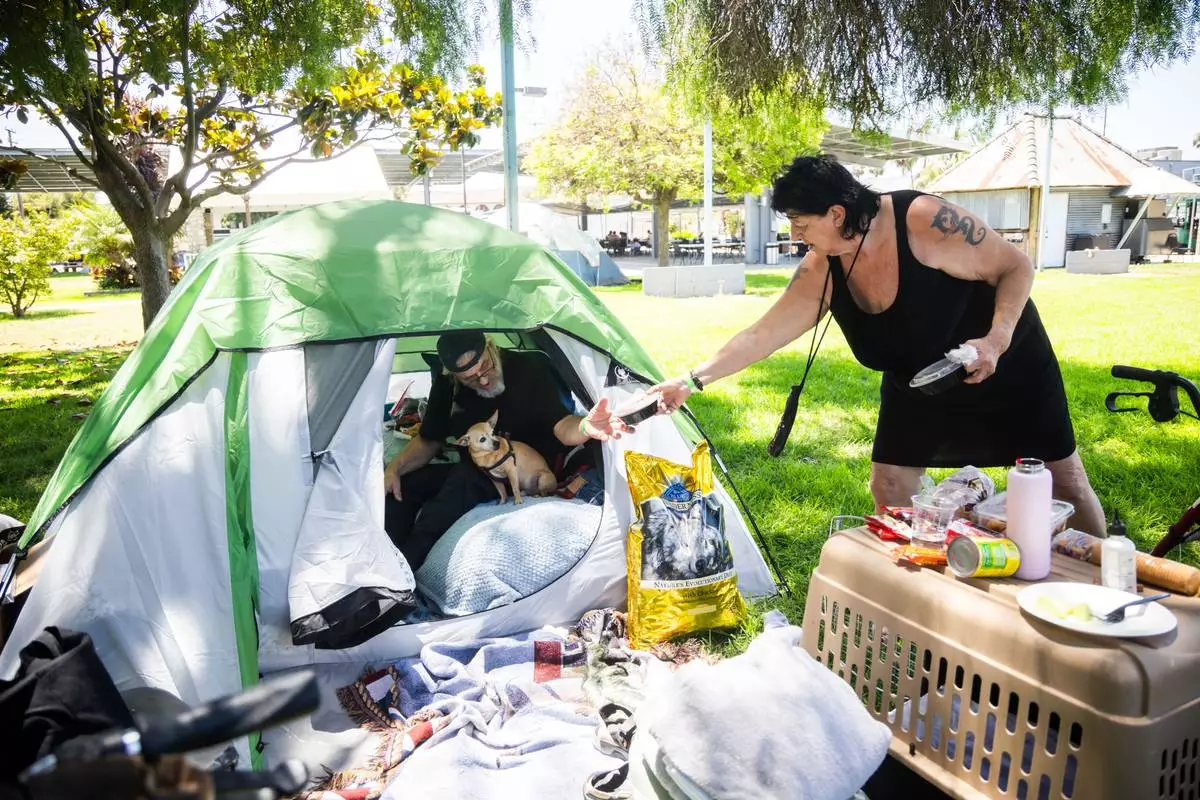
Jan De Jonge and fiancé Sher Stuckman set up a tent with their belonging and pet outside the Elks Lodge in Garden Grove, Calif., on Monday, May 25, 2026. (AP Photo/Ethan Swope)
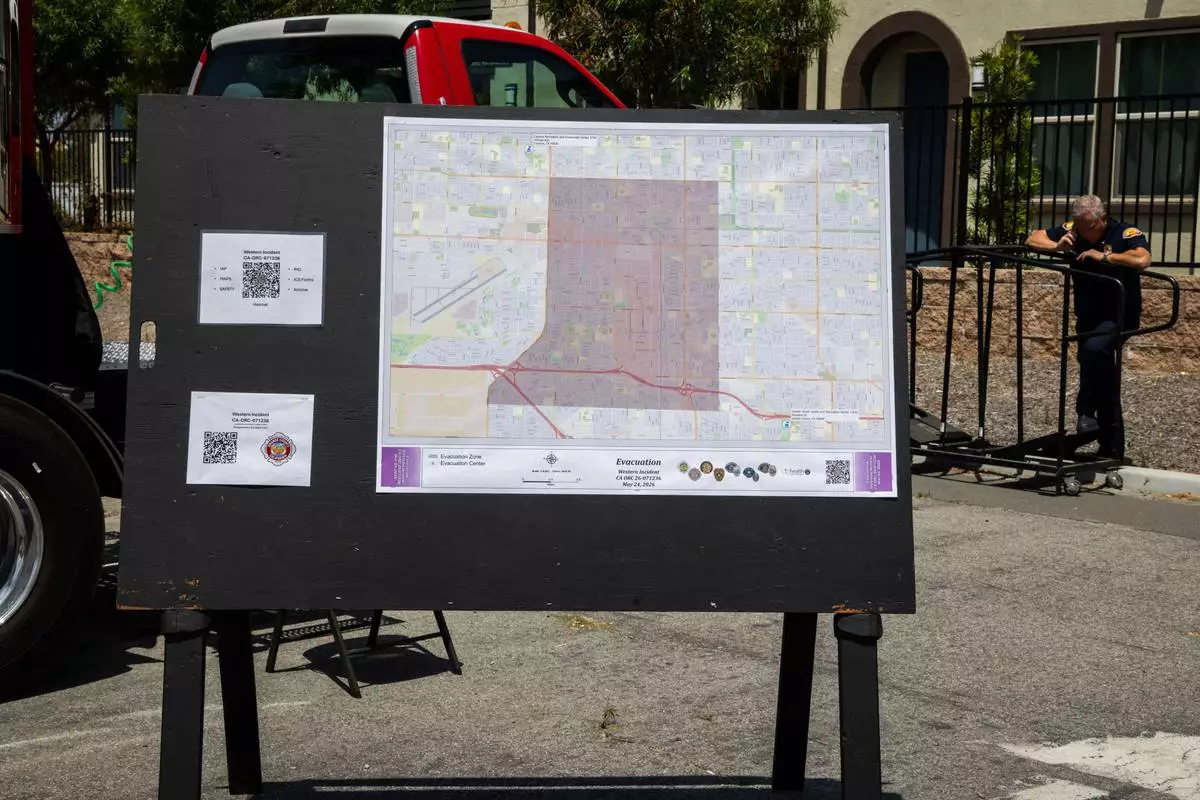
An evacuation map is displayed at the incident command post at the Los Alamitos Race Course in Cypress, Calif., on Sunday, May 24, 2026. (AP Photo/Ethan Swope)
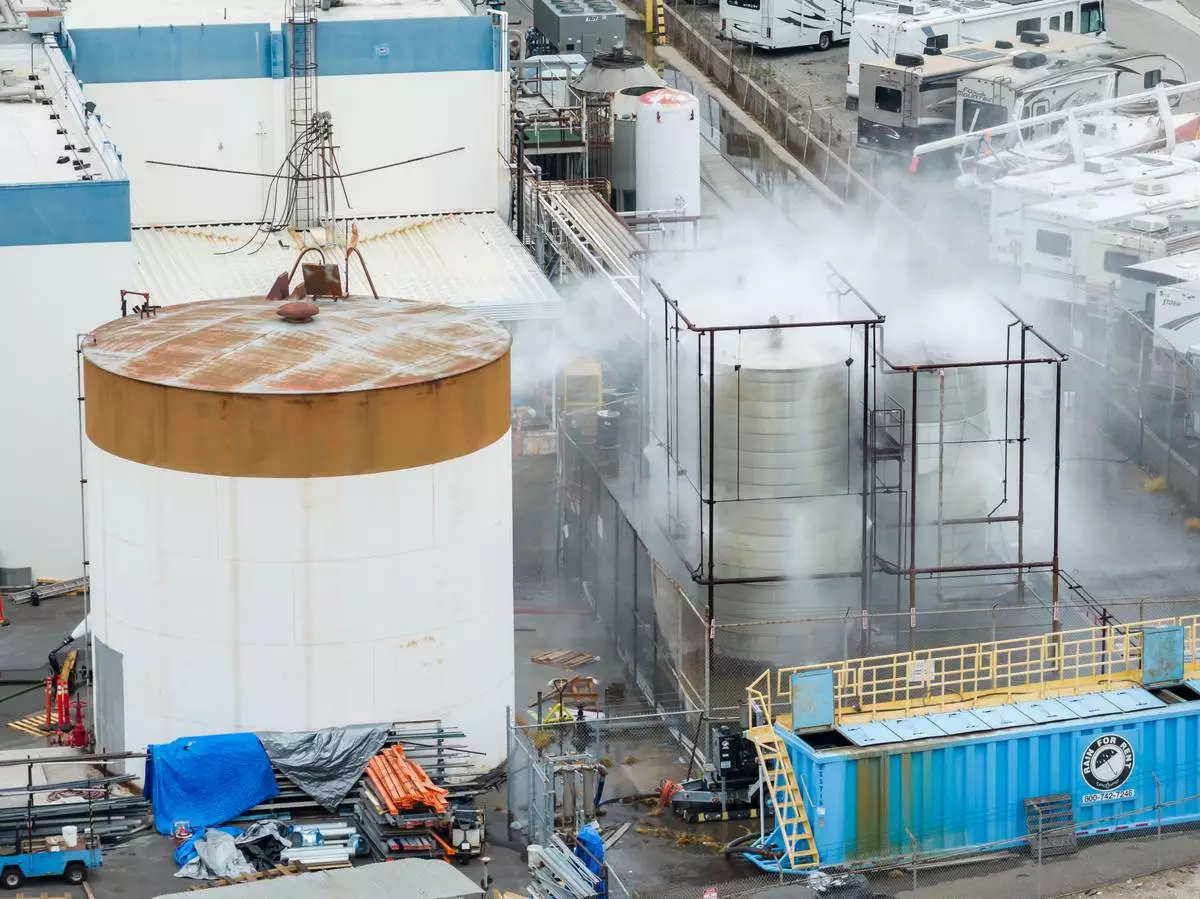
Water is sprayed on a damaged tank at GKN Aerospace in Garden Grove, Calif., on Sunday, May 24, 2026, after the tank containing a chemical used to make plastic parts overheated Thursday. (AP Photo/Ethan Swope)
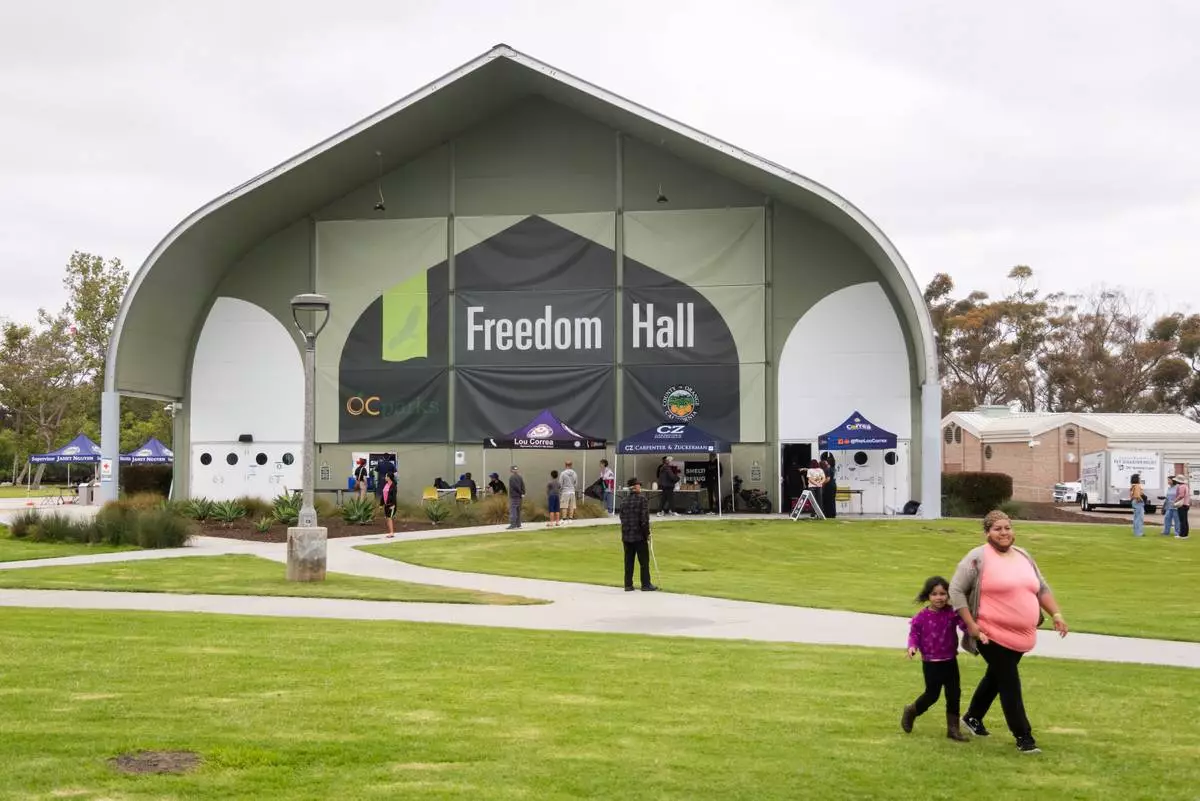
People walk outside Freedom Hall, an evacuation center in Fountain Valley, Calif., on Monday, May 25, 2026. (AP Photo/Ethan Swope)

An American Red Cross volunteer walks outside Freedom Hall, an evacuation center in Fountain Valley, Calif.,on Monday, May 25, 2026. (AP Photo/Ethan Swope)

People tend to their pets outside Freedom Hall, an evacuation center in Fountain Valley, Calif., on Monday, May 25, 2026. (AP Photo/Ethan Swope)