MANCHESTER, England (AP) — A super-sized World Cup has paved the way for tiny Curaçao and Cape Verde to book their places at sport’s biggest global event next year.
Just as FIFA president Gianni Infantino predicted.
Click to Gallery

Erling Haaland greets the people from the city hall balcony after the victory in the World Cup qualifying match between Norway and Italy at San Siro, in Oslo, Monday, Nov. 17, 2025. (Heiko Junge/NTB via AP)

Scotland's Scott McTominay scores the opening goal during the 2026 World Cup European Qualifying soccer match between Scotland and Denmark at Hampden Park, Glasgow, Scotland, Tuesday, Nov. 18, 2025. (Andrew Milligan/PA via AP)

Italy's head coach Gennaro Gattuso walks under the rain before the start of the 2026 World Cup Group I qualifier soccer match between Italy and Norway in Milan, Italy, Sunday, Nov. 16, 2025. (AP Photo/Luca Bruno)

Curaçao players celebrate qualifying for the 2026 FIFA World Cup after a soccer match against Jamaica in Kingston, Jamaica, Tuesday, Nov. 18, 2025. (AP Photo/Collin Reid)
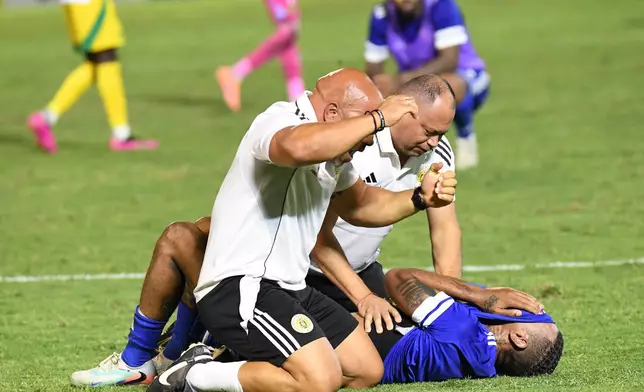
Curacao players and trainers celebrate qualifying for the 2026 FIFA World Cup after their game with Jamaica in Kingston, Jamaica, Tuesday, Nov. 18, 2025. (AP Photo/Collin Reid)
It was back in 2017 when world soccer's governing body announced controversial plans to expand the sport's flagship tournament from 32 teams to 48 in 2026. It would create opportunities, Infantino explained, for countries that “would never have dreamed to participate” in a World Cup.
“Congratulations to Curaçao on an incredible achievement. In only your fourth cycle as an independent nation, you've inspired us all with your deserved qualification,” Infantino said.
Some claimed the expansion was politically motivated. There were concerns about a dilution of quality and drama due to the expanded format.
That remains to be seen. But the bumper version of the tournament — staged in the United States, Canada and Mexico — has already created fascinating storylines long before it kicks off next June.
The Caribbean island of Curaçao, an autonomous territory within the Netherlands kingdom, is the smallest nation by population ever to qualify for the World Cup — overtaking Iceland. Cape Verde is the third smallest.
Uzbekistan and Jordan are also first-time qualifiers and the playoffs could yet see more new faces with New Caledonia, Suriname, Kosovo and Albania all in the mix.
There are places, as well, for nations making long-awaited World Cup comebacks.
Scotland returns for the first time since 1998. The same goes for Norway — meaning Erling Haaland will grace the biggest stage in soccer for the first time — and Austria. Haiti has qualified for only the second time in its history, having last been to World Cup in 1974.
“This is the best feeling,” Scotland coach Steve Clarke said. “We’re there ... fantastic moment.”
The expansion has undoubtedly created more opportunities for regions like CONCACAF, which gets six direct spots, including the three co-hosts. It also has two teams in the playoffs, whereas in 2022 it had three direct spots and another via the playoffs.
Africa had five teams previously, but now it has nine direct spots and one potential entry via the playoffs.
Yet even an expanded edition has still seen established nations struggle. Four-time world champion Italy is in danger of missing out for the third straight time after finishing second in its qualifying group.
The Italians — European champions in 2021 — must go through the playoffs if they are to end their World Cup exile.
That led to complaints from Italy coach Gennaro Gattuso.
“In my day, the best (group) runners-up went straight to the World Cup, now the rules have changed,” he said.
Despite Gattuso's complaints, Europe has more places than any other continent, with 16 teams — up from 13 — qualifying directly or via the playoffs.
There is an argument to say European qualifying can be too easy for the top nations. England qualified as group winner with a 100% record and without conceding a single goal. England has not lost a game in World Cup qualifying since 2009 — covering 39 matches.
Norway, which topped Italy's group, also had a 100% record in qualifying, while Croatia, Belgium, France, the Netherlands, Spain and Switzerland all qualified unbeaten.
Italy's difficulties point to its own decline, having failed to qualify for the World Cup since 2014. That slump dates back further, with Italy being eliminated at the group stage of the last two World Cups it competed at — in 2010 and 2014, having won the tournament in 2006.
Germany won the last of its four world titles 2014 and has gone out at the group stage of the following two World Cups — suggesting the dominance of the established elite may no longer be guaranteed.
That is being felt beyond Europe as well.
Nigeria was, for so long, one of the powerhouses of African soccer and qualified for six out of seven editions from 1994-2018. Now it has missed out on the World Cup for the second time in succession, having also failed to qualify for Qatar in 2022.
Curaçao and Cape Verde have already made history by qualifying for the World Cup and their success should inspire future generations — leading to further development of the game domestically.
That was what FIFA hoped an expanded tournament would achieve.
But the World Cup has been the stage for many famous upsets through the years. The United States stunned mighty England in 1950. In 2022, Saudi Arabia beat Lionel Messi and eventual world champion Argentina. Cameroon beat then-defending champion Argentina in 1990 and Senegal did the same to another defending champion, France, in 2002.
In 2022, Morocco became the first African nation to reach the World Cup semifinals — beating European giants Belgium, Spain and Portugal on the way.
The gap is closing and teams once considered outsiders now have genuine ambition of going deep into tournaments.
As host nation and with Mauricio Pochettino as coach, the United States will aim to better its best World Cup performance when it advanced to the quarterfinals in 2002. A recent revival that includes a 5-1 rout of Uruguay will have further lifted confidence.
But the likes of Argentina, Brazil, Spain and France remain the favorites to lift the trophy that has only been shared among eight nations in its 95-year history.
James Robson is at https://x.com/jamesalanrobson
AP soccer: https://apnews.com/hub/soccer

Erling Haaland greets the people from the city hall balcony after the victory in the World Cup qualifying match between Norway and Italy at San Siro, in Oslo, Monday, Nov. 17, 2025. (Heiko Junge/NTB via AP)
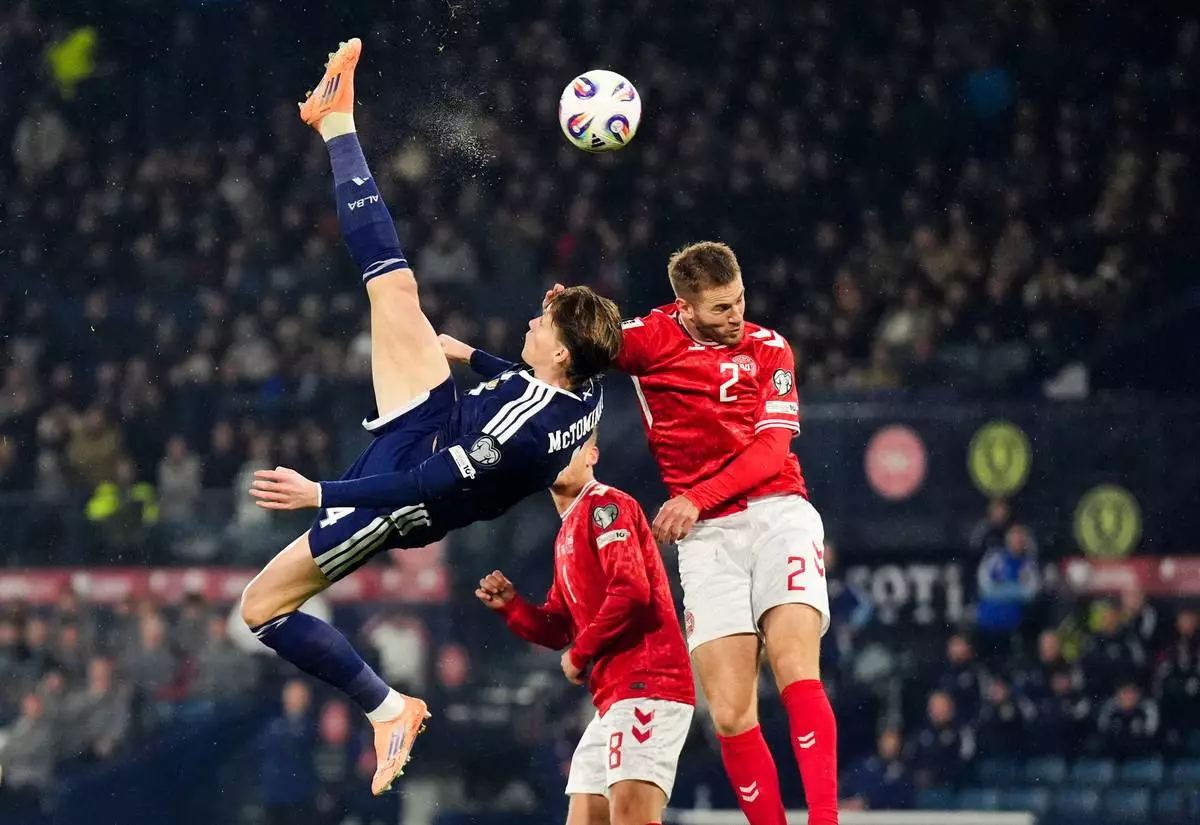
Scotland's Scott McTominay scores the opening goal during the 2026 World Cup European Qualifying soccer match between Scotland and Denmark at Hampden Park, Glasgow, Scotland, Tuesday, Nov. 18, 2025. (Andrew Milligan/PA via AP)

Italy's head coach Gennaro Gattuso walks under the rain before the start of the 2026 World Cup Group I qualifier soccer match between Italy and Norway in Milan, Italy, Sunday, Nov. 16, 2025. (AP Photo/Luca Bruno)

Curaçao players celebrate qualifying for the 2026 FIFA World Cup after a soccer match against Jamaica in Kingston, Jamaica, Tuesday, Nov. 18, 2025. (AP Photo/Collin Reid)

Curacao players and trainers celebrate qualifying for the 2026 FIFA World Cup after their game with Jamaica in Kingston, Jamaica, Tuesday, Nov. 18, 2025. (AP Photo/Collin Reid)
WASHINGTON (AP) — The U.S. Supreme Court is hearing arguments at 10 a.m. ET over the constitutionality of President Donald Trump’s order to end birthright citizenship for children born in the United States to someone in the country illegally or temporarily.
The birthright citizenship order, which Trump signed on Jan. 20, 2025, the first day of his second term, is part of his Republican administration’s broad immigration crackdown.
Trump plans to be in attendance. He will be the first sitting president to attend oral arguments at the nation’s highest court.
Every lower court to have considered the issue has found the order illegal and prevented it from taking effect. A definitive ruling by the nation’s highest court is expected by early summer.
Here’s the latest:
Sauer, Trump’s top Supreme Court lawyer, is at the lectern, defending the president’s birthright citizenship order. Trump is in the courtroom.
On American Samoa, an island cluster in the South Pacific roughly halfway between Hawaii and New Zealand, native-born children are considered “U.S. nationals” — a distinction that gives them certain rights and obligations while denying them others.
American Samoans are entitled to U.S. passports and can serve in the military. Men must register for the Selective Service. They can vote in local elections in American Samoa but cannot hold public office in the U.S. or participate in most U.S. elections.
Those who wish to become citizens can do so, but the process costs hundreds of dollars and can be cumbersome. In 2022, the Supreme Court rejected an appeal seeking to extend birthright citizenship to American Samoa.
An Alaska appeals court is weighing whether to dismiss criminal charges against an Alaska resident born in American Samoa after she was elected to a local school board.
Crowds watched from the sidewalks as Trump’s motorcade drove along Constitution and Independence Avenues, passing the Washington Monument and the National Mall on the way to the court building.
Justice Felix Frankfurter, a native of Austria, was the last of six justices who were born abroad. The current court is American from birth.
Still, the citizenship issue hits close to home for some justices.
Thomas and Ketanji Brown Jackson are descended from enslaved people who eventually had their citizenship established by the 14th Amendment.
Justice Sonia Sotomayor’s parents were born in Puerto Rico, where residents became citizens under a 1917 law enacted by Congress. The justice most closely tied to an immigrant is Alito, whose father was born in Italy.
Way back in 1841, former President John Quincy Adams represented a shipload of African men and women who had been sold into slavery in the famous Amistad case.
Former President William Howard Taft became chief justice nearly eight years after leaving the White House in 1913. Charles Evans Hughes left the Supreme Court for a presidential run in 1912, which he nearly won, then returned to the court in 1930 as chief justice.
In 1966, Richard Nixon argued his only Supreme Court case, which he lost.
Twenty-four Democratic state attorneys general put out a statement Wednesday morning saying they’re “proud to lead the fight against this unlawful order.”
While Democratic attorneys general have sued the Trump administration scores of times, the plaintiffs in this case are represented by the American Civil Liberties Union and other civil rights groups.
The Democratic attorneys filed court papers supporting their position. Twenty-five of their Republican counterparts filed a friend-of-the-court brief backing the Trump administration.
The only state sitting this one out is New Hampshire.
More than 250,000 babies born in the U.S. each year would not be citizens, according to research from the Migration Policy Institute and Pennsylvania State University’s Population Research Institute.
The order would only apply going forward, the administration has said. But opponents have said a court ruling in Trump’s favor could pave the way for a later effort to take away citizenship from people who were born to parents who were not themselves U.S. citizens.
The president and first lady Melania Trump showed up for the court ritual marking the arrival of a new justice following the confirmations of Justice Neil Gorsuch in 2017 and Justice Brett Kavanaugh a year later.
The ceremony for Trump’s third appointee, Justice Amy Coney Barrett, was delayed a year because of the COVID-19 pandemic and Trump, who was no longer in office, did not attend.
Traditionally the president has avoided attending arguments to maintain distance between the government branches — since the executive officer’s presence is seen by many as a way to pressure the independent court to rule in their favor.
Given the unusual nature of it all — Trump’s presence in the courtroom spotlights how high the stakes are for him, as the court’s decision will have massive consequences on his longstanding promise to crack down on immigration.
Last year, Trump said that he badly wanted to attend a hearing on whether he overstepped federal law with his sweeping tariffs, but he decided against it, saying it would have been a distraction.
Adam Winkler, a constitutional law professor at UCLA, told the The Associated Press that Trump’s attending SCOTUS oral arguments signals how important the president views this case.
However, Trump’s presence “is unlikely to sway the justices,” Winkler said, adding that the SCOTUS justices “pride themselves in their independence, even if some agree with much of Trump’s agenda.”
The fanfare of Trump being in the courtroom will make for a different experience for the justices themselves, however, as “Trump’s presence will make the atmosphere a little bit more circus-like,” Winkler said.
Solicitor General D. John Sauer is making his ninth Supreme Court argument and second in as many weeks. Sauer’s biggest win to date was the presidential immunity decision that spared Trump from being tried for his effort to overturn the 2020 election.
Sauer was a Supreme Court law clerk to Justice Antonin Scalia early in his legal career.
ACLU legal director Cecillia Wang, the child of Chinese immigrants, is presenting her second argument to the Supreme Court. In the first Trump administration, a 5-4 conservative majority ruled against Wang’s clients in another immigration case.
It’s not an April Fool’s joke. Alito was born this day in 1950. Only Thomas, who turns 78 in June, is older than Alito among the nine justices.
In the post-pandemic era, the other justices allow the 77-year-old Thomas, the longest-serving member of the court, to pose a question or two before the free-for-all begins.
In a second round of questioning, the justices ask questions in order of seniority. Chief Justice John Roberts, whose center chair makes him the most senior, gets the first crack.
The justices have routinely gone beyond the allotted time since returning to the courtroom following the Covid-19 pandemic.
A buzzer and the court marshal’s cry, “All rise,” signal the justices’ entrance from behind red curtains. The livestream won’t kick in for several minutes, until after the ceremonial swearing-in of lawyers to the Supreme Court bar.
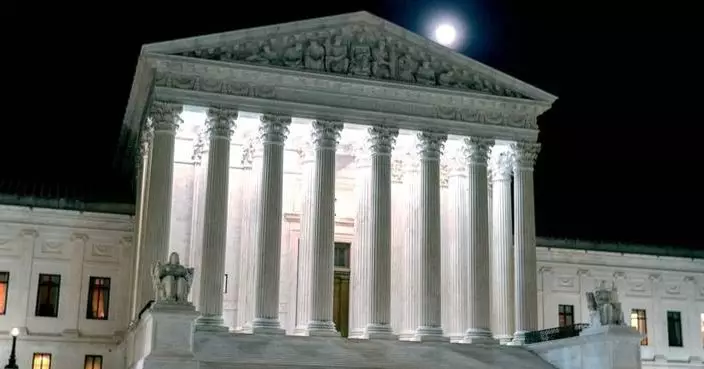
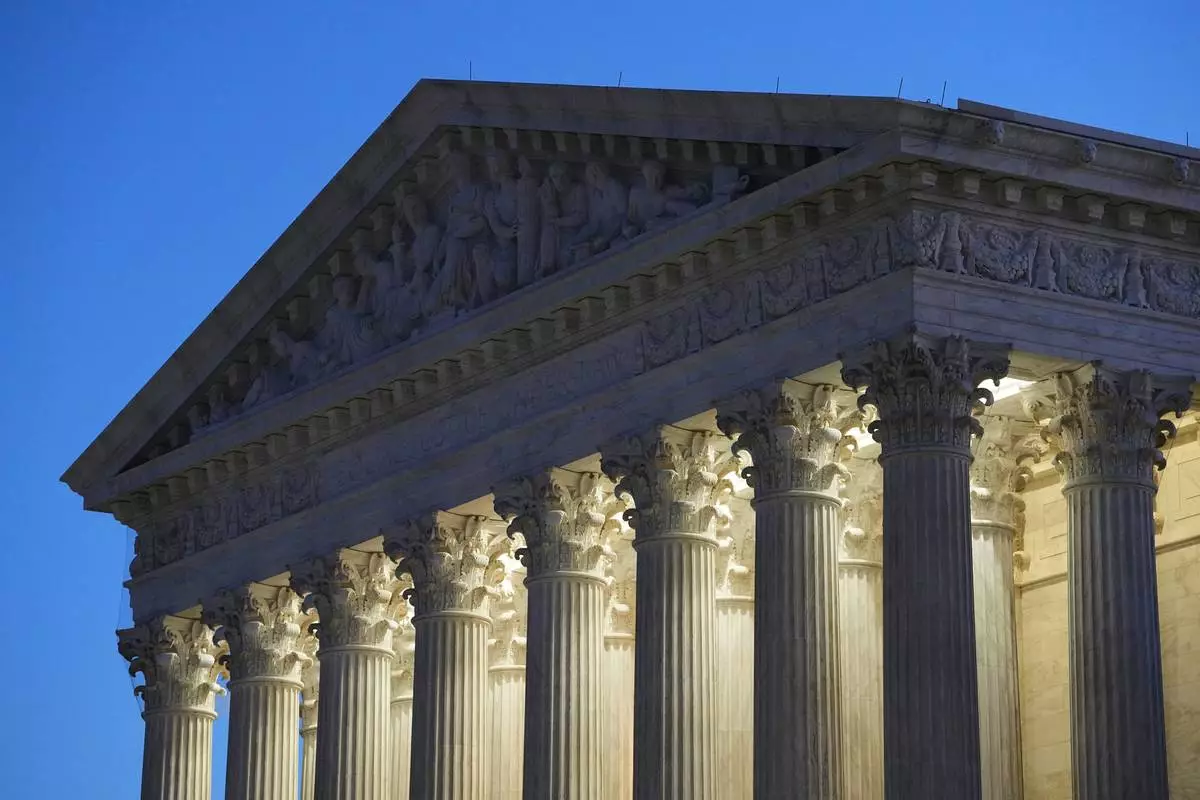
FILE - The U.S. Supreme Court is seen in Washington on Feb. 24, 2026. (AP Photo/Matt Rourke, File)
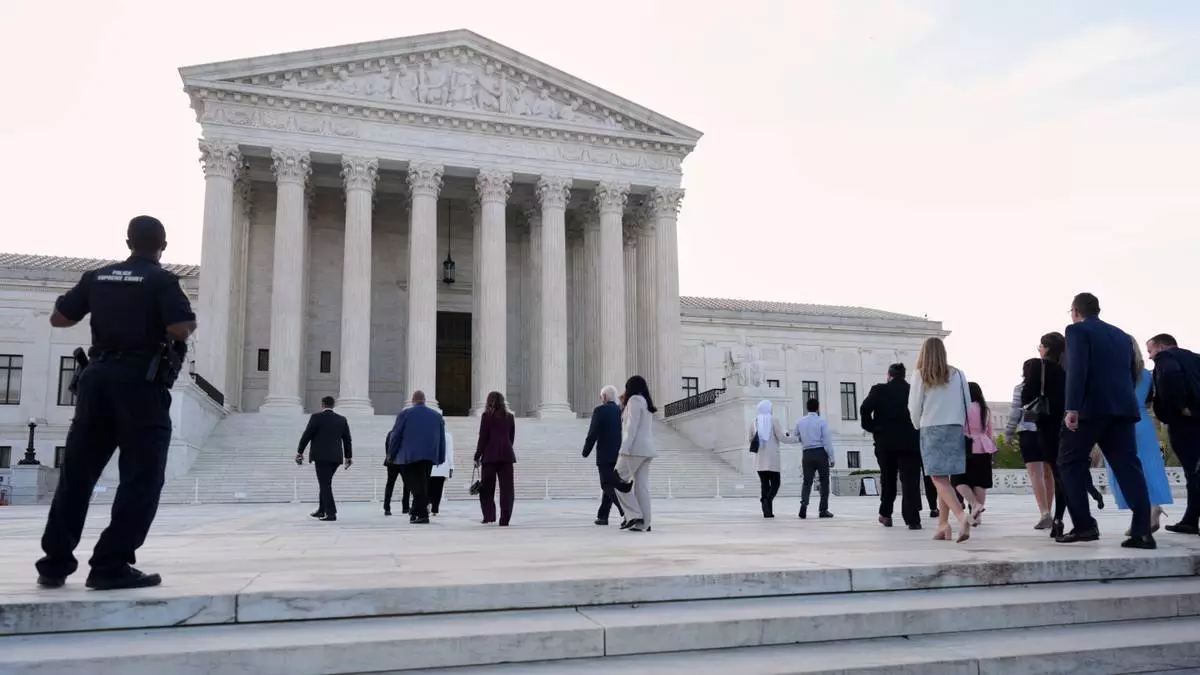
People arrive to walk inside the U.S. Supreme Court, on Capitol Hill in Washington, Wednesday, April 1, 2026. The Supreme Court justices will hear oral arguments today on whether President Donald Trump can deny citizenship to children born to parents who are in the United States illegally or temporarily. (AP Photo/J. Scott Applewhite)