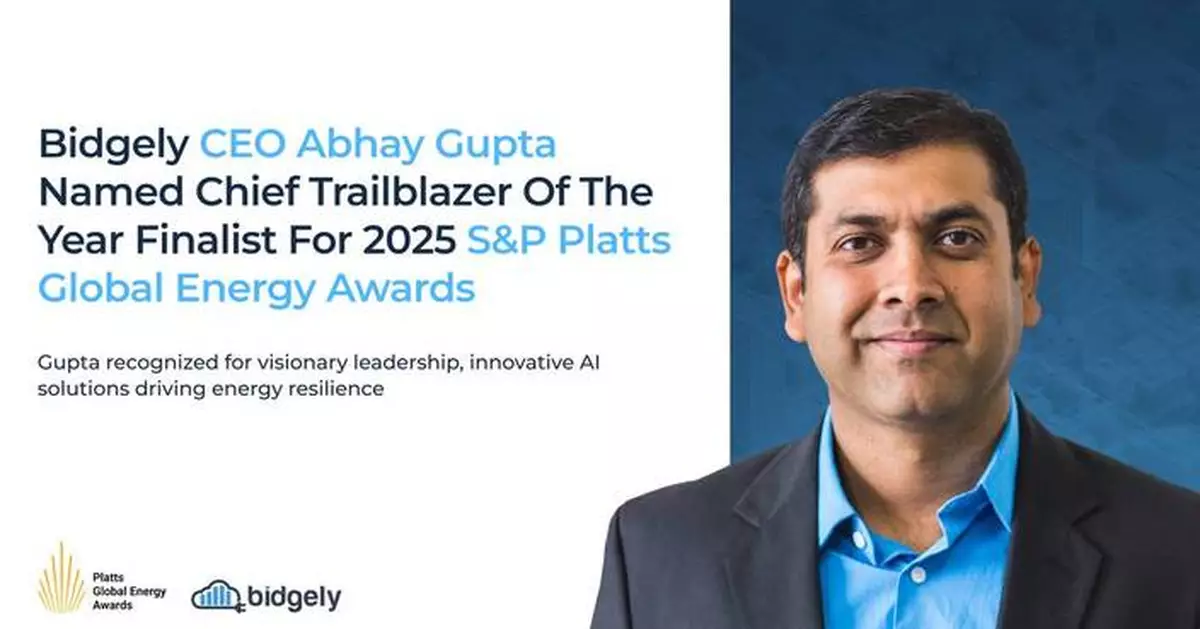
LOS ALTOS, Calif.--(BUSINESS WIRE)--Nov 19, 2025--
Abhay Gupta, the pioneering founder and CEO of Bidgely, has been named a finalist for Chief Trailblazer of the Year in the 27th Annual Platts Global Energy Awards. This distinguished honor recognizes Gupta's profound impact on the energy sector, driven by his groundbreaking approach to artificial intelligence (AI) and a relentless pursuit of a more resilient and stable energy future.
This press release features multimedia. View the full release here: https://www.businesswire.com/news/home/20251119726431/en/
“This recognition is another validation of the audacious vision we started with: to transform raw energy data into the intelligence needed to create reliable, optimized energy grids,” Gupta said. “I am incredibly proud of our team's success in inventing AI-powered solutions that create real value for utility customers, the environment, and the energy industry at large.”
Redefining Energy Intelligence with a Bold Vision
Gupta's nomination is a direct testament to his conviction that hidden intelligence resides within every home's energy footprint. He boldly challenged the status quo, refusing to accept the limitations of expensive hardware-based solutions. His successful breakthrough was the pioneering of AI-powered energy intelligence technology, which can precisely itemize energy consumption from raw meter data and reveal never-before-seen insights into customer behavior and grid operations.
This foundational innovation, secured by 16 accumulated patents, has fundamentally changed how utilities operate and engage with customers. It's the engine behind Bidgely's success, which has scaled under Gupta's direction to partner with more than 40 energy providers globally, all while consistently achieving over 30 percent year-over-year growth and maintaining profitability.
Honoring Energy Innovators
The Platts Global Energy Awards recognize corporate and individual innovation, leadership, and exemplary performance in 21 categories spanning the entire energy and chemicals value chain. The 2025 finalists were announced by S&P Global Commodity Insights, the leading independent provider of information, data, analysis and benchmark prices for the energy and other markets.
The winners of the Platts Global Energy Awards will be selected by an independent panel of judges from each award category's respective group of finalists. Winners will be announced December 11 at the 2025 Platts Global Energy Awards black-tie ceremony and gala in downtown Manhattan in New York City.
“The shifting landscape within the energy industry has brought forward numerous business-impacting challenges. Platts Global Energy Awards is pleased to spotlight companies and individuals who not only navigate the environment well, but continue to lead the way in pioneering vision, progress, exemplary performance, and innovation for a more sustainable energy future,” said Allison Sacco, Executive Producer, S&P Global Commodity Insights.
To view the complete list of award categories and finalists for 2025 and information on the awards and judging, visit the Platts Global Energy Awards website.
About S&P Global Commodity Insights
At S&P Global Commodity Insights, our complete view of global energy and commodity markets enables our customers to make decisions with conviction and create long-term, sustainable value.
We’re a trusted connector that brings together thought leaders, market participants, governments, and regulators and we create solutions that lead to progress. Vital to navigating commodity markets, our coverage includes oil and gas, power, chemicals, metals, agriculture, shipping and energy transition. Platts ® products and services, including leading benchmark price assessments in the physical commodity markets, are offered through S&P Global Commodity Insights. S&P Global Commodity Insights maintains clear structural and operational separation between its price assessment activities and the other activities carried out by S&P Global Commodity Insights and the other business divisions of S&P Global.
S&P Global Commodity Insights is a division of S&P Global (NYSE: SPGI). S&P Global is the world’s foremost provider of credit ratings, benchmarks, analytics and workflow solutions in the global capital, commodity and automotive markets. With every one of our offerings, we help many of the world’s leading organizations navigate the economic landscape so they can plan for tomorrow, today. For more information visit https://www.spglobal.com/commodityinsights.
About Bidgely
Bidgely is an AI-powered SaaS Company accelerating a clean energy future by enabling energy companies and consumers to make data-driven energy-related decisions. Powered by our unique patented technology, Bidgely's UtilityAI™ Platform transforms multiple dimensions of customer data - such as energy consumption, demographics, and interactions - into deeply accurate and actionable consumer energy insights. We leverage these insights to empower each customer with personalized recommendations, tailored to their individual personality and lifestyle, usage attributes, behavioral patterns, purchase propensity, and beyond. From a distributed energy resources (DER) and grid edge perspective, Bidgely is advancing smart meter innovation with data-driven solutions for solar PVs, electric vehicle (EV) detection, EV behavioral load shifting and managed charging, energy theft, short-term load forecasting, grid analytics, and time of use (TOU) rate designs. Bidgely’s UtilityAI™ energy analytics provides deep visibility into generation and consumption for better peak load shaping and grid planning, and delivers targeted recommendations for new value-added products and services. With roots in Silicon Valley, Bidgely has over 16 energy patents, $75M+ in funding, retains 30+ data scientists, and brings a passion for AI to utilities serving residential and commercial customers around the world. For more information, please visit www.bidgely.com or the Bidgely blog at bidgely.com/blog.
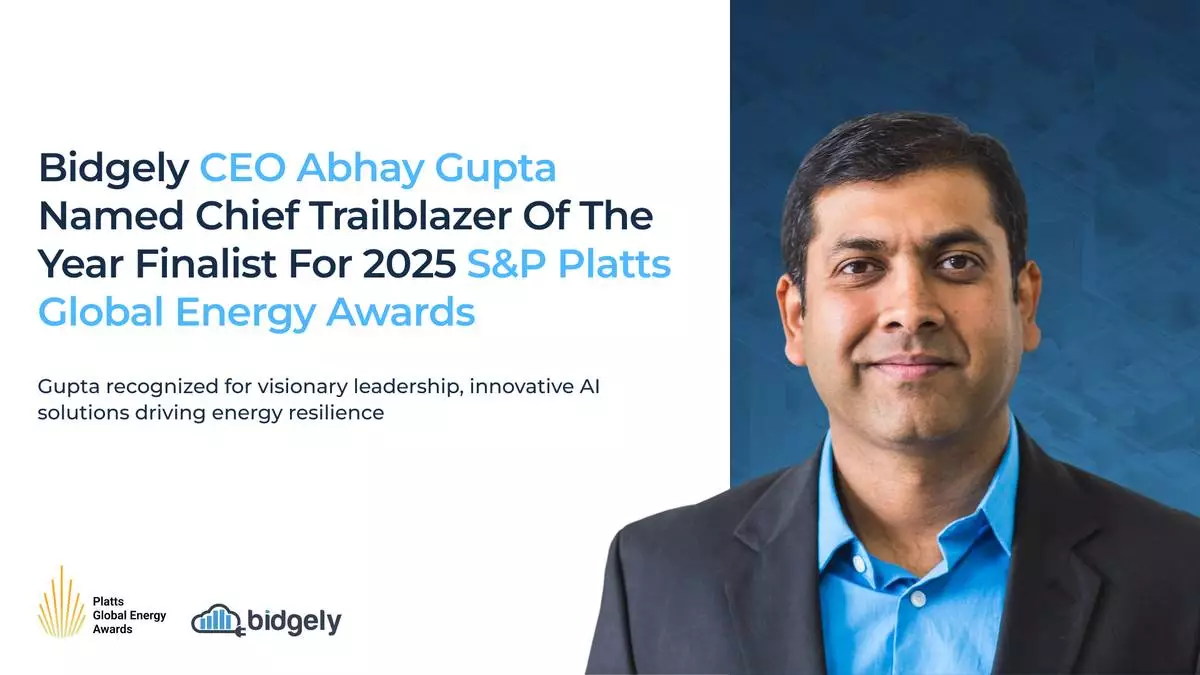
Pioneering founder and CEO of Bidgely, Abhay Gupta, is a finalist for 27th Annual Platts Global Energy Awards Chief Trailblazer of the Year, recognized for his profound AI-driven impact on the energy sector.
WASHINGTON (AP) — The U.S. Supreme Court has begun hearing arguments over the constitutionality of President Donald Trump’s order to end birthright citizenship for children born in the United States to someone in the country illegally or temporarily.
The birthright citizenship order, which Trump signed on Jan. 20, 2025, the first day of his second term, is part of his Republican administration’s broad immigration crackdown.
Trump is in attendance; he is the first sitting president to attend oral arguments at the nation’s highest court.
Every lower court to have considered the issue has found the order illegal and prevented it from taking effect. A definitive ruling by the nation’s highest court is expected by early summer.
Here’s the latest:
Trump spent just over an hour inside the courtroom. He apparently was only interested in hearing the arguments by the government’s lawyer, Solicitor General John Sauer.
The president departed shortly after Sauer wrapped up and the plaintiff was invited to present her case.
Cecillia Wang, the American Civil Liberties Union legal director facing off against Sauer, often centered her arguments around American courts’ reliance on English common law, which provides for citizenship based on the legal concept of jus soli, or “right of soil.”
“When the government tried to strip Mr. Wong Kim Ark’s citizenship on largely the same grounds they raised today, this court said no,” she said, adding “this court held that the 14th Amendment embodies the English common law rule: Virtually everyone born on U.S. soil is subject to its jurisdiction and is a citizen.”
Justice Jackson is drilling down into exactly how the government would actually figure out who’s entitled to citizenship and who’s not.
“Are you suggesting that when a baby is born people have to have documents? Present documents? Is this happening in the delivery room? How are we determining when or whether a newborn child is a citizen of the United States under your rule?” she’s asking Sauer.
Sauer seems to be saying that it would fall to the computer systems that give out Social Security numbers, saying they would automatically check the citizenship of the parents.
Roberts says the word is used 20 times in the 1898 decision. “Isn’t it at least something to be concerned about?”
Wang says it’s true that the Chinese parents were domiciled in the U.S., but that the decision did not turn on that fact, but instead a long history of basing citizenship on where the child was born.
More than an hour in, it’s the opponents’ turn
The ACLU’s Wang has begun her presentation in defense of birthright citizenship.
Sauer noted that the government is “not asking you overrule Wong Kim Ark,” which extended citizenship to children born in the U.S. to foreign parents.
But he added that it was “totally unambiguous” that the 1898 ruling “relates to domiciled aliens,” and not what he called “sojourners,” or temporary visitors.
Judge Alito is asking Sauer about the humanitarian issue of people who have been in the U.S. for a long time and are “subject to removal” but in “their minds” have made a permanent home in America.
Alito also says that immigration laws in the U.S. have been “ineffectively and in some cases unenthusiastically” enforced over the years.
He’s asking Sauer to address the “humanitarian problem” that arises with how to deal with those people when it comes to birthright citizenship.
Sauer is saying that when it comes to birthright citizenship the U.S. is an “outlier among modern nations” and is pointing to places in Europe who don’t allow birthright citizenship and suggesting there doesn’t seem to have been any humanitarian fallout there.
Kavanaugh says Congress might have used different language in laws enacted in 1940 and 1952 if it wanted to make clear that children of people here illegally or temporarily were not entitled to citizenship.
Much of the early discussions revolved around the concepts of “domicile,” or a person’s permanent residence, and to which government that person owes “allegiance.”
Solicitor General D. John Sauer began his arguments by noting that the citizenship clause “was adopted just after the Civil War to grant citizenship to the newly freed slaves and their children, whose allegiance to the United States had been established by generations of domicile here.”
It did not, he said, “grant citizenship to the children of temporary visitors or illegal aliens who have no such allegiance.”
Sauer insists that Trump’s order would apply “only prospectively.”
But Justice Sonia Sotomayor says the logic of the administration’s argument would allow a future president to try to strip citizenship from U.S.-born children years from now.
Sauer was asked by Chief Justice John Roberts about how significant is the issue of “birth tourism.”
Critics of birthright citizenship have long said that it attracts people from other countries who come to the U.S. in order to give birth so that their children can become American citizens. Then they go back to their home country.
Sauer was asked by Roberts about any data on how many people come to the U.S. for this reason. “No one knows for sure,” Sauer said, and cited “media estimates” for various numbers.
Thomas recounts that the aim of the 14th amendment was to make citizens of the freed slaves. “How much of the debates around the 14 Amendment had anything to do with immigration?”
Conservative and liberal justices are questioning Sauer’s history of the debates that led to the adoption of the 14th Amendment. Justice Neil Gorsuch says there’s precious little discussion about domicile, a key part of Sauer’s argument.
Justice Elena Kagan says part of Sauer’s case rests “on some pretty obscure sources.”
Many of the arguments in today’s case go back to the Supreme Court’s 1898 ruling in the case of Wong Kim Ark, which said a U.S.-born child of Chinese nationals was a citizen.
In that ruling, Justice Horace Gray wrote that Fourteenth Amendment “affirms the ancient and fundamental rule of citizenship by birth within the territory. That, he wrote, is “including all children here born of resident aliens.”
Roberts says it’s not clear how the recognized exceptions to citizenship, children of ambassadors and foreign invaders, can be applied to “a whole class of illegal aliens.”
Roberts says he’s not sure “how you get to that big group from such tiny and idiosyncratic examples.”
Sauer, Trump’s top Supreme Court lawyer, is at the lectern, defending the president’s birthright citizenship order. Trump is in the courtroom.
On American Samoa, an island cluster in the South Pacific roughly halfway between Hawaii and New Zealand, native-born children are considered “U.S. nationals” — a distinction that gives them certain rights and obligations while denying them others.
American Samoans are entitled to U.S. passports and can serve in the military. Men must register for the Selective Service. They can vote in local elections in American Samoa but cannot hold public office in the U.S. or participate in most U.S. elections.
Those who wish to become citizens can do so, but the process costs hundreds of dollars and can be cumbersome. In 2022, the Supreme Court rejected an appeal seeking to extend birthright citizenship to American Samoa.
An Alaska appeals court is weighing whether to dismiss criminal charges against an Alaska resident born in American Samoa after she was elected to a local school board.
Crowds watched from the sidewalks as Trump’s motorcade drove along Constitution and Independence Avenues, passing the Washington Monument and the National Mall on the way to the court building.
Justice Felix Frankfurter, a native of Austria, was the last of six justices who were born abroad. The current court is American from birth.
Still, the citizenship issue hits close to home for some justices.
Thomas and Ketanji Brown Jackson are descended from enslaved people who eventually had their citizenship established by the 14th Amendment.
Justice Sonia Sotomayor’s parents were born in Puerto Rico, where residents became citizens under a 1917 law enacted by Congress. The justice most closely tied to an immigrant is Alito, whose father was born in Italy.
Way back in 1841, former President John Quincy Adams represented a shipload of African men and women who had been sold into slavery in the famous Amistad case.
Former President William Howard Taft became chief justice nearly eight years after leaving the White House in 1913. Charles Evans Hughes left the Supreme Court for a presidential run in 1912, which he nearly won, then returned to the court in 1930 as chief justice.
In 1966, Richard Nixon argued his only Supreme Court case, which he lost.
Twenty-four Democratic state attorneys general put out a statement Wednesday morning saying they’re “proud to lead the fight against this unlawful order.”
While Democratic attorneys general have sued the Trump administration scores of times, the plaintiffs in this case are represented by the American Civil Liberties Union and other civil rights groups.
The Democratic attorneys filed court papers supporting their position. Twenty-five of their Republican counterparts filed a friend-of-the-court brief backing the Trump administration.
The only state sitting this one out is New Hampshire.
More than 250,000 babies born in the U.S. each year would not be citizens, according to research from the Migration Policy Institute and Pennsylvania State University’s Population Research Institute.
The order would only apply going forward, the administration has said. But opponents have said a court ruling in Trump’s favor could pave the way for a later effort to take away citizenship from people who were born to parents who were not themselves U.S. citizens.
The president and first lady Melania Trump showed up for the court ritual marking the arrival of a new justice following the confirmations of Justice Neil Gorsuch in 2017 and Justice Brett Kavanaugh a year later.
The ceremony for Trump’s third appointee, Justice Amy Coney Barrett, was delayed a year because of the COVID-19 pandemic and Trump, who was no longer in office, did not attend.
Traditionally the president has avoided attending arguments to maintain distance between the government branches — since the executive officer’s presence is seen by many as a way to pressure the independent court to rule in their favor.
Given the unusual nature of it all — Trump’s presence in the courtroom spotlights how high the stakes are for him, as the court’s decision will have massive consequences on his longstanding promise to crack down on immigration.
Last year, Trump said that he badly wanted to attend a hearing on whether he overstepped federal law with his sweeping tariffs, but he decided against it, saying it would have been a distraction.
Adam Winkler, a constitutional law professor at UCLA, told the The Associated Press that Trump’s attending SCOTUS oral arguments signals how important the president views this case.
However, Trump’s presence “is unlikely to sway the justices,” Winkler said, adding that the SCOTUS justices “pride themselves in their independence, even if some agree with much of Trump’s agenda.”
The fanfare of Trump being in the courtroom will make for a different experience for the justices themselves, however, as “Trump’s presence will make the atmosphere a little bit more circus-like,” Winkler said.
Solicitor General D. John Sauer is making his ninth Supreme Court argument and second in as many weeks. Sauer’s biggest win to date was the presidential immunity decision that spared Trump from being tried for his effort to overturn the 2020 election.
Sauer was a Supreme Court law clerk to Justice Antonin Scalia early in his legal career.
ACLU legal director Cecillia Wang, the child of Chinese immigrants, is presenting her second argument to the Supreme Court. In the first Trump administration, a 5-4 conservative majority ruled against Wang’s clients in another immigration case.
It’s not an April Fool’s joke. Alito was born this day in 1950. Only Thomas, who turns 78 in June, is older than Alito among the nine justices.
In the post-pandemic era, the other justices allow the 77-year-old Thomas, the longest-serving member of the court, to pose a question or two before the free-for-all begins.
In a second round of questioning, the justices ask questions in order of seniority. Chief Justice John Roberts, whose center chair makes him the most senior, gets the first crack.
The justices have routinely gone beyond the allotted time since returning to the courtroom following the Covid-19 pandemic.
A buzzer and the court marshal’s cry, “All rise,” signal the justices’ entrance from behind red curtains. The livestream won’t kick in for several minutes, until after the ceremonial swearing-in of lawyers to the Supreme Court bar.
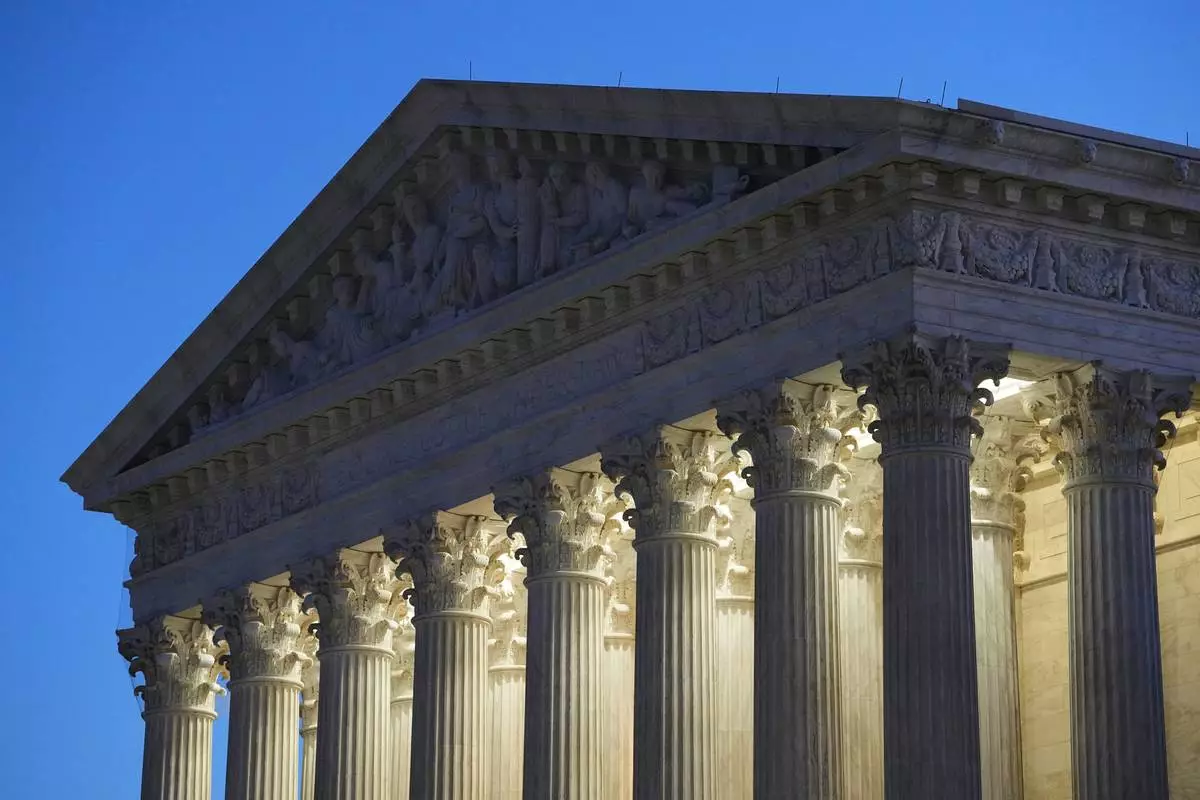
FILE - The U.S. Supreme Court is seen in Washington on Feb. 24, 2026. (AP Photo/Matt Rourke, File)
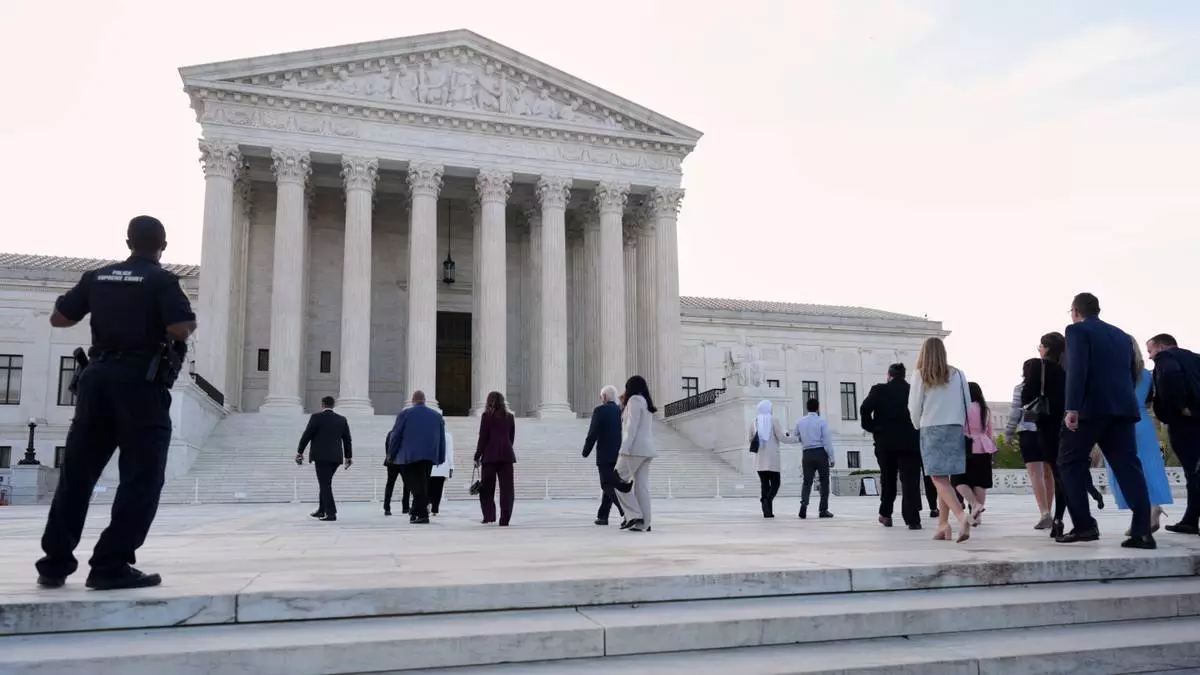
People arrive to walk inside the U.S. Supreme Court, on Capitol Hill in Washington, Wednesday, April 1, 2026. The Supreme Court justices will hear oral arguments today on whether President Donald Trump can deny citizenship to children born to parents who are in the United States illegally or temporarily. (AP Photo/J. Scott Applewhite)