DH introduces tiered and streamlined mechanism to expedite registration of proprietary Chinese medicines, helping businesses tap into global markets
The Department of Health (DH) announced today (November 20) that, starting from January 1, 2026, it will launch a pilot programme to streamline the evaluation and approval process for proprietary Chinese medicines (pCm) registration applications. Along with the existing processing procedures, two new tiers will be introduced, namely "Innovative Drugs" and "Designated Priority Products", with specified target processing times. The new arrangement aims to expedite processing of registration applications under these new tiers, and allow applicants to plan their business and resources more effectively. This initiative aligns with the policy of developing Hong Kong into an international health and medical innovation hub.
"Enterprises in Hong Kong and the Chinese Mainland holding a wholesaler or manufacturer licence in pCm, issued by the Chinese Medicines Board (CMB) under the Chinese Medicine Council of Hong Kong (CMCHK), may leverage the new mechanism to quickly bring suitable pCm products to the Hong Kong market. The DH will evaluate "Innovative Drugs" within 120 working days and submit them to the Chinese Medicines Committee (the Committee) under the CMB for approval. Furthermore, applicants may designate up to two products annually as "Designated Priority Products". The DH will complete the evaluations for these products within 150 working days and submit them to the CMB for approval. Compared to the current average processing time, which takes over 250 working days, the new mechanism will significantly accelerate the process and enable the industry to select products to test the market response, establish product positioning and use Hong Kong as a springboard to tap into global markets," the Assistant Director of Health (Chinese Medicine), Dr Edmund Fong, said.

Dr Edmund Fong, the Assistant Director of Health (Chinese Medicine), Photo source: news.gov.hk
Applicants may refer to "Frequently Asked Questions 5.B.25" on the CMCHK website for details regarding the definitions of each tier, target processing times, and requirements for supplementary documents during the approval stages.
To help the industry better understand the new mechanism, the DH has notified licensed pCm wholesalers and manufacturers via letters in mid-November. Online seminars detailing the mechanism will be held monthly from now until January next year. Interested parties may visit the CMCHK website for details.
The new mechanism will be piloted for two years. The CMB will continuously review its operation and effectiveness, making timely adjustments for optimisation.
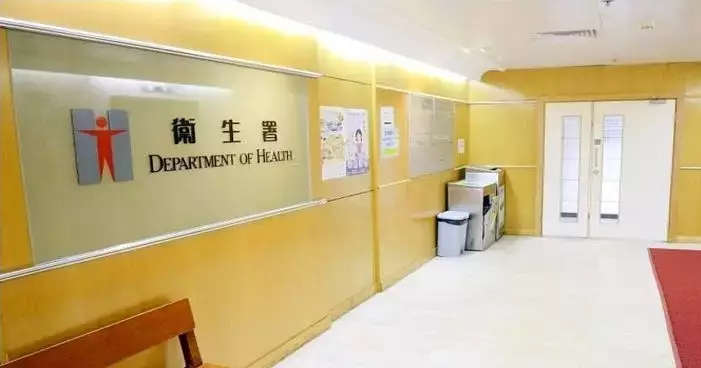
The Department of Health
Re-launch of Reporting Scheme for Unauthorised Building Works in New Territories Exempted Houses
Following the direction of earlier proposals, the Buildings Department (BD) announced today (April 1) the re-launch of the Reporting Scheme for Unauthorised Building Works (UBWs) in New Territories Exempted Houses (NTEHs). The reporting period will last for one year from April 1, 2026 to March 31, 2027.
"In view of the history and unique circumstances of the NTEHs (commonly known as village houses), the Government launched a one-off administrative reporting scheme in 2012 as a special arrangement. Under the scheme, owners could report to the BD about UBWs that were erected before June 28, 2011, posed lower risks or constituted less serious contravention of the law. The reporting period ended in December 2012. The Development Bureau (DEVB) put forward proposals to amend the Buildings Ordinance in December 2024, which included rationalising the policy for handling UBWs. The DEVB also pointed out that in response to the views of villagers and Legislative Council members that the reporting period was too short, the Government prepared to re-launch the Reporting Scheme to allow owners who at that time did not report their UBWs to do so," a spokesman for the BD said.
Relevant stakeholders and Legislative Council members generally considered the above proposals practical and feasible, and they welcomed the proposals. The DEVB and the BD have also consulted Heung Yee Kuk on the relevant implementation arrangements.
The re-launched Reporting Scheme will maintain the original criteria, including:
(1) The types of UBWs that can be reported and their erection dates are the same as the original Reporting Scheme, meaning that only UBWs erected before June 28, 2011, posed lower risks or constituted less serious contravention of the law and were not the First Round Targets (Note) are eligible. Examples include signboards projecting from the external walls of village houses; enclosed rooftop structures with a coverage of not more than 50 per cent of the roofed-over area of the main building.
(2) Same as the original Reporting Scheme, owners are required to conduct safety inspections on the reported UBWs every five years.
"The BD will not require the immediate removal of the reported UBWs unless their structures become obviously dangerous. Regarding UBWs in village houses, the BD is prioritising the handling of First Round Targets. If any relevant UBWs remain not reported after the application deadline of March 31, 2027, the BD will, after dealing with the First Round Targets, take priority enforcement action against the non-reported UBWs. The BD will formulate enforcement strategy for the reported UBWs at a later stage in accordance with the risks and the actual situation," the spokesman added.
To enhance the efficiency of processing applications, reports must be submitted via the electronic platform on the BD's website by technically competent persons or registered professional engineers appointed by owners. In accordance with the user-pays principle, an administrative fee of $600 is payable for each application. Upon successful reports, owners must also pay the relevant administrative fee when conducting safety inspections of the reported UBWs every five years.
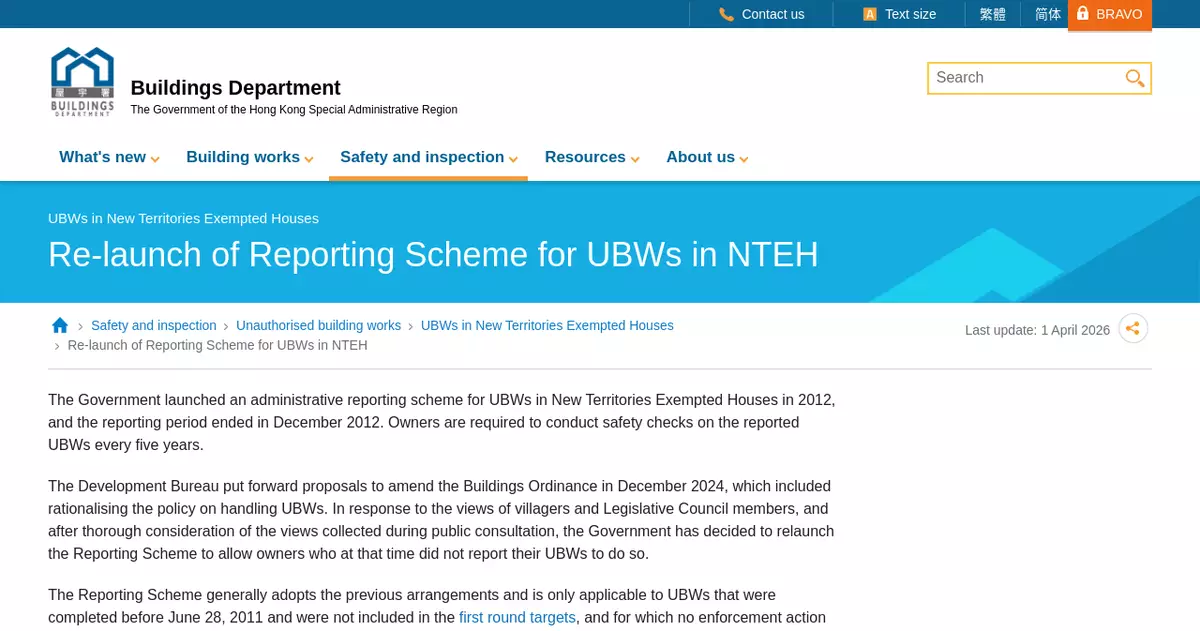
Details of the re-launched Reporting Scheme are available on the BD's website at https://www.bd.gov.hk/en/safety-inspection/ubw/UBW-in-new-territories-exempted-houses/index_relaunch_reporting_scheme.html; Villagers who wish to report can call 2626 1616 for enquiry. The BD will also use different channels such as distributing leaflets and posters to Rural Committees to enable villagers to know more about the re-launch of the Reporting Scheme.
Owners who had successfully participated in the Reporting Scheme in 2012 are not required to submit reports again. However, they must continue to comply with the requirements of the original Reporting Scheme, including conducting safety inspections of the reported UBWs every five years, submitting safety certificates and paying administrative fees to the BD.
Note: The First Round Targets refer to UBWs with higher potential risks and more serious nature, such as village houses of four storeys or more, and enclosed rooftop structures covering more than 50 per cent of the roofed-over area.
Source: AI-found images