Update on chikungunya fever
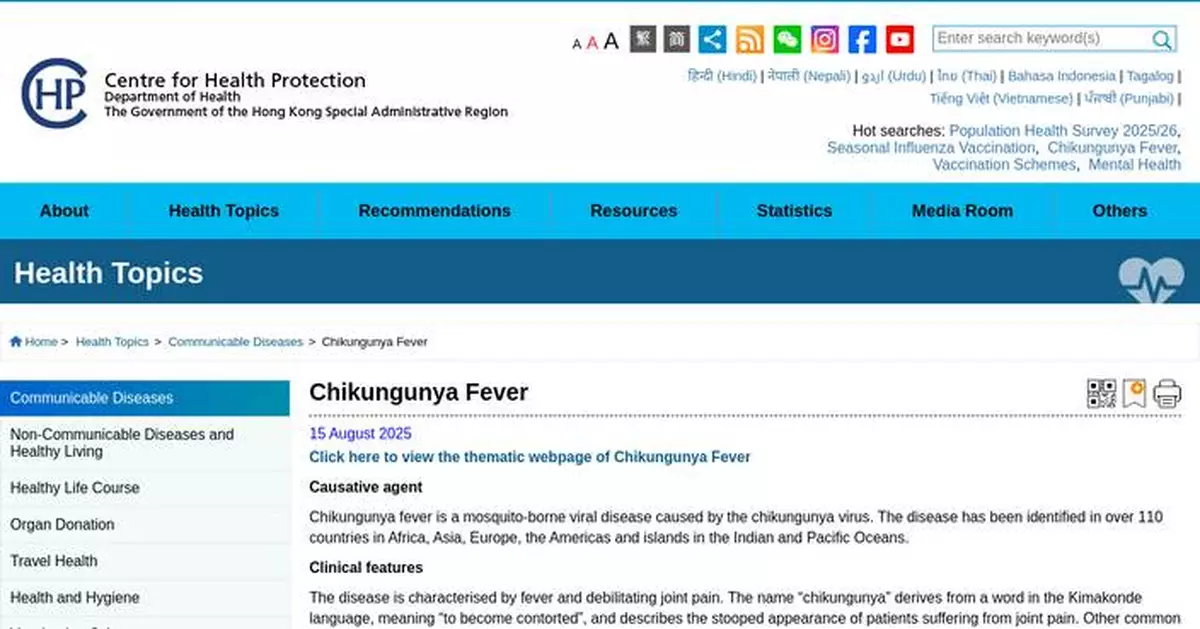
The Centre for Health Protection (CHP) of the Department of Health announced that as of 5pm today (November 20),the CHP has recorded one new imported case of chikungunya fever (CF).
Latest case information
------------------------------
The case involves a 63-year-old male living in Kwai Tsing District. A preliminary investigation revealed that he visited Shenzhen in Guangdong on October 29. He developed a fever in mid-November, and presented with joint pain and rash yesterday (November 19). He sought medical attention at the Accident and Emergency Department of Princess Margaret Hospital on the same day, and admitted for treatment in a mosquito-free environment. He is now in stable condition. His blood sample tested positive for the chikungunya virus upon laboratory testing.
The patient has one household contact, who travelled with him to Shenzhen. She is currently asymptomatic and under medical surveillance.
As the patient has visited CF-affected areas for travel about two weeks before the onset, the CHP considered that he was infected during travel. The case is classified as imported. The CHP will report the case to the health authority of Guangdong Province.
Latest surveillance data
--------------------------
Hong Kong has recorded a total of 65 confirmed CF cases this year. Among them, four were local cases, and the rest were imported cases.
Since the beginning of 2025, and as of September 30, a total of 445 271 suspected and confirmed CF cases and 155 CF-related deaths have been reported in 40 countries/territories. Cases have been reported in the Americas, Africa, Asia, and Europe. CF outbreaks currently occur in many countries worldwide. Members of the public should check the situation of the destinations before travelling abroad.
Government's comprehensive follow-up actions
-----------------------------------------------------
In light of the local case involving a 68-year-old female who lives in Tung Hei Court in Shau Kei Wan, the CHP urged the residents living in the vicinity of the patient's residence to seek medical advice or contact the CHP immediately if they presented with a fever, rash or joint pain since October 15. The CHP collaborated with the Eastern District Services & Community Care Teams to distribute leaflets on CF prevention and questionnaire surveys to about 3 000 households in the affected areas in the vicinity of Tung Hei Court to remind residents to monitor for relevant symptoms and maintain good environmental hygiene at home.
As of 5pm today, the CHP has conducted assessments for over 4 950 individuals through the health consultation booth on 2/F, Hing Tung Shopping Centre in Shau Kei Wan, its inquiry hotline (2125 2373), questionnaire surveys and door-to-door visits at Tung Hei Court. No new symptomatic persons have been identified in the past five days. Four individuals with mild symptoms previously have been arranged to undergo blood tests, and all testednegative for the chikungunya virus. The operating hours of the booth will be adjusted based on actual needs. Please refer to the CHP'swebpagefor the actual operating hours of the health consultation booth.
The Food and Environmental Hygiene Department (FEHD) and relevant departments have comprehensively enhanced the mosquito control operations in Hong Kong since July this year, and this has continued. Among these, the FEHD has conducted vector investigations and targeted mosquito control operations against the imported and local cases. In light of the local cases, the FEHD has immediately conducted follow-up actions, including:
 carrying out intensive fogging in scrubby areas within a 250-metre radius of the relevant locations to kill adult mosquitoes;
carrying out inspections of the locations, removing stagnant water, applying insecticides and disposing of abandoned water containers every week with a view to preventing mosquito breeding; and
enhancing public education efforts through organising health talks, setting up mobile education stations, and distributing publicity leaflets.
carrying out intensive fogging in scrubby areas within a 250-metre radius of the relevant locations to kill adult mosquitoes;
carrying out inspections of the locations, removing stagnant water, applying insecticides and disposing of abandoned water containers every week with a view to preventing mosquito breeding; and
enhancing public education efforts through organising health talks, setting up mobile education stations, and distributing publicity leaflets.
The abovementioned measures will be continued. Furthermore, the Government will further enhance the mosquito control efforts in addition to the existing measures.
Preventive measures to be taken by the public
----------------------------------------------------
Members of the public should use DEET-containing insect repellents or other effective active ingredients properly to prevent mosquito bites, but the following precautions should be taken when using them:
read the label instructions carefully first;
apply right before entering an area with a risk of mosquito bites;
apply on exposed skin and clothing;
use DEET of up to 30 per cent for pregnant women and up to 10 per cent for children (For children who travel to countries or areas where mosquito-borne diseases are endemic or epidemic and where exposure is likely, those aged 2 months or above can use DEET-containing insect repellents with a DEET concentration of up to 30 per cent);
apply sunscreen first, then insect repellent;
reapply only when needed and follow the instructions; and
in addition to DEET, there are other insect repellents available on the market containing different active ingredients, such as IR3535 and picaridin. When using any insect repellent, the public should follow the usage instructions and precautions on the product label.
The FEHD also appeals to members of the public to continue to stay alert and work together to carry out mosquito prevention and control measures early, including inspecting their homes and surroundings to remove potential breeding grounds, changing water in vases and scrubbing their inner surfaces, removing water in saucers under potted plants at least once a week, and properly disposing of containers such as empty cans and lunch boxes. The FEHD also advises members of the public and property management agencies to keep drains free of blockage and level all defective ground surfaces to prevent the accumulation of water. They should also scrub all drains and surface sewers with an alkaline detergent at least once a week to remove any mosquito eggs.
The public should call 1823 in case of mosquito problems, and may visit the following pages for more information: the CF page of theCHPand theTravel Health Service, the latestTravel Health News,tips for using insect repellents, and the CHPFacebook Page,Instagram AccountandYouTube Channel, and also theMosquito Prevention and Control dedicated pageof the FEHD.
Source: AI-found images
Re-launch of Reporting Scheme for Unauthorised Building Works in New Territories Exempted Houses
Following the direction of earlier proposals, the Buildings Department (BD) announced today (April 1) the re-launch of the Reporting Scheme for Unauthorised Building Works (UBWs) in New Territories Exempted Houses (NTEHs). The reporting period will last for one year from April 1, 2026 to March 31, 2027.
"In view of the history and unique circumstances of the NTEHs (commonly known as village houses), the Government launched a one-off administrative reporting scheme in 2012 as a special arrangement. Under the scheme, owners could report to the BD about UBWs that were erected before June 28, 2011, posed lower risks or constituted less serious contravention of the law. The reporting period ended in December 2012. The Development Bureau (DEVB) put forward proposals to amend the Buildings Ordinance in December 2024, which included rationalising the policy for handling UBWs. The DEVB also pointed out that in response to the views of villagers and Legislative Council members that the reporting period was too short, the Government prepared to re-launch the Reporting Scheme to allow owners who at that time did not report their UBWs to do so," a spokesman for the BD said.
Relevant stakeholders and Legislative Council members generally considered the above proposals practical and feasible, and they welcomed the proposals. The DEVB and the BD have also consulted Heung Yee Kuk on the relevant implementation arrangements.
The re-launched Reporting Scheme will maintain the original criteria, including:
(1) The types of UBWs that can be reported and their erection dates are the same as the original Reporting Scheme, meaning that only UBWs erected before June 28, 2011, posed lower risks or constituted less serious contravention of the law and were not the First Round Targets (Note) are eligible. Examples include signboards projecting from the external walls of village houses; enclosed rooftop structures with a coverage of not more than 50 per cent of the roofed-over area of the main building.
(2) Same as the original Reporting Scheme, owners are required to conduct safety inspections on the reported UBWs every five years.
"The BD will not require the immediate removal of the reported UBWs unless their structures become obviously dangerous. Regarding UBWs in village houses, the BD is prioritising the handling of First Round Targets. If any relevant UBWs remain not reported after the application deadline of March 31, 2027, the BD will, after dealing with the First Round Targets, take priority enforcement action against the non-reported UBWs. The BD will formulate enforcement strategy for the reported UBWs at a later stage in accordance with the risks and the actual situation," the spokesman added.
To enhance the efficiency of processing applications, reports must be submitted via the electronic platform on the BD's website by technically competent persons or registered professional engineers appointed by owners. In accordance with the user-pays principle, an administrative fee of $600 is payable for each application. Upon successful reports, owners must also pay the relevant administrative fee when conducting safety inspections of the reported UBWs every five years.
Details of the re-launched Reporting Scheme are available on the BD's website at https://www.bd.gov.hk/en/safety-inspection/ubw/UBW-in-new-territories-exempted-houses/index_relaunch_reporting_scheme.html; Villagers who wish to report can call 2626 1616 for enquiry. The BD will also use different channels such as distributing leaflets and posters to Rural Committees to enable villagers to know more about the re-launch of the Reporting Scheme.
Owners who had successfully participated in the Reporting Scheme in 2012 are not required to submit reports again. However, they must continue to comply with the requirements of the original Reporting Scheme, including conducting safety inspections of the reported UBWs every five years, submitting safety certificates and paying administrative fees to the BD.
Note: The First Round Targets refer to UBWs with higher potential risks and more serious nature, such as village houses of four storeys or more, and enclosed rooftop structures covering more than 50 per cent of the roofed-over area.
Source: AI-found images