
Skip to Content Facebook Feature Image

Dynano Semiconductor Establishes Headquarters in Hong Kong to Enhance Global Market Access and R&D Synergy

Business

Dynano Semiconductor Establishes Headquarters in Hong Kong to Enhance Global Market Access and R&D Synergy
Business

Business

Dynano Semiconductor Establishes Headquarters in Hong Kong to Enhance Global Market Access and R&D Synergy

2025-11-21 11:05 Last Updated At:12:52

Mainland semiconductor materials technology start-up uses Hong Kong as headquarters to scale up operations

Invest Hong Kong (InvestHK) announced today (November 21) that Dynano Semiconductor Technology Company Limited (Dynano Semiconductor) from the Mainland has officially established its foothold in Hong Kong as its headquarters. It aims to efficiently integrate the Chinese Mainland's manufacturing capacity, Hong Kong's international capital, and overseas cutting-edge technology, creating a synergistic model of "research and development (R&D) in Hong Kong, pilot production in the Greater Bay Area (GBA), and access globe markets".

Associate Director-General of Investment Promotion of InvestHK Ms Loretta Lee welcomed Dynano Semiconductor's official establishment in Hong Kong. She said, "By setting up its headquarters in Hong Kong, Dynano Semiconductor has taken a significant step in expanding their overseas operations. It also highlights Hong Kong's increasingly important role as an innovation and technology hub and international business centre. I wish them great success and hope they leverage Hong Kong to explore more overseas markets."

The Chief Technology Officer of Dynano Semiconductor, Professor Huang Mingxin, indicated that Dynano Semiconductor, as one of the first projects in the HKU Techno-Entrepreneurship Academy, has already laid a solid foundation in research. The start-up plans to leverage Hong Kong's geographic advantage to tap into European and Japanese markets, using the city as a "transformation hub" to commercialise its research results.

He said, "Hong Kong, as an international innovation hub, has a vibrant ecosystem, which is a crucial base for our development. The city offers a robust intellectual property protection system, access to global high-end industrial chain resources, and a well-established industry-academia-research mechanism that connects universities, enterprises, and markets. This helps us quickly achieve technological implementation and business scaling, bringing laboratory breakthroughs into industrial scenarios more efficiently."

He added, "Leveraging the opportunities arising from the deep industrial integration in the GBA, Dynano Semiconductor has developed a fast track of 'R&D in Hong Kong, incubation in Shenzhen'. Hong Kong will serve as our global hub for industry-academia-research resources, acting as the connector that connects the University of Hong Kong, international top-tier research institutions, and the semiconductor industry chain. It will be responsible for linking up with overseas advanced equipment suppliers and brands, ensuring that technology meets market demands."

Professor Huang also revealed that the start-up has successfully completed seed and angel rounds of funding last year. Recently, it has built a 100 000-level and 10 000-level cleanroom and introduced several high-end precision pieces of equipment. These developments lay a solid foundation for future technological research and product mass production, marking a new phase of mass production for the start-up. With a more comprehensive R&D environment and industrial capacity, Dynano will continue to focus on breakthroughs in key semiconductor technologies and its industrial applications.

For more information about Dynano Semiconductor, please visit www.dynano.com/en.

To obtain a copy of the photo, please visit www.flickr.com/photos/investhk/albums/72177720330453773.
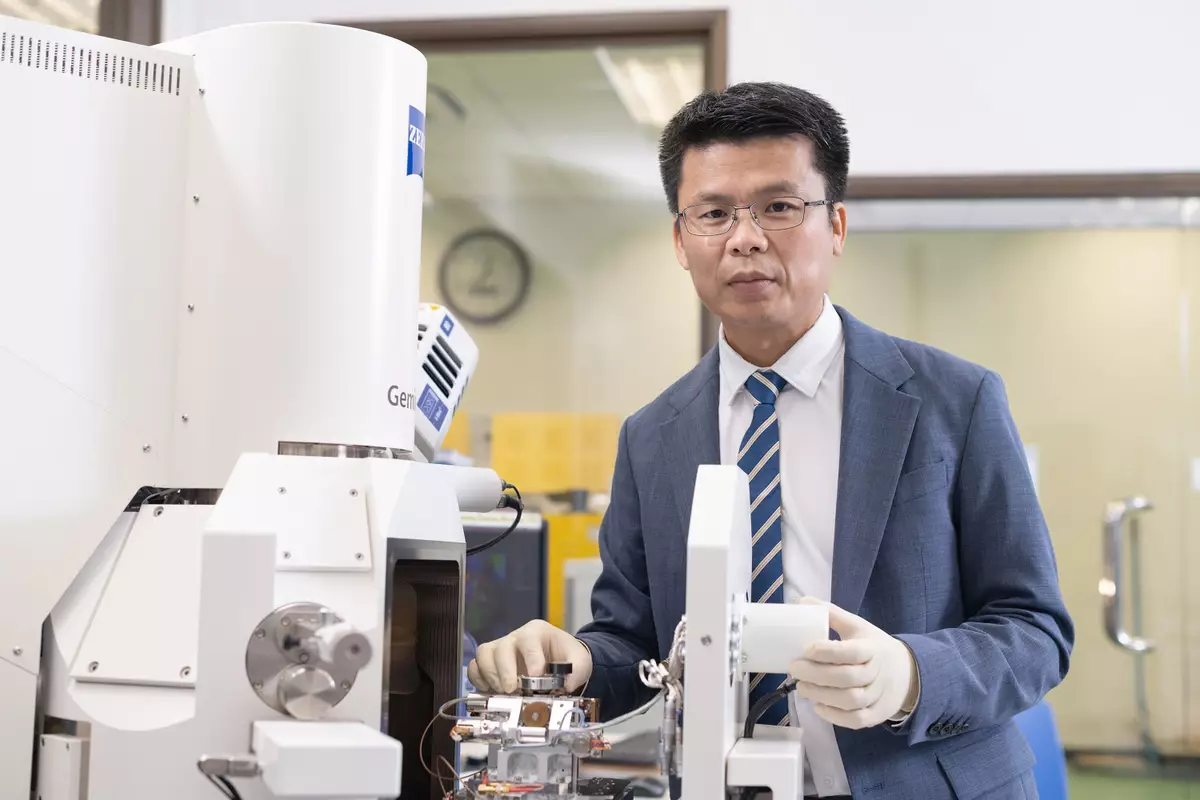
Mainland semiconductor materials technology start-up uses Hong Kong as headquarters to scale up operations  Source: HKSAR Government Press Releases

Mainland semiconductor materials technology start-up uses Hong Kong as headquarters to scale up operations Source: HKSAR Government Press Releases


Re-launch of Reporting Scheme for Unauthorised Building Works in New Territories Exempted Houses

Following the direction of earlier proposals, the Buildings Department (BD) announced today (April 1) the re-launch of the Reporting Scheme for Unauthorised Building Works (UBWs) in New Territories Exempted Houses (NTEHs). The reporting period will last for one year from April 1, 2026 to March 31, 2027.

"In view of the history and unique circumstances of the NTEHs (commonly known as village houses), the Government launched a one-off administrative reporting scheme in 2012 as a special arrangement. Under the scheme, owners could report to the BD about UBWs that were erected before June 28, 2011, posed lower risks or constituted less serious contravention of the law. The reporting period ended in December 2012. The Development Bureau (DEVB) put forward proposals to amend the Buildings Ordinance in December 2024, which included rationalising the policy for handling UBWs. The DEVB also pointed out that in response to the views of villagers and Legislative Council members that the reporting period was too short, the Government prepared to re-launch the Reporting Scheme to allow owners who at that time did not report their UBWs to do so," a spokesman for the BD said.

Relevant stakeholders and Legislative Council members generally considered the above proposals practical and feasible, and they welcomed the proposals. The DEVB and the BD have also consulted Heung Yee Kuk on the relevant implementation arrangements.

The re-launched Reporting Scheme will maintain the original criteria, including:

(1) The types of UBWs that can be reported and their erection dates are the same as the original Reporting Scheme, meaning that only UBWs erected before June 28, 2011, posed lower risks or constituted less serious contravention of the law and were not the First Round Targets (Note) are eligible. Examples include signboards projecting from the external walls of village houses; enclosed rooftop structures with a coverage of not more than 50 per cent of the roofed-over area of the main building.

(2) Same as the original Reporting Scheme, owners are required to conduct safety inspections on the reported UBWs every five years.

"The BD will not require the immediate removal of the reported UBWs unless their structures become obviously dangerous. Regarding UBWs in village houses, the BD is prioritising the handling of First Round Targets. If any relevant UBWs remain not reported after the application deadline of March 31, 2027, the BD will, after dealing with the First Round Targets, take priority enforcement action against the non-reported UBWs. The BD will formulate enforcement strategy for the reported UBWs at a later stage in accordance with the risks and the actual situation," the spokesman added.

To enhance the efficiency of processing applications, reports must be submitted via the electronic platform on the BD's website by technically competent persons or registered professional engineers appointed by owners. In accordance with the user-pays principle, an administrative fee of $600 is payable for each application. Upon successful reports, owners must also pay the relevant administrative fee when conducting safety inspections of the reported UBWs every five years.

Details of the re-launched Reporting Scheme are available on the BD's website at https://www.bd.gov.hk/en/safety-inspection/ubw/UBW-in-new-territories-exempted-houses/index_relaunch_reporting_scheme.html; Villagers who wish to report can call 2626 1616 for enquiry. The BD will also use different channels such as distributing leaflets and posters to Rural Committees to enable villagers to know more about the re-launch of the Reporting Scheme.

Owners who had successfully participated in the Reporting Scheme in 2012 are not required to submit reports again. However, they must continue to comply with the requirements of the original Reporting Scheme, including conducting safety inspections of the reported UBWs every five years, submitting safety certificates and paying administrative fees to the BD.

Note: The First Round Targets refer to UBWs with higher potential risks and more serious nature, such as village houses of four storeys or more, and enclosed rooftop structures covering more than 50 per cent of the roofed-over area.

Source: AI-found images

Source: AI-found images

Recommended Articles