COLOMBO, Sri Lanka--(BUSINESS WIRE)--Nov 21, 2025--
On 20 November 2025, the Government of Sri Lanka officially launched the National Productivity Master Plan, a five-year roadmap designed to shift the country from crisis recovery to productivity-led, export-oriented growth.
This press release features multimedia. View the full release here: https://www.businesswire.com/news/home/20251120954778/en/
Covering 2024–29, the master plan was developed by the National Productivity Secretariat and the Ministry of Industry and Entrepreneurship Development of Sri Lanka with technical support from the Asian Productivity Organization (APO), which engaged the Korea Development Institute’s Center for International Development to lead the analytical and drafting work together with the APO.
APO Secretary-General Dr. Indra Pradana Singawinata emphasized that the plan is intended to bridge Sri Lanka’s transition from short-term stabilization to long-term structural transformation: “Stabilization has begun, but transformation has not yet been secured. This National Productivity Master Plan is the bridge between short-term stabilization and long-term, self-sustaining prosperity.”
The master plan calls for targeted reforms that prioritize innovation; human capital development; modern infrastructure; smarter, more streamlined public institutions; and sector-specific strategies for key tradable industries. By investing in competitive, tradable sectors and aligning skills with opportunity, Sri Lanka can increase productivity while expanding fiscal buffers, strengthening its external position, accelerating recovery from shocks, and transforming overseas employment from necessity into choice.
The Secretary of the Ministry of Industry and Entrepreneurship Development, J. M. Thilaka Jayasundara, described the launch as “a very happy moment” for Sri Lanka’s long-standing productivity movement and emphasized Sri Lanka’s ambition to embed productivity in every part of society. She highlighted 2030 targets to raise industry’s GDP contribution to 28%, build a stronger manufacturing-based economy, and increase industrial and total export revenues to USD 28 billion and USD 45 billion, respectively.
Hon. Chathuranga Abeysinghe, Deputy Minister of Industry and Entrepreneurship Development, called the master plan “a turning point for the country” and welcomed the proposed establishment of a National Productivity Commission as a key success factor for implementation and monitoring.
Following the launch ceremony, APO Secretary-General Dr. Indra, together with the APO and Korea Development Institute delegation and National Productivity Secretariat officials, paid a courtesy call on Prime Minister Hon. Harini Amarasuriya to formally hand over the master plan and discuss practical pathways for implementation. The courtesy call reaffirmed that productivity is a matter of top-level political attention and that the master plan will be treated as a living agenda for national reform.
About the National Productivity Master Plan 2024–29
The master plan sets out a cross-governmental strategy to raise productivity and competitiveness by prioritizing innovation, skills, infrastructure, and smarter public institutions while supporting the key sectors of agriculture, fisheries, tourism, textiles and apparel, and software and ICT.
About the APO
The Asian Productivity Organization (APO) is a regional intergovernmental organization dedicated to improving productivity in the Asia-Pacific region through mutual cooperation. It is nonpolitical, nonprofit, and nondiscriminatory. Established in 1961 with eight founding members, the APO currently comprises 21 member economies: Bangladesh; Cambodia; the Republic of China; Fiji; Hong Kong; India; Indonesia; Islamic Republic of Iran; Japan; the Republic of Korea; Lao PDR; Malaysia; Mongolia; Nepal; Pakistan; the Philippines; Singapore; Sri Lanka; Thailand; Turkiye; and Vietnam.
The APO is shaping the future of the region by fostering the socioeconomic development of its members through national policy advisory services, acting as a think tank, institutional capacity-building initiatives, and knowledge sharing to increase productivity.

The National Productivity Master Plan for Sri Lanka was formally presented to the Prime Minister of Sri Lanka, Hon. Harini Amarasuriya (center), during a courtesy visit.
Launch preparations have begun for the Artemis II mission, NASA’s planned lunar fly-around by four astronauts that will be the first moon trip in 53 years.
Tensions were high as hydrogen fuel started flowing into the rocket hours ahead of the planned launch. Dangerous hydrogen leaks erupted during a countdown test earlier this year, forcing a lengthy flight delay.
The launch team needs to load more than 700,000 gallons of fuel (2.6 million liters) into the 32-story Space Launch System rocket on the pad before the Artemis II crew can board.
The 32-story Space Launch System rocket is poised to blast off Wednesday evening with a two-hour launch window beginning at 6:24 p.m. EDT at Kennedy Space Center in Florida.
Artemis astronauts Reid Wiseman, Victor Glover, Christina Koch and Jeremy Hansen will be on board. They’ll hurtle several thousand miles beyond the moon, hang a U-turn and then come straight back. No circling around the moon, no stopping for a moonwalk — just a quick out-and-back lasting less than 10 days. NASA promises more boot prints in the gray lunar dust, but not before a couple practice missions.
Unlike the Apollo missions that sent astronauts to the moonfrom 1968 through 1972, Artemis’ debut crew includes a woman, a person of color and a Canadian citizen.
Artemis II is the opening shot of NASA’s grand plans for a permanent moon base. The space program is aiming for a moon landing near the lunar south pole in 2028.
The Latest:
The wind is picking up at Cape Canaveral, more clouds are appearing and rain is expected in about two hours. But there is no lightning threat, NASA says, and there’s still an 80% chance the weather will be good enough to launch.
L-minus tracks the overall time to liftoff, counting down the days, hours and minutes away before the planned blastoff. It doesn’t include built-in holds, or pauses — that’s T-minus time.
The T-minus countdown in the final 10 minutes is where nerves tense up and hearts start pounding. Automated software kicks off a series of highly choreographed milestones. During this period, the clock can be stopped if a problem is spotted and restarted if it’s fixed in time.
T-0 is the moment of liftoff — zero — when the boosters ignite and the rocket begins its journey.
NASA has a narrow time frame each month to fly to the moon.
The Earth and moon must be aligned just so to achieve the proper trajectory for the mission. In any given month, there’s only about a week when Artemis II astronauts can lift off.
The Orion capsule needs to get a check of its life-support and other systems in near-Earth orbit. If that goes well, Orion will fire its main engine to hurtle toward the moon, taking advantage of the moon and Earth’s gravity to get there and back in a slingshot maneuver that requires little if any fuel.
Orion also needs sunlight for power and can’t be in darkness for more than 90 minutes at a time. Plus NASA wants to minimize heating during reentry at flight’s end.
The latest launch window runs through April 6. The next opportunity opens on April 30.
The hydrogen tank of the rocket’s core stage is 100% filled. NASA said no significant leaks have been observed so far in fueling. It was hydrogen leaks that prevented the rocket from flying in February.
The alarm clocks just went off in Kennedy Space Center’s crew quarters.
That means it’s rise and shine for the three Americans and one Canadian who are about to become the first lunar visitors in more than 53 years.
They have a long day ahead of them, whether they launch or not.
After breakfast, they’ll start suiting up. NASA’s launch window opens at 6:24 p.m. and lasts a full two hours.
Launch director Charlie Blackwell-Thompson is wearing green as are many of the controllers alongside her in the firing room.
Green represents “go” for NASA, a color symbolizing good luck.
The team is monitoring the fueling of the 322-foot moon rocket, set to blast off Wednesday evening.
A plush toy named Rise will ride with the Artemis II astronauts around the moon, carrying the names of more than 5.6 million people.
Rise is what’s known as a zero gravity indicator, which gives the astronauts a visual cue of when they reach space.
The design was inspired by the iconic “Earthrise” photo during Apollo 8, showing the planet as a shadowed blue marble from space in 1968.
Rise was selected from more than 2,600 contest submissions. It was designed by Lucas Ye of California.
Commander Reid Wiseman and his crew tucked a small memory card into Rise before the toy was loaded into the Orion capsule. The card bears the names of all those who signed up with NASA to vicariously tag along on the nearly 10-day journey.
“Zipping that little pocket on the bottom of Rise was kind of the moment that put it all together for me,” Wiseman said. “We are going for all and by all. It’s time to fly.”
NASA is fueling the new rocket that will send four astronauts to the moon.
Launch teams have begun pumping more than 700,000 gallons (2.6 million liters) of liquid hydrogen and liquid oxygen into the Space Launch System rocket at Kennedy Space Center in Florida.
It’s the latest milestone in the two-day countdown that kicked off on Monday when launch controllers reported to duty.
It will take at least four hours to fully load the rocket before astronauts climb aboard for humanity’s first flight to the moon since Apollo 17 in 1972.
The two-hour launch window opens at 6:24 p.m. EDT.
▶ Read more about Apollo vs. Artemis
The Americans who blazed the trail to the moon more than half a century ago were white men chosen for their military test pilot experience.
The Artemis II crew includes a woman, a person of color and a Canadian, products of a more diversified astronaut corps.
▶ Read more about Christina Koch, Victor Glover, Jeremy Hansen and Reid Wiseman
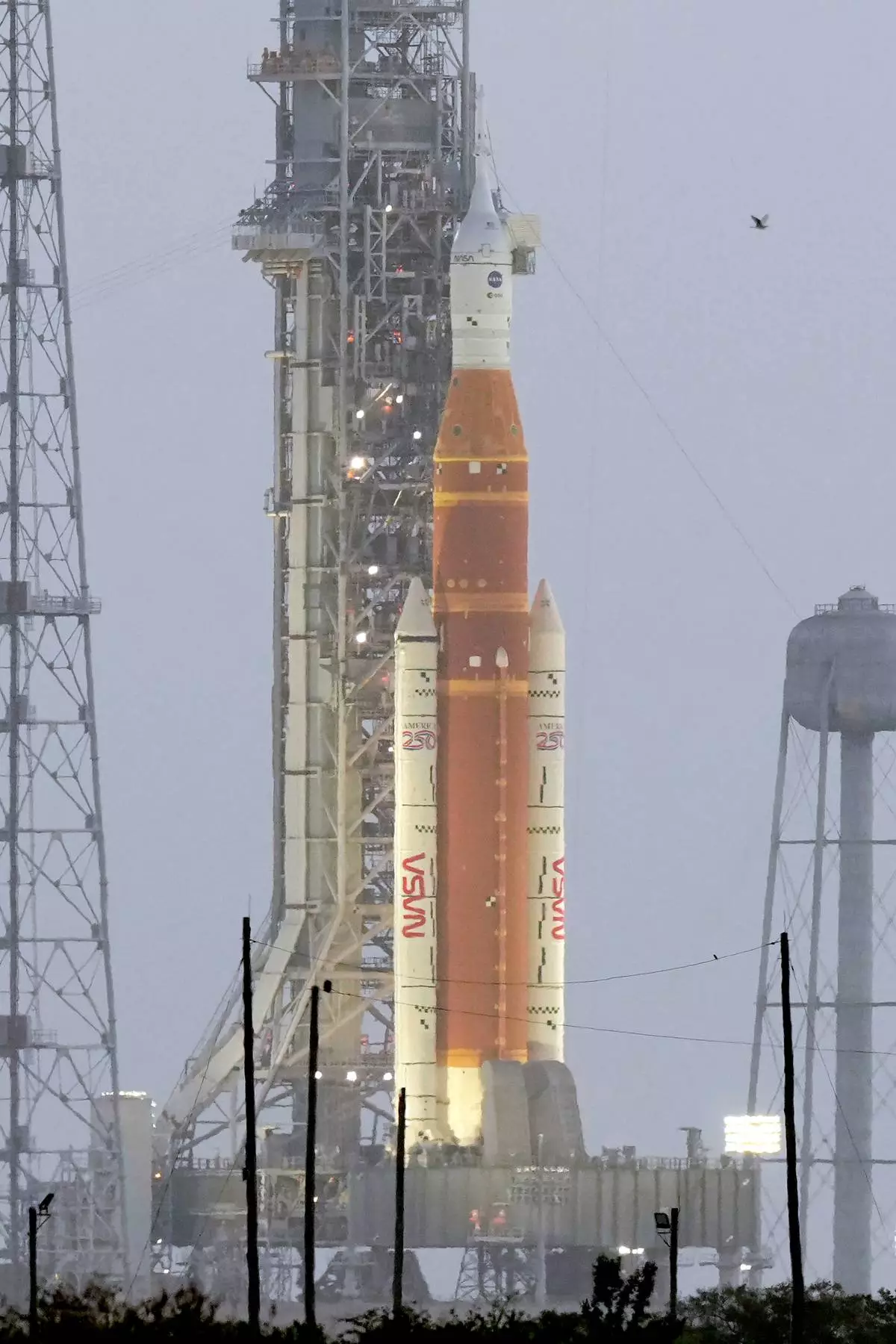
NASA's Artermis II moon rocket sits on Launch Pad 39-B at the Kennedy Space Center hours ahead of planned liftoff Wednesday, April 1, 2026, in Cape Canaveral, Fla. (AP Photo/Chris O'Meara)
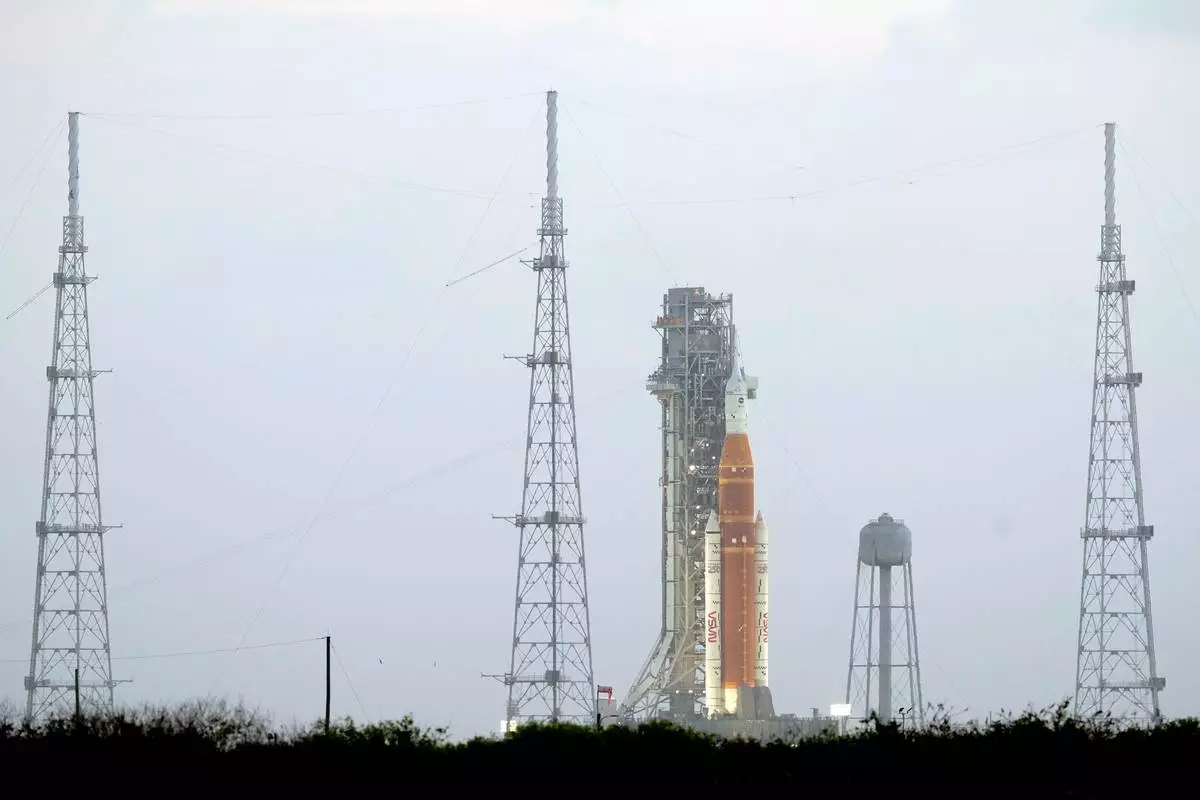
NASA's Artermis II moon rocket sits on Launch Pad 39-B at the Kennedy Space Center hours ahead of a planned launch attempt Wednesday, April 1, 2026, in Cape Canaveral, Fla. (AP Photo/Chris O'Meara)
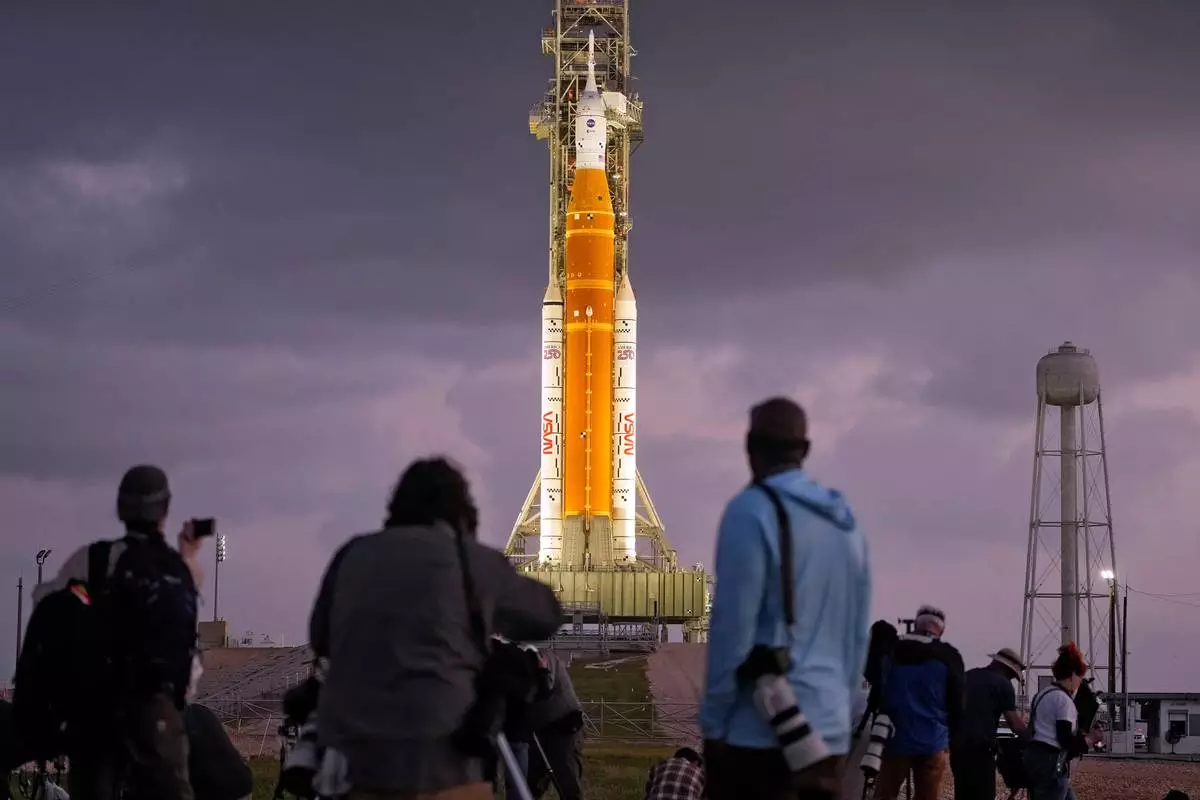
Photographers set up remote cameras near NASA's Artermis II moon rocket on Launch Pad 39-B just before sunrise at the Kennedy Space Center Tuesday, March 31, 2026, in Cape Canaveral, Fla. (AP Photo/Chris O'Meara)