Skip to Content Facebook Feature Image

US labels Maduro-tied Cartel de los Soles as a terror organization. It's not a cartel per se

News

US labels Maduro-tied Cartel de los Soles as a terror organization. It's not a cartel per se
News

News

US labels Maduro-tied Cartel de los Soles as a terror organization. It's not a cartel per se

2025-11-25 04:07 Last Updated At:04:10

CARACAS, Venezuela (AP) — President Donald Trump's administration has ramped up pressure on Venezuelan President Nicolás Maduro by designating the Cartel de los Soles as a foreign terrorist organization. But the entity that the U.S. government alleges is led by Maduro is not a cartel per se.

The designation, published Monday in the Federal Register, is the latest measure in the Trump administration's escalating campaign to combat drug trafficking into the U.S. In previewing the step about a week ago, U.S. Secretary of State Marco Rubio accused Cartel de los Soles, or Cartel of the Suns, of being “responsible for terrorist violence” in the Western Hemisphere.

The move comes as Trump evaluates whether to take military action against Venezuela, which he has not ruled out despite bringing up the possibility of talks with Maduro. Land strikes or other actions would be a major expansion of the monthslong operation that has included a massive military buildup in the Caribbean Sea and striking boats accused of trafficking drugs, killing more than 80 people.

Venezuelans began using the term Cartel de los Soles in the 1990s to refer to high-ranking military officers who had grown rich from drug-running. As corruption expanded nationwide, first under the late President Hugo Chávez and then under Maduro, its use loosely expanded to police and government officials as well as activities like illegal mining and fuel trafficking. The “suns” in the name refer to the epaulettes affixed to the uniforms of high-ranking military officers.

The umbrella term was elevated to a Maduro-led drug-trafficking organization in 2020, when the U.S. Justice Department in Trump's first term announced the indictment of Venezuela’s leader and his inner circle on narcoterrorism and other charges.

“It is not a group,” said Adam Isaacson, director for defense oversight at the Washington Office on Latin America organization. “It’s not like a group that people would ever identify themselves as members. They don’t have regular meetings. They don’t have a hierarchy.”

Maduro’s government in a statement Monday categorically denied the existence of the cartel, describing the Trump administration’s accusation as a “ridiculous fabrication” meant to “justify an illegitimate and illegal intervention against Venezuela.”

Up until this year, the label of foreign terrorist organization had been reserved for groups like the Islamic State or al-Qaida that use violence for political ends. The Trump administration applied it in February to eight Latin American criminal organizations involved in drug trafficking, migrant smuggling and other activities.

The administration blames such designated groups for operating the boats it is striking but rarely identifies the organizations and has not provided any evidence. It says the attacks , which began off the coast of Venezuela and later expanded to the eastern Pacific Ocean, are meant to stop narcotics from flowing to American cities.

But many — including Maduro himself — see the military moves as an effort to end the ruling party's 26-year hold on power.

Since the arrival of U.S. military vessels and troops to the Caribbean months ago, Venezuela’s U.S.-backed political opposition also has reignited its perennial promise of removing Maduro from office, fueling speculation over the purpose of what the Trump administration has called a counterdrug operation.

Trump, like his predecessor, does not recognize Maduro as Venezuela's leader.

Maduro is on his third term after ruling-party loyalists declared him the winner of last year's presidential election despite credible evidence that the opposition's candidate defeated him by a more than 2-to-1 margin. He and senior officials have been repeatedly accused of human rights violations against real and perceived government opponents, including in the aftermath of the July 2024 election.

U.S. Defense Secretary Pete Hegseth said last week that the designation of Cartel de los Soles will provide a “whole bunch of new options to the United States” for dealing with Maduro. But Hegseth, speaking in an interview with conservative news outlet OAN, did not provide details on what those options are and declined to say whether the U.S. military planned to strike land targets inside Venezuela.

“So nothing is off the table, but nothing’s automatically on the table,” he said.

Trump administration officials have signaled that they find it difficult to see a situation in which Maduro remaining in power could be an acceptable endgame. But as Trump considers an array of military and non-military options, including covert action by the CIA, for next steps, there is strong belief inside the administration that Maduro’s rule “is not sustainable,” according to a senior administration official who was not authorized to comment publicly on the sensitive matter.

The official added that Trump has been keenly listening to his intelligence team, which has reported to him that chatter picked up inside Venezuela indicates growing anxiety from Maduro and other high-level Venezuelan officials as the U.S. strikes continue. Trump, the official said, is “very content and satisfied” for the moment with the strikes' impact.

All the while, pleas from Maduro and others close to the Venezuelan leader to speak directly to the administration, relayed through various intermediaries and channels, seem to be more frantic, the official said. But Trump has not sanctioned any intermediaries to speak to Maduro on behalf of the U.S. administration.

Meanwhile, Gen. Dan Caine, the chairman of the Joint Chiefs of Staff, was visiting American troops Monday in Puerto Rico and on a Navy warship in the region.

The 2020 U.S. indictment accused Maduro, Interior Minister Diosdado Cabello and Defense Minister Vladimir Padrino López, among others, of conspiring with Colombian rebels and members of the Venezuelan military for several years “to flood the United States with cocaine” and use the drug trade as a “weapon against America.” Colombia is the world's top cocaine producer.

Before laying down weapons as part of a 2016 peace deal, members of the Revolutionary Armed Forces of Colombia, or FARC, regularly used the porous border region with Venezuela as a haven and hub for U.S.-bound cocaine shipments — often with the support or at least consent of Venezuelan security forces. Dissidents continued the work. Colombia's National Liberation Army guerrilla is also involved in the illegal trade.

Maduro has denied the charges. The U.S. Justice Department this year doubled to $50 million the reward for information that leads to his arrest.

Maduro has insisted that the U.S. is building a false drug-trafficking narrative to try to force him out. He and other government officials have repeatedly cited a United Nations report that they say shows traffickers attempt to move only 5% of the cocaine produced in Colombia through Venezuela.

The U.S. Treasury Department imposed sanctions on the Cartel de los Soles in July, saying Maduro and his top allies had bent the power of the Venezuelan government, military and intelligence services to assist the cartel in trafficking narcotics to the U.S.

U.S. authorities also alleged Maduro’s cartel gave material support to the Venezuelan gang Tren de Aragua and the Sinaloa cartel, both of which were among the organizations that the U.S. designated as foreign terror organizations in February.

Associated Press writer Aamer Madhani in Washington contributed to this report.
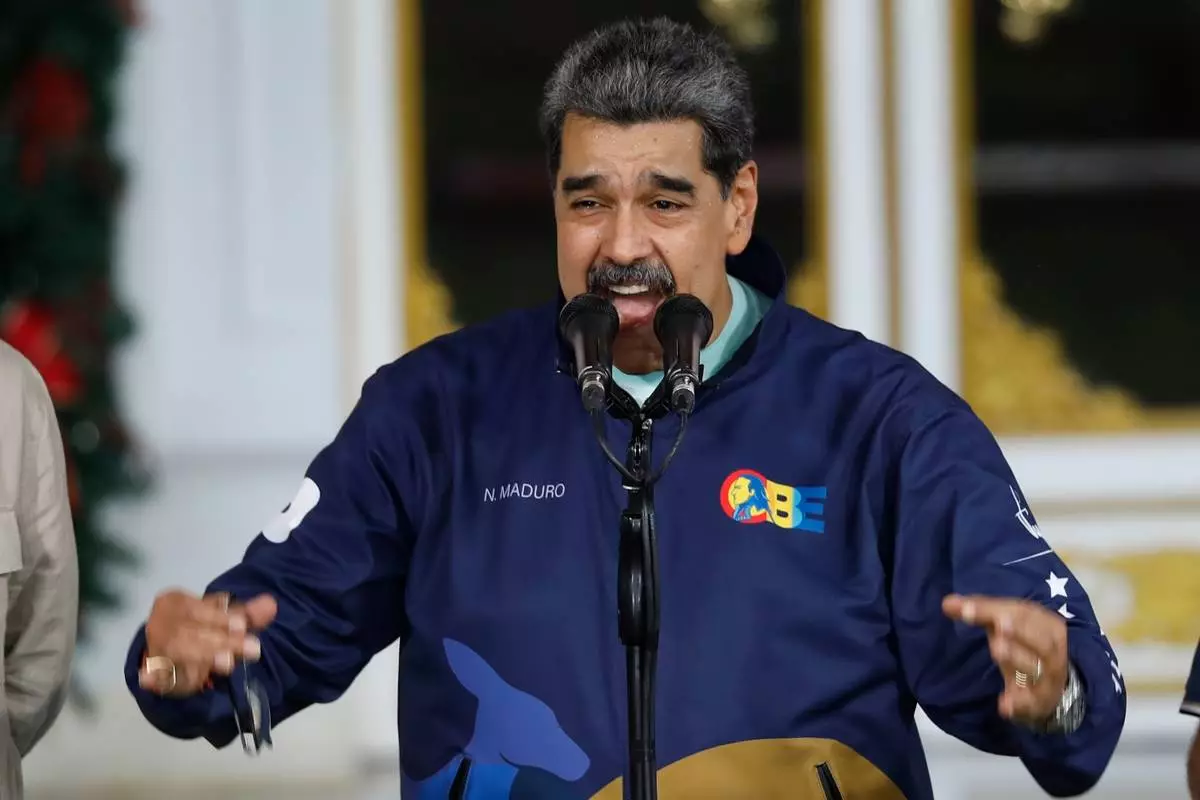
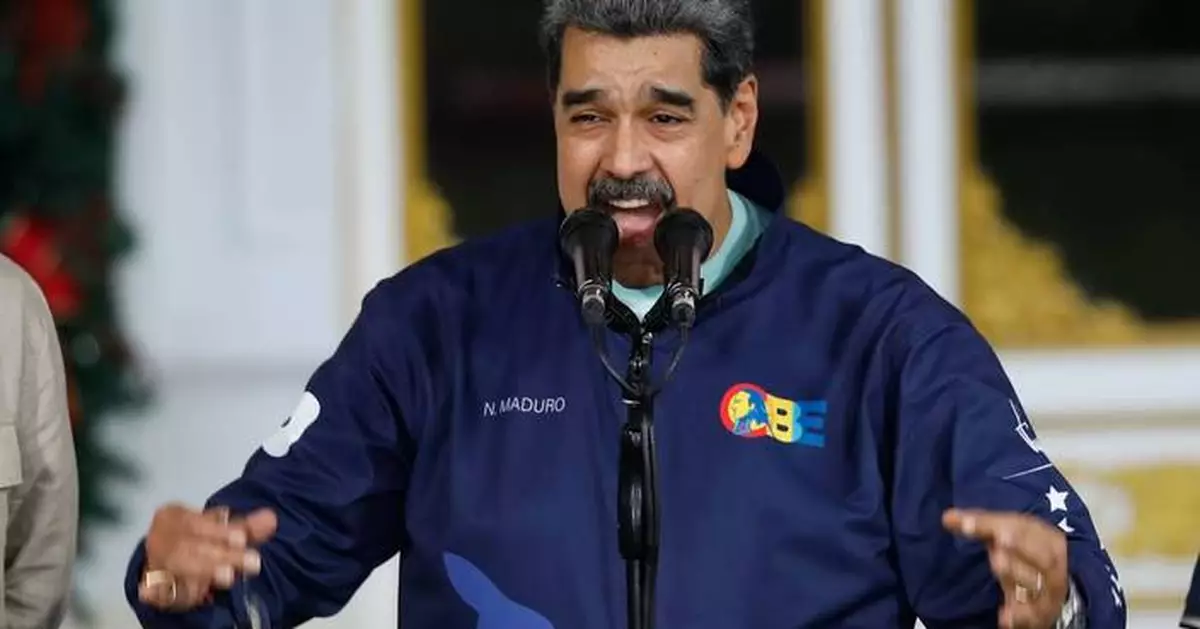
Venezuelan President Nicolas speaks during a Student Day event at the Miraflores presidential palace in Caracas, Venezuela, Friday, Nov. 21, 2025. (AP Photo/Cristian Hernandez)

Venezuelan President Nicolas speaks during a Student Day event at the Miraflores presidential palace in Caracas, Venezuela, Friday, Nov. 21, 2025. (AP Photo/Cristian Hernandez)
NASA's launch team has loaded more than 700,000 gallons of fuel into the 32-story Space Launch System rocket, setting the stage for the Artemis II mission crew members to board.

The mission is NASA’s planned lunar fly-around by four astronauts that will be the first moon trip in 53 years.

The Space Launch System rocket is poised to blast off Wednesday evening with a two-hour launch window beginning at 6:24 p.m. EDT at Kennedy Space Center in Florida.

Artemis astronauts Reid Wiseman, Victor Glover, Christina Koch and Jeremy Hansen will be on board. They’ll hurtle several thousand miles beyond the moon, hang a U-turn and then come straight back. No circling around the moon, no stopping for a moonwalk — just a quick out-and-back lasting less than 10 days. NASA promises more boot prints in the gray lunar dust, but not before a couple practice missions.

Unlike the Apollo missions that sent astronauts to the moonfrom 1968 through 1972, Artemis’ debut crew includes a woman, a person of color and a Canadian citizen.

Artemis II is the opening shot of NASA’s grand plans for a permanent moon base. The space program is aiming for a moon landing near the lunar south pole in 2028.

The Latest:

Wiseman, Glover, Koch and Hansen have left the Neil Armstrong Operations and Checkout Building and are on their way to launch pad 39B.

Waving to family, colleagues and news photographers, the crew boarded the so-called astrovan for the 9-mile ride to the launch pad and their awaiting SLS rocket.

Before their highly anticipated walkout, commander Reid Wiseman and his crew played a quick card game with NASA’s chief astronaut Scott Tingle. It’s a preflight tradition since the space shuttle era.

Losing is good: It means the astronaut has gotten rid of all bad luck before launching.

The four thanked the suit techs and posed for photos, keeping a safe distance from many of the bystanders to avoid germs. They then went down the elevator at the Neil Armstrong Operations & Checkout Building and walk out to a barrage of cameras and cheers.

They’ll take a custom-designed astrovan for the ride to the launch pad

House Speaker Mike Johnson posted on the social media site X ahead of the planned Artemis II launch.

“Praying for the safety and success of the Artemis II crew and @NASA as they undertake a mission that will carry humanity farther into space than we have gone in over half a century. I had the privilege of hosting these courageous pioneers at the State of the Union earlier this year. Americans are watching proudly as our Golden Age reaches new heights!” Johnson wrote.

Wiseman, 50, a retired Navy captain from Baltimore, was serving as NASA’s chief astronaut when asked three years ago to lead humanity’s first lunar trip since 1972.

His wife Carroll’s death from cancer in 2020 gave him pause.

His two teenage daughters, especially the older one, had “zero interest” in him launching again after a 2014 trip to the International Space Station.

“We talked about it and I said, ’Look, of all the people on planet Earth right now, there are four people that are in a position to go fly around the moon,” he said. “I cannot say no to that opportunity.”

The next day, homemade moon cupcakes awaited him, along with his daughters’ support.

Artemis is the twin sister of Apollo in Greek mythology. They are the children of Zeus and Leto. Artemis has long been associated with the moon.

While the Artemis name builds on the Apollo program and pays homage to it, “there is no way we could be that same mission or ever hope to even be,” said NASA astronaut Christina Koch, part of the Artemis II crew.

The Apollo program was all about beating the Russians to the moon and planting the U.S. flag. NASA sent 24 astronauts to the moon between 1968 and 1972, including 12 moonwalkers. Now China is the competition.

NASA is striving for a long-term lunar presence under Artemis, with Mars to follow.

The Artemis II astronauts are now in their orange Orion spacesuits that they will wear for launch and reentry. Testing these new suits is one of the main goals of the mission.

The four are expected to emerge for their trip to the pad sometime before 2pm.

NASA created bright orange custom spacesuits for launch and reentry. Astronauts will also use them in case of a depressurization or some other emergency.

They can survive up to six days in the suits, inserting a straw into the helmet to sip water or protein shakes and relying on undergarment bags and bladders as a built-in toilet.

Future Artemis crews to the lunar surface will wear white moonwalking suits designed by Axiom Space.

During the Apollo era, astronauts wore the same white bulky spacesuits for launch and return as well as for moonwalks because there wasn’t enough storage on board for different outfits.

“We should have done Artemis 50 years ago,” said John Tribe, a propulsion engineer during the Apollo era.

The launch team has loaded more than 700,000 gallons of fuel into the 32-story Space Launch System rocket, setting the stage for the Artemis II crew to board.

The wind is picking up at Cape Canaveral, more clouds are appearing and rain is expected in about two hours. But there is no lightning threat, NASA says, and there’s still an 80% chance the weather will be good enough to launch.

L-minus tracks the overall time to liftoff, counting down the days, hours and minutes away before the planned blastoff. It doesn’t include built-in holds, or pauses — that’s T-minus time.

The T-minus countdown in the final 10 minutes is where nerves tense up and hearts start pounding. Automated software kicks off a series of highly choreographed milestones. During this period, the clock can be stopped if a problem is spotted and restarted if it’s fixed in time.

T-0 is the moment of liftoff — zero — when the boosters ignite and the rocket begins its journey.

NASA has a narrow time frame each month to fly to the moon.

The Earth and moon must be aligned just so to achieve the proper trajectory for the mission. In any given month, there’s only about a week when Artemis II astronauts can lift off.

The Orion capsule needs to get a check of its life-support and other systems in near-Earth orbit. If that goes well, Orion will fire its main engine to hurtle toward the moon, taking advantage of the moon and Earth’s gravity to get there and back in a slingshot maneuver that requires little if any fuel.

Orion also needs sunlight for power and can’t be in darkness for more than 90 minutes at a time. Plus NASA wants to minimize heating during reentry at flight’s end.

The latest launch window runs through April 6. The next opportunity opens on April 30.

The hydrogen tank of the rocket’s core stage is 100% filled. NASA said no significant leaks have been observed so far in fueling. It was hydrogen leaks that prevented the rocket from flying in February.

The alarm clocks just went off in Kennedy Space Center’s crew quarters.

That means it’s rise and shine for the three Americans and one Canadian who are about to become the first lunar visitors in more than 53 years.

They have a long day ahead of them, whether they launch or not.

After breakfast, they’ll start suiting up. NASA’s launch window opens at 6:24 p.m. and lasts a full two hours.

Launch director Charlie Blackwell-Thompson is wearing green as are many of the controllers alongside her in the firing room.

Green represents “go” for NASA, a color symbolizing good luck.

The team is monitoring the fueling of the 322-foot moon rocket, set to blast off Wednesday evening.

A plush toy named Rise will ride with the Artemis II astronauts around the moon, carrying the names of more than 5.6 million people.

Rise is what’s known as a zero gravity indicator, which gives the astronauts a visual cue of when they reach space.

The design was inspired by the iconic “Earthrise” photo during Apollo 8, showing the planet as a shadowed blue marble from space in 1968.

Rise was selected from more than 2,600 contest submissions. It was designed by Lucas Ye of California.

Commander Reid Wiseman and his crew tucked a small memory card into Rise before the toy was loaded into the Orion capsule. The card bears the names of all those who signed up with NASA to vicariously tag along on the nearly 10-day journey.

“Zipping that little pocket on the bottom of Rise was kind of the moment that put it all together for me,” Wiseman said. “We are going for all and by all. It’s time to fly.”

NASA is fueling the new rocket that will send four astronauts to the moon.

Launch teams have begun pumping more than 700,000 gallons (2.6 million liters) of liquid hydrogen and liquid oxygen into the Space Launch System rocket at Kennedy Space Center in Florida.

It’s the latest milestone in the two-day countdown that kicked off on Monday when launch controllers reported to duty.

It will take at least four hours to fully load the rocket before astronauts climb aboard for humanity’s first flight to the moon since Apollo 17 in 1972.

The two-hour launch window opens at 6:24 p.m. EDT.

▶ Read more about Apollo vs. Artemis

The Americans who blazed the trail to the moon more than half a century ago were white men chosen for their military test pilot experience.

The Artemis II crew includes a woman, a person of color and a Canadian, products of a more diversified astronaut corps.

▶ Read more about Christina Koch, Victor Glover, Jeremy Hansen and Reid Wiseman

NASA's Artermis II moon rocket sits on Launch Pad 39-B at the Kennedy Space Center hours ahead of planned liftoff Wednesday, April 1, 2026, in Cape Canaveral, Fla. (AP Photo/Chris O'Meara)

NASA's Artermis II moon rocket sits on Launch Pad 39-B at the Kennedy Space Center hours ahead of planned liftoff Wednesday, April 1, 2026, in Cape Canaveral, Fla. (AP Photo/Chris O'Meara)

NASA's Artermis II moon rocket sits on Launch Pad 39-B at the Kennedy Space Center hours ahead of a planned launch attempt Wednesday, April 1, 2026, in Cape Canaveral, Fla. (AP Photo/Chris O'Meara)

NASA's Artermis II moon rocket sits on Launch Pad 39-B at the Kennedy Space Center hours ahead of a planned launch attempt Wednesday, April 1, 2026, in Cape Canaveral, Fla. (AP Photo/Chris O'Meara)

Photographers set up remote cameras near NASA's Artermis II moon rocket on Launch Pad 39-B just before sunrise at the Kennedy Space Center Tuesday, March 31, 2026, in Cape Canaveral, Fla. (AP Photo/Chris O'Meara)

Photographers set up remote cameras near NASA's Artermis II moon rocket on Launch Pad 39-B just before sunrise at the Kennedy Space Center Tuesday, March 31, 2026, in Cape Canaveral, Fla. (AP Photo/Chris O'Meara)

Recommended Articles