
OAKLAND, Calif.--(BUSINESS WIRE)--Nov 24, 2025--
After a year of look-alike copilots and endless brittle workflow automations, Oakland-based Teammates is launching with a new vision for AI at work. Instead of following the standard playbook of “faster, cheaper, and more efficient” the company is betting that what people really want are virtual colleagues that feel human: collaborative, intuitive, and most notably, remarkably fun to have around.
This press release features multimedia. View the full release here: https://www.businesswire.com/news/home/20251124075393/en/
Teammates’ virtual employees operate less like software tools and more like members of the team. There are no drag and drop flow charts or complicated workflow generators. Instead, Teammates hang out in Slack and Teams just like any remote employee. They get company email addresses, LinkedIn profiles, Salesforce and GitHub accounts, and they operate thousands of applications across all the departments in an organization.
They’re smart, capable, and delightful enough to make you forget they’re made of code.
Founded in 2024 by CEO Ben Stein and CTO Kenneth Hoxworth, and backed by Matrix Partners, Teammates brings decades of experience in scaling human-centric technology. As former Twilio product leaders, Stein and Hoxworth helped grow the company’s text messaging business from $5 million to more than $500 million in revenue. Stein also co-founded QuitCarbon and Mobile Commons (acquired in 2014), where he proved that the key to digital engagement isn’t more technology—it’s understanding human behavior.
Teammates is built around four principles that redefine how AI and humans work together:
"For the past 30 years, people have learned to work with software,” says Stein. “Teammates represents the moment software learned to work with us. They’re not replacing humans, they’re joining them and making every day work better, more productive, and honestly, more enjoyable.”
Teammates is now inviting users to design their first virtual colleague for free at teammates.work
About Teammates
Teammates is the end-to-end platform for companies to design and manage a virtual workforce. We’re pioneering a new type of virtual AI employee – fun, intuitive and able to join your team to help you get your work done right. Learn more at teammates.work.
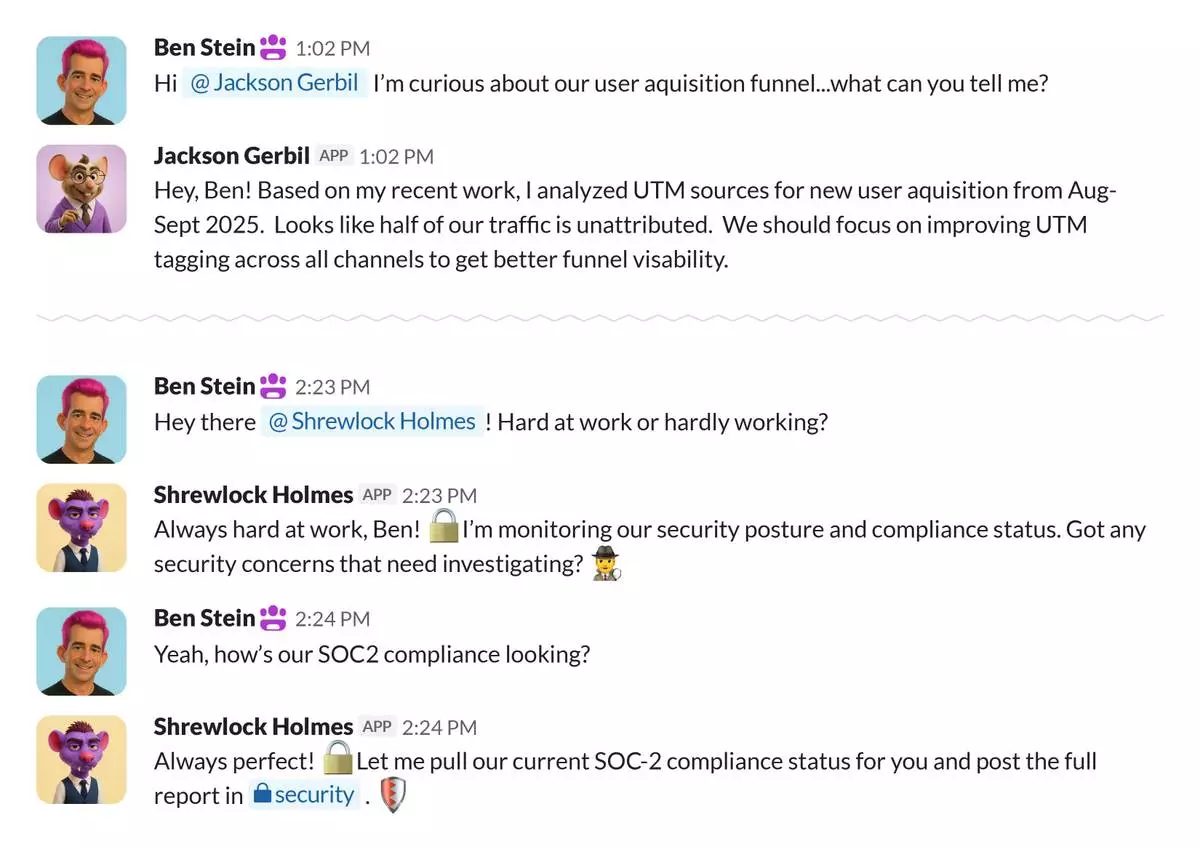
Teammates hang out in Slack and Teams, get company email addresses and operate thousands of applications just like any remote employee.

Teammates' endlessly customizable looks and personalities make them feel less like software tools and more like members of the team.

The death of a nearly blind refugee from Myanmar who was found on a Buffalo street in February — five days after Border Patrol agents left him at a doughnut shop — has been ruled a homicide, authorities said Wednesday.
The Erie County Medical Examiner's Office didn't reach any conclusions about responsibility for Nurul Amin Shah Alam's death, which the agency said was caused by complications of a perforated duodenal ulcer, precipitated by hypothermia and dehydration. Ruling a death a homicide means it resulted from another person's actions — or inaction — but doesn't necessarily mean that a crime was committed.
“This should not have happened,” Erie County Executive Mark Poloncarz, a Democrat, said at a news conference Wednesday. Asked whether the Border Patrol was responsible for his death, he declined to comment and said any such determination would be up to law enforcement agencies.
State Attorney General Letitia James and Erie County District Attorney Mike Keane, both Democrats, noted Wednesday that their offices have been reviewing the case. Keane said in a statement that his office had requested Shah Alam's full autopsy report but “it would be inappropriate” to comment further.
U.S. Customs and Border Protection pointed Wednesday to its previous statement that Shah Alam “showed no signs of distress, mobility issues, or disabilities requiring special assistance” when agents dropped him off Feb. 19 at a Tim Hortons restaurant.
“This death had NOTHING to do” with Border Patrol, its parent agency, the Department of Homeland Security, said in a Feb. 27 social media post, decrying news coverage of the case as an effort “to demonize our law enforcement.”
Immigrant advocates called Wednesday for justice for Shah Alam, a member of the Muslim Rohingya ethnic minority. The group has faced discrimination and oppression in Buddhist-majority Myanmar.
Shah Alam sought safety in the U.S. and “instead, he was left to die in the street,” New York Immigration Coalition President Murad Awawdeh said, calling for a criminal investigation into the Border Patrol agents’ conduct: “Every single person who was involved must be held responsible.”
Gov. Kathy Hochul similarly called for accountability for everyone involved and said her aides spoke to the district attorney Wednesday afternoon. Hochul, a Democrat and Buffalo native, lambasted “the cruelty and inhumanity” of depositing a man who could barely see, or speak English, outside a then-closed restaurant.
Customs and Border Protection has said the restaurant was chosen as “a warm, safe location” near Shah Alam’s last known address.
Many details about the man's health and final days aren't publicly known, as his autopsy report is confidential under New York law.
But Erie County Health Commissioner Gale Burstein told reporters that Shah Alam developed what is commonly known as a stress ulcer, brought on in his case by dehydration and exposure to the cold. The ulcer breached his intestinal wall, creating what is generally a very painful medical emergency that needs rapid treatment, she said.
Shah Alam, 56, left Myanmar many years ago for Malaysia, where he worked in construction. He came to the U.S. as a refugee with his wife and two of his children in December 2024, according to advocates for the family.
Imran Fazal, who knows the family and founded a group called the Rohingya Empowerment Community, said Shah Alam's death left people grieving and fearful.
“This tragedy was entirely preventable, and it reflects a serious failure in the systems meant to protect vulnerable people," Fazal said Wednesday.
Shah Alam spent about a year in the Erie County jail on felony assault and other charges after a 2025 struggle with police who encountered him carrying what appeared to be curtain rods. Police said he bit two officers; advocates for his family said that he hadn't understood officers’ commands to drop the items.
He eventually pleaded guilty to two lesser, misdemeanor charges and was released from jail Feb. 19. Border Patrol then briefly detained him before determining that he wasn't eligible for deportation. His family, which had been awaiting his release from jail, wasn't informed of it.
Surveillance video, obtained by the Investigative Post, showed Shah Alam treading carefully through the Tim Hortons' empty parking lot in his county-issued jail booties, pulling his hood up against the cold and walking off into the night.
Shah Alam’s lawyer ultimately reported him missing to Buffalo police on Feb. 22.
On Feb. 24, he was found dead near the downtown sports arena where the NHL’s Buffalo Sabres play. It was unclear how he got there from the Tim Hortons, several miles away, and Burstein said Wednesday that it was impossible to determine exactly when he died.
FILE - This image from body camera video provided by the Buffalo Police Department shows Nurul Amin Shah Alam, center, led by Buffalo Police officers, Feb. 15, 2025, in Buffalo, N.Y. (Buffalo Police Department via AP, File)