WASHINGTON (AP) — A coalition of nursing and other health care organizations are angry over a Trump administration plan that could limit access to student loans in some cases.
Students pursuing graduate degrees in nursing, physical therapy, public health and some other fields would face tighter federal student loan limits under the plan because it doesn't consider them professional programs.
The revamp is part of Trump’s “Big Beautiful Bill” passed by Congress.
While graduate students could previously borrow loans up to the cost of their degree, the new rules would set caps depending on whether the degree is considered a graduate or professional program.
The Education Department is defining the following fields as professional programs: pharmacy, dentistry, veterinary medicine, chiropractic, law, medicine, optometry, osteopathic medicine, podiatry and theology.
Left out are nursing, physical therapy, dental hygiene, occupational therapy and social work as well as fields outside of health care such as architecture, education, and accounting.
While the plan is still being finalized, the new student loan caps would take effect next July.
The Trump administration says limits on graduate loans are needed to reduce tuition costs. It believes that capping student loans will push universities charging higher-than-average tuition to look at lowering rates.
To define what counts as a professional program, the Education Department is turning to a 1965 law governing student financial aid. The law includes several examples of professional degrees but says it isn't an exhaustive list. The Trump administration's proposal, by contrast, says only the degrees spelled out in the new regulation can count as professional programs.
One in 6 of the nation’s registered nurses held a master’s degree as of 2022, according to the American Association of Colleges of Nursing.
The details of the plan were recently hashed out in a federal rulemaking process.
Some future students could find it more costly or difficult to pursue a specialized degree. Under the new plan, students in professional programs would be able to borrow $50,000 a year and up to $200,000 in total.
Other graduate students, such as those pursuing nursing and physical therapy, would be limited to $20,500 a year and up to $100,000 total.
The Education Department says its data show 95% of nursing students, for example, are in graduate programs that won’t be affected by the new caps. The department says the vast majority of students are in programs that cost less than the $100,000 cap being proposed for federal student loans.
Students already enrolled in graduate programs would be grandfathered into current lending limits.
A coalition of health care organizations has urged the Education Department to change course, arguing that post-bachelor’s health care degrees that are needed for licensure or certification should be considered a professional degree.
They also say that fields being excluded are largely filled by women and in high-demand. According to a U.S. Census Bureau report in 2019, women made up about three-fourths of the full-time, year-round health care workers in the U.S. and accounted for a much higher share in jobs such as dental and medical assistants.
The organizations contend that capping federal student loans will make the ongoing nursing shortage even worse, force students to seek more expensive private loans and threaten patient care.
The American Association of Colleges of Nursing says if the proposal is finalized, “the impact on our already-challenged nursing workforce would be devastating.”
Giving nurses a chance to further their education and advance their careers has attracted young people to the profession, said Susan Pratt, a nurse who is also president of a union representing nurses in Toledo, Ohio.
But making that harder could push away future nurses, she said.
“It's just a smack in the face,” Pratt said. “When we were during the pandemic, the nurses showed up, and this is the thanks we get.”
Seewer reported from Toledo, Ohio.
The Associated Press’ education coverage receives financial support from multiple private foundations. AP is solely responsible for all content. Find AP’s standards for working with philanthropies, a list of supporters and funded coverage areas at AP.org.
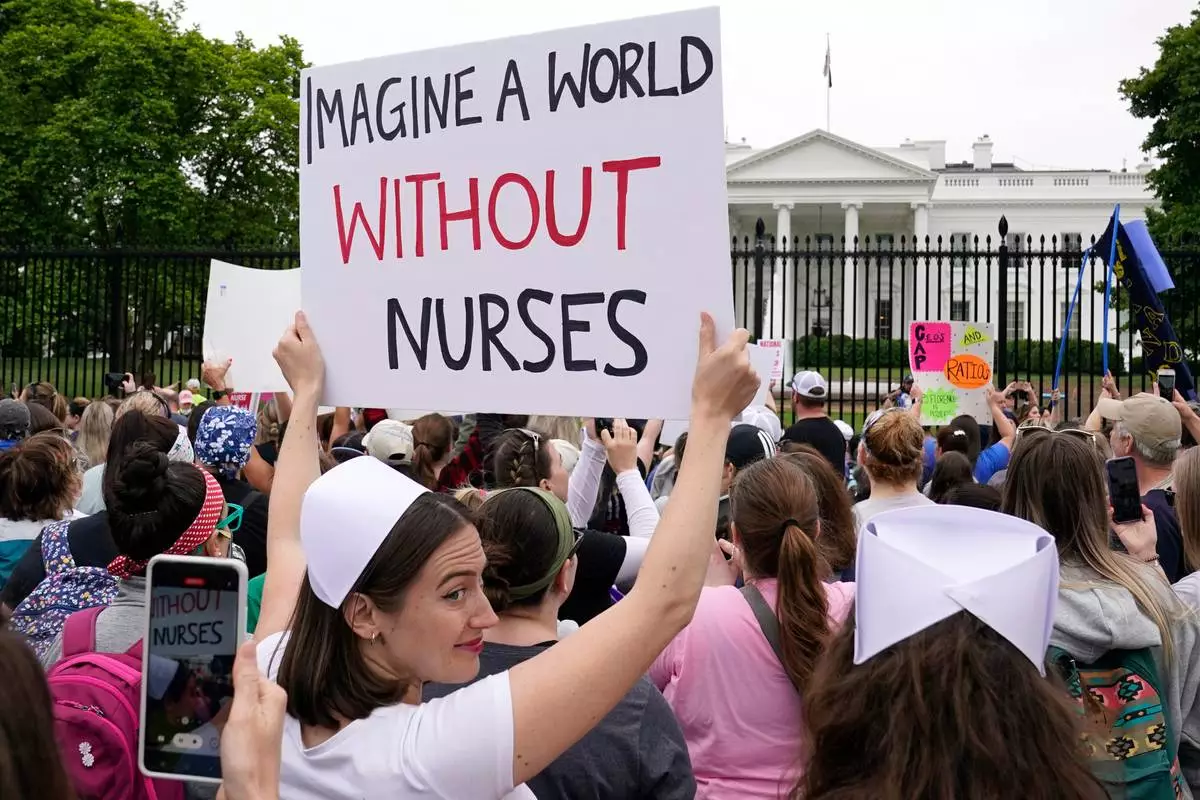
FILE - People protest outside the White House in Washington, May 12, 2022. (AP Photo/Susan Walsh)