Chinese scientists have unraveled the mystery behind the unusually cohesive lunar soil retrieved by China's Chang'e-6 mission from the far side of the moon.
The soil's sticky and clumpy characteristics -- which distinguish it from samples collected on the near side of the moon, have captivated researchers since the mission's successful completion in 2024.
This intriguing observation prompted a comprehensive investigation by a research team led by the Institute of Geology and Geophysics under the Chinese Academy of Sciences. Their findings have been published in the latest issue of Nature Astronomy.
To figure out this peculiar feature, the team carried out a series of experiments, including fixed funnel tests and drum tests -- to measure the angle of repose of the Chang'e-6 lunar soil.
This angle serves as a key indicator of the flow behavior of granular materials. Results revealed that the Chang'e-6 soil exhibited a significantly higher angle of repose compared with near-side samples, rendering its flow properties more akin to those of cohesive terrestrial soils.
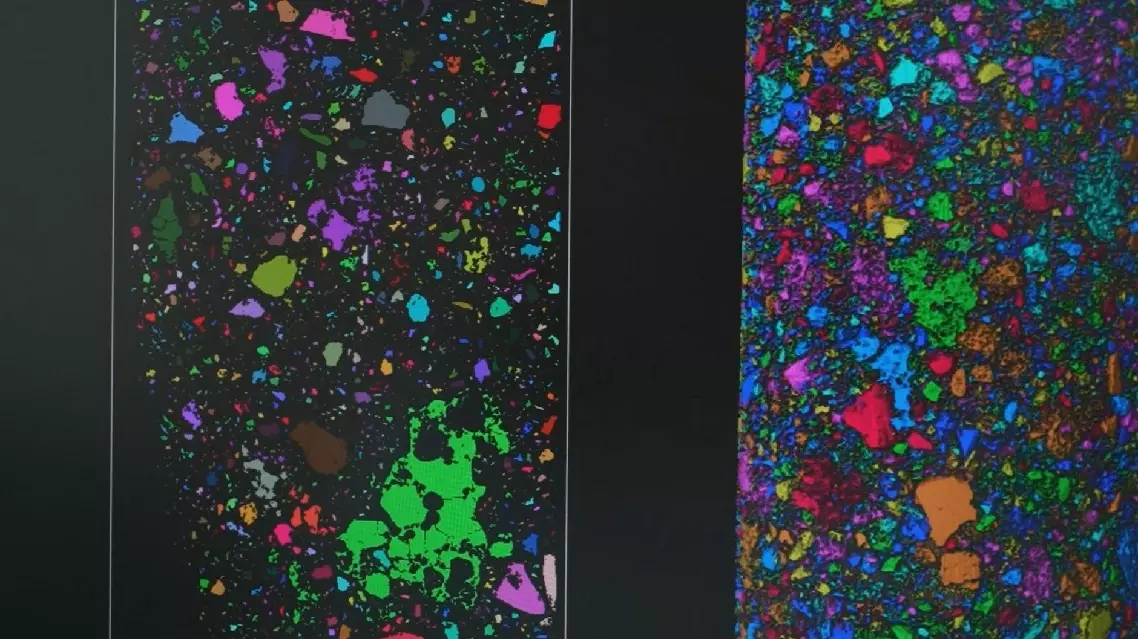
Researchers found that the soil's cohesiveness partially comes from its texture, which is finer than that on the near side of the moon. The texture of the lunar soil on the near side is similar to sand, but that of the far side is more akin to flour. A handful of sand can easily slip through fingers, whereas flour tends to clump together in the palm.
Additionally, the particles of the lunar soil sample from the far side of the moon are angular and rough. The combination of their fine yet rough characteristics amplifies the effects of forces like static electricity, resulting in the soil being unusually cohesive.
The difference between the qualities of the soil on the moon's near and far sides can be attributed to the space environment they are exposed to.
The far side is more frequently and severely hit by meteorites, and the plagioclase minerals, which constitute mountains on the far side, can easily generate a multitude of fine and angular particles upon impact.
Unlike the near side of the moon, the far side is not shielded by the Earth's magnetic field, resulting in its full exposure to a harsher space environment where there are frequent hits from charged particles, meteoroids, and micro-meteoroids.
These relentless clashes fully break down, melt, churn up, and mix the particles, finally creating the fine and sticky soil found on the far side.
The findings are significant for future exploration, landing, and establishment of bases on the moon's far side.
In 2024, Chang'e-6 made history by bringing 1,935.3 grams of lunar far-side samples back to Earth. These samples were collected from the South Pole-Aitken (SPA) Basin, the largest, deepest and oldest basin on the moon.
Chinese scientists decipher mystery of sticky soil on moon's far side