Skip to Content Facebook Feature Image

BP finds leak in major Pacific Northwest pipeline, resumes delivering fuel to Seattle-Tacoma airport

News

BP finds leak in major Pacific Northwest pipeline, resumes delivering fuel to Seattle-Tacoma airport
News

News

BP finds leak in major Pacific Northwest pipeline, resumes delivering fuel to Seattle-Tacoma airport

2025-11-26 06:42 Last Updated At:11:04

SEATTLE (AP) — Oil company BP has found the source of a leak in a major Pacific Northwest pipeline system, allowing it to restart the flow of jet fuel to Seattle-Tacoma International Airport on Tuesday and help avoid any major disruptions to Thanksgiving travel.

Separately, Washington state regulators announced they were fining the company $3.8 million for a 2023 spill from the same pipeline system nearby.

The 400-mile-long (644-kilometer-long) Olympic Pipeline is the backbone of the region’s system for moving gasoline, diesel, jet fuel and other petroleum products from refineries near the Canadian border to distribution terminals in the Pacific Northwest west of the Cascades, including major cities in Washington and Oregon.

BP shut the pipeline system down on Nov. 17 following intermittent shutoffs after a farmer discovered a gas sheen in a drainage ditch on a blueberry farm near Everett, north of Seattle, on Nov. 11. That prompted Washington Gov. Bob Ferguson to declare an emergency last week, lifting restrictions on how long truck drivers could work to enable them to deliver fuel to Sea-Tac by road. Oregon Gov. Tina Kotek issued a similar order Monday.

But late Monday, after excavating in an area where two pipes run alongside each other — one that carries gasoline and another that carries jet fuel — BP said it found the leak in the gasoline pipeline. That allowed it to restart the flow of fuel to the airport and to begin devising a repair plan for the gas pipeline.

Officials and BP are still assessing how much gasoline leaked. Responders have set out recovery equipment to contain and clean up the spill, and no gasoline has been observed outside the area of the response, BP said.

“It will take a couple of days to replenish fuel reserves at the airport, but early indications suggest that travel will not be impacted,” Washington Sen. Maria Cantwell said in a statement. “This is why we need strong pipeline safety oversight and better leak detection technology.”

In a letter to BP last week, Cantwell said the fact that the company didn't notice the leak before the blueberry farmer did raised serious questions about its inspection, maintenance and leak-detection capabilities.

Delta and Alaska Airlines, which had added fuel stops to some flights, said Tuesday they were resuming normal operations while continuing to truck in some fuel until the airport's reserves are replenished.

Previous shutdowns of the pipeline have prompted gas prices to spike in Washington and Oregon.

The pipeline has a lengthy history of leaks, including a 1999 fireball that killed three young people recreating along a creek in Bellingham, Washington. The accident led to an overhaul of federal pipeline regulation.

In 2023, a 25,000-gallon (95,000-liter) spill near Conway, north of Seattle, sent fuel into nearby streams and wetlands.

The state Ecology Department on Monday announced that the cause of that leak was a corroded carbon-steel nut on an assembly used to monitor the pipeline's pressure. The company's inspections failed to identify the nut as a problem, though it shouldn't have been used due to the likelihood of corrosion, the department said.

The department said it was seeking more than $4.6 million from BP for that spill — $3.8 million in fines plus $822,000 in response costs.

The company, which has until Dec. 18 to appeal, said it is reviewing the department's findings.

“As noted by the Washington Department of Ecology, our collaborative, robust response with our partners limited the affected area, reduced environmental impacts and prioritized public health,” BP said in a statement.
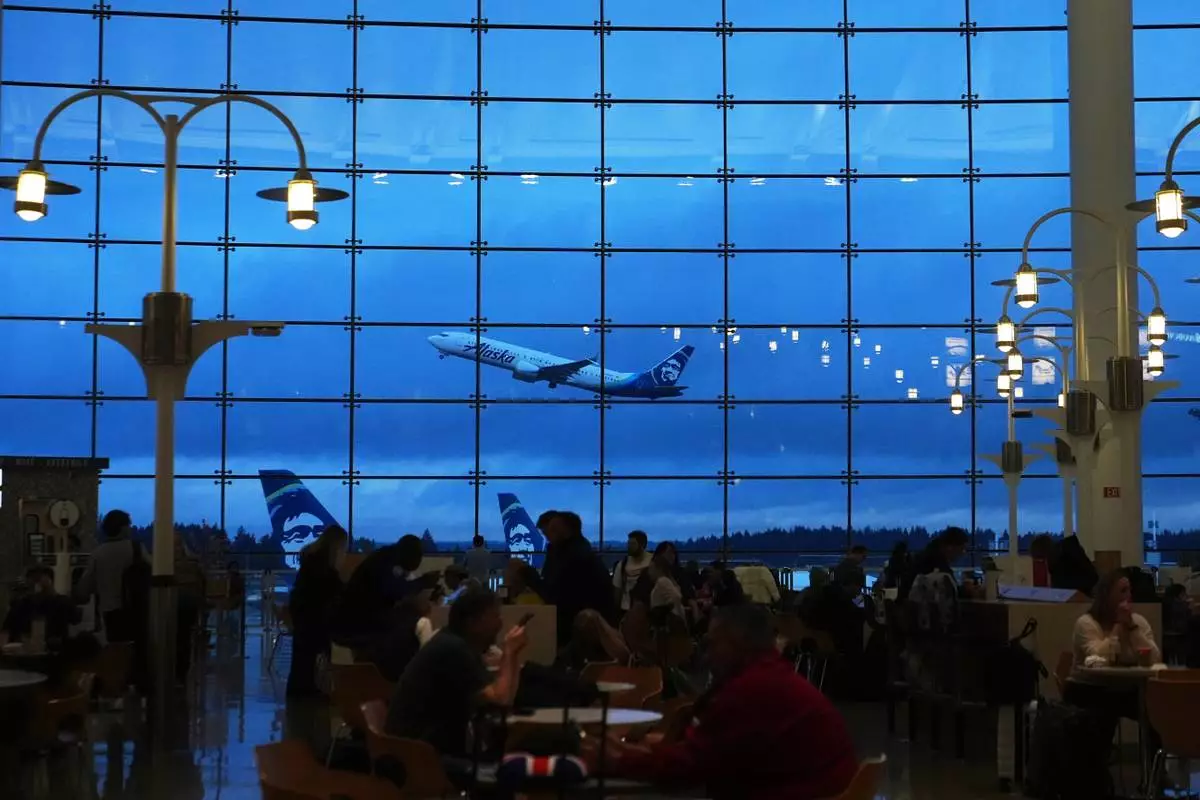
An Alaska Airlines airplane is seen from the central terminal as it takes off at Seattle-Tacoma International Airport Sunday, Nov. 23, 2025, in SeaTac, Wash. (AP Photo/Lindsey Wasson)

An Alaska Airlines airplane is seen from the central terminal as it takes off at Seattle-Tacoma International Airport Sunday, Nov. 23, 2025, in SeaTac, Wash. (AP Photo/Lindsey Wasson)

SEOUL, South Korea (AP) — Ahn Sung-ki, one of South Korean cinema’s biggest stars whose prolific 60-year career and positive, gentle public image earned him the nickname “The Nation’s Actor,” died on Monday. He was 74.

The death of Ahn, who had been fighting blood cancer for years, was announced by his agency, the Artist Company, and the Seoul-based Soonchunhyang University Hospital.

Born to a filmmaker in the southeastern city of Daegu in 1952, Ahn made his debut as a child actor in the movie “The Twilight Train” in 1957. He subsequently appeared in about 70 movies as a child actor before he left the film industry to live an ordinary life.

In 1970, Ahn entered Seoul’s Hankuk University of Foreign Studies as a Vietnamese major. Ahn said he graduated with top honors but failed to land jobs at big companies, who likely saw his Vietnamese major largely useless after a communist victory in the Vietnam War in 1975.

After spending a few years unemployed, Ahn returned to the film industry in 1977 believing he could still excel in acting. In 1980, he rose to fame for his lead role in Lee Jang-ho’s “Good, Windy Days,” a hit coming-of-age movie about the struggle of working-class men from rural areas during the country’s rapid rise. Ahn won the best new actor award in the prestigious Grand Bell Awards, the Korean version of the Academy Awards.

He later starred in a series of highly successful and critically acclaimed movies, sweeping best actor awards and becoming arguably the country’s most popular actor in much of the 1980-90s.

Some of his memorable roles included a Buddhist monk in 1981’s “Mandara,” a beggar in 1984’s “Whale Hunting,” a Vietnam War veteran-turned-novelist in 1992’s “White Badge,” a corrupt police officer in 1993’s “Two Cops,” a murderer in 1999’s “No Where To Hide,” a special forces trainer in 2003’s “Silmido” and a devoted celebrity manager in 2006’s “Radio Star.”

Ahn had collected more than 20 trophies in major movie awards in South Korea, including winning the Grand Bell Awards for best actor five times, an achievement no other South Korean actors have matched yet.

Ahn built up an image as a humble, trustworthy and family-oriented celebrity who avoided major scandals and maintained a quiet, stable personal life. Past public surveys chose Ahn as South Korea’s most beloved actor and deserving of the nickname “The Nation’s Actor.”

In interviews with local media, Ahn couldn’t choose what his favorite movie was, but said that his role as a dedicated, hardworking manger for a washed-up rock singer played by Park Jung-hoon resembled himself in real life the most.

FILE - South Korean actor Ahn Sung-ki smiles for a photo on the red carpet at the 56th Daejong Film Awards ceremony in Seoul, South Korea, June 3, 2020. (AP Photo/Ahn Young-joon, File)

FILE - South Korean actor Ahn Sung-ki smiles for a photo on the red carpet at the 56th Daejong Film Awards ceremony in Seoul, South Korea, June 3, 2020. (AP Photo/Ahn Young-joon, File)

FILE - South Korean actor Ahn Sung-ki attends an event as part of the 11th Pusan International Film Festival in Busan, South Korea, Oct. 13, 2006. (AP Photo/Kin Cheung, File)

FILE - South Korean actor Ahn Sung-ki attends an event as part of the 11th Pusan International Film Festival in Busan, South Korea, Oct. 13, 2006. (AP Photo/Kin Cheung, File)

Recommended Articles