EDB continues to provide support in wake of No. 5 alarm fire in Tai Po
Regarding the No. 5 alarm fire at Wang Fuk Court in Tai Po yesterday (November 26), the Education Bureau (EDB) today (November 27) continued to make all-out efforts to provide appropriate support for various stakeholders.
An EDB spokesman said that, as affected by the fire and obstructed traffic due to nearby road blockages, the following five schools will remain suspended tomorrow (November 28): CCC Fung Leung Kit Memorial Secondary School, Tai Po Baptist Public School, S.K.H. Yuen Chen Maun Chen Primary School, H.K. & Kowloon Kaifong Women's Association Sun Fong Chung College and Po Leung Kuk Lau Chun Kindergarten. For class suspension arrangements, parents are advised to pay attention to the latest announcements of the EDB and schools.
Regarding Primary One Discretionary Places, relevant schools have successfully contacted all affected parents today and made special arrangements for their children's registration procedures.
To assist schools in supporting students in need, the EDB has prepared a crisis management resource kit tailored for the fire incident, which includes counseling suggestions for schools and parents, special class period materials, and Q&As to help teachers and parents assist students in coping with the incident. This resource kit is available on the EDB's "School Crisis Management" webpage (www.edb.gov.hk/en/teacher/crisis-management/about-crisis-management/index.html).
Furthermore, the EDB has contacted the counsellors of the "Teachers' Helpline" (Tel: 8100 3361) for stepping up their telephone counselling and support for affected teachers and principals.
Educational psychologists and officers of the Tai Po District School Development Section of the EDB will maintain close contact with the schools and continue to provide them with necessary assistance.

The Education Bureau
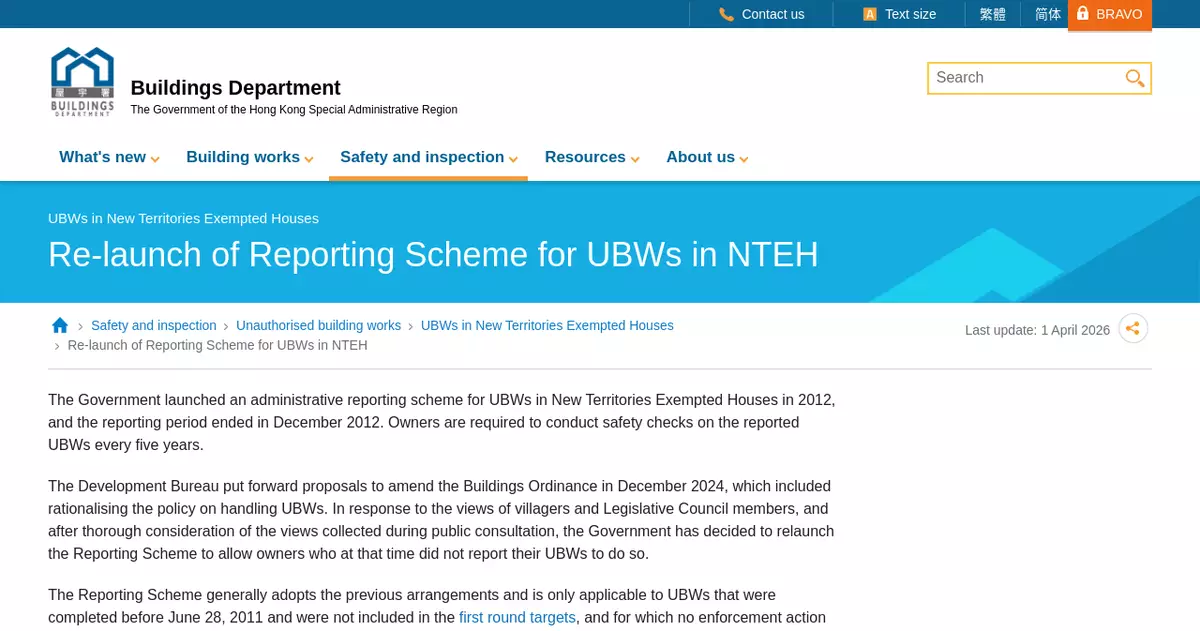
Re-launch of Reporting Scheme for Unauthorised Building Works in New Territories Exempted Houses
Following the direction of earlier proposals, the Buildings Department (BD) announced today (April 1) the re-launch of the Reporting Scheme for Unauthorised Building Works (UBWs) in New Territories Exempted Houses (NTEHs). The reporting period will last for one year from April 1, 2026 to March 31, 2027.
"In view of the history and unique circumstances of the NTEHs (commonly known as village houses), the Government launched a one-off administrative reporting scheme in 2012 as a special arrangement. Under the scheme, owners could report to the BD about UBWs that were erected before June 28, 2011, posed lower risks or constituted less serious contravention of the law. The reporting period ended in December 2012. The Development Bureau (DEVB) put forward proposals to amend the Buildings Ordinance in December 2024, which included rationalising the policy for handling UBWs. The DEVB also pointed out that in response to the views of villagers and Legislative Council members that the reporting period was too short, the Government prepared to re-launch the Reporting Scheme to allow owners who at that time did not report their UBWs to do so," a spokesman for the BD said.
Relevant stakeholders and Legislative Council members generally considered the above proposals practical and feasible, and they welcomed the proposals. The DEVB and the BD have also consulted Heung Yee Kuk on the relevant implementation arrangements.
The re-launched Reporting Scheme will maintain the original criteria, including:
(1) The types of UBWs that can be reported and their erection dates are the same as the original Reporting Scheme, meaning that only UBWs erected before June 28, 2011, posed lower risks or constituted less serious contravention of the law and were not the First Round Targets (Note) are eligible. Examples include signboards projecting from the external walls of village houses; enclosed rooftop structures with a coverage of not more than 50 per cent of the roofed-over area of the main building.
(2) Same as the original Reporting Scheme, owners are required to conduct safety inspections on the reported UBWs every five years.
"The BD will not require the immediate removal of the reported UBWs unless their structures become obviously dangerous. Regarding UBWs in village houses, the BD is prioritising the handling of First Round Targets. If any relevant UBWs remain not reported after the application deadline of March 31, 2027, the BD will, after dealing with the First Round Targets, take priority enforcement action against the non-reported UBWs. The BD will formulate enforcement strategy for the reported UBWs at a later stage in accordance with the risks and the actual situation," the spokesman added.
To enhance the efficiency of processing applications, reports must be submitted via the electronic platform on the BD's website by technically competent persons or registered professional engineers appointed by owners. In accordance with the user-pays principle, an administrative fee of $600 is payable for each application. Upon successful reports, owners must also pay the relevant administrative fee when conducting safety inspections of the reported UBWs every five years.
Details of the re-launched Reporting Scheme are available on the BD's website at https://www.bd.gov.hk/en/safety-inspection/ubw/UBW-in-new-territories-exempted-houses/index_relaunch_reporting_scheme.html; Villagers who wish to report can call 2626 1616 for enquiry. The BD will also use different channels such as distributing leaflets and posters to Rural Committees to enable villagers to know more about the re-launch of the Reporting Scheme.
Owners who had successfully participated in the Reporting Scheme in 2012 are not required to submit reports again. However, they must continue to comply with the requirements of the original Reporting Scheme, including conducting safety inspections of the reported UBWs every five years, submitting safety certificates and paying administrative fees to the BD.
Note: The First Round Targets refer to UBWs with higher potential risks and more serious nature, such as village houses of four storeys or more, and enclosed rooftop structures covering more than 50 per cent of the roofed-over area.
Source: AI-found images