Aerobatic teams from China and South Africa staged outstanding performances at the AERO Asia show, which opened Thursday in south China's Zhuhai City.
At the Zhuhai International Airshow Center, the four-day show drew over 380 companies from 22 countries and regions, showcasing the latest achievements in general aviation and low-altitude economy.
At the air show on Thursday, the South African AERO aerobatic team took the stage first, performing a four-aircraft formation maneuver with the world-class XA42 aerobatic aircraft. Through precise formation changes during dives, the pilots demonstrated their exceptional coordination and masterful aircraft control.
"We prepared a whole sequence of aerobatic maneuvers. We do loops, switch-blades, all kinds of maneuvers. I see around us a lot more types than before. Every year I come to China, there's more and more aircraft. It's very impressive," said Mark Hensman, leader of the aerobatic team and former South African aerobatic champion.
Following the South African team, veteran instructors from China's Hongxing (Red Star) aerobatic team took to the skies in four CJ-6 trainers. The timeless aircraft, still performing with razor-sharp precision, thrilled the crowds with a series of demanding aerobatic maneuvers.
"The CJ-6 is China's first aircraft with fully independent intellectual property rights. It is also a fully aerobatic aircraft with outstanding flight characteristics. Through flight demonstrations by different countries, we promote aviation culture and passion for flight," said Hu Yanchun, leader of the Hongxing aerobatic team.

Aerobatic teams stage thrilling performances at AERO Asia show
More than 1,000 coal mines in China have adopted intelligent systems, as their application expands from pilot projects to large-scale deployment, the China National Coal Association said recently.
Statistics show that by the end of 2025, a total of 1,066 coal mines nationwide have introduced smart systems, with such technologies now supporting more than 65 percent of the country's coal production capacity. The number of autonomous mining trucks in operation surpassed 4,000 units, roughly doubling on an annual basis.
The rapid adoption of smart mining is driven by robust domestic capabilities in intelligent equipment and technology. In Beijing, a newly deployed underground Internet of Things (IoT) precision positioning and management system links workers, positioning cards and operating zones, while also enabling health monitoring. Its core technologies and components are fully domestically developed and have been applied in coal mines and coal preparation plants. "This underground positioning system we've developed has a positioning deviation of less than 20 centimeters when a person or device is stationary. Even when a person or device is moving at high speeds, the margin of error remains minimal. A single device can cover a radius of 800 meters," said Wu Fengdong, general manager of China Coal Beijing Coal Mining Machinery Co., Ltd., a subsidiary of the state-owned China National Coal Group Corporation.
Since the start of the 14th Five-Year Plan period (2021–2025), cumulative investment in smart mining has exceeded 107.1 billion yuan (about 15.6 billion U.S. dollars), with intelligent technologies now widely applied, accelerating the shift from traditional mining to modern, technology-driven extraction.
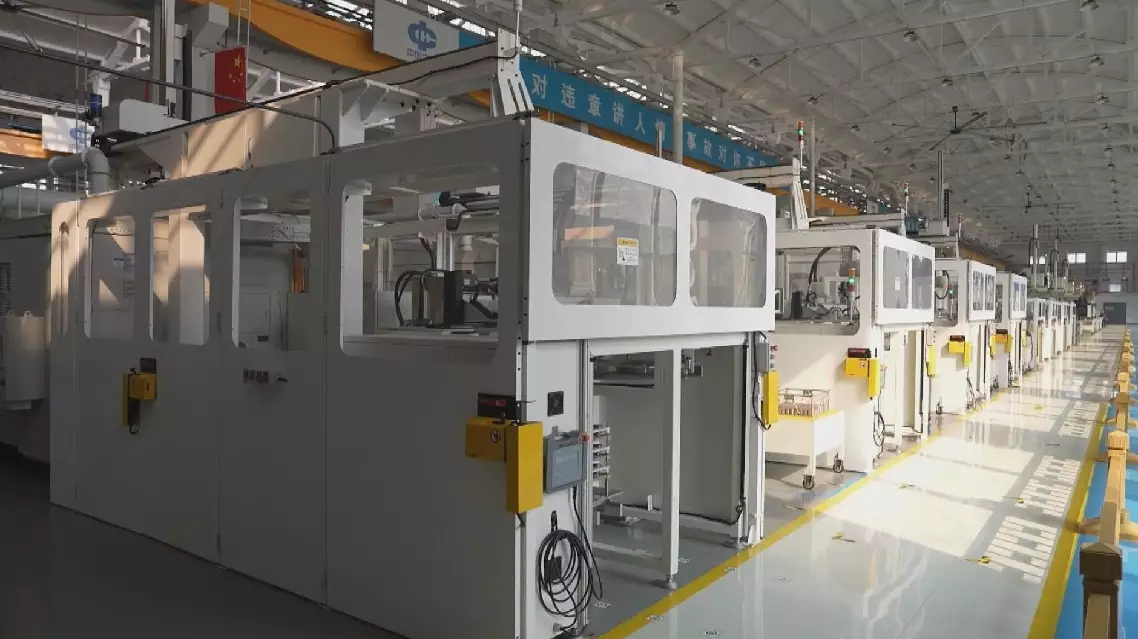
Over 60 pct of China's coal production capacity uses smart technology by end of 2025