China's advances in key 6G technological areas are accelerating its efforts toward full commercialization of the next-generational wireless communication technology by 2030, which could further reshape connectivity and drive innovation across industries.
China has completed its first phase of its 6G technology trials, yielding over 300 advances in key technological areas, the Ministry of Industry and Information Technology announced earlier this month.
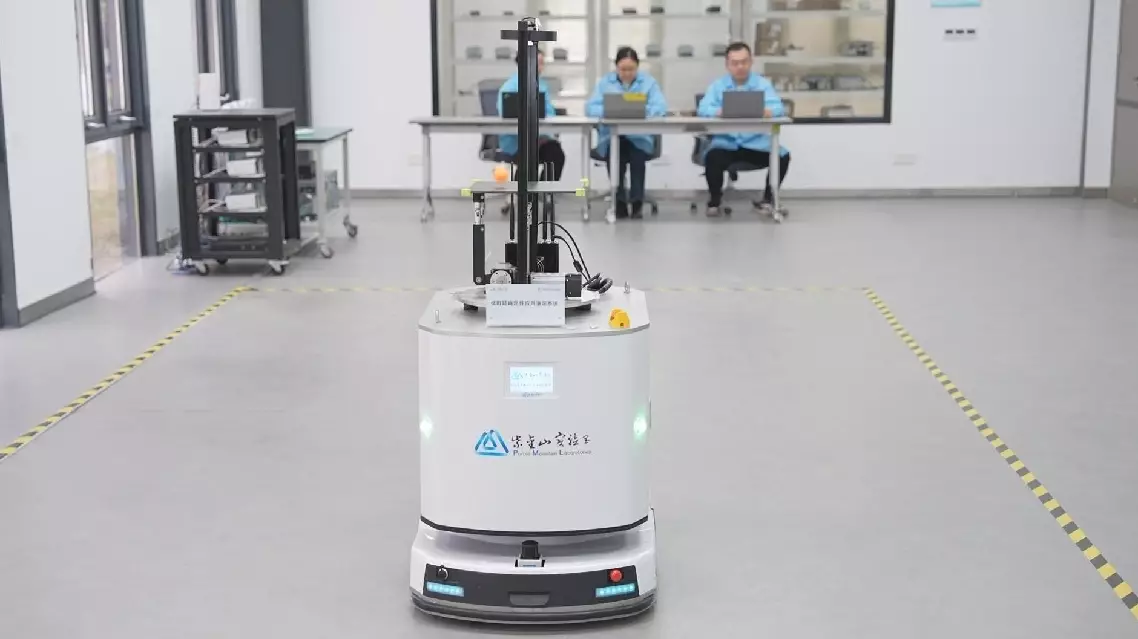
At the Purple Mountain Laboratories in Nanjiang City, east China's Jiangsu Province, a seemingly simple ping-pong ball bounce test is offering a glimpse into the future of smart factories empowered by 6G technology.
A device keeps a ping-pong ball bouncing in a precisely controlled circular trajectory, as if guided by invisible strings. It is the world's first "bounded-latency deterministic wireless access demonstration system" for 6G.
The entire bouncing process relies on real-time wireless control from a 6G network, setting extremely high requirements for latency and stability.
In future industrial settings, 6G is expected to enable microsecond-level synchronization between machines, transforming factories into highly coordinated "organic systems."
"6G will, for the first time, allow wireless networks to penetrate the most critical core production links of industrial control, replacing the most crucial and precise wired control buses. This is not only a leap forward in wireless communication technology itself, but a huge transformation of the entire industrial production model, laying the foundation for truly 'unmanned factories'," said Liu Zening, a associate researcher with the Purple Mountain Laboratories.
Looking ahead, China plans to focus on 6G standards development and industrialization during the 15th Five-Year Plan period (2026-2030), with commercial rollout anticipated around 2030.
"By 2030, we will have the capability for large-scale 6G network deployment, offering more customized, immersive and intelligent application services across all aspects of individual users' daily lives, including clothing, food, housing, transportation and work. By around 2035, large-scale commercial deployment of 6G is anticipated, potentially fostering a trillion-yuan-scale 6G industry and application ecosystem," said Du Ying, deputy director of the Institute for Wireless and Mobile Communications, China Academy of Information and Communications Technology.
China's 6G technology trials are divided into three phases: the first phase is the key technology trial stage, which defines the main technical directions of 6G; the second phase is the technical solution trial stage, which will develop 6G prototypes targeting typical scenarios and performance metrics; and the third phase advances system networking trials, which will develop pre-commercial 6G equipment and conduct testing of key 6G products.
China's advances in key 6G technological areas pave way for full commercialization around 2030