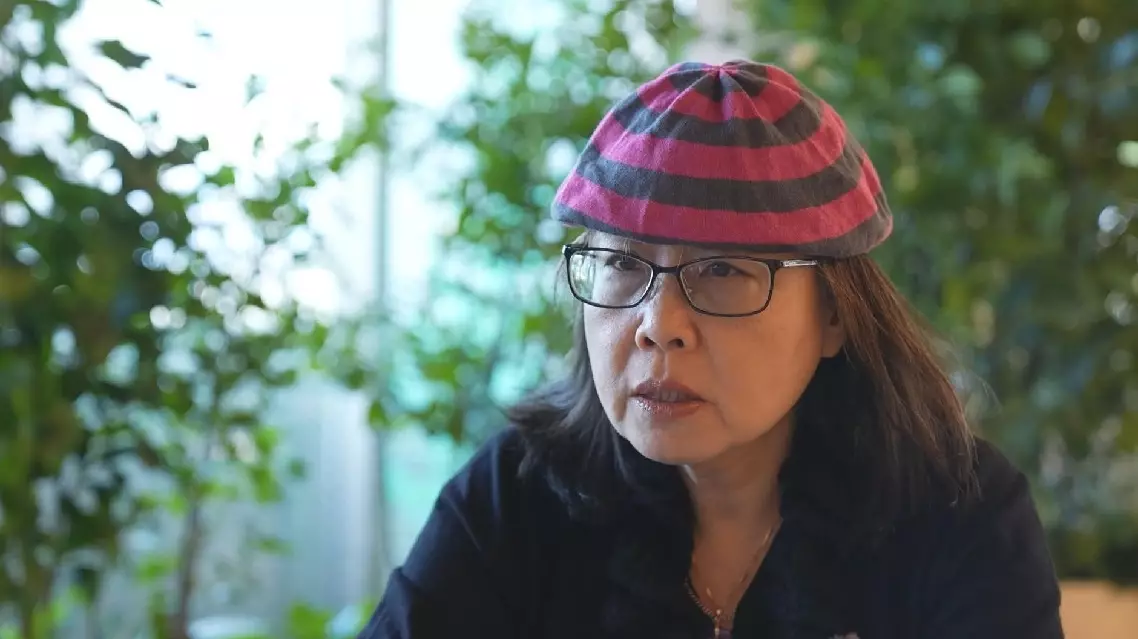
Li Meina, a volunteer in China's Hong Kong Special Administrative Region (HKSAR), has been advocating for the rights of the "comfort women" for over three decades, continuously seeking justice for them.
During World War II, the Japanese army invaded and occupied Hong Kong from late 1941 to 1945. Upon Japan's surrender in 1945, more than 10,000 women and girls in the city had been raped and forced into sexual slavery, widely known as "comfort women."
In an interview with China Global Television Network (CGTN), Li expressed her unwavering commitment to uncovering the truth and seeking justice.
Li introduced Law sisters, who were controlled by the Japanese army and raped repeatedly from 1942 to 1945, and they received neither apology nor compensation from Japan before their deaths. "I'm telling you, on Stone Nullah Lane back then, there were two sisters with the surname Law. Three Japanese soldiers followed them into their home. Let's suppose this is the house. From that day on, the two soldiers would return to rape them two or three times every week. The younger sister passed away this September. She felt tormented until the end. She wanted to see me or speak to the media to reveal this humiliation," Li said.
Li noted that in 1942, the Japanese army established 500 sexual slavery centers on Lockhart Road in Wan Chai alone ostensibly to "comfort" and "inspire" soldiers. Additional centers were set up in residential areas, hotels, and even churches throughout Hong Kong.
Adding to the injustice, the victims' suffering has been persistently denied and dismissed as fabrication by those attempting to erase this history.
For years, Japanese right-wing forces have tried hard to deny the history facts involving "comfort women."
In 2013, Li left her job and launched the website "Hong Kong History Watch" to call for more volunteers to help locate Hong Kong's surviving "comfort women." She pursued this work while confronting what she describes as Japan's "information war," which aims to erase this part of history.
"When I went to the Japanese consulate, some strangers, they came close to me and took pictures of me, It's like frightening me. I don't think they wanted us to mention this again. From time to time, whether it's this prime minister or another prime minister -- when we were young, all the TV showed Japanese cartoons because the Japanese government paid a lot sponsors. Why this happened? I was only a kid, I didn't know about World War II, but I have that question in my mind," she said.
Li said she believes there are likely many more undiscovered victims in Hong Kong, yet their stories remain untold, as both the survivors and their families are silenced by shame.
Confronted with denial from Japanese politicians, including Prime Minister Sanae Takaichi, Li said this reflects Japan's shame over its crimes and an attempt to suppress the truth.
"From time to time, they will say something to deny the war crime, because psychologically, they could not face the reality. They felt very ashamed. That's why they denied it," she added.
Despite decades of effort, Li still faces her toughest challenges: many victims, torn between a desire for acknowledgment and fear of shame, choose to remain silent.
During World War II, at least 400,000 girls and women across Asia, including around 200,000 from China, were forced into "comfort women" by the Japanese army, according to the Research Center for Comfort Women.
The day of August 14 was designated as the International Memorial Day for "Comfort Women" in 2012 by the 11th Asian Alliance Conference for "Comfort Women."
Hong Kong volunteer seeks justice for "comfort women" for 30 years