Skip to Content Facebook Feature Image

November 2025: Hong Kong Experiences Unusually Dry Weather with Record Low Humidity and Minimal Rainfall

HK

November 2025: Hong Kong Experiences Unusually Dry Weather with Record Low Humidity and Minimal Rainfall
HK

HK

November 2025: Hong Kong Experiences Unusually Dry Weather with Record Low Humidity and Minimal Rainfall

2025-12-02 16:00 Last Updated At:12-06 23:35

A dry November

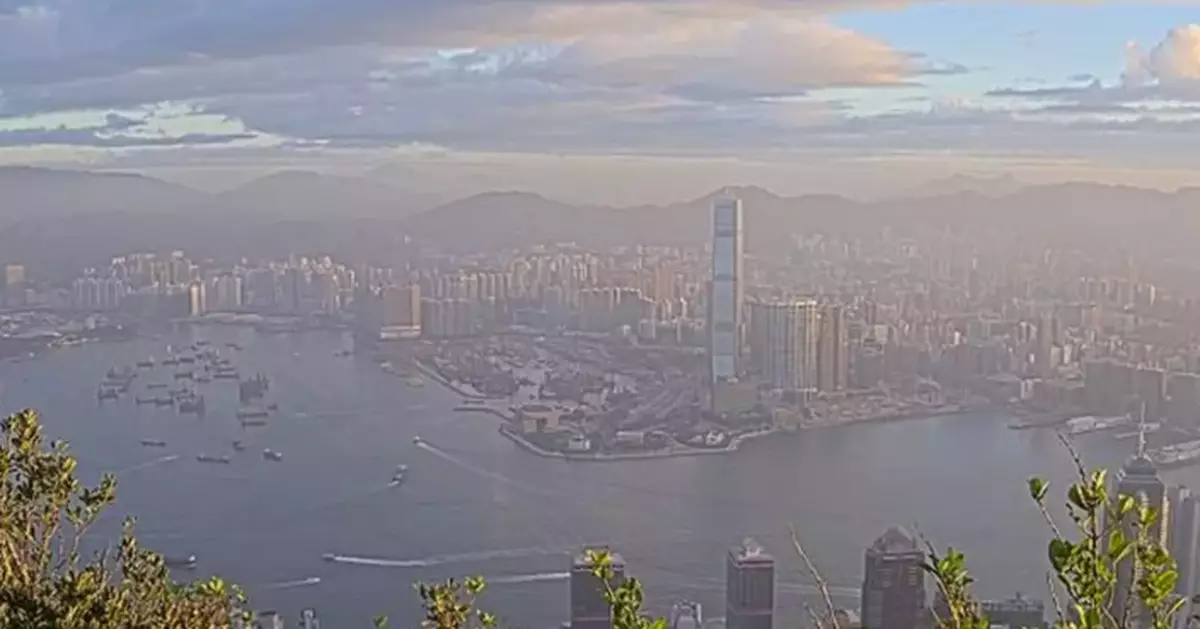
With the dominance of the dry northeast monsoon over southern China for most of the month, the weather in November 2025 was much drier than usual in Hong Kong. The monthly mean relative humidity of 60 per cent was 12 per cent below the normal of 72 per cent and one of the fourth lowest on record for November. The total rainfall for the month was 7.0 millimetres, only about 18 per cent of the normal of 39.3 millimetres. The accumulated rainfall this year up to November was 2 552.2 millimetres, about 6 per cent above the normal of 2 402.4 millimetres for the same period. The monthly mean temperature of 22.3 degrees was near the normal of 22.2 degrees. Mainly attributed to the exceptionally hot weather in September and October, the autumn of the year from September to November was much warmer than usual. The autumn mean minimum temperature of 24.4 degrees, mean temperature of 26.3 degrees and mean maximum temperature of 28.9 degrees were respectively one of the second highest, the third highest and one of the fourth highest on record for the same period.

Under the influence of the northeast monsoon, it was dry with sunny intervals on the first two days of the month. With a band of clouds covering southern China, local weather turned cloudy with one or two light rain patches on November 3 and 4. While there were sunny periods on November 5 and 6, gloomy and rainy weather returned on November 7 with a band of clouds covering southern China. As an anticyclone aloft strengthened gradually, the weather turned generally fine during the day on November 8 and remained so in the following two days. With plenty of sunshine, the temperature at the Observatory rose to a maximum of 28.9 degrees on November 9, the highest of the month.

Additionally, the tropical depression to the south of Guam intensified into a tropical storm on the morning of November 6 and was named Fung-wong. Fung-wong continued to move generally northwestwards and intensified progressively into a super typhoon in the following three days. It moved across Luzon on the morning of November 10 and weakened into a typhoon. Fung-wong turned to move northwards over the northeastern part of the South China Sea on November 11 and weakened gradually under the influence of the northeast monsoon. It skirted the southern part of Taiwan the next night and weakened into an area of low pressure with frontal characteristics.

Under the combined effect of Fung-wong and the northeast monsoon, local winds occasionally reached strong force offshore and on high ground on November 10 and 11. The outer rainbands of Fung-wong brought a few light rain patches on November 11. There was also minor flooding over some low-lying areas during the high tide on the night of November 10 and the early morning of November 11. Dominated by a dry northeast monsoon, apart from the cloudier weather with a few rain patches on November 13 and the next morning, the weather in Hong Kong was generally fine and dry from November 12 to 17.

A cold front reached the coast of southern China on the early morning of November 18. Under the influence of the associated intense northeast monsoon, the weather became appreciably cooler and windy during the day and the next day. The temperature at the Observatory dropped to a minimum of 13.2 degrees on the morning of November 19, the lowest of the month. The weather remained very dry in the following three days. The relative humidity over most parts of the territory stayed below 40 per cent on November 20 and 21. With the band of clouds thinning out, cloudy weather on November 19 and 20 turned generally fine during the day on November 21 and remained so in the following three days.

A strong replenishment of the northeast monsoon reached the coast of southern China on November 25. The weather was generally fine and very dry on November 25 and 26. With another replenishment reaching the coastal areas of Guangdong, the weather remained generally fine and very dry on November 27 and the next two days. The relative humidity at the Observatory once fell to 16 per cent on November 27, equalling the lowest on record in November since the establishment of the automatic weather station at the Observatory's Headquarters in 1984. With a band of clouds covering southern China on the last day of the month, while the weather remained dry locally, it was mainly cloudy with one or two light rain patches at night.

Four tropical cyclones occurred over the South China Sea and the western North Pacific in November 2025.

Details of issuance and cancellation of various warnings/signals in the month are summarised in Table 1. Monthly meteorological figures and departures from normal for November are tabulated in Table 2.
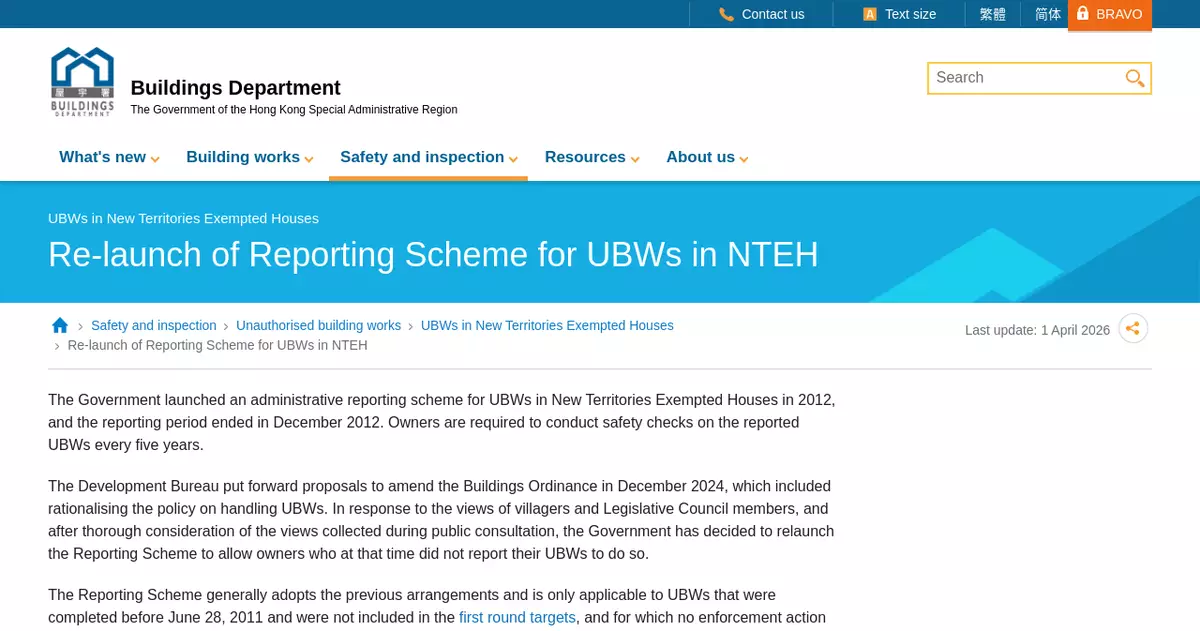

Re-launch of Reporting Scheme for Unauthorised Building Works in New Territories Exempted Houses

Following the direction of earlier proposals, the Buildings Department (BD) announced today (April 1) the re-launch of the Reporting Scheme for Unauthorised Building Works (UBWs) in New Territories Exempted Houses (NTEHs). The reporting period will last for one year from April 1, 2026 to March 31, 2027.

"In view of the history and unique circumstances of the NTEHs (commonly known as village houses), the Government launched a one-off administrative reporting scheme in 2012 as a special arrangement. Under the scheme, owners could report to the BD about UBWs that were erected before June 28, 2011, posed lower risks or constituted less serious contravention of the law. The reporting period ended in December 2012. The Development Bureau (DEVB) put forward proposals to amend the Buildings Ordinance in December 2024, which included rationalising the policy for handling UBWs. The DEVB also pointed out that in response to the views of villagers and Legislative Council members that the reporting period was too short, the Government prepared to re-launch the Reporting Scheme to allow owners who at that time did not report their UBWs to do so," a spokesman for the BD said.

Relevant stakeholders and Legislative Council members generally considered the above proposals practical and feasible, and they welcomed the proposals. The DEVB and the BD have also consulted Heung Yee Kuk on the relevant implementation arrangements.

The re-launched Reporting Scheme will maintain the original criteria, including:

(1) The types of UBWs that can be reported and their erection dates are the same as the original Reporting Scheme, meaning that only UBWs erected before June 28, 2011, posed lower risks or constituted less serious contravention of the law and were not the First Round Targets (Note) are eligible. Examples include signboards projecting from the external walls of village houses; enclosed rooftop structures with a coverage of not more than 50 per cent of the roofed-over area of the main building.

(2) Same as the original Reporting Scheme, owners are required to conduct safety inspections on the reported UBWs every five years.

"The BD will not require the immediate removal of the reported UBWs unless their structures become obviously dangerous. Regarding UBWs in village houses, the BD is prioritising the handling of First Round Targets. If any relevant UBWs remain not reported after the application deadline of March 31, 2027, the BD will, after dealing with the First Round Targets, take priority enforcement action against the non-reported UBWs. The BD will formulate enforcement strategy for the reported UBWs at a later stage in accordance with the risks and the actual situation," the spokesman added.

To enhance the efficiency of processing applications, reports must be submitted via the electronic platform on the BD's website by technically competent persons or registered professional engineers appointed by owners. In accordance with the user-pays principle, an administrative fee of $600 is payable for each application. Upon successful reports, owners must also pay the relevant administrative fee when conducting safety inspections of the reported UBWs every five years.

Details of the re-launched Reporting Scheme are available on the BD's website at https://www.bd.gov.hk/en/safety-inspection/ubw/UBW-in-new-territories-exempted-houses/index_relaunch_reporting_scheme.html; Villagers who wish to report can call 2626 1616 for enquiry. The BD will also use different channels such as distributing leaflets and posters to Rural Committees to enable villagers to know more about the re-launch of the Reporting Scheme.

Owners who had successfully participated in the Reporting Scheme in 2012 are not required to submit reports again. However, they must continue to comply with the requirements of the original Reporting Scheme, including conducting safety inspections of the reported UBWs every five years, submitting safety certificates and paying administrative fees to the BD.

Note: The First Round Targets refer to UBWs with higher potential risks and more serious nature, such as village houses of four storeys or more, and enclosed rooftop structures covering more than 50 per cent of the roofed-over area.

Source: AI-found images

Source: AI-found images

Recommended Articles