VIENNA (AP) — The United States and Russia have both recently threatened to resume nuclear testing, alarming the international community and jeopardizing a global norm against such tests.
Experts say these threats from the world’s two largest nuclear powers put pressure on nonproliferation efforts and endanger global peace and security.
“Because of other countries’ testing programs, I have instructed the Department of War to start testing our Nuclear Weapons on an equal basis,” U.S. President Donald Trump said in a post on his Truth Social site at the end of October. “That process will begin immediately.”
Moscow quickly responded.
Russian President Vladimir Putin told his Security Council that should the U.S. or any signatory to the Comprehensive Nuclear-Test-Ban Treaty conduct nuclear weapons tests, “Russia would be under obligation to take reciprocal measures.”
Here’s is a look at what a resumption of nuclear testing could mean.
Concerns about the negative effects of nuclear weapon tests grew in the 1950s when the U.S. and the Soviet Union carried out multiple powerful atomic tests in the atmosphere. As a result, a limited nuclear test ban treaty was negotiated that prohibited such tests but underground tests were still permitted.
Renewed international efforts to ban all nuclear tests resulted in the start of negotiations for a comprehensive treaty in 1994, culminating in its adoption by the U.N. General Assembly in 1996.
With 187 states having signed the treaty and 178 having ratified it, most experts believe the treaty has established a norm against atomic testing — even without formally entering into force.
For the treaty to officially take effect, 44 specific states — listed in an annex to the treaty — must ratify it. Nine of them have not yet done so.
China, Egypt, Iran, Israel and the U.S. signed but didn’t ratify it. India, North Korea and Pakistan neither signed nor ratified the treaty. Russia signed and ratified the treaty but revoked its ratification in 2023, saying the imbalance between its ratification and U.S. failure to do so was “unacceptable in the current international situation.”
Alongside the treaty, the Comprehensive Nuclear-Test-Ban Treaty Organization was established in Vienna. It runs a global monitoring network to detect nuclear tests worldwide, operating 307 monitoring stations, using seismic, hydroacoustic, infrasound and radionuclide technologies.
The organization is financed mainly through assessed contributions by its member states. Its budget for 2025 is more than $139 million.
Daryl Kimball, executive director of the Arms Control Association in Washington, said that a resumption of U.S. atomic tests would “open the door for states with less nuclear testing experience to conduct full-scale tests that could help them perfect smaller, lighter warhead designs.”
This would “decrease U.S. and international security,” he said.
Joseph Rodgers, fellow at the Washington-based Center for Strategic and International Studies, said that states such as China or India stand to profit from a resumption of nuclear tests.
“It makes more sense for them to test” than it does for the U.S. or Russia, the two states who have conducted most atomic tests to date, Rodgers said.
The U.S. conducted its last nuclear test in 1992. Since 1996, only 10 nuclear tests have been conducted by three countries: India, Pakistan and North Korea. None of them have signed or ratified the treaty
The vast majority of nuclear tests — approximately 2,000 — occurred before 1996, mostly by the U.S. and Soviet Union.
Given the uncertainty around Trump’s announcement and the potential for escalation of tensions around the issue, the test ban treaty organization could play a role in resolving the situation.
Rodgers said that the treaty organization is primarily a scientific one and should focus on providing scientific data to the international community.
But Kimball disagrees, suggesting the organization's Executive Secretary Robert Floyd could “take the initiative and bring together” officials from the U.S. and other countries to help resolve some uncertainties, such as what type of nuclear tests the U.S. president was referring to in his statement.
Floyd told The Associated Press that in the current situation, he believes his organization’s main role is providing “confidence to states” that they would know if a nuclear weapon explosion occurred “anywhere, anytime.”
The organization's monitoring network successfully detected all six atomic tests conducted by North Korea between 2006 and 2017, he said.
The White House has so far not clarified what kind of tests Trump meant and what other countries he was referring to in his statement. U.S. Energy Secretary Chris Wright said the new tests would not include nuclear explosions.
Nuclear test explosions banned under the treaty are so-called supercritical tests, where fissile material is compressed to start a self-sustaining nuclear chain reaction that creates an explosion.
These tests produce a nuclear yield — the amount of energy released, which defines a weapon’s destructive power. The treaty bans any nuclear explosion with a yield, following a zero yield standard.
In contrast, subcritical nuclear experiments, the ones Wright was referring to, produce no self-sustaining chain reaction and no explosion. Nuclear weapon states, including the U.S., conduct these experiments routinely without violating the treaty.
Kimball says hydronuclear tests with extremely small yields conducted underground in metal chambers are “undetectable” by the organization's monitoring system.
“So that creates what I would say is a verification gap regarding this particular type of extremely low yield explosion,” he said.
When the organization's monitoring system was established in the 1990s, it was designed to detect nuclear explosions of 1 kiloton (1,000 tons of TNT). Floyd said the system actually performs better, detecting explosions below 1 kiloton, at 500 tons of TNT.
The nuclear bomb dropped on Hiroshima by the U.S. was approximately 15 kilotons.
The Associated Press receives support for nuclear security coverage from the Carnegie Corporation of New York and Outrider Foundation. The AP is solely responsible for all content.
Additional AP coverage of the nuclear landscape: https://apnews.com/projects/the-new-nuclear-landscape/
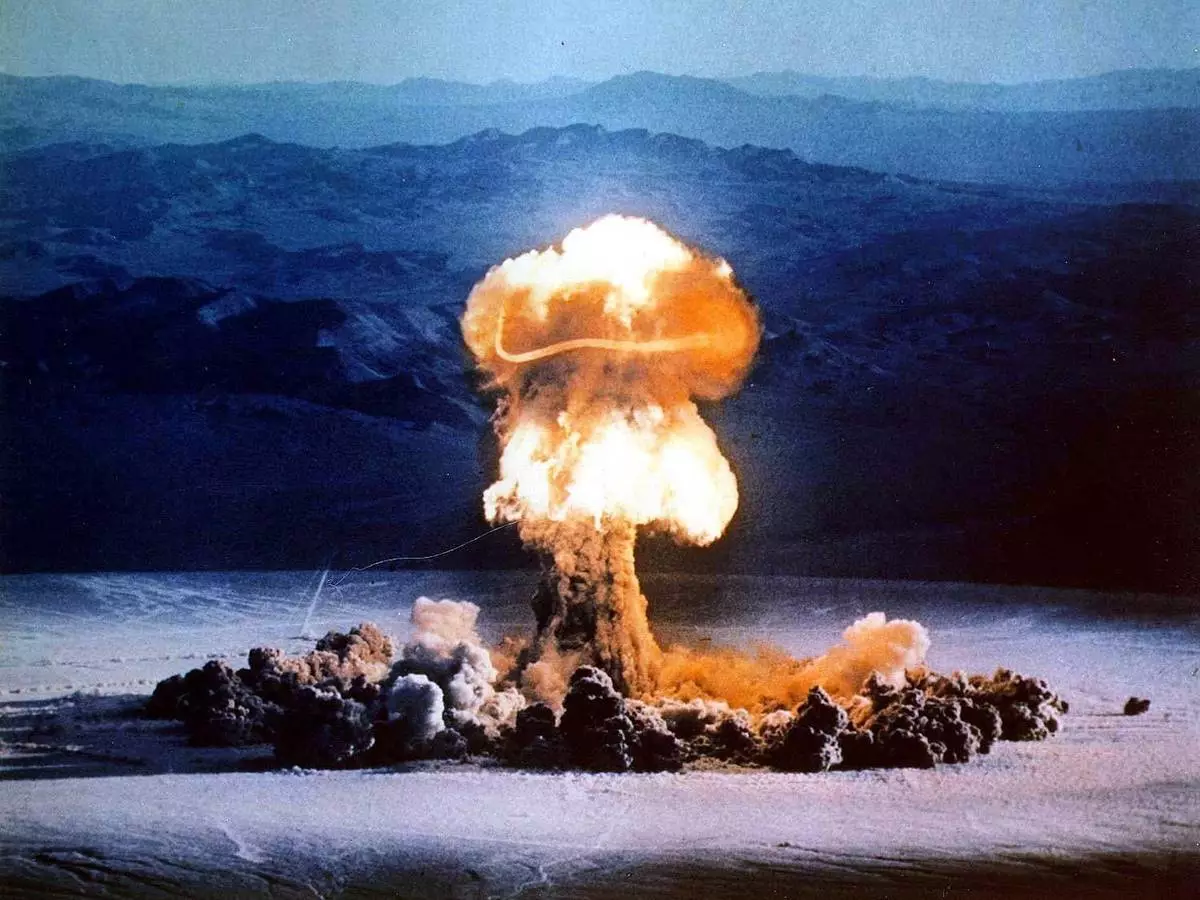
FILE - A mushroom cloud rises from a test blast at the Nevada Test Site on June 24, 1957. (U.S. Energy Department via AP, File)
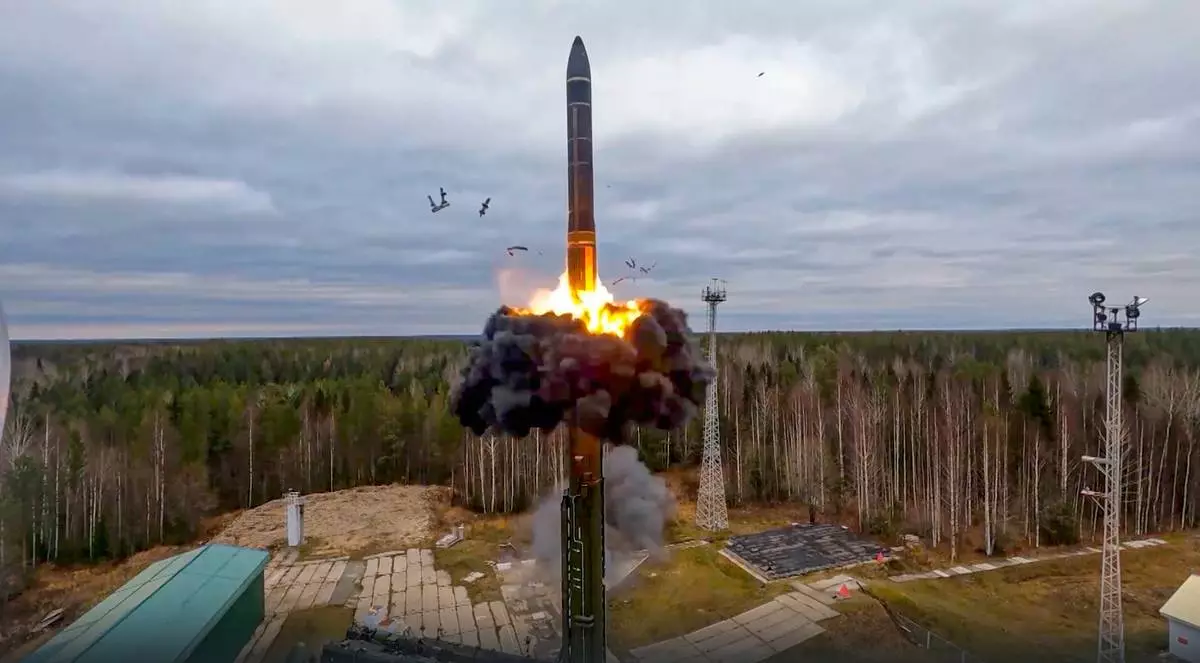
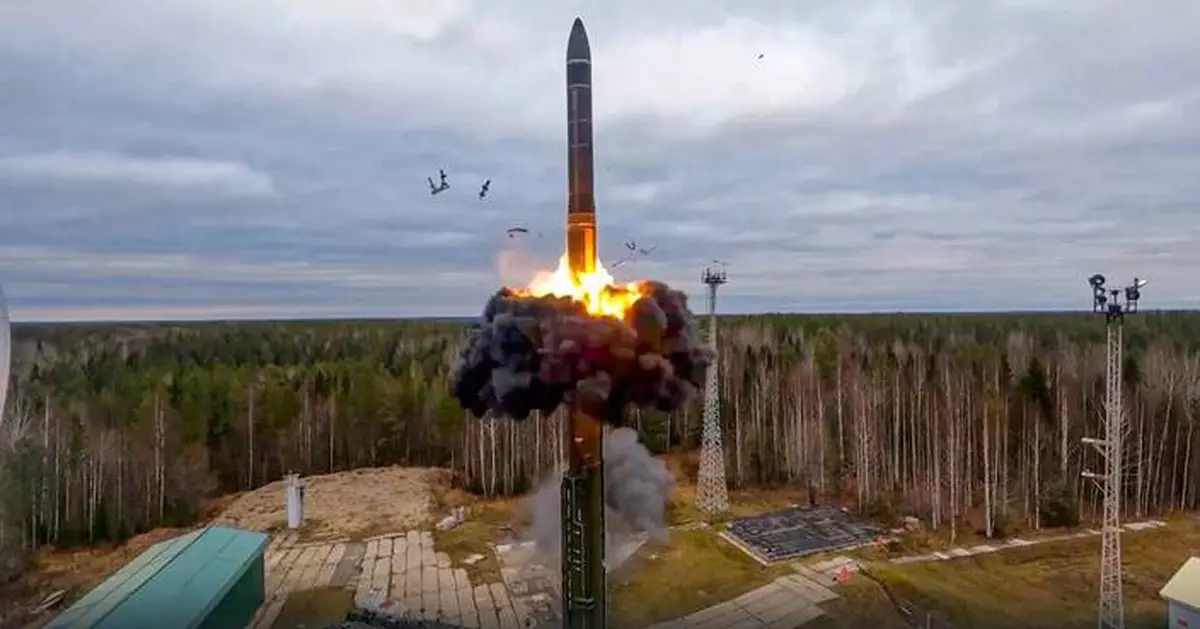
FILE - In this photo taken from video released by Russian Defense Ministry Press Service on Oct. 26, 2022, a Yars intercontinental ballistic missile is test-fired as part of Russia's nuclear drills from a launch site in Plesetsk, northwestern Russia. (Russian Defense Ministry Press Service via AP, File)
WASHINGTON (AP) — Becky Pepper-Jackson finished third in the discus throw in West Virginia last year though she was in just her first year of high school. Now a 15-year-old sophomore, Pepper-Jackson is aware that her upcoming season could be her last.
West Virginia has banned transgender girls like Pepper-Jackson from competing in girls and women's sports, and is among the more than two dozen states with similar laws. Though the West Virginia law has been blocked by lower courts, the outcome could be different at the conservative-dominated Supreme Court, which has allowed multiple restrictions on transgender people to be enforced in the past year.
The justices are hearing arguments Tuesday in two cases over whether the sports bans violate the Constitution or the landmark federal law known as Title IX that prohibits sex discrimination in education. The second case comes from Idaho, where college student Lindsay Hecox challenged that state's law.
Decisions are expected by early summer.
President Donald Trump's Republican administration has targeted transgender Americans from the first day of his second term, including ousting transgender people from the military and declaring that gender is immutable and determined at birth.
Pepper-Jackson has become the face of the nationwide battle over the participation of transgender girls in athletics that has played out at both the state and federal levels as Republicans have leveraged the issue as a fight for athletic fairness for women and girls.
“I think it’s something that needs to be done,” Pepper-Jackson said in an interview with The Associated Press that was conducted over Zoom. “It’s something I’m here to do because ... this is important to me. I know it’s important to other people. So, like, I’m here for it.”
She sat alongside her mother, Heather Jackson, on a sofa in their home just outside Bridgeport, a rural West Virginia community about 40 miles southwest of Morgantown, to talk about a legal fight that began when she was a middle schooler who finished near the back of the pack in cross-country races.
Pepper-Jackson has grown into a competitive discus and shot put thrower. In addition to the bronze medal in the discus, she finished eighth among shot putters.
She attributes her success to hard work, practicing at school and in her backyard, and lifting weights. Pepper-Jackson has been taking puberty-blocking medication and has publicly identified as a girl since she was in the third grade, though the Supreme Court's decision in June upholding state bans on gender-affirming medical treatment for minors has forced her to go out of state for care.
Her very improvement as an athlete has been cited as a reason she should not be allowed to compete against girls.
“There are immutable physical and biological characteristic differences between men and women that make men bigger, stronger, and faster than women. And if we allow biological males to play sports against biological females, those differences will erode the ability and the places for women in these sports which we have fought so hard for over the last 50 years,” West Virginia's attorney general, JB McCuskey, said in an AP interview. McCuskey said he is not aware of any other transgender athlete in the state who has competed or is trying to compete in girls or women’s sports.
Despite the small numbers of transgender athletes, the issue has taken on outsize importance. The NCAA and the U.S. Olympic and Paralympic Committees banned transgender women from women's sports after Trump signed an executive order aimed at barring their participation.
The public generally is supportive of the limits. An Associated Press-NORC Center for Public Affairs Research poll conducted in October 2025 found that about 6 in 10 U.S. adults “strongly” or “somewhat” favored requiring transgender children and teenagers to only compete on sports teams that match the sex they were assigned at birth, not the gender they identify with, while about 2 in 10 were “strongly” or “somewhat” opposed and about one-quarter did not have an opinion.
About 2.1 million adults, or 0.8%, and 724,000 people age 13 to 17, or 3.3%, identify as transgender in the U.S., according to the Williams Institute at the UCLA School of Law.
Those allied with the administration on the issue paint it in broader terms than just sports, pointing to state laws, Trump administration policies and court rulings against transgender people.
"I think there are cultural, political, legal headwinds all supporting this notion that it’s just a lie that a man can be a woman," said John Bursch, a lawyer with the conservative Christian law firm Alliance Defending Freedom that has led the legal campaign against transgender people. “And if we want a society that respects women and girls, then we need to come to terms with that truth. And the sooner that we do that, the better it will be for women everywhere, whether that be in high school sports teams, high school locker rooms and showers, abused women’s shelters, women’s prisons.”
But Heather Jackson offered different terms to describe the effort to keep her daughter off West Virginia's playing fields.
“Hatred. It’s nothing but hatred,” she said. "This community is the community du jour. We have a long history of isolating marginalized parts of the community.”
Pepper-Jackson has seen some of the uglier side of the debate on display, including when a competitor wore a T-shirt at the championship meet that said, “Men Don't Belong in Women's Sports.”
“I wish these people would educate themselves. Just so they would know that I’m just there to have a good time. That’s it. But it just, it hurts sometimes, like, it gets to me sometimes, but I try to brush it off,” she said.
One schoolmate, identified as A.C. in court papers, said Pepper-Jackson has herself used graphic language in sexually bullying her teammates.
Asked whether she said any of what is alleged, Pepper-Jackson said, “I did not. And the school ruled that there was no evidence to prove that it was true.”
The legal fight will turn on whether the Constitution's equal protection clause or the Title IX anti-discrimination law protects transgender people.
The court ruled in 2020 that workplace discrimination against transgender people is sex discrimination, but refused to extend the logic of that decision to the case over health care for transgender minors.
The court has been deluged by dueling legal briefs from Republican- and Democratic-led states, members of Congress, athletes, doctors, scientists and scholars.
The outcome also could influence separate legal efforts seeking to bar transgender athletes in states that have continued to allow them to compete.
If Pepper-Jackson is forced to stop competing, she said she will still be able to lift weights and continue playing trumpet in the school concert and jazz bands.
“It will hurt a lot, and I know it will, but that’s what I’ll have to do,” she said.
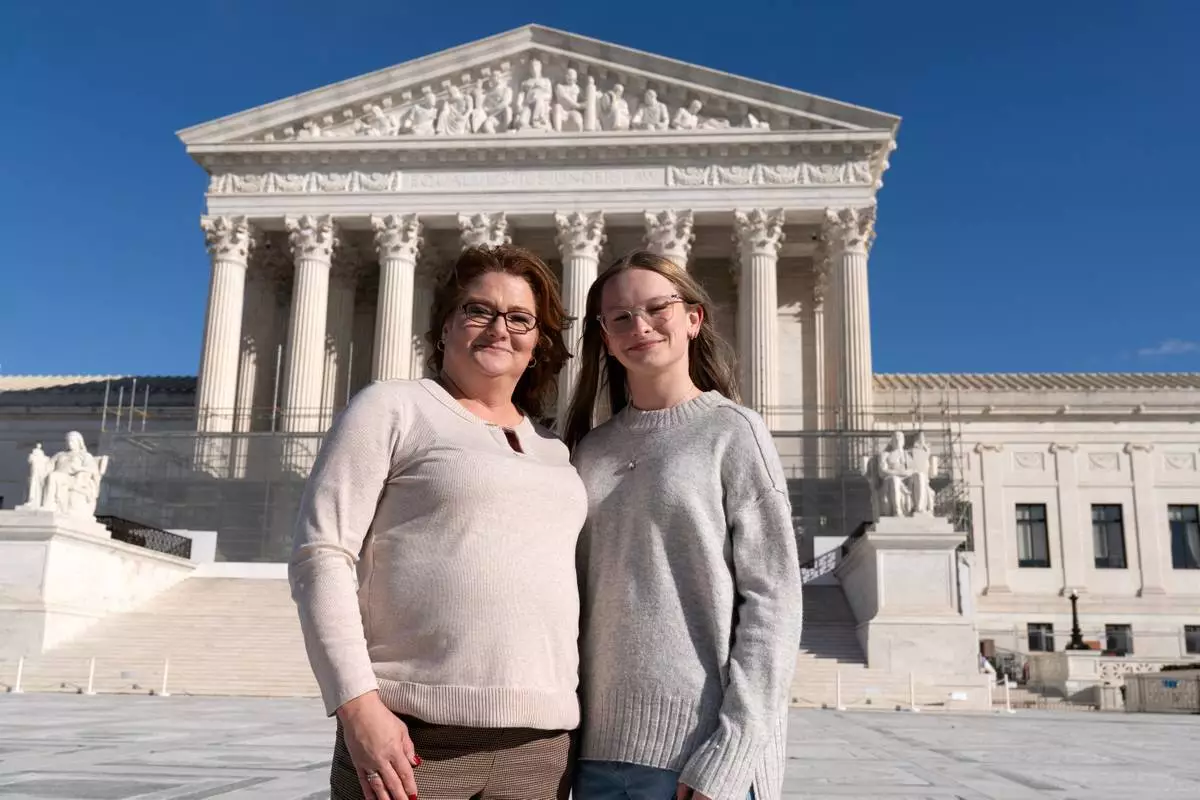
Heather Jackson, left, and Becky Pepper-Jackson pose for a photograph outside of the U.S. Supreme Court in Washington, Sunday, Jan. 11, 2026. (AP Photo/Jose Luis Magana)
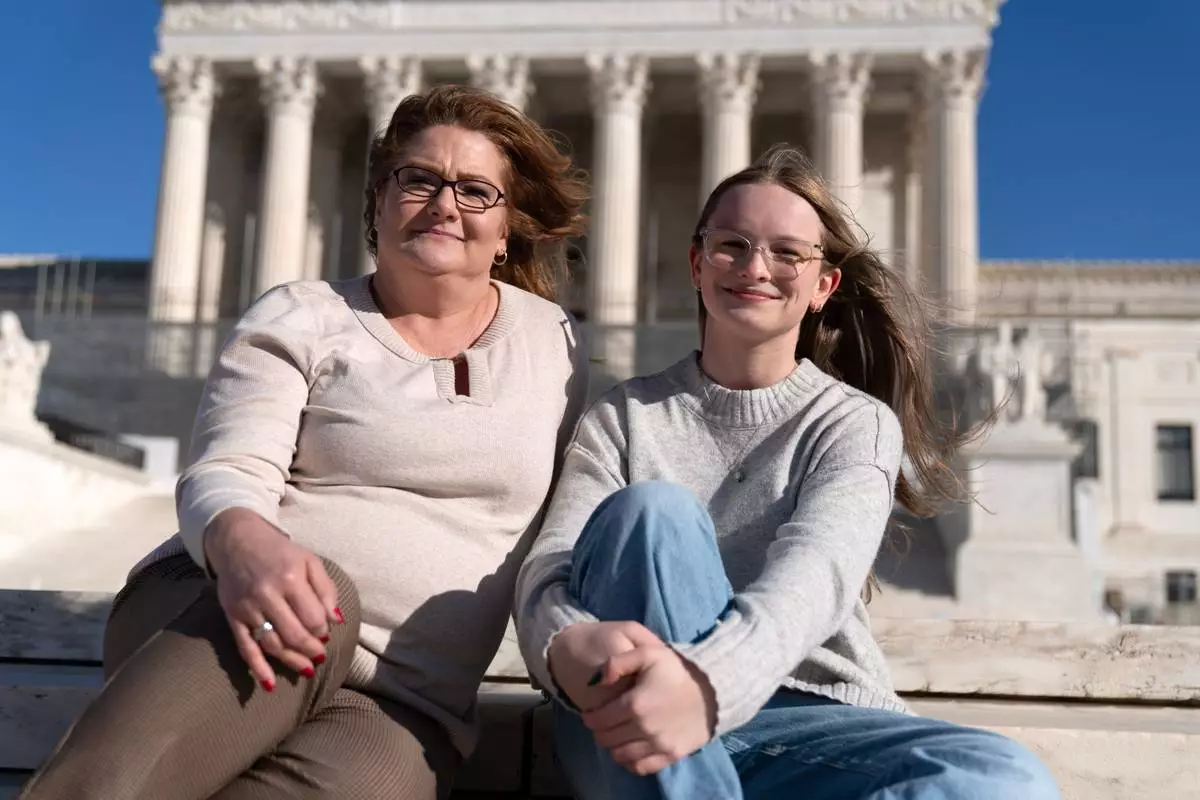
Heather Jackson, left, and Becky Pepper-Jackson pose for a photograph outside of the U.S. Supreme Court in Washington, Sunday, Jan. 11, 2026. (AP Photo/Jose Luis Magana)

Becky Pepper-Jackson poses for a photograph outside of the U.S. Supreme Court in Washington, Sunday, Jan. 11, 2026. (AP Photo/Jose Luis Magana)
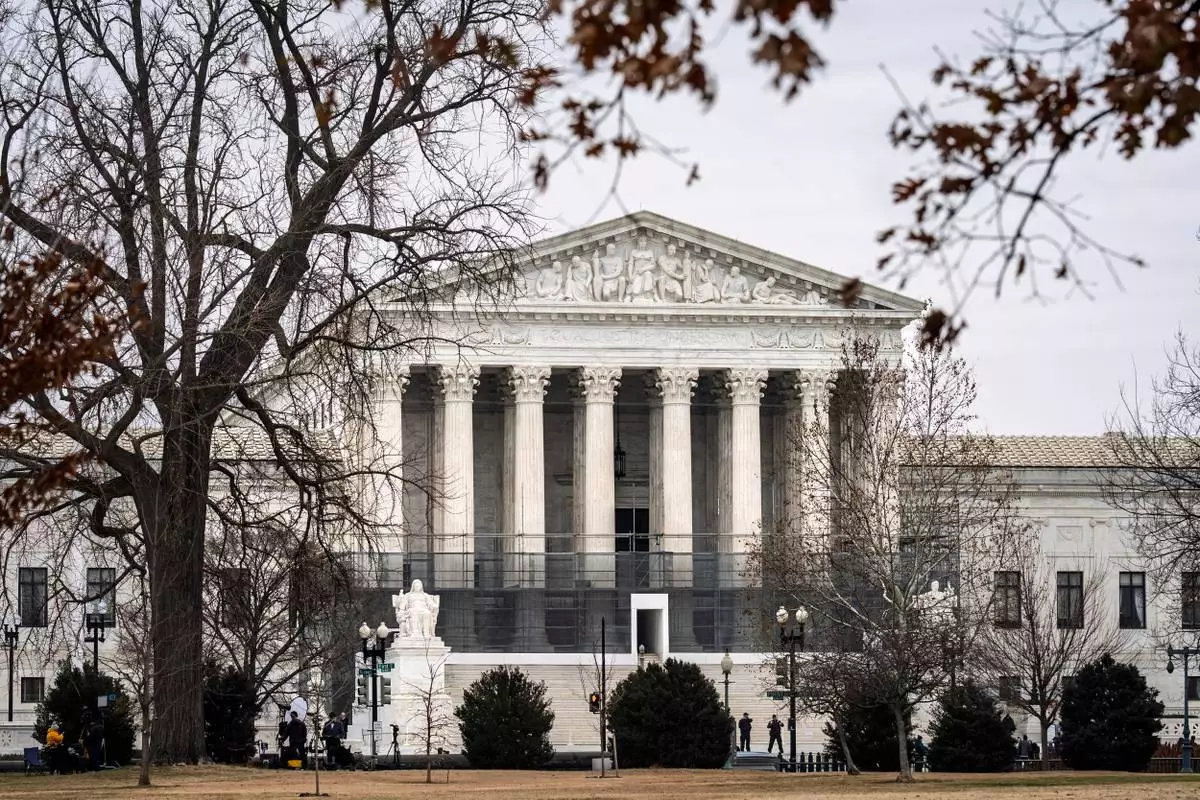
The Supreme Court stands is Washington, Friday, Jan. 9, 2026. (AP Photo/J. Scott Applewhite)
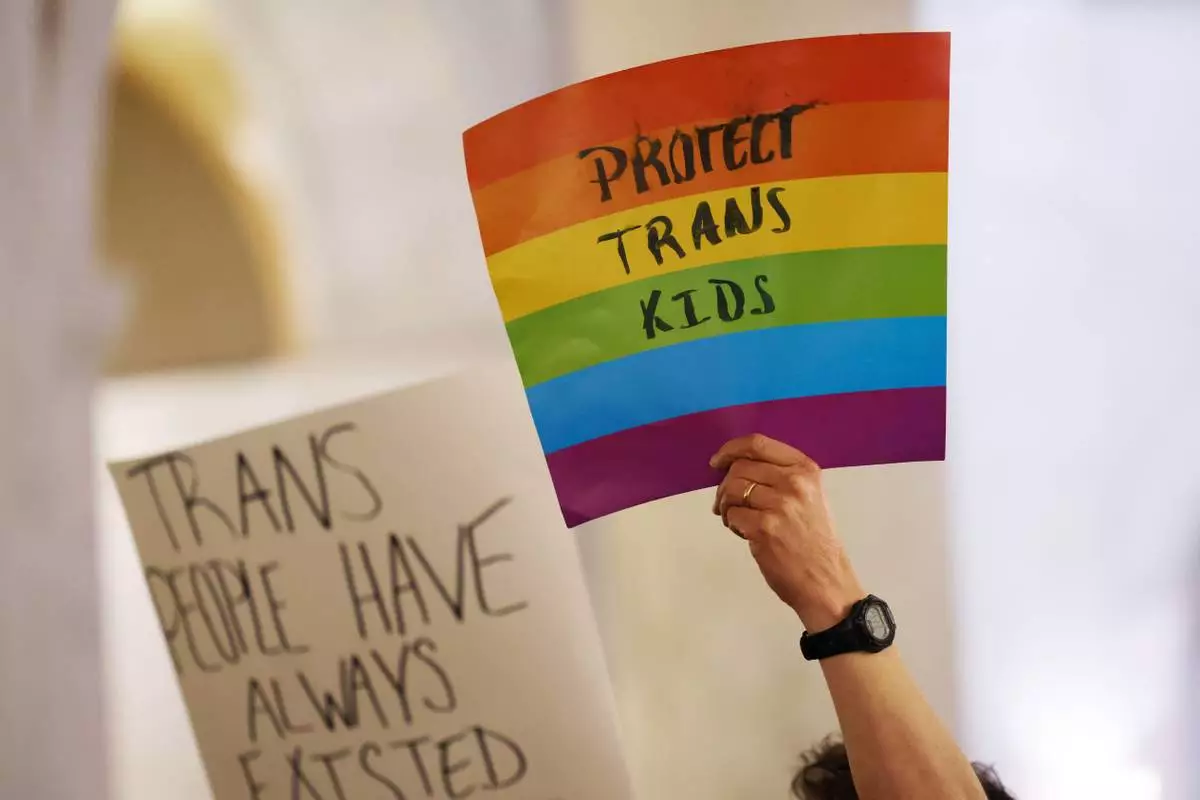
FILE - Protestors hold signs during a rally at the state capitol in Charleston, W.Va., on March 9, 2023. (AP Photo/Chris Jackson, file)