CHICAGO--(BUSINESS WIRE)--Dec 2, 2025--
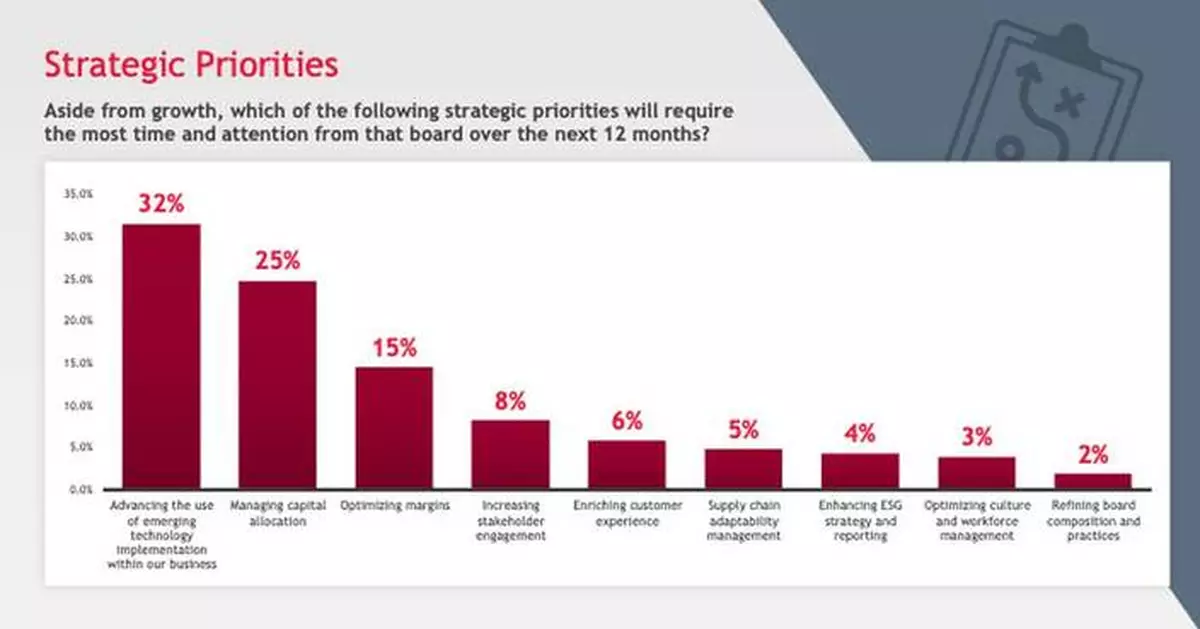
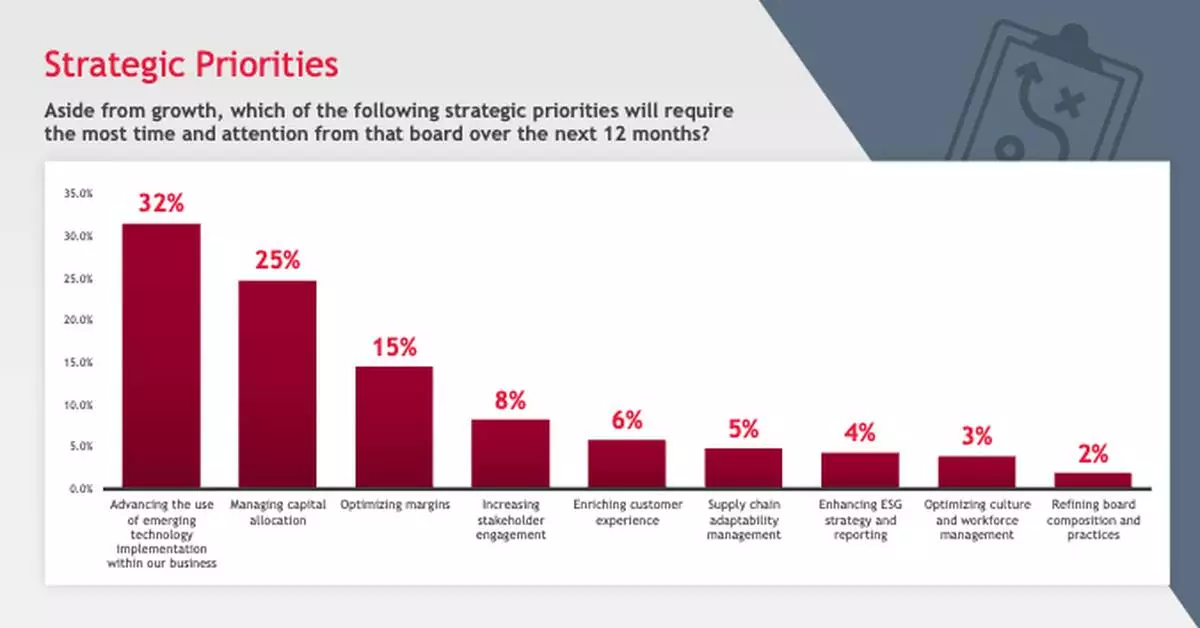
BDO USA released its 2025 Board Survey today, an annual report that polled over 200 public company board directors on their priorities and challenges in the coming year. As digital innovation continues to dominate boardroom agendas, many directors feel pressure to demonstrate returns on their technological investments — a challenge increased by changing workforce adoption needs. According to BDO’s survey, nearly one-third (32%) of directors feel that advancing the use of emerging technology implementation will require the most board time and attention in the next year, and 23% still believe their tech implementation lags competitors.
This press release features multimedia. View the full release here: https://www.businesswire.com/news/home/20251202692063/en/
“As directors continue to prioritize growth and innovation, many boardrooms are faced with the human side of digital integration and relentless market volatility. Companies must not only keep pace with competitors but also master implementation to drive meaningful ROI and mitigate risk,” said Amy Rojik, founder of the Center for Corporate Governance at BDO USA. “Effective oversight and value delivery requires collaboration and thoughtful dialogue between management teams and boards, robust change management and integration plans, and an iterative risk and innovation strategy that centers around people just as much as technology.”
In addition to capturing board sentiment on economic uncertainty, regulatory change, and technological disruption, the survey also revealed insight into how directors will approach growth, risk, and human capital considerations of the board, management, and the broader workforce over the next 12 months:
Primary Paths for Growth: Directors increasingly see product development and strategic dealmaking as their top levers for growth in 2026. The report shows that over half (53%) of directors plan to increase investment in mergers and acquisitions (M&A) in 2026, with 30% reporting that strategic dealmaking and partnerships will be their board’s primary focus in the year ahead. Another 31% of directors say that their board is most focused on investing in new products and services for growth, and roughly three-in-four (73%) plan for increased strategic investments in research and development. However, success in all areas will hinge on strong integration plans that consider culture, human capital management, technology debt, and operational excellence.
Technology Implementation Risk: As companies race to deploy AI capabilities, boards are looking to balance speed with caution, BDO’s survey reveals. Nearly one-quarter (23%) see rapidly innovating and developing AI capabilities as the most significant challenge to their business. While trying to keep pace with competitors, boards will also have to navigate the challenges of data privacy and properly train their talent for generative AI adoption to see success. Yet, 17% of boards admit to not having a robust vision for technology implementation and the mitigation of cybersecurity risk.
Human Capital Management & Leadership Dynamics: BDO’s survey also reveals an increased focus on talent and leadership development to navigate AI’s changing impact on the workplace. Over half (51%) of directors are planning increased investments in their workforce, and an equal percentage are specifically targeting training and skills development programs. Directors are also looking into additional skills and experiences that can enhance a board’s ability to govern, drive culture, and develop the C-suite to drive long-term strategy. This is underscored by the 58% of directors who see room for improvement in their management team’s work on talent oversight and workforce development.
As boards prepare for 2026, evolving business needs demand that directors and their management teams sharpen their focus on skills across strategic oversight, risk management, and workforce development. Learn more about how directors perceive the ability of both the board and management to address these and other issues by downloading the 2025 BDO Board Survey report here.
About the 2025 BDO Board Survey
Conducted by Rabin Roberts, an independent market research consulting firm, on behalf of the BDO Center for Corporate Governance, the 2025 BDO Board survey examined the opinions of more than 200 corporate directors of public company boards in August and September 2025. Respondents sit on public boards across a variety of industries including, but not limited to, technology, retail, nonprofit, manufacturing, financial services, energy, healthcare, life sciences, real estate, education, and hospitality.
Survey questions included a mix of “select one,” “select three,” or “select all that apply,” which account for the distribution of responses.
About BDO USA
Our purpose is helping people thrive, every day. Together, we are focused on delivering exceptional and sustainable outcomes and value for our people, our clients, and our communities. BDO is proud to be an ESOP company, reflecting a culture that puts people first. BDO professionals provide assurance, tax, and advisory services for a diverse range of clients across the U.S. and in over 160 countries through our global organization.
BDO is the brand name for the BDO network and for each of the BDO Member Firms. BDO USA, P.C., a Virginia professional corporation, is the U.S. member of BDO International Limited, a UK company limited by guarantee, and forms part of the international BDO network of independent member firms. For more information, please visit: www.bdo.com.
(Graphic: BDO USA)

DUBAI, United Arab Emirates (AP) — Iran fired more missiles at Israel and Gulf Arab states Thursday, demonstrating Tehran’s continued ability to strike its neighbors even as U.S. President Donald Trump claimed the threat from the country was nearly eliminated.
Iran’s attacks on Gulf states along with its chokehold on the Strait of Hormuz have disrupted the world’s energy supplies with effects far beyond the Middle East. That has proved to be Iran’s greatest strategic advantage in the war. Britain held a call with nearly three dozen countries about how to reopen the strait once the fighting is over.
Trump has insisted the strait can be taken by force — but said it is not up to the U.S. to do that. In an address to the American people Wednesday night, he encouraged countries that depend on oil from Hormuz to “build some delayed courage” and go “take it.”
Before the U.S. and Israel started the war on Feb. 28 with strikes on Iran, the waterway was open to traffic and 20% of all traded oil passed through it.
Iran responded defiantly to Trump’s speech, in which the American president claimed U.S. military action had been so decisive that “one of the most powerful countries” is “really no longer a threat.”
A spokesman for Iran’s military, Lt. Col. Ebrahim Zolfaghari, insisted Thursday that Tehran maintains hidden stockpiles of arms, munitions and production facilities. He said facilities targeted so far by U.S. strikes are “insignificant.”
Just before Trump began his address — in which he said U.S. “core strategic objectives are nearing completion” — explosions were heard in Dubai as air defenses worked to intercept an Iranian missile barrage.
Less than a half-hour after the president was done, Israel said its military was also working to intercept incoming missiles. Sirens sounded in Bahrain, home to the U.S. Navy’s 5th Fleet, immediately after the speech.
Attacks continued across Iran on Thursday, with strikes reported in multiple cities.
Trump posted footage on social media showing what he said was the collapse of Iran's biggest bridge and threatening, “Much more to follow.”
Earlier Thursday, Iran state media reported that the B1 bridge, which was still under construction, was attacked. Two semiofficial news agencies reported that two people were killed. It was not immediately clear if the footage Trump shared was the B1 bridge, reportedly the tallest in the Middle East.
In a post on X that included a picture of what appeared to be the same bridge, Iran’s Foreign Minister Abbas Araghchi wrote, “Striking civilian infrastructure only conveys the defeat and moral collapse of an enemy in disarray.”
Even amid the conflict, families went to a park in Tehran to play games and grill food to mark the last day of Iranian New Year, or Nowruz.
In Lebanon — where Israel has launched a ground invasion against Iran-backed Hezbollah militants — Israeli strikes have killed 27 people in the past 24 hours, the Health Ministry said.
More than 1,900 people have been killed in Iran during the war, while 19 have been reported dead in Israel. More than two dozen people have died in Gulf states and the occupied West Bank, while 13 U.S. service members have been killed.
More than 1,300 people have been killed and more than 1 million displaced in Lebanon. Ten Israeli soldiers have also died there.
Iranian attacks on about two dozen commercial ships, and the threat of more, have halted nearly all traffic in the waterway that connects the Persian Gulf to the open ocean.
Since March 1, traffic through the strait has dropped 94% over the same period last year, according to the Lloyds List Intelligence shipping data firm. Two ships are confirmed to have paid a fee, the firm said, while others were allowed through based on agreements with their home governments.
Saudi Arabia piped about 1 billion barrels of oil away from the Strait of Hormuz in March, according to maritime data firm Kpler, while Iraq said Thursday that it had started to truck oil across Syria to avoid the strait.
The 35 countries that spoke Thursday, including all G7 industrialized democracies except the U.S., as well as the United Arab Emirates and Bahrain, signed a declaration last month demanding Iran stop blocking the strait.
Thursday’s talks were focused on political and diplomatic measures, but British Foreign Secretary Yvette Cooper said military planners from an unspecified number of countries will also plot ways to ensure security once fighting ends, including potential mine-clearing work and “reassurance” for commercial shipping.
No country appears willing to try to open the strait by force while the war is raging. French President Emmanuel Macron, while on a visit to South Korea, called a military operation to secure the waterway “unrealistic.”
But there is a concern that Iran might limit traffic through the waterway even after U.S. and Israeli attacks cease.
The conflict is driving up prices for oil and natural gas, roiling stock markets, pushing up the cost of gasoline and threatening to make a range of goods, including food, more expensive.
On Thursday, Brent crude, the international standard, rose again and was around $108, up about 50% from Feb. 28.
Though the oil and gas that typically transits the strait is primarily sold to Asian nations, Japan and South Korea were the only two countries from the region joining Thursday's call about the strait. The supply of jet fuel has also been interrupted, with consequences for travel worldwide.
Rising from Bangkok and Corder reported from The Hague, Netherlands. Associated Press writers Will Weissert in Washington and David McHugh in Frankfurt, Germany, and Toqa Ezzidin in Cairo contributed to this story.
Israeli security forces and rescue teams inspect a site struck by an Iranian missile in Petah Tikva, Israel,Thursday, April 2, 2026. (AP Photo/Ohad Zwigenberg)
A boy who fled with his family following Israeli strikes in southern Lebanon sits inside the van they are using as shelter in Sidon, Lebanon, Thursday, April 2, 2026. (AP Photo/Emilio Morenatti)
A family enjoys their time during the annual public picnic day, known as Sizdeh Bedar, an ancient tradition, marking the 13th and last day of Iranian New Year, or Nowruz, holidays, at Mellat park in Tehran, Iran, Thursday, April 2, 2026. (AP Photo/Vahid Salemi)
Mourners gather during a funeral procession for Alireza Tangsiri, head of Iran's Islamic Revolutionary Guard Corps Navy, and others killed in Israeli strikes in late March, in Tehran, Iran, Wednesday, April 1, 2026. (AP Photo/Vahid Salemi)
A firefighter extinguishes a car at the site of Israeli airstrikes, in Beirut, Lebanon, Wednesday, April 1, 2026. (AP Photo/Hussein Malla)
People take cover in a bomb shelter as air raid sirens warn of incoming Iranian missile strikes in Bnei Brak, Israel, Wednesday, April 1, 2026. (AP Photo/Oded Balilty)
Members from the Popular Mobilization Forces attend a funeral of fighters who were killed in a U.S. airstrike, in Tal Afar, Nineveh province, north of Baghdad, Iraq, Thursday, April 2, 2026. (AP Photo/Hadi Mizban)
The Indian flagged LPG carrier Jag Vasant transporting liquefied petroleum gas, is seen at the Mumbai Port in Mumbai, India, after it arrived clearing the Strait of Hormuz, Wednesday, April 1, 2026. (AP Photo/Rafiq Maqbool)
President Donald Trump speaks about the Iran war from the Cross Hall of the White House on Wednesday, April 1, 2026, in Washington. (AP Photo/Alex Brandon, Pool)
President Donald Trump walks from the Blue Room to speak about the Iran war from the Cross Hall of the White House on Wednesday, April 1, 2026, in Washington. (AP Photo/Alex Brandon, Pool)
President Donald Trump speaks about the Iran war from the Cross Hall of the White House on Wednesday, April 1, 2026, in Washington. (AP Photo/Alex Brandon, Pool)