NEW YORK (AP) — The NHL has sent a memo to its teams about a rule that requires certain players to wear helmets in pregame warmups.
The memo was sent to all 32 clubs on Tuesday night. All players who debuted in the 2019-20 season or later are required to wear helmets during warmups.
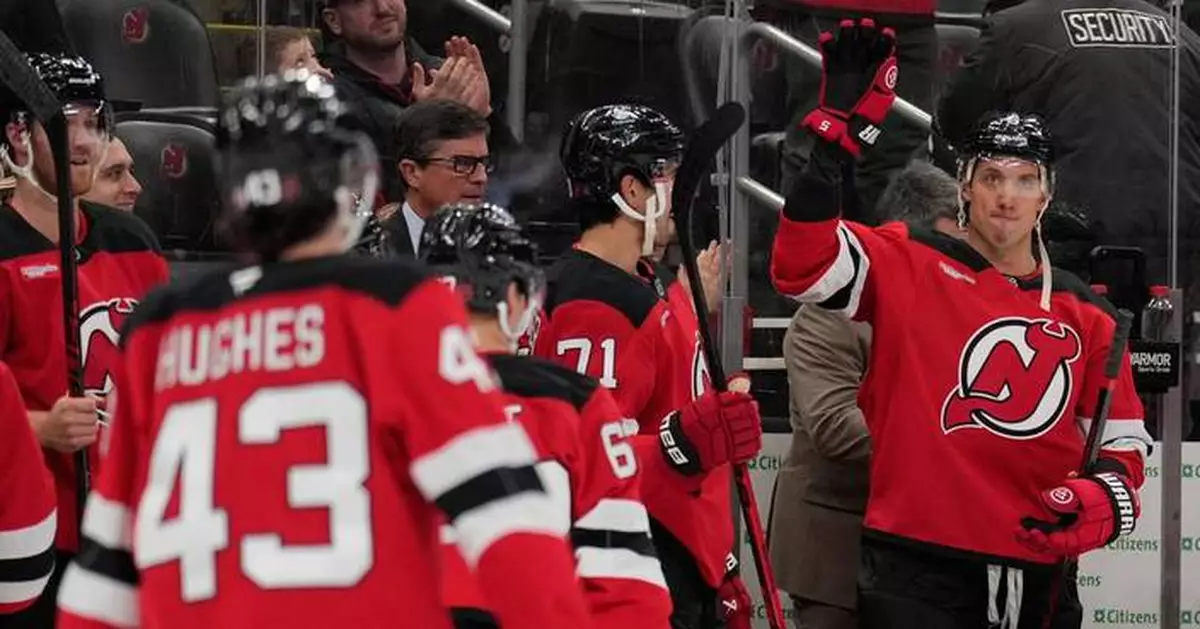
Within the past few days, Ottawa and New Jersey were in violation of Rule 9.6, which went onto effect in 2022. The Senators, playing at Vegas, were hoping to end a losing streak at T-Mobile Arena, while the Devils were celebrating defenseman Brenden Dillon’s 1,000th game.
Neither team was expected to be punished beyond a warning.
Players who have been in the NHL since before 2019 are grandfathered into being able to choose whether to go helmet-less. The league also has barred players from continuing to play without a helmet during games and prevented them from removing the head protection before fighting.
Injuries have happened during warmups from falls or errant pucks, including Taylor Hall getting cut by a skate in 2012.
Visors on helmets were agreed to by the league and the NHLPA in 2013, also grandfathered. Four players remain without one.
AP NHL: https://apnews.com/hub/nhl
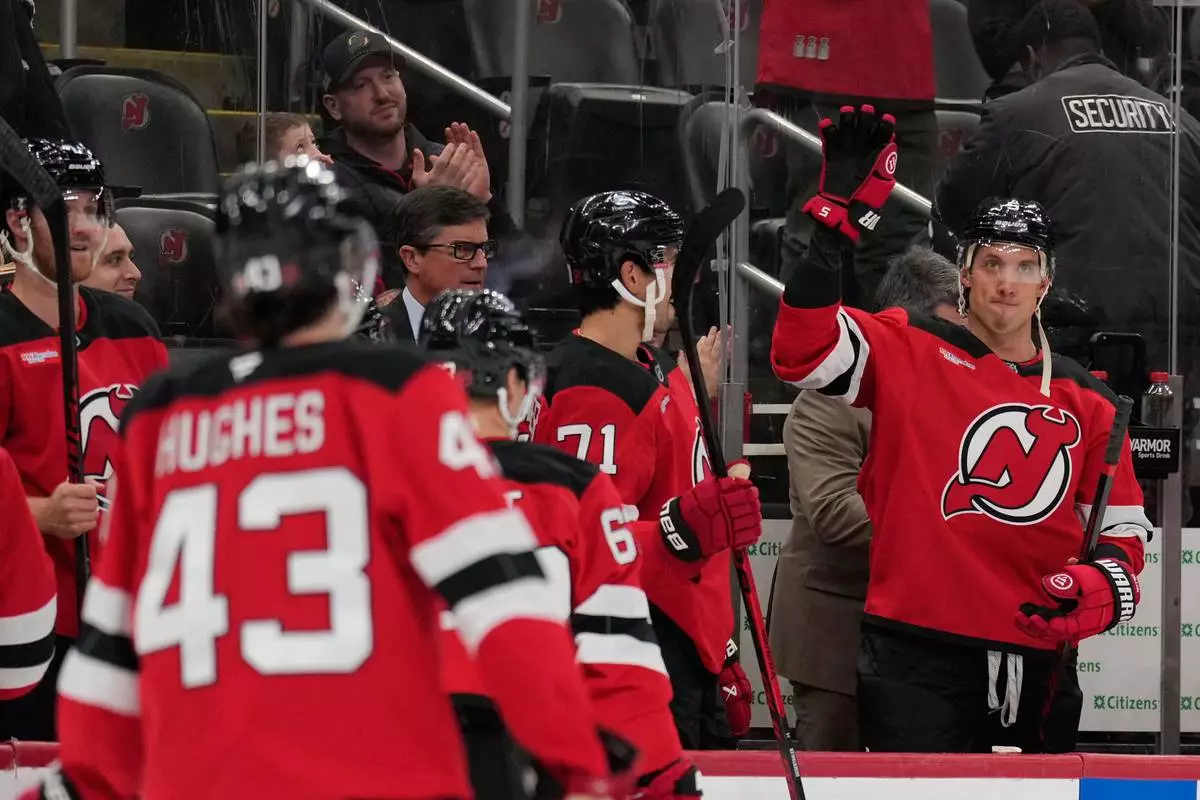
New Jersey Devils' Brenden Dillon, right, waves as an announcer acknowledges his 1000 game during the first period of an NHL hockey game against the Columbus Blue Jackets in Newark, N.J., Monday, Dec. 1, 2025. (AP Photo/Seth Wenig)
NEW YORK (AP) — More drops for AI stocks are dragging the U.S. market lower Wednesday, and Wall Street is heading toward a fourth straight loss.
The S&P 500 fell 0.8% in afternoon trading, though it's still not far from its all-time high set last week. The Dow Jones Industrial Average was down 128 points, or 0.3%, as of 1:14 p.m. Eastern time, and the Nasdaq composite was 1.2% lower.
The majority of stocks within the S&P 500 were rising, but they're getting drowned out by drops from the artificial-intelligence industry.
Questions continue to dog the former superstars about whether their yearslong dominance of Wall Street meant their prices shot too high, as well as whether all the investment in AI will produce enough profit and productivity to prove worth the cost. Worries are also rising about the debt that some companies are taking on to pay for it all.
Broadcom dropped 5.4%, Oracle fell 4.6% and CoreWeave sank 4.9%. Nvidia, the chip company that’s become Wall Street’s most influential stock because of its tremendous size, fell 3% and was the heaviest weight on the S&P 500.
Only 17% of respondents in a survey of relatively big businesses by UBS said they're in production at scale with their AI projects. That could be “a reminder for tech investors to remain sober about the likely 2026 revenue growth uplift from AI products,” according to UBS analysts, though the rate continues to rise.
Also on the losing end of Wall Street was Lennar, which sank 4.9% following a mixed profit report. The homebuilder delivered a weaker profit for the latest quarter than analysts expected, though its revenue topped expectations.
Executive Chairman Stuart Miller said that conditions remain challenging, with customers feeling less confident while looking for discounts and more affordable options. As a result, the company gave limited forecasts for its upcoming financial performance.
Progressive, meanwhile, fell 2.2% after the insurer based in Mayfield Village, Ohio, said that its net income for November fell 5% from its year-ago level.
On the winning side of Wall Street were oil companies, after President Donald Trump ordered a blockade of all “sanctioned oil tankers” into Venezuela. It’s Trump’s latest escalation in pressure on Venezuela, which may be sitting on more oil than any other country.
That sent the price of a barrel of benchmark U.S. crude higher by 1.6% to $56.03, just a day after it sank to its lowest level since 2021. Brent crude, the international standard, climbed 1.7% to $59.90 per barrel.
That in turn helped ConocoPhillips rise 3.5% and cut into its loss for the year so far, which came into the day at 8.5%. Devon Energy rallied 3.6%, and Halliburton added 1%. Oil prices had dropped through most of this year on expectations that companies are pumping more than enough crude to meet the world’s demand.
Netflix climbed 1% after Warner Bros. Discovery’s board said it still recommends shareholders approve a buyout offer for its Warner Bros. business from the streaming giant, rather than a competing hostile bid from Paramount Skydance for the entire company.
Warner Bros. Discovery slipped 2.1%, while Paramount Skydance fell 3.2%.
In the bond market, Treasury yields held relatively steady ahead of a report coming on Thursday that will show how bad inflation has been for U.S. consumers.
The yield on the 10-year Treasury held at 4.15%, where it was late Tuesday.
In stock markets abroad, indexes were mixed in Europe following a stronger finish in Asia.
South Korea’s Kospi leaped 1.4% for one of the world’s bigger gains and shaved its loss for the week so far down to 2.7%.
AP Business Writer Elaine Kurtenbach contributed.
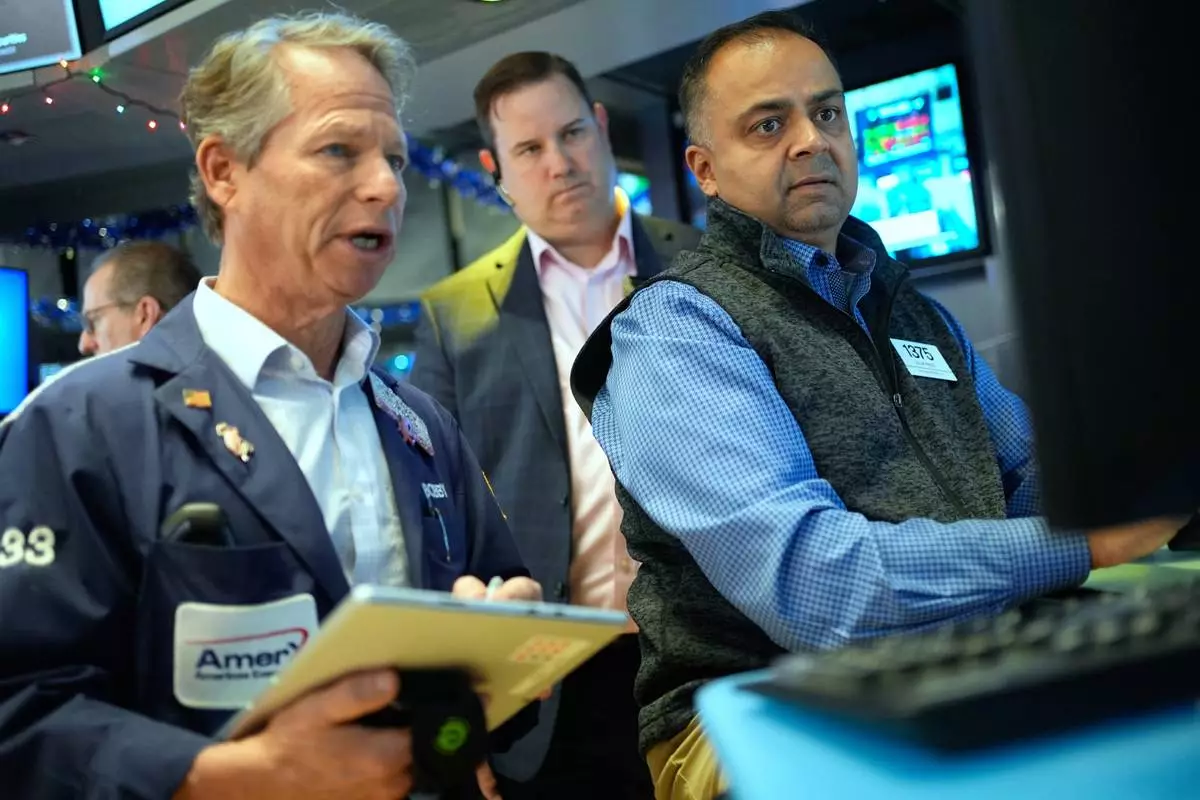
Dilip Patel, right, and Bobby Charmak, left, work on the floor at the New York Stock Exchange in New York, Wednesday, Dec. 10, 2025. (AP Photo/Seth Wenig)
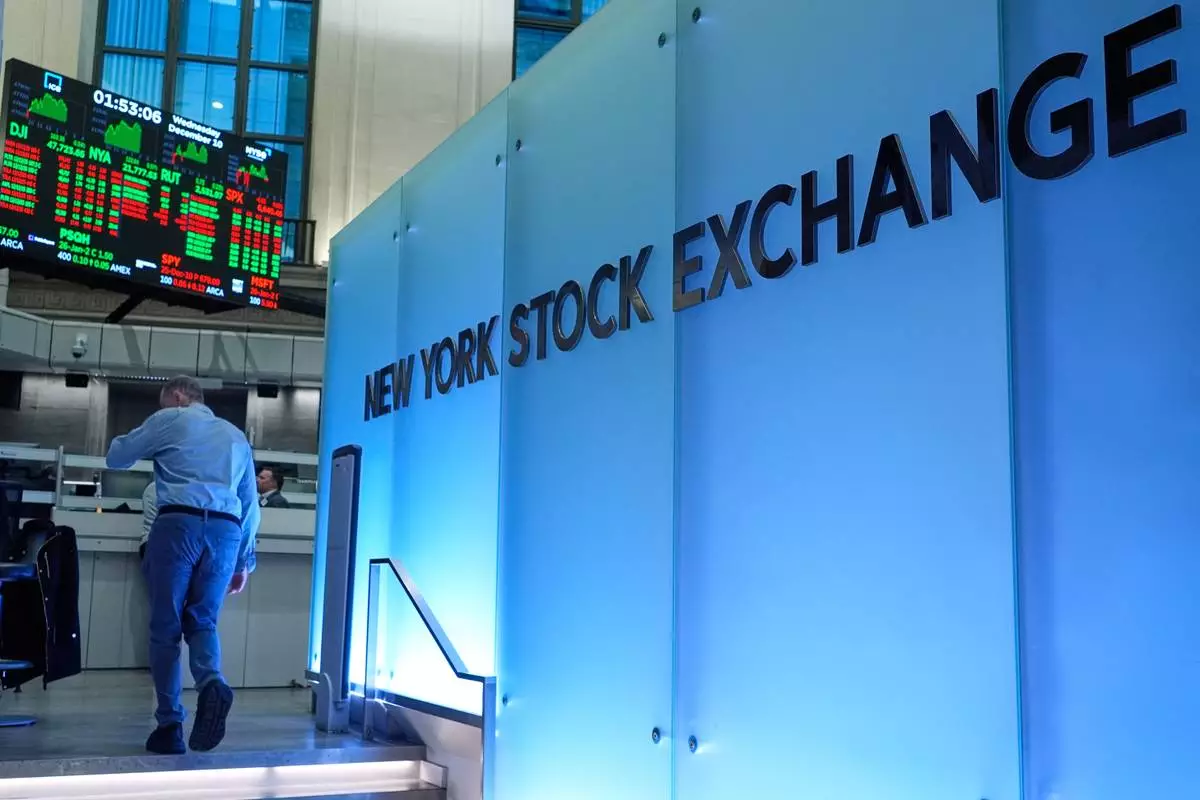
Traders work on the floor at the New York Stock Exchange in New York, Wednesday, Dec. 10, 2025. (AP Photo/Seth Wenig)

Currency traders work near a screen showing the Korea Composite Stock Price Index (KOSPI), left, at the foreign exchange dealing room of the Hana Bank headquarters, in Seoul, South Korea, Wednesday, Dec. 17, 2025. (AP Photo/Ahn Young-joon)

A currency trader watches monitors near a screen showing the Korea Composite Stock Price Index (KOSPI) at the foreign exchange dealing room of the Hana Bank headquarters, in Seoul, South Korea, Wednesday, Dec. 17, 2025. (AP Photo/Ahn Young-joon)

A currency trader stands near a screen showing the Korea Composite Stock Price Index (KOSPI), top left, and the foreign exchange rate between U.S. dollar and South Korean won at the foreign exchange dealing room of the Hana Bank headquarters, in Seoul, South Korea, Wednesday, Dec. 17, 2025. (AP Photo/Ahn Young-joon)