Skip to Content Facebook Feature Image

Deadly Asian floods are no fluke. They’re a climate warning, scientists say

News

Deadly Asian floods are no fluke. They’re a climate warning, scientists say
News

News

Deadly Asian floods are no fluke. They’re a climate warning, scientists say

2025-12-03 14:46 Last Updated At:14:50

HANOI, Vietnam (AP) — Southeast Asia is being pummeled by unusually severe floods this year, as late-arriving storms and relentless rains wreak havoc that has caught many places off guard.

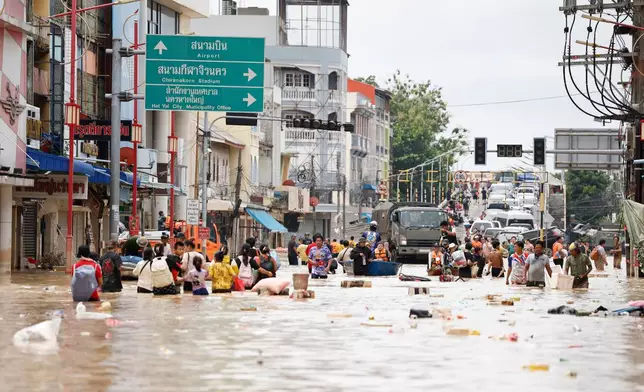
Deaths have topped 1,400 across Indonesia, Sri Lanka, and Thailand, with more than 1,000 still missing in floods and landslides. In Indonesia, entire villages remain cut off after bridges and roads were swept away. Thousands in Sri Lanka lack clean water, while Thailand’s prime minister acknowledged shortcomings in his government's response.

More Images
FILE - People wade through floodwaters in Songkhla province, southern Thailand, on Nov. 27, 2025. (AP Photo/Sarot Meksophawannakul, File)

FILE - People wade through floodwaters in Songkhla province, southern Thailand, on Nov. 27, 2025. (AP Photo/Sarot Meksophawannakul, File)

FILE - People watch rough waves caused by Typhoon Kalmaegi in Khanh Hoa, Vietnam, on Nov. 6, 2025. (AP Photo/Hau Dinh, File)
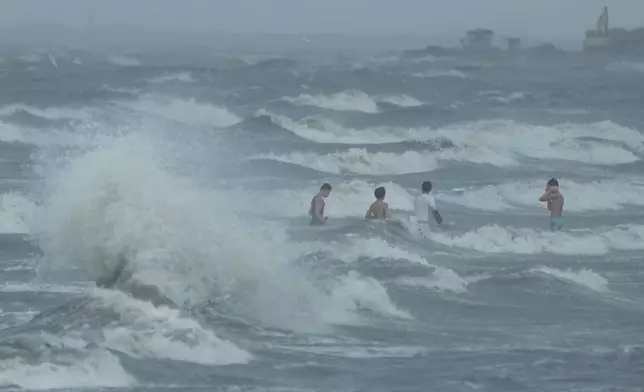
FILE - People watch rough waves caused by Typhoon Kalmaegi in Khanh Hoa, Vietnam, on Nov. 6, 2025. (AP Photo/Hau Dinh, File)

FILE - Men swim despite strong waves due to Typhoon Fung-wong along a coastal village on Nov. 10, 2025, in Navotas, Philippines. (AP Photo/Aaron Favila, File)
FILE - Men swim despite strong waves due to Typhoon Fung-wong along a coastal village on Nov. 10, 2025, in Navotas, Philippines. (AP Photo/Aaron Favila, File)

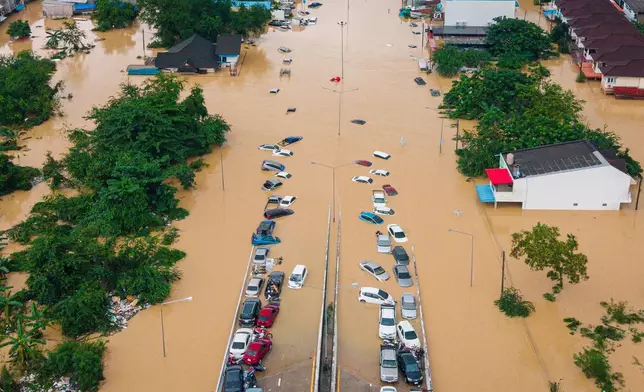
FILE - Cars and houses are submerged in floodwaters in Songkhla province, southern Thailand, on Nov. 26, 2025. (AP Photo/Arnun Chonmahatrakool, File)
FILE - Cars and houses are submerged in floodwaters in Songkhla province, southern Thailand, on Nov. 26, 2025. (AP Photo/Arnun Chonmahatrakool, File)

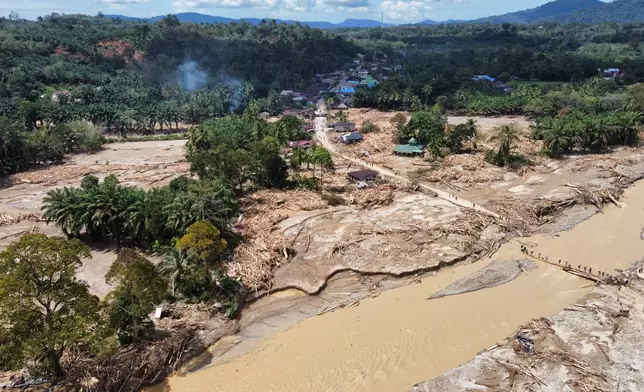
FILE - This aerial photo taken using drone shows a village affected by a flash flood in Batang Toru, North Sumatra, Indonesia, on Dec. 1, 2025. (AP Photo/Binsar Bakkara, File)
FILE - This aerial photo taken using drone shows a village affected by a flash flood in Batang Toru, North Sumatra, Indonesia, on Dec. 1, 2025. (AP Photo/Binsar Bakkara, File)

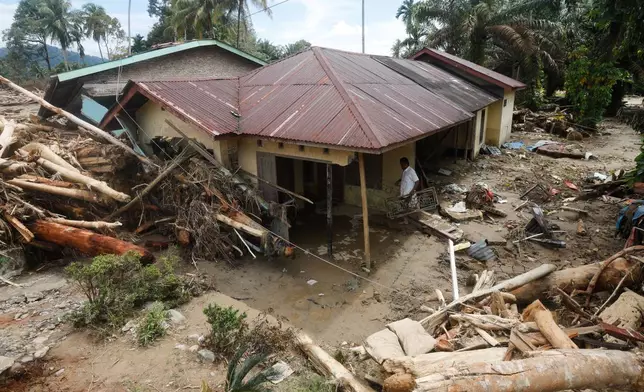
A man cleans his house at a village affected by flood in Batang Toru, North Sumatra, Indonesia, Wednesday, Dec. 3, 2025. (AP Photo/Binsar Bakkara)
A man cleans his house at a village affected by flood in Batang Toru, North Sumatra, Indonesia, Wednesday, Dec. 3, 2025. (AP Photo/Binsar Bakkara)

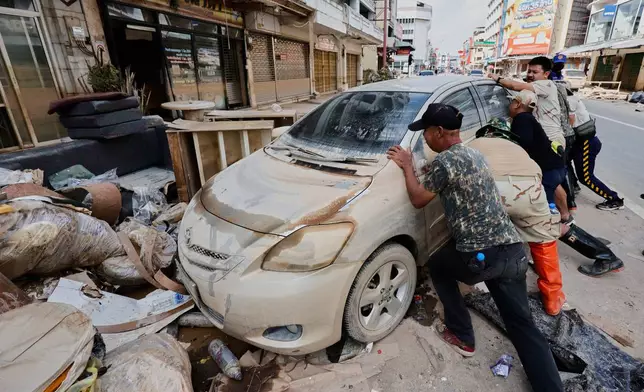
Peoples move a car damaged from floods in Songkhla province, southern Thailand, Sunday, Nov. 30, 2025. (AP Photo/Sarot Meksophawannakul)

Peoples move a car damaged from floods in Songkhla province, southern Thailand, Sunday, Nov. 30, 2025. (AP Photo/Sarot Meksophawannakul)

A man cleans the mud and slush from his shop after floods in Gelioya, Sri Lanka Sri Lanka, Monday, Dec. 1, 2025. (AP Photo/Eranga Jayawardena)
A man cleans the mud and slush from his shop after floods in Gelioya, Sri Lanka Sri Lanka, Monday, Dec. 1, 2025. (AP Photo/Eranga Jayawardena)

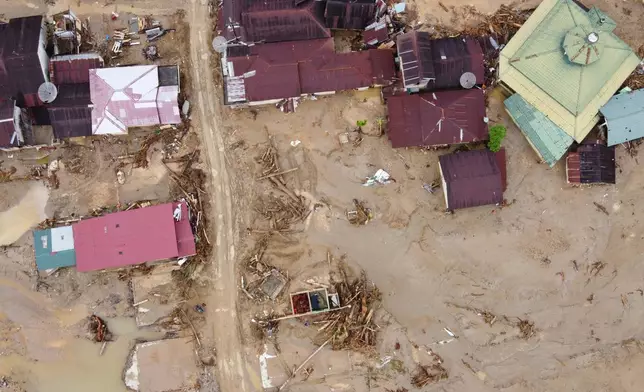
This drone shot shows the devastation at a village affected by a flash flood in Batang Toru, North Sumatra, Indonesia, Tuesday, Dec. 2, 2025. (AP Photo/Binsar Bakkara)
This drone shot shows the devastation at a village affected by a flash flood in Batang Toru, North Sumatra, Indonesia, Tuesday, Dec. 2, 2025. (AP Photo/Binsar Bakkara)

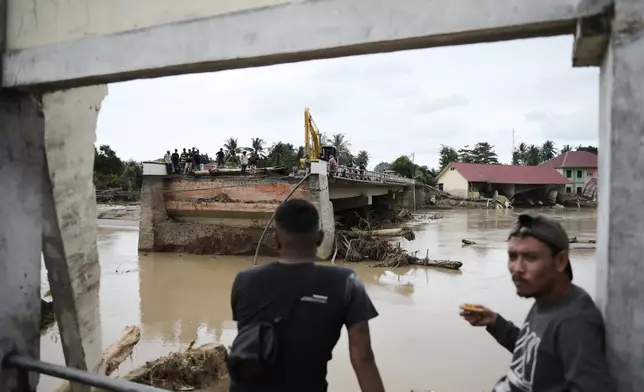
Men sit near a bridge collapsed during a flash flood in Pidie Jaya, Aceh province, Indonesia, Tuesday, Dec. 2, 2025. (AP Photo/Reza Saifullah)

Men sit near a bridge collapsed during a flash flood in Pidie Jaya, Aceh province, Indonesia, Tuesday, Dec. 2, 2025. (AP Photo/Reza Saifullah)

Malaysia is still reeling from one its worst floods, which killed three and displaced thousands. Meanwhile, Vietnam and the Philippines have faced a year of punishing storms and floods that have left hundreds dead.

What feels unprecedented is exactly what climate scientists expect: A new normal of punishing storms, floods and devastation.

“Southeast Asia should brace for a likely continuation and potential worsening of extreme weather in 2026 and for many years immediately following that," said Jemilah Mahmood, who leads the think tank Sunway Centre for Planetary Health in Kuala Lumpur, Malaysia.

Climate patterns last year helped set the stage for 2025's extreme weather.

Atmospheric levels of heat-trapping carbon dioxide jumped by the most on record in 2024. That “turbocharged” the climate, the United Nation's World Meteorological Organization says, resulting in more extreme weather.

Asia is bearing the brunt of such changes, warming nearly twice as fast as the global average. Scientists agree that the intensity and frequency of extreme weather events are increasing.

Warmer ocean temperatures provide more energy for storms, making them stronger and wetter, while rising sea levels amplify storm surges, said Benjamin Horton, a professor of earth science at the City University of Hong Kong.

Storms are arriving later in the year, one after another as climate change affects air and ocean currents, including systems like El Nino, which keeps ocean waters warmer for longer and extends the typhoon season. With more moisture in the air and changes in wind patterns, storms can form quickly.

“While the total number of storms may not dramatically increase, their severity and unpredictability will," Horton said.

The unpredictability, intensity, and frequency of recent extreme weather events are overwhelming Southeast Asian governments, said Aslam Perwaiz of the Bangkok-based intergovernmental Asian Disaster Preparedness Center. He attributes that to a tendency to focus on responding to disasters rather than preparing for them.

“Future disasters will give us even less lead time to prepare," Perwaiz warned.

In Sri Lanka’s hardest-hit provinces, little has changed since 2004 Indian Ocean tsunami, said Sarala Emmanuel, a human-rights researcher in Batticaloa. It killed 230,000 people.

"When a disaster like this happens, the poor and marginalized communities are the worst affected,” Emmanuel said. That includes poor tea plantation workers living in areas prone to landslides.

Unregulated development that damages local ecosystems has worsened flood damage, said Sandun Thudugala of the Colombo-based non-profit Law and Society Trust. Sri Lanka needs to rethink how it builds and plans, he said, taking into account a future where extreme weather is the norm.

Videos of logs swept downstream in Indonesia suggested deforestation may have made the floods worse. Since 2000, the flood-inundated Indonesian provinces of Aceh, North Sumatra and West Sumatra have lost 19,600 square kilometers (7,569 square miles) of forest, an area larger than the state of New Jersey, according to Global Forest Watch.

Officials rejected claims of illegal logging, saying the timber looked old and probably came from landholders.

Countries are losing billions of dollars a year because of climate change.

Vietnam estimates that it lost over $3 billion in the first 11 months of this year because of floods, landslides and storms.

Thailand's government data is fragmented, but its agriculture ministry estimates about $47 million in agricultural losses since August. The Kasikorn Research Center estimates the November floods in southern Thailand alone caused about $781 million in losses, potentially shaving off 0.1% of GDP.

Indonesia doesn't have data for losses for this year but its annual average losses from natural disasters are $1.37 billion, its finance ministry says.

Costs from disasters are an added burden for Sri Lanka, which contributes a tiny fraction of global carbon emissions but is at the frontline of climate impacts, while it spends most of its wealth to repay foreign loans, said Thudugala.

"There is also an urgent need for vulnerable countries like ours to get compensated for loss and damages we suffer because of global warming,” Thudugala said.

“My request ... is support to recover some of the losses we have suffered,” said Rohan Wickramarachchi, owner of a commercial building in the central Sri Lankan town of Peradeniya that was flooded to its second floor. He and dozens of other families he knows must now start over.

Responding to increasingly desperate calls for help, at the COP30 global climate conference last month in Brazil, countries pledged to triple funding for climate adaptation and make $1.3 trillion in annual climate financing available by 2035. That’s still woefully short of what developing nations requested, and it's unclear if those funds will actually materialize.

Southeast Asia is at a crossroads for climate action, said Thomas Houlie of the science and policy institute, Climate Analytics. The region is expanding use of renewable energy but still reliant on fossil fuels.

“What we’re seeing in the region is dramatic and it’s unfortunately a stark reminder of the consequences of the climate crisis," Houlie said.

Delgado reported from Bangkok. Associated Press writers Edna Tarigan in Jakarta, Indonesia, Jintamas Saksornchai in Bangkok, Thailand, Sibi Arasu in Bengaluru, India, Eranga Jayawardena in Kandy, Sri Lanka, and Eileen Ng in Kuala Lumpur, Malaysia, contributed to this report.

The Associated Press’ climate and environmental coverage receives financial support from multiple private foundations. The AP is solely responsible for all content. Find AP’s standards for working with philanthropies, a list of supporters and funded coverage areas at AP.org.

FILE - People wade through floodwaters in Songkhla province, southern Thailand, on Nov. 27, 2025. (AP Photo/Sarot Meksophawannakul, File)

FILE - People wade through floodwaters in Songkhla province, southern Thailand, on Nov. 27, 2025. (AP Photo/Sarot Meksophawannakul, File)

FILE - People watch rough waves caused by Typhoon Kalmaegi in Khanh Hoa, Vietnam, on Nov. 6, 2025. (AP Photo/Hau Dinh, File)

FILE - People watch rough waves caused by Typhoon Kalmaegi in Khanh Hoa, Vietnam, on Nov. 6, 2025. (AP Photo/Hau Dinh, File)

FILE - Men swim despite strong waves due to Typhoon Fung-wong along a coastal village on Nov. 10, 2025, in Navotas, Philippines. (AP Photo/Aaron Favila, File)

FILE - Men swim despite strong waves due to Typhoon Fung-wong along a coastal village on Nov. 10, 2025, in Navotas, Philippines. (AP Photo/Aaron Favila, File)

FILE - Cars and houses are submerged in floodwaters in Songkhla province, southern Thailand, on Nov. 26, 2025. (AP Photo/Arnun Chonmahatrakool, File)

FILE - Cars and houses are submerged in floodwaters in Songkhla province, southern Thailand, on Nov. 26, 2025. (AP Photo/Arnun Chonmahatrakool, File)

FILE - This aerial photo taken using drone shows a village affected by a flash flood in Batang Toru, North Sumatra, Indonesia, on Dec. 1, 2025. (AP Photo/Binsar Bakkara, File)
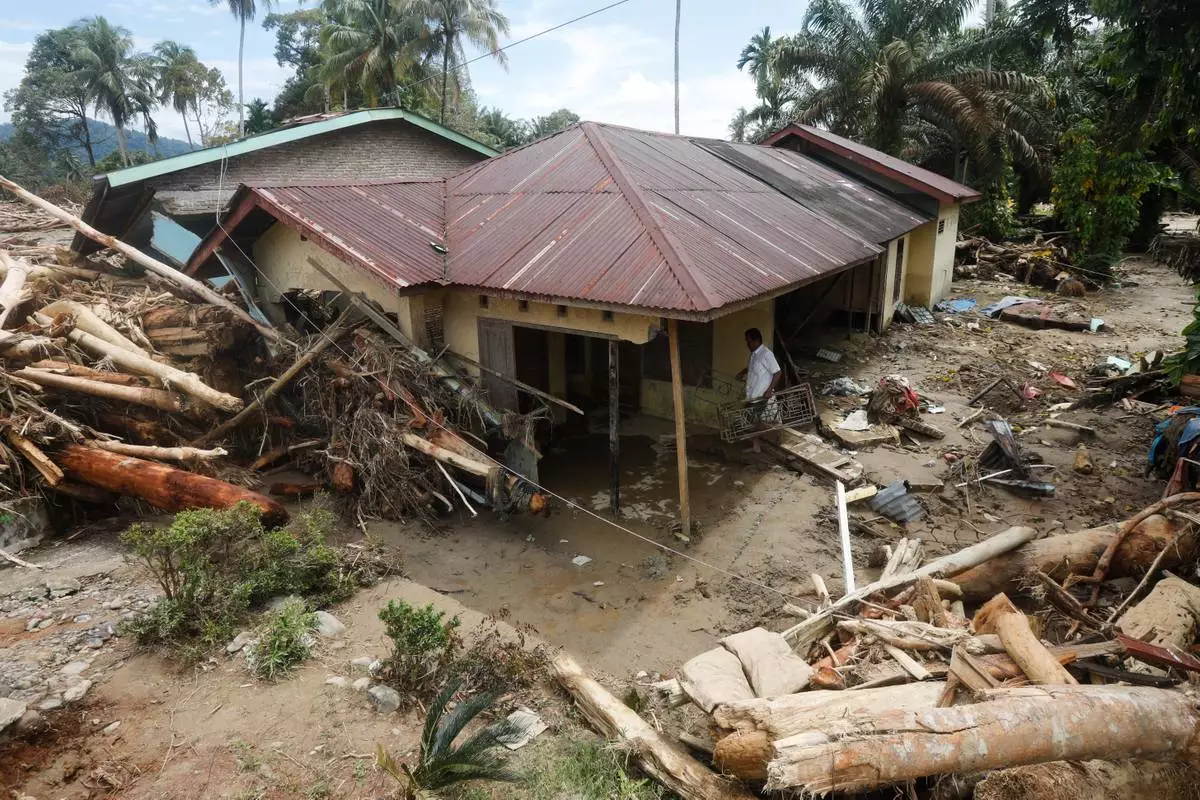
FILE - This aerial photo taken using drone shows a village affected by a flash flood in Batang Toru, North Sumatra, Indonesia, on Dec. 1, 2025. (AP Photo/Binsar Bakkara, File)

A man cleans his house at a village affected by flood in Batang Toru, North Sumatra, Indonesia, Wednesday, Dec. 3, 2025. (AP Photo/Binsar Bakkara)

A man cleans his house at a village affected by flood in Batang Toru, North Sumatra, Indonesia, Wednesday, Dec. 3, 2025. (AP Photo/Binsar Bakkara)

Peoples move a car damaged from floods in Songkhla province, southern Thailand, Sunday, Nov. 30, 2025. (AP Photo/Sarot Meksophawannakul)

Peoples move a car damaged from floods in Songkhla province, southern Thailand, Sunday, Nov. 30, 2025. (AP Photo/Sarot Meksophawannakul)

A man cleans the mud and slush from his shop after floods in Gelioya, Sri Lanka Sri Lanka, Monday, Dec. 1, 2025. (AP Photo/Eranga Jayawardena)

A man cleans the mud and slush from his shop after floods in Gelioya, Sri Lanka Sri Lanka, Monday, Dec. 1, 2025. (AP Photo/Eranga Jayawardena)

This drone shot shows the devastation at a village affected by a flash flood in Batang Toru, North Sumatra, Indonesia, Tuesday, Dec. 2, 2025. (AP Photo/Binsar Bakkara)
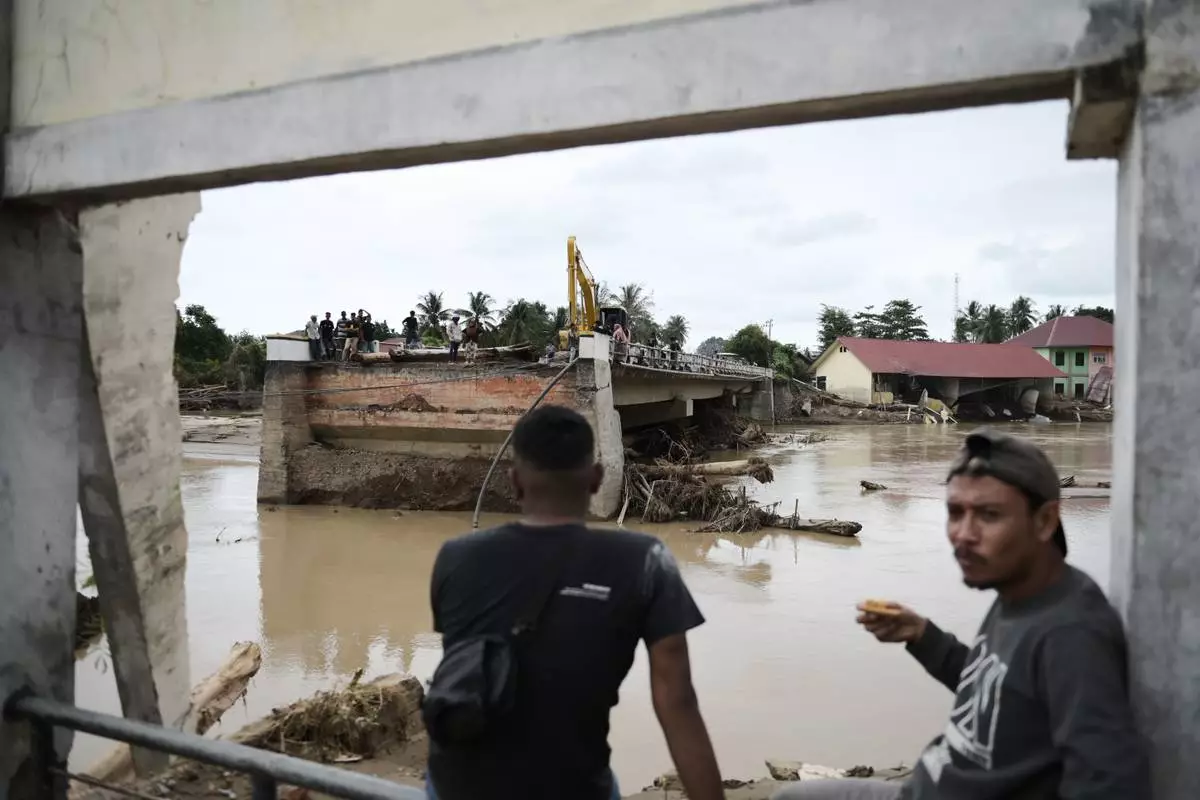
This drone shot shows the devastation at a village affected by a flash flood in Batang Toru, North Sumatra, Indonesia, Tuesday, Dec. 2, 2025. (AP Photo/Binsar Bakkara)

Men sit near a bridge collapsed during a flash flood in Pidie Jaya, Aceh province, Indonesia, Tuesday, Dec. 2, 2025. (AP Photo/Reza Saifullah)


Men sit near a bridge collapsed during a flash flood in Pidie Jaya, Aceh province, Indonesia, Tuesday, Dec. 2, 2025. (AP Photo/Reza Saifullah)

CAPE CANAVERAL, Fla. (AP) — Four astronauts embarked on a high-stakes flight around the moon Wednesday, humanity’s first lunar voyage in more than half a century and the thrilling leadoff in NASA’s push toward a landing in two years.

Carrying three Americans and one Canadian, the 32-story rocket rose from NASA’s Kennedy Space Center where tens of thousands gathered to witness the dawn of this new era. Crowds also jammed the surrounding roads and beaches, reminiscent of the Apollo moonshots in the 1960s and ’70s. It is NASA’s biggest step yet toward establishing a permanent lunar presence.

“On this historic mission, you take with you the heart of this Artemis team, the daring spirit of the American people and our partners across the globe, and the hopes and dreams of a new generation,” said Charlie Blackwell-Thompson, the launch director. “Good luck, Godspeed Artemis II. Let’s go.”

Artemis II set sail from the same Florida launch site that sent Apollo’s explorers to the moon so long ago. The handful still alive cheered this next generation’s grand adventure as the Space Launch System rocket thundered into the early evening sky, a nearly full moon beckoning some 248,000 miles (400,000 kilometers) away.

Five minutes into the flight, Commander Reid Wiseman saw the team’s target: “We have a beautiful moonrise, we’re headed right at it,” he said from the capsule. On board with him are pilot Victor Glover, Christina Koch and Canada's Jeremy Hansen. It was the most diverse lunar crew ever with the first woman, person of color and non-U. S. citizen riding in NASA’s new Orion capsule.

Tensions were high earlier in the day as hydrogen fuel started flowing into the rocket. Dangerous hydrogen leaks erupted during a countdown test earlier this year, forcing a lengthy flight delay.

To NASA’s relief, no significant hydrogen leaks occurred. The launch team loaded more than 700,000 gallons of fuel (2.6 million liters) into the 32-story Space Launch System rocket on the pad, a smooth operation that set the stage for the Artemis II crew to board.

NASA also had to deal with some issues beforehand but was able to resolve them and allow the launch to proceed without delay, one of them related to commands not getting through to the rocket’s flight-termination system, which is needed to send a self-destruct signal in case the rocket veers off course and threatens populated areas.

That issue was quickly resolved, according to NASA. It also had to troubleshoot one of the batteries in the capsule’s launch-abort system. Launch controllers scrambled to understand why the battery’s temperature was out of limit. Ultimately, it didn't prevent the launch from taking place.

The astronauts will stick close to home for the first 25 hours of their 10-day test flight, checking out the capsule in orbit around Earth before firing the main engine that will propel them to the moon.

They won’t pause for a stopover or orbit the moon like Apollo 8’s first lunar visitors did so famously on Christmas Eve 1968, reading from Genesis. But they stand to become the most distant humans ever when their capsule zooms past the moon and continues another 4,000 miles (6,400 kilometers) beyond, before making a U-turn and tearing straight home to a splashdown in the Pacific.

Once settled in a high orbit around Earth, the astronauts planned to assume manual control and practice steering their capsule around the rocket’s detached upper stage, venturing within 33 feet (10 meters). NASA wants to know how Orion handles in case the self-flying feature fails and the pilots need to take control.

Four days later during the lunar flyby, the moon will appear to be the size of a basketball held at arm’s length. The astronauts will take turns peering through Orion’s windows with cameras. If the lighting is right, they should see features never before viewed through human eyes. They’ll also catch snippets of a total solar eclipse, donning eclipse glasses as the moon briefly blocks the sun from their perspective and the corona is revealed.

All of NASA’s moon plans — a surge in launches over the next several years leading to a sustainable moon base for astronauts assisted by robotic rovers and drones — hinge on Artemis II going well.

It’s been more than three years since Artemis I, the only other time NASA’s SLS rocket and Orion capsule have soared. With no one aboard, the Artemis I capsule lacked life-support equipment and other crew essentials like a water dispenser and toilet.

These systems are now making their space debut on Artemis II, ratcheting up the risk. That’s why NASA is waiting a full day before committing Wiseman and his crew to a four-day trip to the moon and four-day journey back.

“There’s always been a lot riding on this mission,” NASA’s Lori Glaze said ahead of launch. But the teams are even more “energized” now that the space agency is finally accelerating the lunar launch pace and laser-focusing on surface operations — seismic changes announced recently by new administrator Jared Isaacman.

With half the world’s population not yet born when NASA’s 12 moonwalkers left their boot prints in the gray lunar dust, Artemis offers a fresh beginning, NASA’s science mission chief Nicky Fox said earlier this week.

“There are a lot of people who don’t remember Apollo. There are generations who weren’t alive when Apollo launched. This is their Apollo,” said Fox, who was 4 when Apollo 17 closed out the era.

NASA is in it for the long haul this time. Unlike Apollo, which focused on fast flags and footprints in a breakneck race against the Soviet Union, Artemis is striving for a sustainable moon base elaborate enough to satisfy even the most hard-core science fiction fans. But make no mistake: Isaacman and the Trump Administration want the next boot prints to be made by Americans, not the Chinese.

Until Isaacman’s program makeover, Artemis III was crawling toward a moon landing no sooner than 2029. The billionaire spacewalker slid in a new Artemis III for 2027 so astronauts could practice docking their Orion capsule with a lunar lander in orbit around Earth. Astronauts’ momentous landing near the moon’s south pole shifted to Artemis IV in 2028 — two years before an anticipated Chinese crew’s arrival.

Like Apollo 13 — astronauts’ only moon landing miss — Artemis II will use a free-return, lunar flyby trajectory to get home with gravity’s tug and a minimum of gas. The gravity of both the moon and Earth will provide much if not most of the oomph to keep Orion on its out-and-back, figure-eight loop.

The danger is right up there for Artemis II. NASA has refused to release its risk assessment for the mission. Managers contend it’s better than 50-50 — the usual odds for a new rocket — but how much more is murky.

The SLS rocket leaked flammable hydrogen fuel during ground tests, a recurring problem that engineers still do not completely understand. The hydrogen leaks and unrelated helium blockages stalled the flight for two months, coming on top of years of vexing delays and cost overruns. Both problems also thwarted Artemis I, whose capsule returned with excessive heat shield damage. To NASA’s relief, Wednesday’s countdown was leak-free but a few issues cropped up in the final hours.

Beating the Soviet Union to the moon made the huge risks acceptable for Apollo, said Charlie Duke, one of only four surviving moonwalkers.

“I’m cheering you on,” Duke said in a note to Wiseman and his crew before their flight.

During a weekend news conference, Koch stressed how humanity’s path to Mars goes through the moon, the proving ground for points beyond.

“It is our strong hope that this mission is the start of an era where everyone, every person on Earth, can look at the moon and think of it as also a destination,” she said.

Added Glover: “It’s the story of humanity. Not Black history, not women’s history, but that it becomes human history.”

The Associated Press Health and Science Department receives support from the Howard Hughes Medical Institute’s Department of Science Education and the Robert Wood Johnson Foundation. The AP is solely responsible for all content.

NASA's Artemis II moon rocket lifts off from the Kennedy Space Center's Launch Pad 39-B Wednesday, April 1, 2026, in Cape Canaveral, Fla. (AP Photo/Chris O'Meara)

NASA's Artemis II moon rocket lifts off from the Kennedy Space Center's Launch Pad 39-B Wednesday, April 1, 2026, in Cape Canaveral, Fla. (AP Photo/Chris O'Meara)

NASA's Artemis II moon rocket lifts off from the Kennedy Space Center's Launch Pad 39-B Wednesday, April 1, 2026, in Cape Canaveral, Fla. (AP Photo/Chris O'Meara)

NASA's Artemis II moon rocket lifts off from the Kennedy Space Center's Launch Pad 39-B Wednesday, April 1, 2026, in Cape Canaveral, Fla. (AP Photo/Chris O'Meara)

NASA's Artemis II moon rocket lifts off from the Kennedy Space Center's Launch Pad 39-B Wednesday, April 1, 2026, in Cape Canaveral, Fla. (AP Photo/Chris O'Meara)

NASA's Artemis II moon rocket lifts off from the Kennedy Space Center's Launch Pad 39-B Wednesday, April 1, 2026, in Cape Canaveral, Fla. (AP Photo/Chris O'Meara)

The NASA Artemis II SLS (Space Launch System) rocket with the Orion spacecraft launches at the Kennedy Space Center, Wednesday, April 1, 2026, in Cape Canaveral, Fla. (AP Photo/John Raoux)

The NASA Artemis II SLS (Space Launch System) rocket with the Orion spacecraft launches at the Kennedy Space Center, Wednesday, April 1, 2026, in Cape Canaveral, Fla. (AP Photo/John Raoux)

Astronauts, Mission Specialist Christina Koch, right, and Pilot Victor Glover wave to family members as they leave the Operations and Checkout Building for a trip to Launch Pad 39-B and a planned liftoff on NASA's Artermis II moon rocket at the Kennedy Space Center Wednesday, April 1, 2026, in Cape Canaveral, Fla. (AP Photo/Chris O'Meara)

Astronauts, Mission Specialist Christina Koch, right, and Pilot Victor Glover wave to family members as they leave the Operations and Checkout Building for a trip to Launch Pad 39-B and a planned liftoff on NASA's Artermis II moon rocket at the Kennedy Space Center Wednesday, April 1, 2026, in Cape Canaveral, Fla. (AP Photo/Chris O'Meara)

Artemis 2 crew member Commander Reid Wiseman holds "Rise" after the crew's arrival at the Kennedy Space Center Friday, March 27, 2026, in Cape Canaveral, Fla. (AP Photo/Chris O'Meara)

Artemis 2 crew member Commander Reid Wiseman holds "Rise" after the crew's arrival at the Kennedy Space Center Friday, March 27, 2026, in Cape Canaveral, Fla. (AP Photo/Chris O'Meara)

Commander Reid Wiseman poses for a photo with family members after leaving the Operations and Checkout Building for a trip to Launch Pad 39-B and a planned liftoff on NASA's Artermis II moon rocket at the Kennedy Space Center Wednesday, April 1, 2026, in Cape Canaveral, Fla. (AP Photo/Chris O'Meara)

Commander Reid Wiseman poses for a photo with family members after leaving the Operations and Checkout Building for a trip to Launch Pad 39-B and a planned liftoff on NASA's Artermis II moon rocket at the Kennedy Space Center Wednesday, April 1, 2026, in Cape Canaveral, Fla. (AP Photo/Chris O'Meara)

Astronauts, from left, Mission Specialist Jeremy Hansen, of Canada,, Pilot Victor Glover, Commander Reid Wiseman, and Mission Specialist Christina Koch pose for a photo after leaving the Operations and Checkout Building for a trip to Launch Pad 39-B and a planned liftoff on NASA's Artermis II moon rocket at the Kennedy Space Center Wednesday, April 1, 2026, in Cape Canaveral, Fla. (AP Photo/Chris O'Meara)

Astronauts, from left, Mission Specialist Jeremy Hansen, of Canada,, Pilot Victor Glover, Commander Reid Wiseman, and Mission Specialist Christina Koch pose for a photo after leaving the Operations and Checkout Building for a trip to Launch Pad 39-B and a planned liftoff on NASA's Artermis II moon rocket at the Kennedy Space Center Wednesday, April 1, 2026, in Cape Canaveral, Fla. (AP Photo/Chris O'Meara)

NASA's Artermis II moon rocket sits on Launch Pad 39-B at the Kennedy Space Center hours ahead of a planned launch attempt Wednesday, April 1, 2026, in Cape Canaveral, Fla. (AP Photo/Chris O'Meara)

NASA's Artermis II moon rocket sits on Launch Pad 39-B at the Kennedy Space Center hours ahead of a planned launch attempt Wednesday, April 1, 2026, in Cape Canaveral, Fla. (AP Photo/Chris O'Meara)

This photo provided by NASA shows NASA astronauts Reid Wiseman, Artemis II commander, from left, Victor Glover, Artemis II pilot, Christina Koch, Artemis II mission specialist, and CSA (Canadian Space Agency) astronaut Jeremy Hansen, Artemis II mission specialist, right, in a group photograph as they visit NASA's Artemis II SLS (Space Launch System) rocket and Orion spacecraft, Monday, March 30, 2026, at Launch Complex 39B of NASA's Kennedy Space Center, in Cape Canaveral, Fla. (Bill Ingalls/NASA via AP)

This photo provided by NASA shows NASA astronauts Reid Wiseman, Artemis II commander, from left, Victor Glover, Artemis II pilot, Christina Koch, Artemis II mission specialist, and CSA (Canadian Space Agency) astronaut Jeremy Hansen, Artemis II mission specialist, right, in a group photograph as they visit NASA's Artemis II SLS (Space Launch System) rocket and Orion spacecraft, Monday, March 30, 2026, at Launch Complex 39B of NASA's Kennedy Space Center, in Cape Canaveral, Fla. (Bill Ingalls/NASA via AP)

NASA's Artermis II moon rocket sits on Launch Pad 39-B at the Kennedy Space Center hours ahead of planned liftoff Wednesday, April 1, 2026, in Cape Canaveral, Fla. (AP Photo/Chris O'Meara)

NASA's Artermis II moon rocket sits on Launch Pad 39-B at the Kennedy Space Center hours ahead of planned liftoff Wednesday, April 1, 2026, in Cape Canaveral, Fla. (AP Photo/Chris O'Meara)

Recommended Articles